
Journal of Traditional Chinese Medicine ›› 2025, Vol. 45 ›› Issue (3): 610-617.DOI: 10.19852/j.cnki.jtcm.20250103.001
Previous Articles Next Articles
Systematic acupuncture explains acupuncture at Baihui (GV20) and Fengchi (GB20) targeting the inflammatory response to regulate migraine
MIN Yu1,2( ), ZHENG Meifeng3, SUN Ju3, PENG Zetong3, CAO Zhixian3, HUANG Xiaohua3
- 1 Medical College of Acu-Moxi and Rehabilitation, Guangzhou University of Chinese Medicine, Guangzhou 510006, China
2 Department of Rehabilitation Medicine, the Affiliated Panyu Central Hospital of Guangzhou Medical University, Guangzhou 511400, China
3 Department of Rehabilitation Medicine, the Affiliated Panyu Central Hospital of Guangzhou Medical University, Guangzhou 511400, China
-
Received:2024-02-22Accepted:2024-08-29Online:2025-06-15Published:2025-01-03 -
Contact:MIN Yu, Medical College of Acu-Moxi and Rehabilitation, Guangzhou University of Chinese Medicine, Guangzhou 510006, China; Department of Rehabilitation Medicine, the Affiliated Panyu Central Hospital of Guangzhou Medical University, Guangzhou 511400, China. minyu@pyhospital.com.cn,Telephone: +86 13632473059
-
Supported by:Study on the Mechanism of Action of Dutong and Tiaoshen Acupuncture in Improving Upper Limb Motor Function After Ischemic Stroke based on Functional Near-infrared Spectroscopy Technology (Science and Technology Program of Panyu, 2022-Z04-107)

Cite this article
MIN Yu, ZHENG Meifeng, SUN Ju, PENG Zetong, CAO Zhixian, HUANG Xiaohua. Systematic acupuncture explains acupuncture at Baihui (GV20) and Fengchi (GB20) targeting the inflammatory response to regulate migraine[J]. Journal of Traditional Chinese Medicine, 2025, 45(3): 610-617.
share this article

Figure 1 Baihui (GV20) and Fengchi (GB20) target information and intersection of acupoints with migraine targets A: the Venn diagram of Fengchi (GB20) and Baihui (GV20); B: the intersection of acupoints and migraine targets, in which red is the acupoint, gray and light green are the targets, and dark green are the intersecting targets; C: the target information of Fengchi (GB20) and Baihui (GV20).
Figure 1 Baihui (GV20) and Fengchi (GB20) target information and intersection of acupoints with migraine targets A: the Venn diagram of Fengchi (GB20) and Baihui (GV20); B: the intersection of acupoints and migraine targets, in which red is the acupoint, gray and light green are the targets, and dark green are the intersecting targets; C: the target information of Fengchi (GB20) and Baihui (GV20).
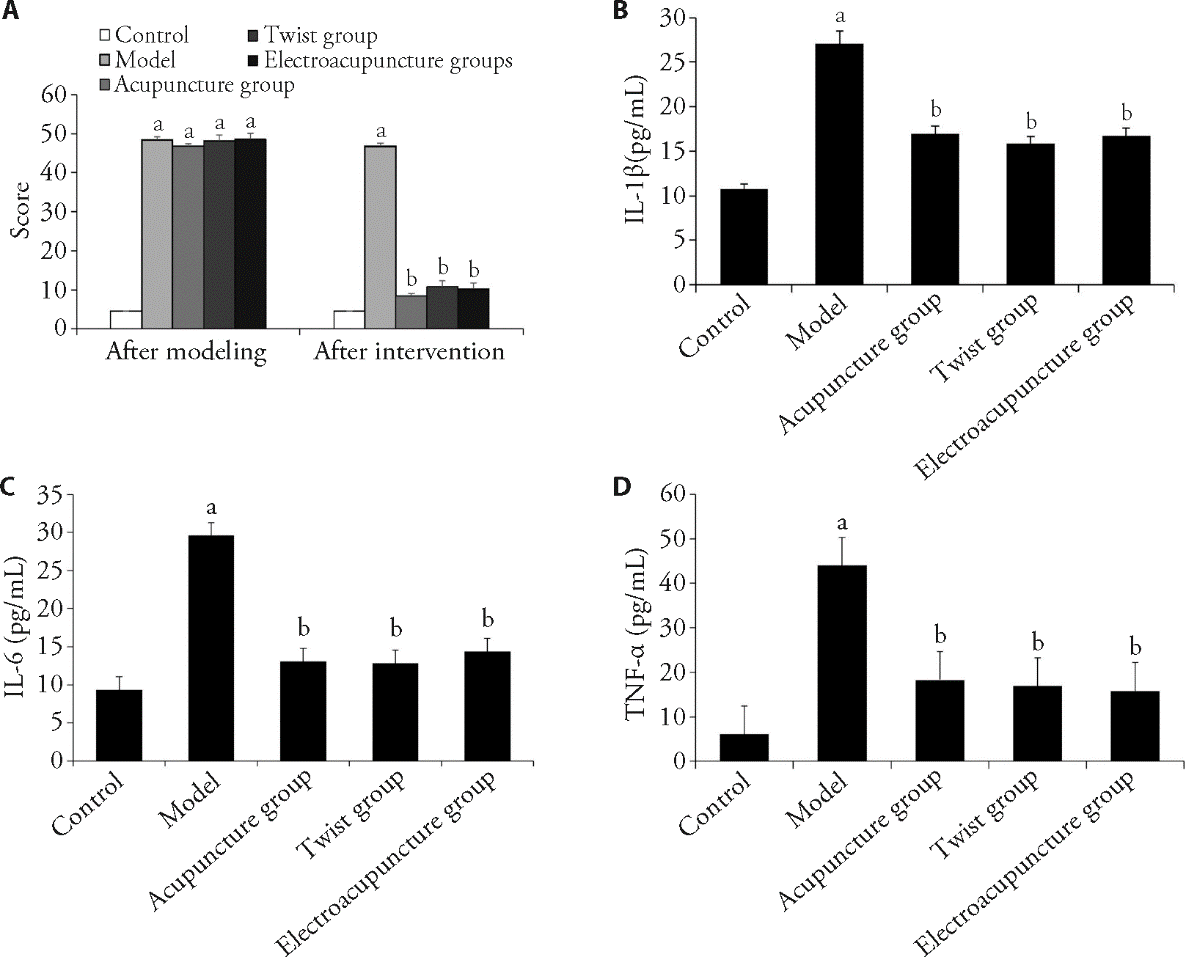
Figure 2 Behavioral scores and changes in inflammatory factor levels in rats A: behavioral score; B: levels of IL-1β; C: levels of IL-6; D: levels of TNF-α, respectively, as measured via ELISA. After 30 min of successful modeling, the rats were immobilized. In the acupuncture group, "Baihui (GV20)" and "Fengchi (GB20)" were selected for acupuncture. The depth of needle insertion was approximately 2 mm, and the needle was retained for 30 min. The needles were manually twisted for 1 min with flat tonic and flat diarrhea, twisting once every 5 min for 1 min each time for 30 min. The electroacupuncture group was treated with a parse and dense waveform, frequency 2/15 Hz, and electroacupuncture intensity 1 mA, which lasted for 30 min. The model group and the control group only received routine immobilization for 0.5 h without any acupuncture intervention. IL-1β: interleukin-1 beta; IL-6: interleukin-6; TNF-α: tumor necrosis factor-alpha; ELISA: enzyme linked immunosorbent assay. Comparisons between groups were analyzed by Student's t tests, and the values are shown as the mean ± standard deviation (n = 10). Compared with the control group, aP < 0.05; compared with the Model group, bP < 0.05.
Figure 2 Behavioral scores and changes in inflammatory factor levels in rats A: behavioral score; B: levels of IL-1β; C: levels of IL-6; D: levels of TNF-α, respectively, as measured via ELISA. After 30 min of successful modeling, the rats were immobilized. In the acupuncture group, "Baihui (GV20)" and "Fengchi (GB20)" were selected for acupuncture. The depth of needle insertion was approximately 2 mm, and the needle was retained for 30 min. The needles were manually twisted for 1 min with flat tonic and flat diarrhea, twisting once every 5 min for 1 min each time for 30 min. The electroacupuncture group was treated with a parse and dense waveform, frequency 2/15 Hz, and electroacupuncture intensity 1 mA, which lasted for 30 min. The model group and the control group only received routine immobilization for 0.5 h without any acupuncture intervention. IL-1β: interleukin-1 beta; IL-6: interleukin-6; TNF-α: tumor necrosis factor-alpha; ELISA: enzyme linked immunosorbent assay. Comparisons between groups were analyzed by Student's t tests, and the values are shown as the mean ± standard deviation (n = 10). Compared with the control group, aP < 0.05; compared with the Model group, bP < 0.05.

Figure 3 Effect of acupuncture on target proteins HMOX1, AKT1, STAT3, P-ERK1/ERK2 and TLR4 A: effects of acupuncture on target proteins HMOX1, AKT1 and STAT3; B: effects of acupuncture on target proteins P-ERK1/ERK2 and TLR4. After 30 min of successful modeling, the rats were immobilized. In the acupuncture group, "Baihui (GV20)" and "Fengchi (GB20)" were selected for acupuncture. The depth of needle insertion was approximately 2 mm, and the needle was retained for 30 min. The needles were manually twisted for 1 min with flat tonic and flat diarrhea, twisting once every 5 min for 1 min each time for 30 min. The electroacupuncture group was treated with a parse and dense waveform, frequency 2/15 Hz, and electroacupuncture intensity 1 mA, which lasted for 30 min. The model group and the control group only received routine immobilization for 0.5 h without any acupuncture intervention. All increased after modeling after acupuncture, twist or electroacupuncture intervention, the expression of the above proteins was reduced. HMOX1: heme oxygenase 1; AKT1: protein kinase B; STAT3: signal transducer and activator of transcription 3; P-ERK1/ERK2: extracellular signal-regulated kinase 1/extracellular signal-regulated kinase 2; TLR4: toll-like receptor 4; GAPDH: glyceraldehyde-3-phosphate dehydrogenase. Comparisons between groups were analyzed by Student's t tests, and the values are shown as the mean ± standard deviation (n = 10). Differences were considered statistically significant at P < 0.05.
Figure 3 Effect of acupuncture on target proteins HMOX1, AKT1, STAT3, P-ERK1/ERK2 and TLR4 A: effects of acupuncture on target proteins HMOX1, AKT1 and STAT3; B: effects of acupuncture on target proteins P-ERK1/ERK2 and TLR4. After 30 min of successful modeling, the rats were immobilized. In the acupuncture group, "Baihui (GV20)" and "Fengchi (GB20)" were selected for acupuncture. The depth of needle insertion was approximately 2 mm, and the needle was retained for 30 min. The needles were manually twisted for 1 min with flat tonic and flat diarrhea, twisting once every 5 min for 1 min each time for 30 min. The electroacupuncture group was treated with a parse and dense waveform, frequency 2/15 Hz, and electroacupuncture intensity 1 mA, which lasted for 30 min. The model group and the control group only received routine immobilization for 0.5 h without any acupuncture intervention. All increased after modeling after acupuncture, twist or electroacupuncture intervention, the expression of the above proteins was reduced. HMOX1: heme oxygenase 1; AKT1: protein kinase B; STAT3: signal transducer and activator of transcription 3; P-ERK1/ERK2: extracellular signal-regulated kinase 1/extracellular signal-regulated kinase 2; TLR4: toll-like receptor 4; GAPDH: glyceraldehyde-3-phosphate dehydrogenase. Comparisons between groups were analyzed by Student's t tests, and the values are shown as the mean ± standard deviation (n = 10). Differences were considered statistically significant at P < 0.05.
| 1. | Yu SY. Understanding headaches from macro to micro. Zhong Guo Teng Tong Yi Xue Za Zhi 2014; 20: 2-4. |
| 2. | Peters GL. Migraine overview and summary of current and emerging treatment options. Am J Manag Care 2019; 25: S23-34. |
| 3. |
Burch R, Rizzoli P, Loder E. The prevalence and impact of migraine and severe headache in the united states: figures and trends from government health studies. Headache 2018; 58: 496-505.
DOI PMID |
| 4. | Loo LS, Ailani J, Schim J, et al. Efficacy and safety of Iasmiditan in patients using concomitant migraine preventive medications: findings from SAMURAI and SPARTAN, two randomized phase 3 trials. J Headache Pain 2019; 20: 84. |
| 5. |
Labastida-Ramírez A, Rubio-Beltrán E, Haanes KA, et al. Lasmiditan inhibits calcitonin gene-related peptide release in the rodent trigeminovascular system. Pain 2020; 161: 1092-9.
DOI PMID |
| 6. |
Rubio-Beltran E, Chan KY, Danser AJ, MaassenVanDenBrink A, Edvinsson L. Characterisation of the calcitonin gene-related peptide receptor antagonists ubrogepant and atogepant in human isolated coronary, cerebral and middle meningeal arteries. Cephalalgia 2020; 40: 357-66.
DOI PMID |
| 7. |
Yang Y, Chen M, Sun Y, Gao B, Chen Z, Wang Z. Safety and efficacy of ubrogepant for the acute treatment of episodic migraine: a Meta-analysis of randomized clinical trials. CNS Drugs 2020; 34: 463-71.
DOI PMID |
| 8. | Xu Y, Cai J, Li W, et al. Examining the effector mechanisms of the feishu acupoint (BL13) in the treatment of pneumonia based on systematic acupuncture and moxibustion research. Evid Based Complement Alternat Med 2021; 5578104. |
| 9. | Du YH, Qin D. Acupuncture therapy. Beijing: People's Medical Publishing House, 2012: 105-60. |
| 10. |
Shi N, Guo S, Su Y, et al. Improvement in the retention rate of transplanted fat in muscle by denervation. Aesthet Surg J 2018; 38: 1026-34.
DOI PMID |
| 11. | Wang MM, Yu XH, Wei G, et al. Effects of liver-soothing and mind-regulating acupuncture on the expression of receptor activity-modified protein 1 and serotonin 1D receptors in migraine rats. Zhen Ci Yan Jiu 2018; 43: 440-4. |
| 12. | Chinese Acupuncture Association. Common acupoint names and locations of experimental animals part 2: rats. Zhen Ci Yan Jiu 2021; 46: 351-2. |
| 13. | Guo Y. Experimental acupuncture science. Beijing: China Traditional Chinese Medicine Press, 2016: 210-65. |
| 14. | Greco R, Demartini C, Francavilla M, Zanaboni AM, Tassorelli C. Antagonism of CGRP receptor: central and peripheral mechanisms and mediators in an animal model of chronic migraine. Cells 2022; 11: 3092. |
| 15. | Jiang Q, Di Q, Shan D, Xu Q. Nonylphenol inhibited HIF-1alpha regulated aerobic glycolysis and induced ROS mediated apoptosis in rat sertoli cells. Ecotoxicol Environ Saf 2022; 241: 113822. |
| 16. |
Balamurugan K. HIF-1 at the crossroads of hypoxia, inflammation, and cancer. Int J Cancer 2016; 138: 1058-66.
DOI PMID |
| 17. | Jain T, Nikolopoulou EA, Xu Q, Qu A. Hypoxia inducible factor as a therapeutic target for atherosclerosis. Pharmacol Ther 2018; 183: 22-33. |
| 18. | Cavestro C, Ferrero M, Mandrino S, Di Tavi M, Rota E. Novelty in inflammation and immunomodulation in migraine. Curr Pharm Des 2019; 25: 2919-36. |
| 19. |
Edvinsson L, Haanes KA, Warfvinge K. Does inflammation have a role in migraine. Nat Rev Neurol 2019; 15: 483-90.
DOI PMID |
| 20. |
Sarady JK, Zuckerbraun BS, Bilban M, et al. Carbon monoxide protection against endotoxic shock involves reciprocal effects on iNOS in the lung and liver. FASEB J 2004; 18: 854-6.
DOI PMID |
| 21. | Yu H, Littlewood T, Bennett M. Akt isoforms in vascular disease. Vascul Pharmacol 2015; 71: 57-64. |
| 22. | Hillmer EJ, Zhang H, Li HS, Watowich SS. STAT3 signaling in immunity. Cytokine Growth Factor Rev 2016; 31: 1-15. |
| 23. | Huang B, Lang X, Li X. The role of IL-6/JAK2/STAT3 signaling pathway in cancers. Front Oncol 2022; 12: 1023177. |
| 24. | Roux PP, Blenis J. ERK and p 38 MAPK-activated protein kinases: a family of protein kinases with diverse biological functions. Microbiol Mol Biol Rev 2004; 68: 320-44. |
| 25. |
Lehnardt S, Massillon L, Follett P, et al. Activation of innate immunity in the CNS triggers neurodegeneration through a toll-like receptor 4-dependent pathway. Proc Natl Acad Sci USA 2003; 100: 8514-9.
PMID |
| 26. | Karimy JK, Reeves BC, Kahle KT. Targeting TLR4-dependent inflammation in post-hemorrhagic brain injury. Expert Opin Ther Targets 2020; 24: 525-33. |
| [1] | LI Weijia, LU Jing, MA Chao, LIU Mengmeng, PEI Ke, CHEN Hongyan, LIN Zhe, LYU Guangfu. Hamayou (Oviductus Ranae) protein hydrolysate ameliorates depression by regulating the mitogen-activated protein kinase pathway [J]. Journal of Traditional Chinese Medicine, 2025, 45(3): 493-507. |
| [2] | SUN Jiao, WANG Yueming, LYU Jian, LIU Xin, YUE Bingnan, LI Yinyin, LIU Jipeng, SUN Yize, LIU Qingguo, YAN Liu. Effect of electroacupuncture on hypertensive and sympathetic excitability mechanism mediated by the paraventricular nucleus of the hypothalamus in spontaneous hypertensive rats [J]. Journal of Traditional Chinese Medicine, 2025, 45(3): 586-596. |
| [3] | CHEN Shumin, LIU Zhenyu, JI Jia, CHANG Jin, LI Zhihua, WANG Yingying, YANG Jinsheng. Acupuncture with different frequencies for tobacco dependence: a randomized controlled trial [J]. Journal of Traditional Chinese Medicine, 2025, 45(3): 651-659. |
| [4] | WEN Zhigang, LU Shuai, CHENG Xiumei. Clinical observation on the effect of warming meridian medicinal wine, polarized light external application combined with acupuncture and moxibustion on pain after vertebroplasty [J]. Journal of Traditional Chinese Medicine, 2025, 45(3): 660-666. |
| [5] | YUAN Jiayao, WU Suhui, MENG Yufan, LI Hanbing, LI Genlin, XU Jiangyan. Yishen Tongluo formula (益肾通络方) ameliorates kidney injury via modulating inflammation and apoptosis in streptozotocin-induced diabetic kidney disease mice [J]. Journal of Traditional Chinese Medicine, 2025, 45(2): 254-265. |
| [6] | HUANG Jiaen, LUO Qing, DONG Gengting, PENG Weiwen, HE Jianhong, DAI Weibo. Xiahuo Pingwei San (夏藿平胃散) attenuated intestinal inflammation in dextran sulfate sodium-induced ulcerative colitis mice through inhibiting the receptor for advanced glycation end-products signaling pathway [J]. Journal of Traditional Chinese Medicine, 2025, 45(2): 311-325. |
| [7] | LI Yongfeng, CHEN Xinyi, REN Wei, QIAO Haifa. Electroacupuncture stimulation of auricular concha region improves loss of control over stress induced depression-like behavior by modulating 5-hydroxytryptamine 1A receptor [J]. Journal of Traditional Chinese Medicine, 2025, 45(2): 326-334. |
| [8] | TIAN Yuan, BU He, WANG Tieshan, YANG Dongliang, ZHANG Wei, LIU Tong, ZHANG Li, HUO Zejun. Efficacy of electro-acupuncture at “Weizhong” (BL40) on macrophage polarization in rats with injured lumbar multifidus [J]. Journal of Traditional Chinese Medicine, 2025, 45(2): 335-347. |
| [9] | HU Junwei, FENG Jiwei, LI Wen, LIU Lumin, LI Xu, XU Ge, LIU Jiandang, CHEN Yuelai. Electroacupuncture improves cyclophosphamide-induced bladder overactivity by reducing mechanotransduction in the rat urothelium [J]. Journal of Traditional Chinese Medicine, 2025, 45(2): 348-358. |
| [10] | KANG Jiale, DU Zhongming, GUO Wei, DU Shuo, HAN Guanxiong, CHEN Sheng. Effect of acupuncture on serum levels of hypothalamic-pituitary-adrenal axis related hormones and immune factors in rats with allergic rhinitis [J]. Journal of Traditional Chinese Medicine, 2025, 45(2): 359-367. |
| [11] | BAI Tianyu, YANG Jiaen, YIN Liang, LI Jinling, LIU Jianxian, LI Zongchang, SUN Zeming, JIA Ning, XU Chengchao. Effect of acupuncture on brain activity in patients with decreasing ovarian reserve: a resting-state functional magnetic resonance imaging study [J]. Journal of Traditional Chinese Medicine, 2025, 45(2): 450-457. |
| [12] | WU Jiaman, TANG Meng, LUO Yu, ZHU Haimin, ZHAO Tianqi, MA Fei, NING Yan. Electroacupuncture enhances the mitophagy of granulosa cells in premature ovarian insufficiency model mice by inactivating the hippo-yes-associated protein/transcriptional co-activator with postsynaptic density protein, drosophila disc large tumor suppressor, and zonula occludens-1 protein binding motif pathway [J]. Journal of Traditional Chinese Medicine, 2025, 45(1): 13-21. |
| [13] | LI Siting, WANG Shaojun, YIN Yehui, DE Gejing, LI Caicai, WANG Ziyan, CAO Wenjie. Electroacupuncture alleviates zymosan-induced colorectal hypersensitivity [J]. Journal of Traditional Chinese Medicine, 2025, 45(1): 32-38. |
| [14] | AN Yuanyuan, LIU Wang, LI Yanjie, WANG Yanchun, REN Xiaobin, HE Hongbing. Effect and mechanism of Sanqi (Radix Notoginseng) in treating periodontitis [J]. Journal of Traditional Chinese Medicine, 2025, 45(1): 66-75. |
| [15] | LANG Jiawang, JIN Lingqing, LUO Jianchang, LANG Boxu. Effects of acupuncture combined with bone-setting therapy to treat tourette syndrome: a three-arm randomized controlled trial [J]. Journal of Traditional Chinese Medicine, 2025, 45(1): 176-183. |
| Viewed | ||||||
|
Full text |
|
|||||
|
Abstract |
|
|||||