
Journal of Traditional Chinese Medicine ›› 2025, Vol. 45 ›› Issue (3): 651-659.DOI: 10.19852/j.cnki.jtcm.2025.03.022
Previous Articles Next Articles
Acupuncture with different frequencies for tobacco dependence: a randomized controlled trial
CHEN Shumin1, LIU Zhenyu1, JI Jia1, CHANG Jin1, LI Zhihua1, WANG Yingying1( ), YANG Jinsheng2
- 1 Institute of Acupuncture and Moxibustion, China Academy of Chinese Medical Sciences, Beijing 100700, China
2 Institute of Basic Theory for Chinese Medicine, China Academy of Chinese Medical Sciences, Beijing 100700, China
-
Received:2023-05-20Accepted:2023-11-30Online:2025-06-15Published:2024-09-27 -
Contact:Prof. WANG Yingying, Institute of Acupuncture and Moxibustion, China Academy of Chinese Medical Sciences, Beijing 100700, China. yyw261206@126.com,Telephone: +86-13426485985 -
Supported by:Fund of Science and Technology Innovation Project of Chinese Academy of Chinese Medical Sciences Project: Self-service Acupuncture Smoking Cessation Research and Development(CI2021A03506);Fund of Capital Health Development Special Research Project: Research on Development and Clinical Applicalion of Wrist Acupuncture Smoking Cessation Instrument(2022-1-4281)

Cite this article
CHEN Shumin, LIU Zhenyu, JI Jia, CHANG Jin, LI Zhihua, WANG Yingying, YANG Jinsheng. Acupuncture with different frequencies for tobacco dependence: a randomized controlled trial[J]. Journal of Traditional Chinese Medicine, 2025, 45(3): 651-659.
share this article
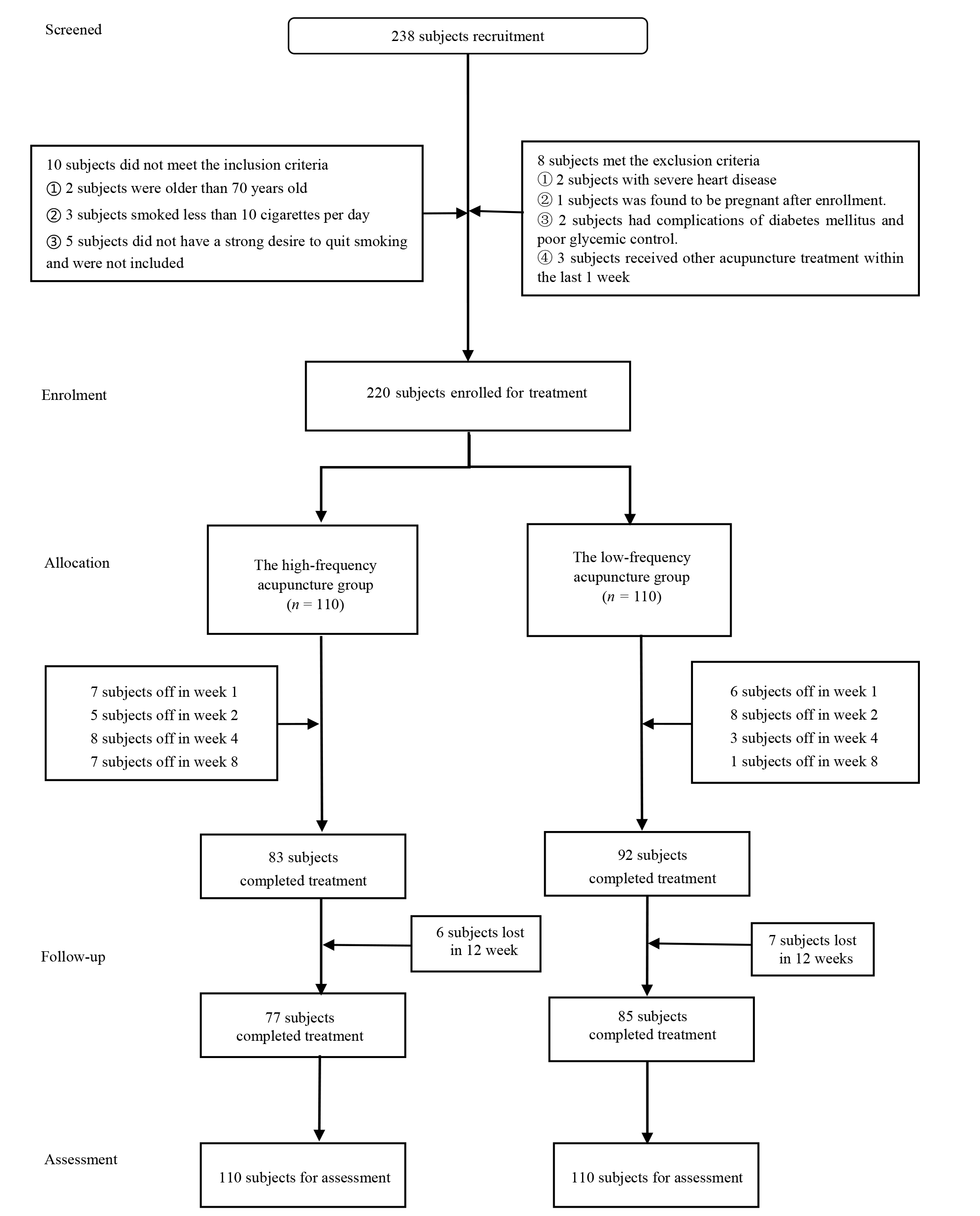
Figure 1 Flow chart of the subjects
Figure 1 Flow chart of the subjects
Table 1 Baseline smoking characteristics
| Characteristic | HF group (n = 110) | LF group (n = 110) | Overall (n = 220) | P value | |
|---|---|---|---|---|---|
| Gender [n (%)] | Male | 105 (95.5) | 106 (96.4) | 211 (95.9) | 1.000 |
| Female | 5 (4.5) | 4 (3.6) | 9 (4.1) | ||
| Age (years) [n (%)] | 20-30 | 9 (8.2) | 5 (4.5) | 14 (6.4) | 0.414 |
| 31-40 | 18 (16.4) | 24 (21.8) | 42 (19.1) | ||
| 41-50 | 35 (31.8) | 32 (29.1) | 67 (30.5) | ||
| > 51 | 48 (43.6) | 49 (44.5) | 97 (44.1) | ||
| mean±SD | 47.3±13.2 | 48.7±11.7 | 48.0±12.5 | ||
| Ethnicity [n (%)] | Han Chinese | 102 (92.7) | 106 (96.4) | 208 (94.5) | 0.235 |
| Other minorities | 8 (7.3) | 4 (3.6) | 12 (5.5) | ||
| Marital status [n (%)] | Unmarried | 14 (12.7) | 14 (12.7) | 28 (12.7) | 0.928 |
| Married | 93 (84.5) | 92 (83.6) | 185 (84.1) | ||
| Other | 3 (2.7) | 4 (3.6) | 7 (3.2) | ||
| Educational status [n (%)] | None school | 3 (2.7) | 0 (0.0) | 3 (1.4) | 0.138 |
| Primary school | 5 (4.5) | 4 (3.6) | 9 (4.1) | ||
| Lower/higher secondary school | 46 (41.8) | 40 (36.4) | 86 (39.1) | ||
| University and above | 56 (50.9) | 66 (60.0) | 122 (55.5) | ||
| Self-rated physical condition | 40-60 | 15 (13.6) | 17 (15.5) | 32 (14.5) | 0.788 |
| [n (%)] | 61-80 | 57 (51.8) | 60 (54.5) | 117 (53.2) | |
| 81-100 | 38 (34.5) | 33 (30.0) | 71 (32.3) | ||
| mean±SD | 78.6±14.3 | 78.1±13.2 | 78.3±13.7 | ||
| No. of cigarettes smoked per day | 1-10 | 29 (26.4) | 26 (23.6) | 55 (25.0) | 0.332 |
| [n (%)] | 11-20 | 61 (55.5) | 68 (61.8) | 129 (58.6) | |
| >21 | 20 (18.2) | 16 (14.5) | 36 (16.4) | ||
| mean±SD | 19.1±10.7 | 17.9±7.1 | 18.5±9.1 | ||
| Age of smoking initiation (years) | 1-10 | 16 (14.5) | 7 (6.4) | 23 (10.5) | 0.771 |
| [n (%)] | 11-20 | 18 (16.4) | 28 (25.5) | 46 (20.9) | |
| >21 | 76 (69.1) | 75 (68.2) | 151 (68.6) | ||
| mean±SD | 26.8±12.3 | 27.3±11.9 | 27.0±12.1 | ||
| FTND score before treatment | mild | 45 (40.9) | 36 (32.7) | 81 (36.8) | 0.392 |
| [n (%)] | moderate | 42 (38.2) | 51 (46.4) | 93 (42.3) | |
| severe | 23 (20.9) | 23 (20.9) | 46 (20.9) | ||
| mean±SD | 4.412.5 | 4.5±2.2 | 4.5±2.3 | ||
| HSI score before treatment | 2.9±1.7 | 3.0±1.5 | 3.0±1.6 | 0.739 | |
| Expiratory CO before treatment | 12.2±3.9 | 11.7±4.3 | 12.0±4.1 | 0.325 | |
| Self-scored smoking cessation confidence | 78.6±14.3 | 78.1±13.2 | 78.3±13.7 | 0.788 | |
Table 1 Baseline smoking characteristics
| Characteristic | HF group (n = 110) | LF group (n = 110) | Overall (n = 220) | P value | |
|---|---|---|---|---|---|
| Gender [n (%)] | Male | 105 (95.5) | 106 (96.4) | 211 (95.9) | 1.000 |
| Female | 5 (4.5) | 4 (3.6) | 9 (4.1) | ||
| Age (years) [n (%)] | 20-30 | 9 (8.2) | 5 (4.5) | 14 (6.4) | 0.414 |
| 31-40 | 18 (16.4) | 24 (21.8) | 42 (19.1) | ||
| 41-50 | 35 (31.8) | 32 (29.1) | 67 (30.5) | ||
| > 51 | 48 (43.6) | 49 (44.5) | 97 (44.1) | ||
| mean±SD | 47.3±13.2 | 48.7±11.7 | 48.0±12.5 | ||
| Ethnicity [n (%)] | Han Chinese | 102 (92.7) | 106 (96.4) | 208 (94.5) | 0.235 |
| Other minorities | 8 (7.3) | 4 (3.6) | 12 (5.5) | ||
| Marital status [n (%)] | Unmarried | 14 (12.7) | 14 (12.7) | 28 (12.7) | 0.928 |
| Married | 93 (84.5) | 92 (83.6) | 185 (84.1) | ||
| Other | 3 (2.7) | 4 (3.6) | 7 (3.2) | ||
| Educational status [n (%)] | None school | 3 (2.7) | 0 (0.0) | 3 (1.4) | 0.138 |
| Primary school | 5 (4.5) | 4 (3.6) | 9 (4.1) | ||
| Lower/higher secondary school | 46 (41.8) | 40 (36.4) | 86 (39.1) | ||
| University and above | 56 (50.9) | 66 (60.0) | 122 (55.5) | ||
| Self-rated physical condition | 40-60 | 15 (13.6) | 17 (15.5) | 32 (14.5) | 0.788 |
| [n (%)] | 61-80 | 57 (51.8) | 60 (54.5) | 117 (53.2) | |
| 81-100 | 38 (34.5) | 33 (30.0) | 71 (32.3) | ||
| mean±SD | 78.6±14.3 | 78.1±13.2 | 78.3±13.7 | ||
| No. of cigarettes smoked per day | 1-10 | 29 (26.4) | 26 (23.6) | 55 (25.0) | 0.332 |
| [n (%)] | 11-20 | 61 (55.5) | 68 (61.8) | 129 (58.6) | |
| >21 | 20 (18.2) | 16 (14.5) | 36 (16.4) | ||
| mean±SD | 19.1±10.7 | 17.9±7.1 | 18.5±9.1 | ||
| Age of smoking initiation (years) | 1-10 | 16 (14.5) | 7 (6.4) | 23 (10.5) | 0.771 |
| [n (%)] | 11-20 | 18 (16.4) | 28 (25.5) | 46 (20.9) | |
| >21 | 76 (69.1) | 75 (68.2) | 151 (68.6) | ||
| mean±SD | 26.8±12.3 | 27.3±11.9 | 27.0±12.1 | ||
| FTND score before treatment | mild | 45 (40.9) | 36 (32.7) | 81 (36.8) | 0.392 |
| [n (%)] | moderate | 42 (38.2) | 51 (46.4) | 93 (42.3) | |
| severe | 23 (20.9) | 23 (20.9) | 46 (20.9) | ||
| mean±SD | 4.412.5 | 4.5±2.2 | 4.5±2.3 | ||
| HSI score before treatment | 2.9±1.7 | 3.0±1.5 | 3.0±1.6 | 0.739 | |
| Expiratory CO before treatment | 12.2±3.9 | 11.7±4.3 | 12.0±4.1 | 0.325 | |
| Self-scored smoking cessation confidence | 78.6±14.3 | 78.1±13.2 | 78.3±13.7 | 0.788 | |
Table 2 Comparison of point and continuous abstinence rates at 8th week and 12th week in two groups [n (%)]
| Type | Viewpoint | Index | HF group (n = 110) | LF group (n = 110) | P value |
|---|---|---|---|---|---|
| Point abstinence rate | 8th week | expiratory CO | 53 (48.2) | 41 (37.3) | 0.102 |
| 12th week | expiratory CO | 46 (41.8) | 45 (40.9) | 0.891 | |
| Continuous abstinence rate | 8th week | self-report | 27 (24.5) | 17 (15.5) | 0.092 |
| 12th week | self-report | 28 (25.5) | 20 (18.2) | 0.192 |
Table 2 Comparison of point and continuous abstinence rates at 8th week and 12th week in two groups [n (%)]
| Type | Viewpoint | Index | HF group (n = 110) | LF group (n = 110) | P value |
|---|---|---|---|---|---|
| Point abstinence rate | 8th week | expiratory CO | 53 (48.2) | 41 (37.3) | 0.102 |
| 12th week | expiratory CO | 46 (41.8) | 45 (40.9) | 0.891 | |
| Continuous abstinence rate | 8th week | self-report | 27 (24.5) | 17 (15.5) | 0.092 |
| 12th week | self-report | 28 (25.5) | 20 (18.2) | 0.192 |
Table 3 Comparison of FTND scores before and after treatment in two groups [Score, M (IQR)]
| Group | n | 1st week | 2nd week | 4th week | 8th week | 12th week |
|---|---|---|---|---|---|---|
| HF | 110 | 3.00 (4.00) | 3.00 (3.00)a | 2.50 (4.00)a | 2.00 (4.00)a | 2.00 (3.00)a |
| LF | 110 | 4.00 (3.00) | 3.00 (4.00)b | 2.50 (3.00)b | 2.00 (3.00)b | 2.00 (3.00)b |
Table 3 Comparison of FTND scores before and after treatment in two groups [Score, M (IQR)]
| Group | n | 1st week | 2nd week | 4th week | 8th week | 12th week |
|---|---|---|---|---|---|---|
| HF | 110 | 3.00 (4.00) | 3.00 (3.00)a | 2.50 (4.00)a | 2.00 (4.00)a | 2.00 (3.00)a |
| LF | 110 | 4.00 (3.00) | 3.00 (4.00)b | 2.50 (3.00)b | 2.00 (3.00)b | 2.00 (3.00)b |
Table 4 Comparison of MNWS scores before and after treatment in two groups [scores, M (IQR)]
| Group | n | 1st week | 2nd week | 4th week | 8th week | 12th week |
|---|---|---|---|---|---|---|
| HF | 110 | 6.00 (5.00) | 6.0 (4.00) | 4.0 (3.50) | 3.00 (5.00)a | 3.00 (5.00)a |
| LF | 110 | 6.00 (6.00) | 6.0 (5.00) | 4.5 (4.00) | 3.00 (4.00)b | 3.00 (4.00)b |
Table 4 Comparison of MNWS scores before and after treatment in two groups [scores, M (IQR)]
| Group | n | 1st week | 2nd week | 4th week | 8th week | 12th week |
|---|---|---|---|---|---|---|
| HF | 110 | 6.00 (5.00) | 6.0 (4.00) | 4.0 (3.50) | 3.00 (5.00)a | 3.00 (5.00)a |
| LF | 110 | 6.00 (6.00) | 6.0 (5.00) | 4.5 (4.00) | 3.00 (4.00)b | 3.00 (4.00)b |
Table 5 Comparison of Qsu-Brief scores before and after treatment between two groups of subjects with different NMR degrees [score, M (IQR)]
| Group | n | 1st week | 2nd week | 4th week | 8th week | 12th week |
|---|---|---|---|---|---|---|
| HF | 110 | 24.00 (19.00) | 22.00 (16.00) | 21.00 (11.00) | 17.00 (12.00)a | 17.00 (15.00)a |
| LF | 110 | 22.00 (16.00) | 21.00 (12.00) | 18.00 (10.00) | 16.00 (12.00)bc | 16.00 (11.00)bd |
Table 5 Comparison of Qsu-Brief scores before and after treatment between two groups of subjects with different NMR degrees [score, M (IQR)]
| Group | n | 1st week | 2nd week | 4th week | 8th week | 12th week |
|---|---|---|---|---|---|---|
| HF | 110 | 24.00 (19.00) | 22.00 (16.00) | 21.00 (11.00) | 17.00 (12.00)a | 17.00 (15.00)a |
| LF | 110 | 22.00 (16.00) | 21.00 (12.00) | 18.00 (10.00) | 16.00 (12.00)bc | 16.00 (11.00)bd |
| 1. |
Fouad H, Commar A, Hamadeh R, El-Awa F, Shen Z, Fraser C. Estimated and projected prevalence of tobacco smoking in males, eastern mediterranean region, 2000-2025. East Mediterr Health J 2021; 27: 76-82.
DOI PMID |
| 2. |
Rigotti NA, Kruse GR, Livingstone-Banks J, Hartmann-Boyce J. Treatment of tobacco smoking: a review. JAMA 2022; 327: 566-77.
DOI PMID |
| 3. | Ministry of Health of People’s Republic of China, China Report on the Health Hazards of Smoking. Beijing: People's Medical Publishing House, 2021: 1-4. |
| 4. | Wang JH, van Haselen R, Wang M, et al. Acupuncture for smoking cessation: a systematic review and Meta-analysis of 24 randomized controlled trials. Tob Induc Dis 2019; 4: 48. |
| 5. |
Lhommeau N, Huchet A, Castera P. Acupuncture et arrêt de la consommation tabagique, unerevue de la littérature [Acupuncture and smoking cessation, a review of the literature]. Rev Mal Respir 2020; 37: 474-8.
DOI PMID |
| 6. | Dai R, Cao Y, Zhang H, et al. Comparison between acupuncture and nicotine replacement therapies for smoking cessation based on randomized controlled trials: a systematic review and bayesian network Meta-analysis. Evid Based Complement Alternat Med 2021; 2021: 9997516. |
| 7. |
Bier ID, Wilson J, Studt P, Shakleton M. Auricular acupuncture, education, and smoking cessation: a randomized, sham-controlled trial. Am J Public Health 2002; 92: 1642-7.
PMID |
| 8. |
Lee EJ. The effect of auricular acupressure and positive group psychotherapy with motivational interviewing for smoking cessation in korean adults. Holist Nurs Pract 2020; 34: 113-20.
DOI PMID |
| 9. | Dai R, Zhang J, Zhang H, Zhao N, Song F, Fan J. Effect of acupuncture and auricular acupressure on smoking cessation: protocol of a systematic review and bayesian network Meta-analysis. Medicine (Baltimore) 2020; 99: e20295. |
| 10. | Yoon DE, Lee IS, Chae Y. Identifying dose components of manual acupuncture to determine the dose-response relationship of acupuncture treatment: a systematic review. Am J Chin Med 2022; 50: 653-71. |
| 11. | Lin LL, Wang LQ, Yang JW, et al. Researches status on time-effect of acupuncture. Zhong Guo Zhen Jiu 2019; 39: 565-70. |
| 12. |
FF Ma, HW Zhang, BX Li, PY Cheng, Yu MW, Wang XM. Acupuncture and moxibustion for malignant tumor patients with psychological symptoms of insomnia, anxiety and depression: a systematic review and Meta-analysis. J Tradit Chin Med 2023; 43: 441-56.
DOI |
| 13. | Liu Z, Yang JS, Wu Y, et al. Predictors for smoking cessation with acupuncture in a hong kong population. Evid Based Complement Alternat Med 2015; 2015: 189694. |
| 14. | Wang TS, Bai P. Clinical study of 37 cases of periarthritis of shoulder treated with different acupuncture frequency. Jiangsu Zhong Yi Yao 2019; 51: 62-5. |
| 15. |
Eisenberg MJ, Hébert-Losier A, Windle SB, et al. Effect of e-cigarettes plus counseling vs counseling alone on smoking cessation: a randomized clinical trial. JAMA 2020; 324: 1844-854.
DOI PMID |
| 16. | Regional Office for the Western Pacific. World health organization standard acupuncture acupoint location-western pacific region. World Health Organization 2009: 25-219. |
| 17. | Liu Z, Wang YY, Wu Y, et al. Modern literature research on acupuncture and smoking cessation. J Tradit Chin Med 2015; 56: 2116-20. |
| 18. | Jang S, Lee JA, Jang BH, Shin YC, Ko SG, Park S. Clinical effectiveness of traditional and complementary medicine interventions in combination with nicotine replacement therapy on smoking cessation: a randomized controlled pilot trial. J Altern Complement Med 2019; 25: 526-34. |
| 19. | Wee LH, West R, Mariapun J, et al. Should the threshold for expired-air carbon monoxide concentration as a means of verifying self-reported smoking abstinence be reduced in clinical treatment programmes? Evidence from a Malaysian smokers' clinic. Addict Behav 2015; 47: 74-9. |
| 20. | Chulasai P, Chinwong D, Vientong P, et al. Smartphone application for smoking cessation (quit with us): a randomized controlled trial among young adult light smokers in thailand. Int J Environ Res Public Health 2022; 19: 8265. |
| 21. |
Dijkstra A, Tromp D. Is the FTND a measure of physical as well as psychological tobacco dependence? J Subst Abuse Treat 2002; 23: 367-74.
PMID |
| 22. | Whittaker R, Borland R, Bullen C, Lin RB, McRobbie H, Rodgers A. Mobile phone-based interventions for smoking cessation. Cochrane Database Syst Rev 2016; 4: CD006611. |
| 23. | Chai X, Yang JS, Liu Z, et al. Effect of the different smoking cessation regimens with acupuncture on smoking withdrawal and their influence factors: a multi-center randomized controlled trial. Zhong Guo Zhen Jiu 2019; 39: 1255-261. |
| 24. | Wang YY, Liu Z, Wu Y, et al. Efficacy of acupuncture is noninferior to nicotine replacement therapy for tobacco cessation: results of a prospective, randomized, active-controlled open-label trial. Chest 2018; 153: 680-88. |
| 25. | Wang YY, Liu Z, Wu Y, et al. A randomized controlled trial on smoking cessation by acupuncture. Beijing Zhong Yi Yao Da Xue Xue Bao 2018; 41: 605-10. |
| 26. | Hajek P, Phillips-Waller A, Przulj D, et al. A randomized trial of e-cigarettes versus nicotine-replacement therapy. N Engl J Med 2019; 380: 629-37. |
| 27. |
Quisenberry AJ, Pittman J, Goodwin RD, Bickel WK, D'Urso G, Sheffer CE. Smoking relapse risk is increased among individuals in recovery. Drug Alcohol Depend 2019; 202: 93-103.
DOI PMID |
| 28. |
Fagerström K, Russ C, Yu CR, Yunis C, Foulds J. The Fagerström test for nicotine dependence as a predictor of smoking abstinence: a pooled analysis of varenicline clinical trial data. Nicotine Tob Res 2012; 14: 1467-73.
DOI PMID |
| 29. | Liu Z, Wang YY, Wu Y, et al. Analysis of compliance factors of subjects with acupuncture smoking cessation in Hong Kong. Beijing Zhong Yi Yao Da Xue Xue Bao 2016; 39: 82-8. |
| 30. | Biedermann F, Fleischhacker WW. Psychotic disorders in DSM-5 and ICD-11. CNS Spectr 2016; 21: 349-54. |
| 31. | Fei YT, Cao HJ, Xia RY, et al. Methodological challenges in design and conduct of randomised controlled trials in acupuncture. BMJ 2022; 376: e064345. |
| 32. | Yuan YY, Zhang W, Kuang HJ, et al. Literature study on clinical outcome indicators in randomized controlled trials of acupuncture and smoking cessation. Zhong Yi Za Zhi 2022; 63: 1179-185. |
| 33. |
Chen Q, Wang Q, Ding S, et al. Problems lowering the study quality in traditional medicine, introspection from an example of Meta-analysis of acupuncture. BMC Complement Med Ther 2020; 20: 41.
DOI PMID |
| 34. |
Besson M, Granon S, Mameli-Engvall M, et al. Long-term effects of chronic nicotine exposure on brain nicotinic receptors. Proc Natl Acad Sci USA 2007; 104: 8155-60.
PMID |
| 35. |
Jin YT, Wu LT, Guo YL, Xia C, Yu BY, Xuan LH. Long-term efficacy of point application therapy on different acupoints and durations in the treatment of asthma: a randomized controlled trial. J Tradit Chin Med 2023; 43: 146-53.
DOI |
| 36. | Leone FT, Zhang Y, Evers-Casey S, et al. Initiating pharmacologic treatment in tobacco-dependent adults. An official american thoracic society clinical practice guideline Am J Respir Crit Care Med 2020; 202: e5-31. |
| 37. |
Yavagal PC, Nagesh L. Efficacy of laser auricular acupuncture for smoking cessation: a randomised controlled trial. Sultan Qaboos Univ Med J 2021; 21: e275-81.
DOI PMID |
| 38. |
Hugley MJ, Wolford-Clevenger C, Sisson ML, Nguyen AT, Cropsey KL. Self-initiated gradual smoking reduction among community correction smokers. Addict Behav 2019; 93: 100-3.
DOI PMID |
| [1] | SUN Jiao, WANG Yueming, LYU Jian, LIU Xin, YUE Bingnan, LI Yinyin, LIU Jipeng, SUN Yize, LIU Qingguo, YAN Liu. Effect of electroacupuncture on hypertensive and sympathetic excitability mechanism mediated by the paraventricular nucleus of the hypothalamus in spontaneous hypertensive rats [J]. Journal of Traditional Chinese Medicine, 2025, 45(3): 586-596. |
| [2] | MIN Yu, ZHENG Meifeng, SUN Ju, PENG Zetong, CAO Zhixian, HUANG Xiaohua. Systematic acupuncture explains acupuncture at Baihui (GV20) and Fengchi (GB20) targeting the inflammatory response to regulate migraine [J]. Journal of Traditional Chinese Medicine, 2025, 45(3): 610-617. |
| [3] | WEN Zhigang, LU Shuai, CHENG Xiumei. Clinical observation on the effect of warming meridian medicinal wine, polarized light external application combined with acupuncture and moxibustion on pain after vertebroplasty [J]. Journal of Traditional Chinese Medicine, 2025, 45(3): 660-666. |
| [4] | LI Yongfeng, CHEN Xinyi, REN Wei, QIAO Haifa. Electroacupuncture stimulation of auricular concha region improves loss of control over stress induced depression-like behavior by modulating 5-hydroxytryptamine 1A receptor [J]. Journal of Traditional Chinese Medicine, 2025, 45(2): 326-334. |
| [5] | TIAN Yuan, BU He, WANG Tieshan, YANG Dongliang, ZHANG Wei, LIU Tong, ZHANG Li, HUO Zejun. Efficacy of electro-acupuncture at “Weizhong” (BL40) on macrophage polarization in rats with injured lumbar multifidus [J]. Journal of Traditional Chinese Medicine, 2025, 45(2): 335-347. |
| [6] | HU Junwei, FENG Jiwei, LI Wen, LIU Lumin, LI Xu, XU Ge, LIU Jiandang, CHEN Yuelai. Electroacupuncture improves cyclophosphamide-induced bladder overactivity by reducing mechanotransduction in the rat urothelium [J]. Journal of Traditional Chinese Medicine, 2025, 45(2): 348-358. |
| [7] | KANG Jiale, DU Zhongming, GUO Wei, DU Shuo, HAN Guanxiong, CHEN Sheng. Effect of acupuncture on serum levels of hypothalamic-pituitary-adrenal axis related hormones and immune factors in rats with allergic rhinitis [J]. Journal of Traditional Chinese Medicine, 2025, 45(2): 359-367. |
| [8] | BAI Tianyu, YANG Jiaen, YIN Liang, LI Jinling, LIU Jianxian, LI Zongchang, SUN Zeming, JIA Ning, XU Chengchao. Effect of acupuncture on brain activity in patients with decreasing ovarian reserve: a resting-state functional magnetic resonance imaging study [J]. Journal of Traditional Chinese Medicine, 2025, 45(2): 450-457. |
| [9] | WU Jiaman, TANG Meng, LUO Yu, ZHU Haimin, ZHAO Tianqi, MA Fei, NING Yan. Electroacupuncture enhances the mitophagy of granulosa cells in premature ovarian insufficiency model mice by inactivating the hippo-yes-associated protein/transcriptional co-activator with postsynaptic density protein, drosophila disc large tumor suppressor, and zonula occludens-1 protein binding motif pathway [J]. Journal of Traditional Chinese Medicine, 2025, 45(1): 13-21. |
| [10] | LI Siting, WANG Shaojun, YIN Yehui, DE Gejing, LI Caicai, WANG Ziyan, CAO Wenjie. Electroacupuncture alleviates zymosan-induced colorectal hypersensitivity [J]. Journal of Traditional Chinese Medicine, 2025, 45(1): 32-38. |
| [11] | LANG Jiawang, JIN Lingqing, LUO Jianchang, LANG Boxu. Effects of acupuncture combined with bone-setting therapy to treat tourette syndrome: a three-arm randomized controlled trial [J]. Journal of Traditional Chinese Medicine, 2025, 45(1): 176-183. |
| [12] | Emre Bulut, Didem Özkal Eminoğlu, Yasemin Çayır. Effect of electroacupuncture on pain after periodontal flap surgery: a randomized controlled trial [J]. Journal of Traditional Chinese Medicine, 2025, 45(1): 184-191. |
| [13] | HE Ling, YANG Hui, LI Kang, WANG Junwen, SUN Zhibo, YANG Jinsheng, ZHANG Jing. Research on acupuncture robots based on the OptiTrack motion capture system and a robotic arm [J]. Journal of Traditional Chinese Medicine, 2025, 45(1): 201-212. |
| [14] | WANG Bingyu, JIN Fangfang, GAO Jiawei, YANG Liuxin, ZHANG Yali, YUAN Xingxing, ZHANG Yang. Acupuncture reduces sedative and anaesthetic consumption and improves pain tolerance in patients undergoing colonoscopy: a Meta-analysis [J]. Journal of Traditional Chinese Medicine, 2024, 44(6): 1091-1103. |
| [15] | ZHANG Boyang, ZHOU Yang, FENG Liyuan, SUI Dan, HE Lei, TONG Dan, WANG Ruoyu, SUI Xue, SONG Jing, WANG Dongyan. A neural regulation mechanism of head electroacupuncture on brain network of patients with stroke related sleep disorders [J]. Journal of Traditional Chinese Medicine, 2024, 44(6): 1268-1276. |
| Viewed | ||||||
|
Full text |
|
|||||
|
Abstract |
|
|||||