
Journal of Traditional Chinese Medicine ›› 2025, Vol. 45 ›› Issue (1): 176-183.DOI: 10.19852/j.cnki.jtcm.2025.01.017
Previous Articles Next Articles
Effects of acupuncture combined with bone-setting therapy to treat tourette syndrome: a three-arm randomized controlled trial
LANG Jiawang, JIN Lingqing, LUO Jianchang, LANG Boxu( )
)
- Department of Acupuncture and Massage, Municipal Hospital Affiliated to Medical School of Taizhou University, Taizhou 318000, China
-
Received:2024-03-22Accepted:2024-09-04Online:2025-02-15Published:2025-01-10 -
Contact:LANG Boxu, Department of Acupuncture and Massage, Municipal Hospital Affiliated to Medical School of Taizhou University, Taizhou 318000, China.tsylbx@tzc.edu.cn Telephone: +86 13957685225 -
Supported by:Traditional Chinese medicine foundation of Zhejiang province: Clinical Study on the Correlation Between Tourette Syndrome and Anatomical Changes in the Atlantoaxial Joint(2010ZB162);Medical Health Science and Technology Project of Zhejiang Provincial Health Commission: Study on Protein Fingerprinting of Tourette Syndrome(2011KYB142);Renowned Traditional Chinese Medicine Expert Inheritance Studio Construction Project of Zhejiang province(GZS2020049);Key Disciplines of Traditional Chinese Medicine Foundation of Zhejiang Province(2012-XK-D20)

Cite this article
LANG Jiawang, JIN Lingqing, LUO Jianchang, LANG Boxu. Effects of acupuncture combined with bone-setting therapy to treat tourette syndrome: a three-arm randomized controlled trial[J]. Journal of Traditional Chinese Medicine, 2025, 45(1): 176-183.
share this article
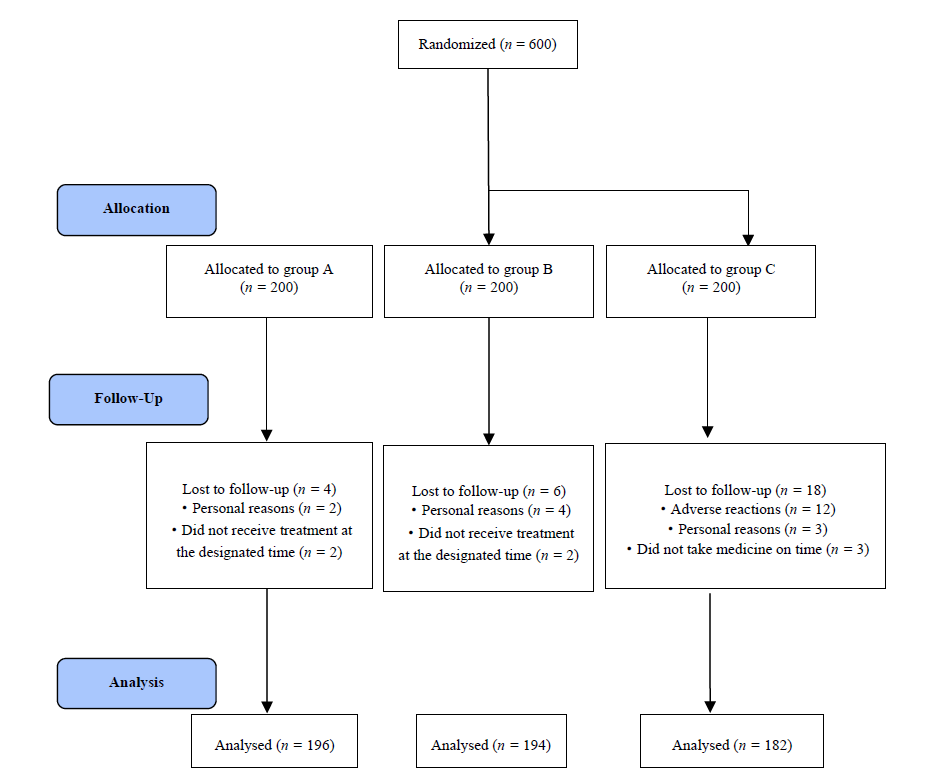
Figure 1 Flow chart of the study
Figure 1 Flow chart of the study
Table 1 Comparative analysis of baseline data
| Item | Group A (n = 200) | Group B (n = 200) | Group C (n = 200) | P value |
|---|---|---|---|---|
| Gender (male/female) (n) | 156/44 | 151/49 | 156/44 | 0.789 |
| Age (years) | 8.1±2.5 | 7.7±2.3 | 7.8±2.7 | 0.33 |
| Course of disease (years) | 2.7±1.2 | 2.6±1.1 | 2.6±1.2 | 0.464 |
| YGTSS (points) | 18.7±7.1 | 19.3±7.1 | 19.2±7.5 | 0.652 |
| Social function impairment (points) | 30 (20, 30) | 30 (20, 30) | 30 (20, 40) | 0.846 |
Table 1 Comparative analysis of baseline data
| Item | Group A (n = 200) | Group B (n = 200) | Group C (n = 200) | P value |
|---|---|---|---|---|
| Gender (male/female) (n) | 156/44 | 151/49 | 156/44 | 0.789 |
| Age (years) | 8.1±2.5 | 7.7±2.3 | 7.8±2.7 | 0.33 |
| Course of disease (years) | 2.7±1.2 | 2.6±1.1 | 2.6±1.2 | 0.464 |
| YGTSS (points) | 18.7±7.1 | 19.3±7.1 | 19.2±7.5 | 0.652 |
| Social function impairment (points) | 30 (20, 30) | 30 (20, 30) | 30 (20, 40) | 0.846 |
Table 2 Comparison of scores of YGTSS, social function impairment in each group before and after treatment ($\bar{x}±s$)
| Outcome | Group A (n = 200) | Group B (n = 200) | Group C (n = 200) | ||||
|---|---|---|---|---|---|---|---|
| Before | After | Before | After | Before | After | ||
| YGTSS (points) | 19 ±7 | 4±6a | 19±7 | 6±6c | 19±7 | 8±7e | |
| Social function impairment (n) | No damage | 1 | 131b | 0 | 85d | 1 | 59f |
| Extremely mild | 12 | 26 | 9 | 35 | 10 | 29 | |
| mild | 51 | 19 | 55 | 34 | 52 | 30 | |
| Moderate | 88 | 12 | 92 | 26 | 85 | 38 | |
| Pronounced | 42 | 7 | 37 | 13 | 42 | 20 | |
| Serious | 6 | 1 | 7 | 1 | 10 | 6 | |
Table 2 Comparison of scores of YGTSS, social function impairment in each group before and after treatment ($\bar{x}±s$)
| Outcome | Group A (n = 200) | Group B (n = 200) | Group C (n = 200) | ||||
|---|---|---|---|---|---|---|---|
| Before | After | Before | After | Before | After | ||
| YGTSS (points) | 19 ±7 | 4±6a | 19±7 | 6±6c | 19±7 | 8±7e | |
| Social function impairment (n) | No damage | 1 | 131b | 0 | 85d | 1 | 59f |
| Extremely mild | 12 | 26 | 9 | 35 | 10 | 29 | |
| mild | 51 | 19 | 55 | 34 | 52 | 30 | |
| Moderate | 88 | 12 | 92 | 26 | 85 | 38 | |
| Pronounced | 42 | 7 | 37 | 13 | 42 | 20 | |
| Serious | 6 | 1 | 7 | 1 | 10 | 6 | |
Table 3 Comparison of difference of YGTSS, social function impairment score among groups (scores)
| Outcome | Group A (n = 200) | Group B (n = 200) | Group C (n = 200) |
|---|---|---|---|
| Difference of YGTSS score ( | 15±7a | 13±7c | 11±7 |
| Difference of social function impairment score [M (P25, P75)] | 20 (12.5, 30)b | 10 (20, 20)d | 10 (0, 20) |
Table 3 Comparison of difference of YGTSS, social function impairment score among groups (scores)
| Outcome | Group A (n = 200) | Group B (n = 200) | Group C (n = 200) |
|---|---|---|---|
| Difference of YGTSS score ( | 15±7a | 13±7c | 11±7 |
| Difference of social function impairment score [M (P25, P75)] | 20 (12.5, 30)b | 10 (20, 20)d | 10 (0, 20) |
Table 4 Comparison of clinical efficacy, long-term efficacy [n (%)]
| Outcome | Group A (n = 186) | Group B (n = 178) | Group C (n = 144) | |
|---|---|---|---|---|
| Clinical efficacy | Clinical control | 122 (62.2)a | 79 (40.7)c | 53 (29.1) |
| Effective | 42 (21.4) | 60 (30.9) | 47 (25.8) | |
| Valid | 22 (11.2) | 39 (20.1) | 44 (24.2) | |
| Invalid | 10 (5.1) | 16 (8.2) | 38 (20.9) | |
| Total efficacy | 186 (94.9) | 178 (91.8) | 144 (79.1)c | |
| Long-term efficacy | No | 95 (77.9) | 48 (60.8) | 17 (32.1) |
| Yes | 27 (22.1)b | 31 (39.2)d | 32 (67.9) |
Table 4 Comparison of clinical efficacy, long-term efficacy [n (%)]
| Outcome | Group A (n = 186) | Group B (n = 178) | Group C (n = 144) | |
|---|---|---|---|---|
| Clinical efficacy | Clinical control | 122 (62.2)a | 79 (40.7)c | 53 (29.1) |
| Effective | 42 (21.4) | 60 (30.9) | 47 (25.8) | |
| Valid | 22 (11.2) | 39 (20.1) | 44 (24.2) | |
| Invalid | 10 (5.1) | 16 (8.2) | 38 (20.9) | |
| Total efficacy | 186 (94.9) | 178 (91.8) | 144 (79.1)c | |
| Long-term efficacy | No | 95 (77.9) | 48 (60.8) | 17 (32.1) |
| Yes | 27 (22.1)b | 31 (39.2)d | 32 (67.9) |
| 1. | Johnson KA, Worbe Y, Foote KD, Butson CR, Gunduz A, Okun MS. Tourette syndrome: clinical features, pathophysiology, and treatment. Lancet Neurol 2022; 28: 303-9. |
| 2. | Lin WD, Tsai FJ, Chou IC. Current understanding of the genetics of tourette syndrome. Biomed J 2022; 45: 271-9. |
| 3. |
Hirschtritt ME, Lee PC, Pauls DL, et al. Tourette Syndrome Association International Consortium for Genetics. Lifetime prevalence, age of risk, and genetic relationships of comorbid psychiatric disorders in Tourette syndrome. JAMA Psychiatry 2015; 72: 325-33.
DOI PMID |
| 4. |
Szejko N, Jakubczyk A, Janik P. Prevalence and clinical correlates of self-harm behaviors in Gilles de la Tourette Syndrome. Front Psychiatry 2019; 10: 638.
DOI PMID |
| 5. | Robertson MM, Trimble MR, Lees AJ. Self-injurious behaviour and the Gilles de la Tourette syndrome: a clinical study and review of the literature 1989; 19: 611-25. |
| 6. | Kurlan R. Clinical practice. Tourette's syndrome. N Engl J Med 2010; 363: 2332-8. |
| 7. |
Fulton WA. Intermittent medication cessation in the treatment of Tourette syndrome. Neurosci Biobehav Rev 1988; 12: 235-40.
PMID |
| 8. | Liu Z, Cui Y, Sun D, et al. Current status, diagnosis, and treatment recommendation for tic disorders in China. Front Psychiatry 2020; 11: 774. |
| 9. | Moher D, Hopewell S, Schulz K, et al. CONSORT 2010 statement: updated guidelines for reporting parallel group randomised trials. J Clin Epidemiol 2010; 63: e1-37. |
| 10. | MacPherson H, Altman DG, Hammerschlag R, et al. Revised STandards for reporting interventions in clinical trials of acupuncture (STRICTA): extending the CONSORT statement. PLoS Med 2010; 7: e1000261. |
| 11. | American Psychiatric Association DSM- Task Force Arlington VA US. Diagnostic and statistical manual of mental disorders: DSM-5™ (5th ed.). Codas 2013; 25: 191. |
| 12. | Lang B, Jin L. Clinical observation on acupuncture at eight nape points for vertigo due to vertebrobasilar insufficiency. Shanghai Zhen Jiu Za Zhi 2014; 33: 890-2. |
| 13. | Feng TY (chief editor). Clinical study on treating STI by integrated Traditional and Western Medicine. Beijing: China Science and Technology Press 2002: 32-5. |
| 14. | Leckman JF, Riddle MA, Hardin MT, et al. The yale global tic severity scale: initial testing of a clinician-rated scale of tic severity. J Am Acad Child Adolesc Psychiatry 1989; 28: 566-73. |
| 15. | Yang N, Ma R, Hu SY, et al. Efficacy and safety of Choudongning capsule (CDN) in children with Tourette's syndrome of spleen deficiency and phlegm accumulation. Zhong Guo Zhong Yao Za Zhi 2016; 41: 3100-6. |
| 16. | Huang Y, He Y, Zheng G, et al. Observation on the efficacy of Jingling oral liquid combined with Tiapride hydrochloride in the treatment of Tourette syndrome. Shi Yong Yi Xue Za Zhi 2014; 17: 2847-48. |
| 17. |
Robertson MM, Eapen V, Cavanna AE. The international prevalence, epidemiology, and clinical phenomenology of Tourette syndrome: a cross-cultural perspective. J Psychosom Res 2009; 67: 475-83.
DOI PMID |
| 18. |
Robertson MM. The prevalence and epidemiology of Gilles de la Tourette syndrome. Part 1: the epidemiological and prevalence studies. J Psychosom Res 2008; 65: 461-72.
DOI PMID |
| 19. | Cui Y, Zheng Y, Zhong C. Advances in research on epidemiology of tic disorders (review). Zhong Guo Xin Li Wei Sheng Za Zhi 2008; 22: 505-7. |
| 20. |
Ludolph AG, Roessner V, Münchau A, Müller-Vahl K. Tourette syndrome and other tic disorders in childhood, adolescence and adulthood. Dtsch Arztebl Int 2012; 109: 821-28.
DOI PMID |
| 21. |
Robertson MM, Eapen V, Singer HS, et al. Gilles de la Tourette syndrome. Nat Rev Dis Primers 2017; 3: 16097.
DOI PMID |
| 22. |
Buse J, Schoenefeld K, Münchau A, Roessner V. Neuromodulation in Tourette syndrome: dopamine and beyond. Neurosci Biobehav Rev 2013; 37: 1069-84.
DOI PMID |
| 23. | Lin L, Lan Y, Zhu H, et al. Effects of chemogenetic inhibition of D 1 or D2 receptor-containing neurons of the substantia nigra and striatum in mice with Tourette syndrome. Front Mol Neurosci 2021; 14: 779436. |
| 24. |
McNaught KS, Mink JW. Advances in understanding and treatment of Tourette syndrome. Nat Rev Neurol 2011; 7: 667-76.
DOI PMID |
| 25. | Lu C, Wu LQ, Hao H, et al. Clinical efficacy and safety of acupuncture treatment of TIC disorder in children: a systematic review and Meta-analysis of 22 randomized controlled trials. Complement Ther Med 2021; 59: 102734. |
| 26. | Rong P, Ma R, Han X, Wu H. Guideline for TCM pediatrics clinical diagnosis and treatment·tic disorder (amendment). Zhong Yi Er Ke Za Zhi 2019; 15: 1-6. |
| 27. | Lang B, Wang L, Luo J, Jin L. The relationship between atlantoaxial factors of vertebral artery and cervical vertigo. Zhong Yi Zheng Gu 2017; 29: 28-30. |
| 28. | Tian J. Blade needle therapy (5) -Blade needle therapy of vertebrobasilar insufficiency due to cervical soft tissue damage. Zhong Guo Zhen Jiu 2005; 25: 437-8. |
| 29. | Caligiore D, Mannella F, Arbib MA, Baldassarre G, et al. Dysfunctions of the basal ganglia-cerebellar-thalamo-cortical system produce motor tics in Tourette syndrome. PLoS Comput Biol 2017; 13: e1005395. |
| 30. | Gong S, Yang J, Qin C. Observation on curative effect of manipulative therapy of atlantoaxial and atlanto-occipital joint in treatment of transient tic disorder. Zhong Guo Kang Fu Yi Xue Za Zhi 2017; 32: 334-6. |
| 31. | Jin X, Ye S. Effect of chiropractic and dredging scheme on blinking symptoms of atlantoaxial dislocation in children with Tourette syndrome. Zhong Yi Er Ke Za Zhi 2018; 14: 55-9. |
| 32. | Kang J, Fan D, Liu J, et al. Clinical study of long's spinal-related therapy combined with bedside traction in treatment of pediatric cervicogenic Tourette syndrome. Zhong Yi Yao Xue Bao 2019; 47: 81-5. |
| 33. | Li Z, Gong S, Duan Y. Gilles De La Tourette’s syndrome and cervical spine trauma. Xian Dai Kang Fu 1999: 25-6. |
| 34. | Ma F, Cao N, Wang L, Zhao L. Advances in research on models of Tourette syndrome. Zhong Feng Yu Shen Jing Ji Bing Za Zhi 2018; 35: 285-8. |
| [1] | WU Jiaman, TANG Meng, LUO Yu, ZHU Haimin, ZHAO Tianqi, MA Fei, NING Yan. Electroacupuncture enhances the mitophagy of granulosa cells in premature ovarian insufficiency model mice by inactivating the hippo-yes-associated protein/transcriptional co-activator with postsynaptic density protein, drosophila disc large tumor suppressor, and zonula occludens-1 protein binding motif pathway [J]. Journal of Traditional Chinese Medicine, 2025, 45(1): 13-21. |
| [2] | LI Siting, WANG Shaojun, YIN Yehui, DE Gejing, LI Caicai, WANG Ziyan, CAO Wenjie. Electroacupuncture alleviates zymosan-induced colorectal hypersensitivity [J]. Journal of Traditional Chinese Medicine, 2025, 45(1): 32-38. |
| [3] | YE Wujie, YANG Yawei, ZHANG Da, TANG Ling, CUI Minying, FU Bin, ZHANG Meng, HU Xingang, ZHAO Yan. Effectiveness of combining Qingyanyin formulated granules (轻燕饮配方颗粒) with press needles in treating abdominal obesity: a multicenter randomized controlled trial [J]. Journal of Traditional Chinese Medicine, 2025, 45(1): 107-114. |
| [4] | Emre Bulut, Didem Özkal Eminoğlu, Yasemin Çayır. Effect of electroacupuncture on pain after periodontal flap surgery: a randomized controlled trial [J]. Journal of Traditional Chinese Medicine, 2025, 45(1): 184-191. |
| [5] | HE Ling, YANG Hui, LI Kang, WANG Junwen, SUN Zhibo, YANG Jinsheng, ZHANG Jing. Research on acupuncture robots based on the OptiTrack motion capture system and a robotic arm [J]. Journal of Traditional Chinese Medicine, 2025, 45(1): 201-212. |
| [6] | WANG Bingyu, JIN Fangfang, GAO Jiawei, YANG Liuxin, ZHANG Yali, YUAN Xingxing, ZHANG Yang. Acupuncture reduces sedative and anaesthetic consumption and improves pain tolerance in patients undergoing colonoscopy: a Meta-analysis [J]. Journal of Traditional Chinese Medicine, 2024, 44(6): 1091-1103. |
| [7] | WU Qiaomin, GUAN Xuanke, LIU Jinfeng, WANG Yanli, CHANG Xing, LIU Zhiming, LIU Ruxiu. Compound Tongyang Fumai decoction (通阳复脉方) improves quality of life in sick sinus syndrome: a randomized controlled study [J]. Journal of Traditional Chinese Medicine, 2024, 44(6): 1247-1253. |
| [8] | QIAN Jianan, XU Yan, HU Hongyi, ZHAO Aiguang. Clinical efficacy and safety evaluation of Buzhongyiqi pills (补中益气丸) on appetite improvement in patients with colorectal cancer receiving chemotherapy: a pilot randomized cross-over clinical trial [J]. Journal of Traditional Chinese Medicine, 2024, 44(6): 1254-1267. |
| [9] | ZHANG Boyang, ZHOU Yang, FENG Liyuan, SUI Dan, HE Lei, TONG Dan, WANG Ruoyu, SUI Xue, SONG Jing, WANG Dongyan. A neural regulation mechanism of head electroacupuncture on brain network of patients with stroke related sleep disorders [J]. Journal of Traditional Chinese Medicine, 2024, 44(6): 1268-1276. |
| [10] | XI Hanqing, LI Xia, ZHANG Ziyi, CUI Xiang, JING Xianghong, ZHU Bing, GAO Xinyan. Neuro- and immuno-modulation mediated by the cardiac sympathetic nerve: a novel insight into the anti-ischemic efficacy of acupuncture [J]. Journal of Traditional Chinese Medicine, 2024, 44(5): 1058-1066. |
| [11] | XU Yingshan, WU Chunxiao, YU Wei, GUO Hongji, LU Liming, XU Nenggui, TANG Chunzhi. Systematic review and Meta-analysis of brain plasticity associated with electroacupuncture in experimental ischemic stroke [J]. Journal of Traditional Chinese Medicine, 2024, 44(5): 859-870. |
| [12] | DENG Yasheng, HAN Siyin, XI Lanhua, HUANG Hui, LIANG Tianwei, ZHENG Yiqing, FAN Yanping, LIN Jiang. Traditional Chinese Medicine in the treatment of recurrent respiratory tract infections in children: an overview of systematic reviews and Meta-analyses [J]. Journal of Traditional Chinese Medicine, 2024, 44(5): 871-884. |
| [13] | ZHENG Peng, MENG Ying, LIU Meijun, YU Di, LIU Huiying, WANG Fuchun, XU Xiaohong. Electroacupuncture inhibits hippocampal oxidative stress and autophagy in sleep-deprived rats through the protein kinase B and mechanistic target of rapamycin signaling pathway [J]. Journal of Traditional Chinese Medicine, 2024, 44(5): 974-980. |
| [14] | ZHANG Fang, YAN Cuina, WENG Zhijun, WU Luyi, QI Li, ZHAO Min, XIN Yuhu, WU Huangan, LIU Huirong. Regulatory role of electroacupuncture on satellite glial cell activity in the colon and dorsal root ganglion of rats with irritable bowel syndrome [J]. Journal of Traditional Chinese Medicine, 2024, 44(5): 981-990. |
| [15] | LI Zhongzheng, ZHAO Yadan, Ma Weigang, Zhang Yonglong, XU Zhifang, XI Qiang, LI Yanqi, QIN Siru, ZHANG Zichen, WANG Songtao, ZHAO Xue, LIU Yangyang, GUO Yi, GUO Yongming. Adenosine triphosphate mediates the pain tolerance effect of manual acupuncture at Zusanli (ST36) in mice [J]. Journal of Traditional Chinese Medicine, 2024, 44(4): 660-669. |
| Viewed | ||||||
|
Full text |
|
|||||
|
Abstract |
|
|||||
