
Journal of Traditional Chinese Medicine ›› 2025, Vol. 45 ›› Issue (5): 979-986.DOI: 10.19852/j.cnki.jtcm.2025.05.005
• Original Articles • Previous Articles Next Articles
Research on the effects and preliminary mechanism of action of Shaoyao Gancao granule (芍药甘草颗粒) on hypothalamic-pituitary-adrenal axis and T lymphocytes in stressed alopecia areata mice
LYU Shuying1,2, QU Baoquan1,2, LIN Wenjun3, YANG Dingquan1,2( )
)
- 1 Department of Dermatology, China-Japan Friendship Hospital, Beijing 100029, China
2 National Medical Center of Integrated Traditional Chinese and Western Medicine, Beijing 100029, China
3 School of Clinical Medicine, Beijing University of Chinese Medicine, Beijing 100029, China
-
Received:2024-06-22Accepted:2024-10-30Online:2025-10-15Published:2025-09-15 -
Contact:Prof. YANG Dingquan, Department of Dermatology, China-Japan Friendship Hospital, Beijing 100029, China; National Medical Center of Integrated Traditional Chinese and Western Medicine, Beijing 100029, China. ydqlx@163.com, Telephone: +86-10-84205322 -
Supported by:National Natural Science Foundation of China: Nervo-endocrine-immune Mechanism of Shaoyao-Gancao Decoction for the Treatment of Liver Stagnation and Spleen Deficiency Type Alopecia Areata by Regulating the Hypothalamic-pituitary-adrenal Axis(81973691)

Cite this article
LYU Shuying, QU Baoquan, LIN Wenjun, YANG Dingquan. Research on the effects and preliminary mechanism of action of Shaoyao Gancao granule (芍药甘草颗粒) on hypothalamic-pituitary-adrenal axis and T lymphocytes in stressed alopecia areata mice[J]. Journal of Traditional Chinese Medicine, 2025, 45(5): 979-986.
share this article
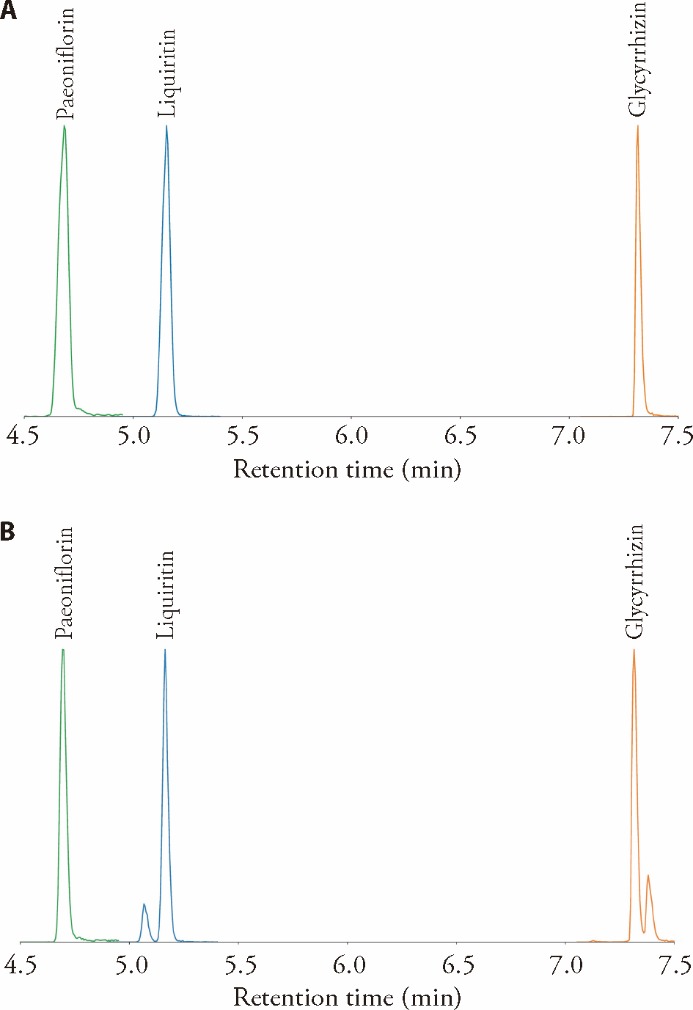
Figure 1 Total ion chromatogram of SGG A: the extracted ion flow chromatogram of the control; B: the extracted ion flow chromatogram of the samples, in which the retention time of paeoniflorin was 4.7 min, that of liquiritin was 5.16 min, and that of glycyrrhizin acid was 7.3 min. SGG: Shaoyao Gancao granule.
Figure 1 Total ion chromatogram of SGG A: the extracted ion flow chromatogram of the control; B: the extracted ion flow chromatogram of the samples, in which the retention time of paeoniflorin was 4.7 min, that of liquiritin was 5.16 min, and that of glycyrrhizin acid was 7.3 min. SGG: Shaoyao Gancao granule.
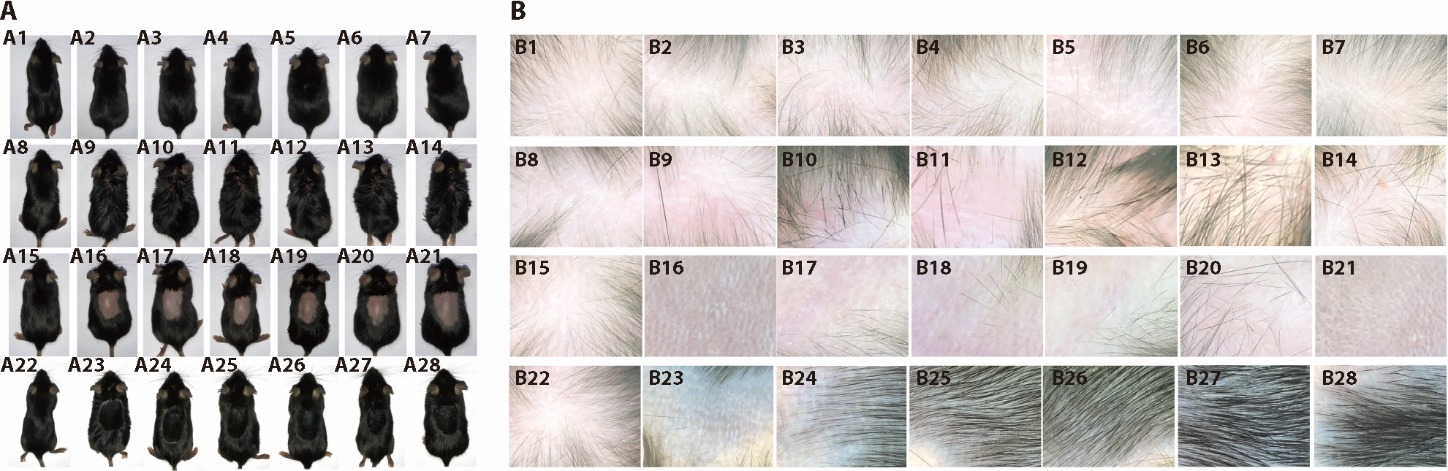
Figure 2 Overall and trichoscopic changes of hair in mice A: photographs of the backs of mice at different times in each group; B: trichoscopic photographs (× 30) of the backs of mice at different times in each group. A1-A7: Control group, Model group, SGL group, SGM group, SGH group, Antalarmin group, and CG group dorsal photographs on Day 1. A8-A14: Control group, Model group, SGL group, SGM group, SGH group, Antalarmin group, and CG group dorsal photographs on Day 7. A15-A21: Control group, Model group, SGL group, SGM group, SGH group, Antalarmin group, and CG group dorsal photographs on Day 10. A22-A28: Control group, Model group, SGL group, SGM group, SGH group, Antalarmin group, and CG group dorsal photographs on Day 24. B1-B7: Control group, Model group, SGL group, SGM group, SGH group, Antalarmin group, and CG group dorsal trichoscopic images on Day 1. B8-B14: Control group, Model group, SGL group, SGM group, SGH group, Antalarmin group, and CG group dorsal trichoscopic images on Day 7. B15-B21: Control group, Model group, SGL group, SGM group, SGH group, Antalarmin group, and CG group dorsal trichoscopic images on Day 10. B22-B28: Control group, Model group, SGL group, SGM group, SGH group, Antalarmin group, and CG group dorsal trichoscopic images on Day 24. Control group: no durg, no stress; Model group: IMQ + CUMS; CG group: IMQ + CUMS + CG (20 mg·kg-1·d-1, days 10-24); SGL group: IMQ + CUMS + SGL (1.95 g/kg, days 10-24); SGM group: IMQ + CUMS + SGM (3.9 g/kg, days 10-24); SGH group: IMQ + CUMS + SGH (7.8 g/kg, days 10-24); Antalarmin group: IMQ + CUMS + Antalarmin (20 mg/kg, days 17-24). IMQ: imiquimod; CUMS: chronic unpredictable mild stress: CG: compound glycyrrhizin; SGL: Shaoyao Gancao granule low dose; SGM: Shaoyao Gancao granule medium dose; SGH: Shaoyao Gancao granule high dose.
Figure 2 Overall and trichoscopic changes of hair in mice A: photographs of the backs of mice at different times in each group; B: trichoscopic photographs (× 30) of the backs of mice at different times in each group. A1-A7: Control group, Model group, SGL group, SGM group, SGH group, Antalarmin group, and CG group dorsal photographs on Day 1. A8-A14: Control group, Model group, SGL group, SGM group, SGH group, Antalarmin group, and CG group dorsal photographs on Day 7. A15-A21: Control group, Model group, SGL group, SGM group, SGH group, Antalarmin group, and CG group dorsal photographs on Day 10. A22-A28: Control group, Model group, SGL group, SGM group, SGH group, Antalarmin group, and CG group dorsal photographs on Day 24. B1-B7: Control group, Model group, SGL group, SGM group, SGH group, Antalarmin group, and CG group dorsal trichoscopic images on Day 1. B8-B14: Control group, Model group, SGL group, SGM group, SGH group, Antalarmin group, and CG group dorsal trichoscopic images on Day 7. B15-B21: Control group, Model group, SGL group, SGM group, SGH group, Antalarmin group, and CG group dorsal trichoscopic images on Day 10. B22-B28: Control group, Model group, SGL group, SGM group, SGH group, Antalarmin group, and CG group dorsal trichoscopic images on Day 24. Control group: no durg, no stress; Model group: IMQ + CUMS; CG group: IMQ + CUMS + CG (20 mg·kg-1·d-1, days 10-24); SGL group: IMQ + CUMS + SGL (1.95 g/kg, days 10-24); SGM group: IMQ + CUMS + SGM (3.9 g/kg, days 10-24); SGH group: IMQ + CUMS + SGH (7.8 g/kg, days 10-24); Antalarmin group: IMQ + CUMS + Antalarmin (20 mg/kg, days 17-24). IMQ: imiquimod; CUMS: chronic unpredictable mild stress: CG: compound glycyrrhizin; SGL: Shaoyao Gancao granule low dose; SGM: Shaoyao Gancao granule medium dose; SGH: Shaoyao Gancao granule high dose.
Table 1 Mouse body weight change graph (g, x - ± s)
| Group | n | Day 1 | Day 7 | Day 10 | Day 20 | Day 24 |
|---|---|---|---|---|---|---|
| Control | 10 | 17.5±0.8 | 18.6±1.0 | 18.8±0.9 | 19.0±1.1 | 19.4±0.7 |
| Model | 10 | 17.0±0.7 | 15.3±0.8 | 18.5±0.9 | 16.9±0.7 | 18.0±0.8 |
| SGL | 10 | 17.1±0.8 | 15.3±0.8 | 17.9±0.7 | 17.8±0.8 | 17.6±0.7 |
| SGM | 10 | 17.1±1.1 | 15.0±1.1 | 18.1±1.1 | 18.3±1.1 | 18.3±0.7 |
| SGH | 10 | 16.8±0.9 | 15.4±1.1 | 17.4±0.7 | 18.0±0.7 | 18.3±0.9 |
| Antalarmin | 10 | 17.5±1.0 | 15.2±1.2 | 18.2±1.2 | 17.0±0.9 | 17.9±1.2 |
| CG | 10 | 17.2±1.1 | 14.9±0.9 | 17.6±0.7 | 17.7±1.2 | 17.9±0.8 |
| P value | - | 0.555 | <0.001a | 0.01b | <0.001a | <0.001a |
Table 1 Mouse body weight change graph (g, x - ± s)
| Group | n | Day 1 | Day 7 | Day 10 | Day 20 | Day 24 |
|---|---|---|---|---|---|---|
| Control | 10 | 17.5±0.8 | 18.6±1.0 | 18.8±0.9 | 19.0±1.1 | 19.4±0.7 |
| Model | 10 | 17.0±0.7 | 15.3±0.8 | 18.5±0.9 | 16.9±0.7 | 18.0±0.8 |
| SGL | 10 | 17.1±0.8 | 15.3±0.8 | 17.9±0.7 | 17.8±0.8 | 17.6±0.7 |
| SGM | 10 | 17.1±1.1 | 15.0±1.1 | 18.1±1.1 | 18.3±1.1 | 18.3±0.7 |
| SGH | 10 | 16.8±0.9 | 15.4±1.1 | 17.4±0.7 | 18.0±0.7 | 18.3±0.9 |
| Antalarmin | 10 | 17.5±1.0 | 15.2±1.2 | 18.2±1.2 | 17.0±0.9 | 17.9±1.2 |
| CG | 10 | 17.2±1.1 | 14.9±0.9 | 17.6±0.7 | 17.7±1.2 | 17.9±0.8 |
| P value | - | 0.555 | <0.001a | 0.01b | <0.001a | <0.001a |
Table 2 OFT and FST of mice ( x - ± s)
| Group | n | Moving distance (m) | Upright number | Number of entries into central area | Swimming immobility time (s) |
|---|---|---|---|---|---|
| Control | 8 | 54.1±15.9a | 22.9±11.6a | 17.9±4.6b | 82.4±13.9b |
| Model | 8 | 33.4±5.8 | 8.0±4.6 | 5.5±1.9 | 135.7±15.8 |
| SGL | 8 | 39.3±8.1 | 8.5±3.0 | 9.1±4.2c | 93.8±9.6b |
| SGM | 8 | 53.2±5.2b | 17.6±4.7a | 12.1±2.2b | 86.2±25.6a |
| SGH | 8 | 52.6±16.1c | 20.6±3.9b | 16.5±2.9b | 88.5±17.3b |
| Antalarmin | 8 | 54.4±6.6b | 20.1±7.7a | 14.8±5.8a | 92.1±18.4b |
| CG | 8 | 48.5±8.9a | 15.9±4.2a | 13.9±3.4b | 99.1±19.0a |
Table 2 OFT and FST of mice ( x - ± s)
| Group | n | Moving distance (m) | Upright number | Number of entries into central area | Swimming immobility time (s) |
|---|---|---|---|---|---|
| Control | 8 | 54.1±15.9a | 22.9±11.6a | 17.9±4.6b | 82.4±13.9b |
| Model | 8 | 33.4±5.8 | 8.0±4.6 | 5.5±1.9 | 135.7±15.8 |
| SGL | 8 | 39.3±8.1 | 8.5±3.0 | 9.1±4.2c | 93.8±9.6b |
| SGM | 8 | 53.2±5.2b | 17.6±4.7a | 12.1±2.2b | 86.2±25.6a |
| SGH | 8 | 52.6±16.1c | 20.6±3.9b | 16.5±2.9b | 88.5±17.3b |
| Antalarmin | 8 | 54.4±6.6b | 20.1±7.7a | 14.8±5.8a | 92.1±18.4b |
| CG | 8 | 48.5±8.9a | 15.9±4.2a | 13.9±3.4b | 99.1±19.0a |
Table 3 Serum CRH, ACTH, and cortisol levels in mice ( x - ± s)
| Group | n | CRH | ACTH | Cortisol |
|---|---|---|---|---|
| Control | 6 | 75.0±8.4a | 61.2±6.8c | 9.5±1.2a |
| Model | 6 | 106.9±10.6 | 93.1±14.5 | 15.7±2.4 |
| SGL | 6 | 96.7±10.0 | 88.8±13.6 | 13.5±1.9 |
| SGM | 6 | 95.6±10.3 | 76.7±10.6b | 11.9±2.2b |
| SGH | 6 | 92.7±3.5b | 69.0±15.0b | 10.3±1.4c |
| Antalarmin | 6 | 88.1±13.9b | 68.1±15.6b | 10.9±2.5c |
| CG | 6 | 87.6±13.9b | 71.1±14.4b | 10.7±2.4c |
Table 3 Serum CRH, ACTH, and cortisol levels in mice ( x - ± s)
| Group | n | CRH | ACTH | Cortisol |
|---|---|---|---|---|
| Control | 6 | 75.0±8.4a | 61.2±6.8c | 9.5±1.2a |
| Model | 6 | 106.9±10.6 | 93.1±14.5 | 15.7±2.4 |
| SGL | 6 | 96.7±10.0 | 88.8±13.6 | 13.5±1.9 |
| SGM | 6 | 95.6±10.3 | 76.7±10.6b | 11.9±2.2b |
| SGH | 6 | 92.7±3.5b | 69.0±15.0b | 10.3±1.4c |
| Antalarmin | 6 | 88.1±13.9b | 68.1±15.6b | 10.9±2.5c |
| CG | 6 | 87.6±13.9b | 71.1±14.4b | 10.7±2.4c |
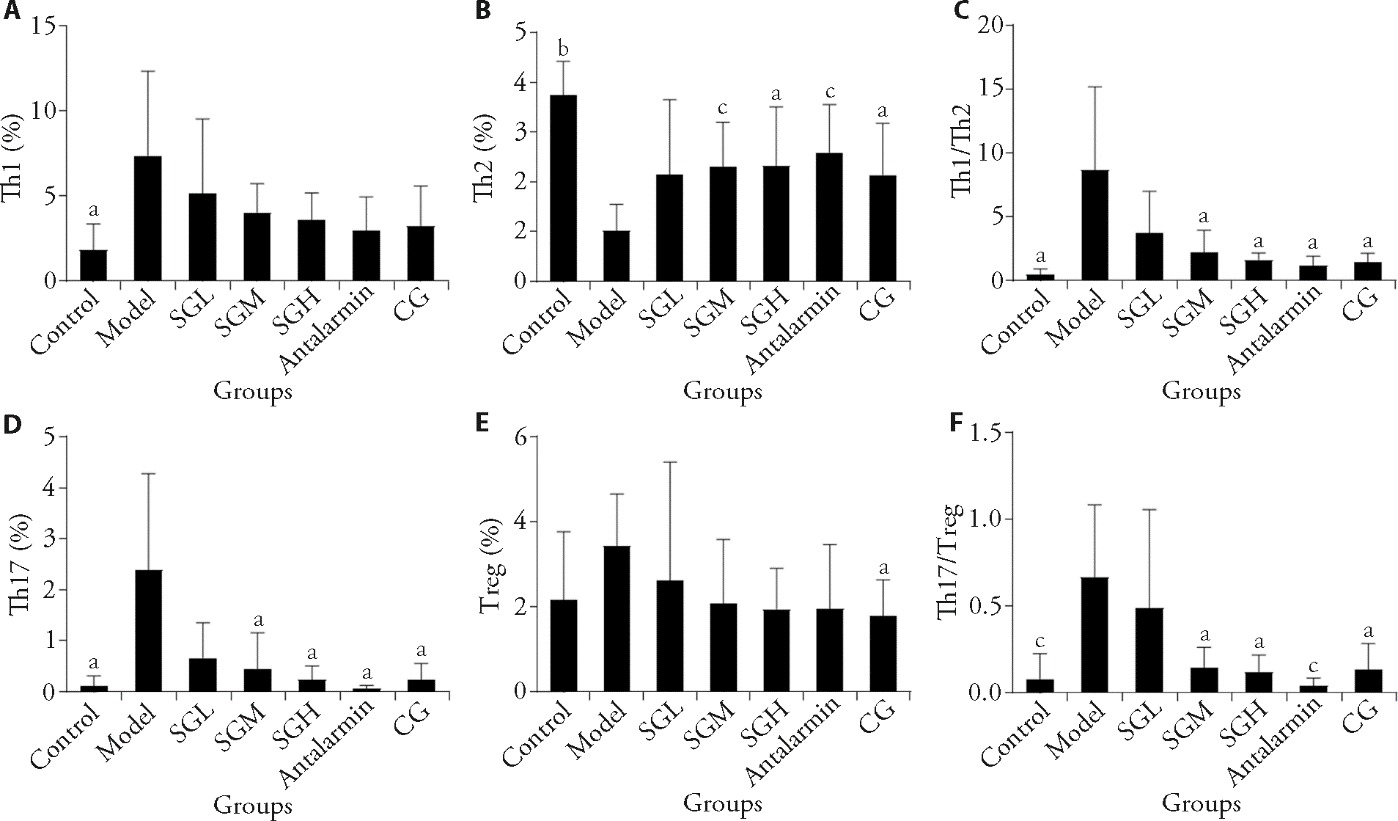
Figure 3 T cell differentiation of mice in each group A: differentiation of mouse peripheral blood Th1 cells; B: differentiation of mouse peripheral blood Th2 cells; C: mouse peripheral blood Th1/Th2 cell ratio; D: differentiation of mouse peripheral blood Th17 cells; E: differentiation of mouse peripheral blood Treg cells; F: mouse peripheral blood Th17/Treg cell ratio. Control group: no durg, no stress; Model group: IMQ + CUMS; CG group: IMQ + CUMS + CG (20 mg·kg-1·d-1, days 10-24); SGL group: IMQ + CUMS + SGL (1.95 g/kg, days 10-24); SGM group: IMQ + CUMS + SGM (3.9 g/kg, days 10-24); SGH group: IMQ + CUMS + SGH (7.8 g/kg, days 10-24); Antalarmin group: IMQ + CUMS + Antalarmin (20 mg/kg, days 17-24). IMQ: imiquimod; CUMS: chronic unpredictable mild stress: CG: compound glycyrrhizin; SGL: Shaoyao Gancao granule low dose; SGM: Shaoyao Gancao granule medium dose; SGH: Shaoyao Gancao granule high dose. Comparisons between multiple groups used one-way analysis of variance analysis. Data are presented as mean ± standard deviation (n = 6). Compared with the model group, aP < 0.05, bP < 0.001, cP < 0.01.
Figure 3 T cell differentiation of mice in each group A: differentiation of mouse peripheral blood Th1 cells; B: differentiation of mouse peripheral blood Th2 cells; C: mouse peripheral blood Th1/Th2 cell ratio; D: differentiation of mouse peripheral blood Th17 cells; E: differentiation of mouse peripheral blood Treg cells; F: mouse peripheral blood Th17/Treg cell ratio. Control group: no durg, no stress; Model group: IMQ + CUMS; CG group: IMQ + CUMS + CG (20 mg·kg-1·d-1, days 10-24); SGL group: IMQ + CUMS + SGL (1.95 g/kg, days 10-24); SGM group: IMQ + CUMS + SGM (3.9 g/kg, days 10-24); SGH group: IMQ + CUMS + SGH (7.8 g/kg, days 10-24); Antalarmin group: IMQ + CUMS + Antalarmin (20 mg/kg, days 17-24). IMQ: imiquimod; CUMS: chronic unpredictable mild stress: CG: compound glycyrrhizin; SGL: Shaoyao Gancao granule low dose; SGM: Shaoyao Gancao granule medium dose; SGH: Shaoyao Gancao granule high dose. Comparisons between multiple groups used one-way analysis of variance analysis. Data are presented as mean ± standard deviation (n = 6). Compared with the model group, aP < 0.05, bP < 0.001, cP < 0.01.
| 1. | Ito N, Ito T, Kromminga A, et al. Human hair follicles display a functional equivalent of the hypothalamic-pituitary-adrenal (HPA) axis and synthesize cortisol. Faseb J 2005; 19: 1332. |
| 2. | Lyu SY, Wang L, Duan YH, Huang D, Yang DQ. Prediction of the mechanism of Shaoyao Gancao decoction in the treatment of alopecia areata by network pharmacology and its preliminary verification study. Evid-based Complement Altern Med 2022; 2022: 13. |
| 3. | Xu C, Zhang QM, Xu MQ. Study on the relationship between liver controlling dispersion and neurodegenerative diseases based on psychological stress. Huan Qiu Zhong Yi Yao 2021; 14: 230-5. |
| 4. | Lu LL. Observation of the relationship between AA constitution theory of TCM and relative factors for AA, TCM syndrom and black dot sign. Nanjing: Nanjing University of Chinese Medicine, 2017: 1-55. |
| 5. | Zhang ZJ (Han dynasty). Shang Han Za Bing Lun. Beijing: People's Medical Publishing House, 2005: 31. |
| 6. | Qu YZ, Ma SJ, Zhu GW, et al. Historical evolution and modern research on Shaoyao Gancaotang. Zhong Guo Shi Yan Fang Ji Xue Za Zhi 2020; 26: 216-25. |
| 7. | He F, Xu JP, Yang MH, et al. Influence of Shaoyao Gancao decoction on ratio of Treg/Thl7 in rats with asthma. Zhong Hua Zhong Yi Yao Za Zhi 2016, 31: 4477-9. |
| 8. | Kim HS, Cho DH, Kim HJ, Lee JY, Cho BK, Park HJ. Immunoreactivity of corticotropin-releasing hormone, adreno-corticotropic hormone and alpha-melanocyte-stimulating hormone in alopecia areata. Exp Dermatol 2006; 15: 515-22. |
| 9. |
Zhang XQ, Yu M, Yu W, Weinberg J, Shapiro J, McElwee KJ. Development of alopecia areata is associated with higher central and peripheral hypothalamic-pituitary-adrenal tone in the skin graft induced C3H/HeJ mouse model. J Invest Dermatol 2009; 129: 1527-38.
DOI PMID |
| 10. |
Catania A, Gatti S, Colombo G, Lipton JM. Targeting melanocortin receptors as a novel strategy to control inflammation. Pharmacol Rev 2004; 56: 1-29.
DOI PMID |
| 11. | Zhang Y, Wen JH. Advances in experimental studies on the antidepressant effects and mechanisms of paeoniflorin. Yunnan Zhong Yi Zhong Yao Za Zhi 2018; 39: 78-81. |
| 12. | Wang CL, Wang LY, Wang JX, et al. Effects of albiflorin, paeoniflorin on the behavior and hypothalamic-pituitary-adrenal axis in depressed rats modelized by chronic restraint stress stimulation combined with isolation. Zhong Hua Zhong Yi Yao Za Zhi 2017; 32: 3121-5. |
| 13. | Yang DQ, Zheng JW, Zhang YM, Jin YL, Gan CN, Bai YP. Total glucosides of paeony capsule plus compound glycyrrhizin tablets for the treatment of severe alopecia areata in children: a randomized controlled trial. Evid-based Complement Altern Med 2013; 2013: 5. |
| 14. |
Slominski A. On the role of the corticotropin-releasing hormone signalling system in the aetiology of inflammatory skin disorders. Br J Dermatol 2009; 160: 229-32.
DOI PMID |
| 15. | Han YM, Sheng YY, Xu F, et al. Imbalance of T-helper 17 and regulatory T cells in patients with alopecia areata. J Dermatol 2015; 42: 981-8. |
| 16. | Chen JC, Lin R, Zhang YF, et al. Effect of Shaoyao Gancao decoction on inflammatory injury of posterior cervical muscle based on miR-146a regulation of NF-κB signaling pathway. Kang Fu Xue Bao 2020, 30: 206-11. |
| 17. | Cen ZJ, Deng GW, Xiong M. Effectiveness of supplemented Shaoyao Gancao decoction combined with conventional symp-tomatic treatment of atrophic gastritis and its effect on serum IL-6 and IL-17 expression levels. Neimenggu Zhong Yi Yao 2021, 40: 33-4. |
| 18. | Lu XY, Ren YW, Yang X, Zhang AH. Effects of modified Paeoniae-Glycyrrhizae decoction in the treatment of postherpetic neuralgia on pain, serum neuropeptide Y and substance P levels. Hainan Yi Xue 2021; 32: 31-4. |
| 19. | Qin CF. Clinical and immunological mechanism study of Shaoyao Gancao granule in the treatment of severe alopecia areata. Beijing: Beijing University of Chinese Medicine 2020: 1-64. |
| 20. | Wang SD. Clinical study on the treatment of severe alopecia areata with Shaoyao Gancao granule. Beijing: Beijing University of Chinese Medicine 2018: 1-63. |
| [1] | SHAN Wenjun, GU Haowen, GUAN Haiyu, LI Ping, WANG Yi, HAN Miaoru, WANG Houchun, HUANG Xiaoyan, BAO Kun. Dampness syndrome aggravates T helper 17/regulatory T imbalance to promote renal injury in rats with experimental membranous nephropathy [J]. Journal of Traditional Chinese Medicine, 2025, 45(5): 1028-1039. |
| [2] | NI Shuang, LIU Xiaofei, GUO Xiaoyan, GU Zuxi, WU Panqing, CONG Chao, LI Shengnan, GAO Xianwei, XU Lianwei. Mechanism of Tiaogeng decoction (调更汤) in a cognitive dysfunction mouse model [J]. Journal of Traditional Chinese Medicine, 2025, 45(5): 987-997. |
| [3] | DU Haixia, QIU Chuan, MA Yanpeng, PAN Shuo, WANG Xiqiang, WANG Junkui, LIU Zhongwei. Matrine alleviates coronary microvascular dysfunction in ischemia with non-obstructive coronary artery disease mice induced by advanced glycation end products via inhibition of the reactive oxygen species-mediated endoplasmic reticulum stress in cardiac microvascular endothelial cells [J]. Journal of Traditional Chinese Medicine, 2025, 45(3): 473-484. |
| [4] | LIU Xiaoyao, LI Jialin, WANG Weiling, FAN Qiongyin, SU Zeqi, HE Cheng, WANG Chunguo, GAO Jian, WANG Ting. Pharmacological effect and possible mechanism of Mudan Huaban recipe (牡丹化斑方) on melasma in mice induced by ultraviolet B and progesterone [J]. Journal of Traditional Chinese Medicine, 2025, 45(3): 518-527. |
| [5] | XU Bojun, TAO Tian, ZHAO Liangbin, ZHENG Hui, ZHAN huakui, GUO Julan. Bushen Tongluo recipe (补肾通络方) improves oxidative stress homeostasis, inhibits transforming growth factor/Notch signaling pathway, and regulates the lncRNA maternally expressed gene 3/miR-145 axis to delay diabetic kidney disease [J]. Journal of Traditional Chinese Medicine, 2025, 45(3): 561-570. |
| [6] | LI Yongfeng, CHEN Xinyi, REN Wei, QIAO Haifa. Electroacupuncture stimulation of auricular concha region improves loss of control over stress induced depression-like behavior by modulating 5-hydroxytryptamine 1A receptor [J]. Journal of Traditional Chinese Medicine, 2025, 45(2): 326-334. |
| [7] | ZHENG Peng, MENG Ying, LIU Meijun, YU Di, LIU Huiying, WANG Fuchun, XU Xiaohong. Electroacupuncture inhibits hippocampal oxidative stress and autophagy in sleep-deprived rats through the protein kinase B and mechanistic target of rapamycin signaling pathway [J]. Journal of Traditional Chinese Medicine, 2024, 44(5): 974-980. |
| [8] | LIU Tongtong, ZHANG Xi, YANG Hui, LIN Xiaoyuan, LIU Jian, ZHANG Xiuli, GUO Dongwei, ZHAO Hongqing, ZOU Manshu, LEI Chang, LONG Hongping, LUO Yan, XIANG Yun, GE Jinwen, WANG Yuhong, MENG Pan. Luteolin promotes neuronogenesis in hippocampus of chronic unpredictable mild stress rats and primary hippocampus of fetal rats [J]. Journal of Traditional Chinese Medicine, 2024, 44(4): 670-679. |
| [9] | Zubaria Tul Ain, Iram Fatima, Sana Naseer, Sobia Kanwal, Tariq Mahmood. Assessment of phytochemicals, antioxidant, anti-hemolytic, anti-inflammatory and anti-cancer potential of flowers, leaves and stem extracts of Rosa arvensis [J]. Journal of Traditional Chinese Medicine, 2024, 44(4): 804-812. |
| [10] | CHEN Youlan, DING Mingming, HUANG Chaoyuan, ZHENG Yiyuan, LIU Fengbin. Chang'an decoction (肠安方) alleviates endoplasmic reticulum stress by regulating mitofusin 2 to improve colitis [J]. Journal of Traditional Chinese Medicine, 2024, 44(3): 427-436. |
| [11] | YU Zhengqiu, YU Liuda, CHEN Ye, LI Mingjing, CAI Wanru. Effectiveness and safety of Qidong Huoxue decoction (芪冬活血饮) in treatment of acute lung injury and acute respiratory distress syndrome: a randomized, controlled trial [J]. Journal of Traditional Chinese Medicine, 2024, 44(2): 381-387. |
| [12] | HUANG Hongmei, YANG Maojun, LI Ting, WANG Dandan, LI Ying, TANG Xiaochi, YUAN Lu, GU Shi, XU Yong. Neferine inhibits the progression of diabetic nephropathy by modulating the miR-17-5p/nuclear factor E2-related factor 2 axis [J]. Journal of Traditional Chinese Medicine, 2024, 44(1): 44-53. |
| [13] | ZHANG Xiaoying, WANG Ruixuan, WANG Yiqing, XU Fanxing, YAN Tingxu, WU Bo, ZHANG Ming, JIA Ying. Spinosin protects Neuro-2a/APP695 cells from oxidative stress damage by inactivating p38 [J]. Journal of Traditional Chinese Medicine, 2023, 43(5): 868-875. |
| [14] | LIU Bingbing, LI Jieru, SI Jianchao, CHEN Qi, YANG Shengchang, JI Ensheng. Ginsenoside Rb1 alleviates chronic intermittent hypoxia-induced diabetic cardiomyopathy in db/db mice by regulating the adenosine monophosphate-activated protein kinase/Nrf2/heme oxygenase-1 signaling pathway [J]. Journal of Traditional Chinese Medicine, 2023, 43(5): 906-914. |
| [15] | ZHOU Hua, LI Hui, WANG Haihua. Potential protective effects of the water-soluble Chinese propolis on experimental ulcerative colitis [J]. Journal of Traditional Chinese Medicine, 2023, 43(5): 925-933. |
| Viewed | ||||||
|
Full text |
|
|||||
|
Abstract |
|
|||||
