
Journal of Traditional Chinese Medicine ›› 2025, Vol. 45 ›› Issue (5): 1067-1077.DOI: 10.19852/j.cnki.jtcm.2025.05.013
• Original Articles • Previous Articles Next Articles
Mechanisms of Baishao (Radix Paeoniae Alba) and Gancao (Radix Glycyrrhizae) on major depressive disorder: network pharmacology and in vivo validation
PEI Ke1, LI Yong1, LIN Zhe1( ), LYU Guangfu2()
- 1 School of Pharmaceutical Sciences, Changchun University of Chinese Medicine, Changchun 130117, China
2 Jilin Ginseng Academy, Changchun University of Chinese Medicine, Changchun 130117, China
-
Received:2024-10-12Accepted:2025-01-25Online:2025-10-15Published:2025-09-15 -
Contact:Prof. LIN Zhe, School of Pharmaceutical Sciences, Changchun University of Chinese Medicine, Changchun 130117, China. linzhe1228@163.com;
LYU Guangfu, Jilin Ginseng Academy, Changchun University of Chinese Medicine, Changchun 130117, China. lvgf@ccucm.edu.cn,Telephone: +86-10-86172208; +86-18626609676 -
Supported by:Jilin Provincial Department of Science and Technology project: Exploring the Material Basis and Action Pathways of Baihu Tang's Antipyretic Effect based on Omics Technology(20240602036RC)

Cite this article
PEI Ke, LI Yong, LIN Zhe, LYU Guangfu. Mechanisms of Baishao (Radix Paeoniae Alba) and Gancao (Radix Glycyrrhizae) on major depressive disorder: network pharmacology and in vivo validation[J]. Journal of Traditional Chinese Medicine, 2025, 45(5): 1067-1077.
share this article

Figure 1 Network pharmacological results A: volcanic map of the GEO differential gene in patients with MDD; B: venny diagram of APR-GR against MDD; C: network topology results; D: drug-ingredient-target-disease network diagram; F: GO enrichment analysis scatter diagram; G: relationship between pathways and proteins. MDD: Major depressive disorder; GEO: Gene Expression Omnibus; GO: Gene Ontology; APR-GR: Baishao (Radix Paeoniae Alba) and Gancao (Radix Glycyrrhizae).
Figure 1 Network pharmacological results A: volcanic map of the GEO differential gene in patients with MDD; B: venny diagram of APR-GR against MDD; C: network topology results; D: drug-ingredient-target-disease network diagram; F: GO enrichment analysis scatter diagram; G: relationship between pathways and proteins. MDD: Major depressive disorder; GEO: Gene Expression Omnibus; GO: Gene Ontology; APR-GR: Baishao (Radix Paeoniae Alba) and Gancao (Radix Glycyrrhizae).

Figure 2 Molecular docking pattern results A: docking model of mairin with ADRA1A; B: docking model of mairin with ADRA1B; C: docking model of mairin with ADRB2; D: docking model of mairin with CHRM1; E: docking model of mairin with CHRM2. F: docking model of mairin with SLC6A4. CHRM1: muscarinic acetylcholine receptor M1; CHRM2: muscarinic acetylcholine receptor M2; ADRA1A: adrenergic a1A receptor; ADRB2: β-2 adrenergic receptor; SLC6A4: serotonin transporter; ADRA1B: adrenergic a1B receptor.
Figure 2 Molecular docking pattern results A: docking model of mairin with ADRA1A; B: docking model of mairin with ADRA1B; C: docking model of mairin with ADRB2; D: docking model of mairin with CHRM1; E: docking model of mairin with CHRM2. F: docking model of mairin with SLC6A4. CHRM1: muscarinic acetylcholine receptor M1; CHRM2: muscarinic acetylcholine receptor M2; ADRA1A: adrenergic a1A receptor; ADRB2: β-2 adrenergic receptor; SLC6A4: serotonin transporter; ADRA1B: adrenergic a1B receptor.
Table 1 Molecular docking results of the main active ingredient with the core target
| Target | Sitosterol | Mairin (KJ/mol) |
|---|---|---|
| ADRA1A | -12.53 | -11.93 |
| SLC6A4 | -11.24 | -10.94 |
| ADRB2 | -10.87 | -10.07 |
| ADRA1B | -9.37 | -9.84 |
| CHRM1 | -8.56 | -8.88 |
| CHRM2 | -7.17 | -8.97 |
Table 1 Molecular docking results of the main active ingredient with the core target
| Target | Sitosterol | Mairin (KJ/mol) |
|---|---|---|
| ADRA1A | -12.53 | -11.93 |
| SLC6A4 | -11.24 | -10.94 |
| ADRB2 | -10.87 | -10.07 |
| ADRA1B | -9.37 | -9.84 |
| CHRM1 | -8.56 | -8.88 |
| CHRM2 | -7.17 | -8.97 |

Figure 3 Behavioral test results and hippocampal morphology results A: effect of APR-GR on sugar water preference; B: OFT movement trajectory diagram; B1: control group; B2: model group; B3: APR-GR group; C: OFT results; C1: effect of APR-GR on center residence time; C2: effect of APR-GR on corner residence time; C3: effect of APR-GR ontotal travel distance; D: MWM, TST and FST experimental results. D1: effect of APR-GR in TST; D2: effect of APR-GR in FST; D3: effect of APR-GR incubation period in MWM; D4: effect of APR-GR movement in MWM; E: MWM movement trajectory diagram; E1: control group; E2: model group; E3: APR-GR group; F: mouse hippocampus pathological sections (× 200); F1: control group; B2: model group; B3: APR-GR group; control group: drink and eat freely + the same volume of normal saline was given by gavage, model group: chronic unpredictable mild stress, APR-GR: model group + APR-GR (1.5 g·kg-1·d-1). TST: tail suspension test; FST: forced swimming test; MWM: morris water maze; OFT: open field test; APR-GR: Baishao (Radix Paeoniae Alba) and Gan Cao (Radix Glycyrrhizae). Data are presented as mean ± standard deviation (n = 10) and analyzed using the t-test statistical method; aP < 0.01, compared with the control group; bP < 0.01, compared with the model group.
Figure 3 Behavioral test results and hippocampal morphology results A: effect of APR-GR on sugar water preference; B: OFT movement trajectory diagram; B1: control group; B2: model group; B3: APR-GR group; C: OFT results; C1: effect of APR-GR on center residence time; C2: effect of APR-GR on corner residence time; C3: effect of APR-GR ontotal travel distance; D: MWM, TST and FST experimental results. D1: effect of APR-GR in TST; D2: effect of APR-GR in FST; D3: effect of APR-GR incubation period in MWM; D4: effect of APR-GR movement in MWM; E: MWM movement trajectory diagram; E1: control group; E2: model group; E3: APR-GR group; F: mouse hippocampus pathological sections (× 200); F1: control group; B2: model group; B3: APR-GR group; control group: drink and eat freely + the same volume of normal saline was given by gavage, model group: chronic unpredictable mild stress, APR-GR: model group + APR-GR (1.5 g·kg-1·d-1). TST: tail suspension test; FST: forced swimming test; MWM: morris water maze; OFT: open field test; APR-GR: Baishao (Radix Paeoniae Alba) and Gan Cao (Radix Glycyrrhizae). Data are presented as mean ± standard deviation (n = 10) and analyzed using the t-test statistical method; aP < 0.01, compared with the control group; bP < 0.01, compared with the model group.
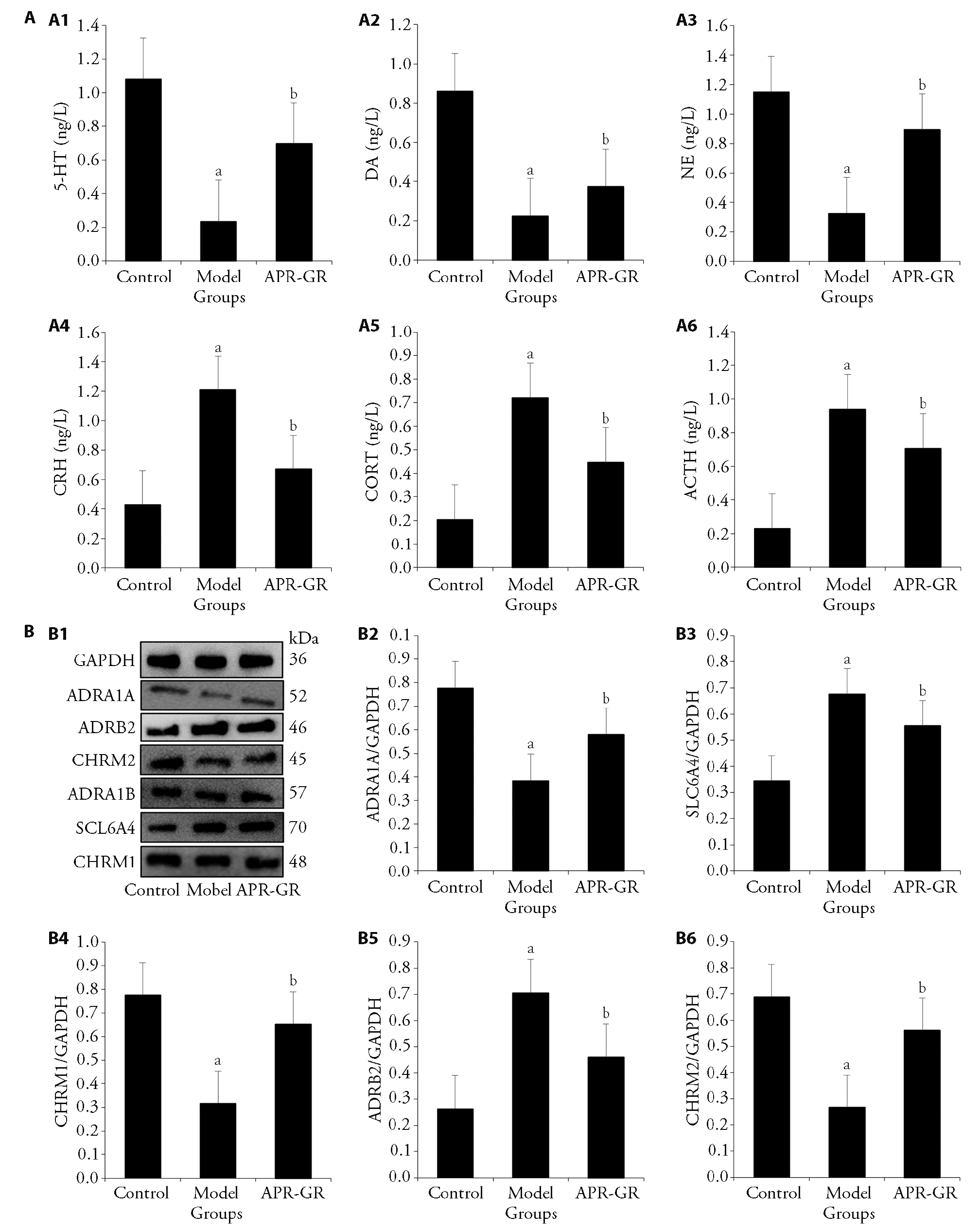
Figure 4 biochemical indicator results and the expression of related proteins in brain A: effects on biochemical indicators in brain. A1: effects of APR-GR on the levels of 5-HT in brain; A2: effects of APR-GR on the levels of DA in brain; A3: effects of APR-GR on the levels of NE in brain; B: effects on biochemical indicators in serum. B1: effect of APR-GR in serum CRH levels; B2: effect of APR-GR in serum ACTH levels; B3: effect of APR-GR in serum CORT levels; C: Western blot result. C1: correlated protein band diagram; C2: effect of APR-GR on ADRA1A expression; C3: effect of APR-GR on SLC6A expression; C4: effect of APR-GR on CHRM1 expression; C5: effect of APR-GR on ADRB2 expression; C5: effect of APR-GR on CHRM2 expression; control group: drink and eat freely + the same volume of normal saline was given by gavage, model group: chronic unpredictable mild stress, APR-GR: model group + APR-GR (1.5 g·kg-1·d-1); ACTH: adreno cortico tropic hormone, CORT: corticosterone; CRH: corticotropin releasing hormone; 5-HT: 5-hydroxytryptamine; DA: dopamine; NE: norepinephrine; CHRM1: muscarinic acetylcholine receptor M1; CHRM2: muscarinic acetylcholine receptor M2; ADRA1A: adrenergic a1A receptor; ADRB2: β-2 adrenergic receptor; SLC6A4: serotonin transporter; APR-GR: Baishao (Radix Paeoniae Alba) and Gan Cao (Radix Glycyrrhizae). Data are presented as mean ± standard deviation (n = 10) and analyzed using the t-test statistical method. aP ≤ 0.01, compared with the control group; bP ≤ 0.01, compared with the model group.
Figure 4 biochemical indicator results and the expression of related proteins in brain A: effects on biochemical indicators in brain. A1: effects of APR-GR on the levels of 5-HT in brain; A2: effects of APR-GR on the levels of DA in brain; A3: effects of APR-GR on the levels of NE in brain; B: effects on biochemical indicators in serum. B1: effect of APR-GR in serum CRH levels; B2: effect of APR-GR in serum ACTH levels; B3: effect of APR-GR in serum CORT levels; C: Western blot result. C1: correlated protein band diagram; C2: effect of APR-GR on ADRA1A expression; C3: effect of APR-GR on SLC6A expression; C4: effect of APR-GR on CHRM1 expression; C5: effect of APR-GR on ADRB2 expression; C5: effect of APR-GR on CHRM2 expression; control group: drink and eat freely + the same volume of normal saline was given by gavage, model group: chronic unpredictable mild stress, APR-GR: model group + APR-GR (1.5 g·kg-1·d-1); ACTH: adreno cortico tropic hormone, CORT: corticosterone; CRH: corticotropin releasing hormone; 5-HT: 5-hydroxytryptamine; DA: dopamine; NE: norepinephrine; CHRM1: muscarinic acetylcholine receptor M1; CHRM2: muscarinic acetylcholine receptor M2; ADRA1A: adrenergic a1A receptor; ADRB2: β-2 adrenergic receptor; SLC6A4: serotonin transporter; APR-GR: Baishao (Radix Paeoniae Alba) and Gan Cao (Radix Glycyrrhizae). Data are presented as mean ± standard deviation (n = 10) and analyzed using the t-test statistical method. aP ≤ 0.01, compared with the control group; bP ≤ 0.01, compared with the model group.
| 1. |
Sousa GM Júnior, Vargas HDQ, Barbosa FF, Galvão-Coelho NL. Stress, memory, and implications for major depression. Behav Brain Res 2021; 412: 113410.
DOI PMID |
| 2. | Li XY, Yan YH, Jian S, et al. Effectiveness and safety of Jiawei Xiaoyao pill in the treatment of premenstrual syndrome (liver depression, spleen deficiency, and blood-heat syndrome): a multi-center, randomized, placebo-controlled trial. J Tradit Chin Med 2024; 44: 373-80. |
| 3. |
Evans-Lacko S, Aguilar-Gaxiola S, Al-Hamzawi A, et al. Socio-economic variations in the mental health treatment gap for people with anxiety, mood, and substance use disorders: results from the WHO World Mental Health (WMH) surveys. Psychol Med 2018; 48: 1560-71.
DOI PMID |
| 4. | Mekonen T, Chan GCK, Connor JP, Hides L, Leung J. Estimating the global treatment rates for depression: a systematic review and meta-analysis. J Affect Disord 2021; 295: 1234-42. |
| 5. |
Cipriani A, Furukawa TA, Salanti G, et al. Comparative efficacy and acceptability of 21 antidepressant drugs for the acute treatment of adults with major depressive disorder: a systematic review and network Meta-analysis. Lancet 2018; 391: 1357-66.
DOI PMID |
| 6. |
Shamabadi A, Akhondzadeh S. Advances in alternative and integrative medicine in the treatment of depression: a review of the evidence. Arch Iran Med 2021; 24: 409-18.
DOI PMID |
| 7. | Pan HT, Xi ZQ, Wei XQ, Wang K. Ramulus Cinnamomi (cassiae) -Paeonia lactiflora a network pharmacology approach to predict potential targets and mechanisms of "herb pair" in the treatment of chronic pain with comorbid anxiety and depression. Ann Med 2022; 54: 413-25. |
| 8. | Zhang ZJ (Eastern Han Dynasty). Shang Han Lun. Beijing: People's Medical Publishing House, 2023; 148. |
| 9. | Hu PH, Zhang YL, Zhong XM, Qiu FM, Huang Z. Study on the medication rules of Traditional Chinese Medicine in treating depression. Pharmocol Clin Chin Mater Med 2020; 36: 210-5. |
| 10. | Fan ZZ, Zhao WH, Guo J, et al. Antidepressant activities of flavonoids from Glycyrrhiza uralensis and its neurogenesis protective effect in rats. Yao Xue Xue Bao 2012; 47: 1612-7. |
| 11. |
Wang YQ, Zhang WB, Wang YX, et al. Traditional chinese medicine constitution among patients with allergic rhinitis and its correlation with anxiety and depression. J Tradit Chin Med 2023; 43: 1252-8.
DOI |
| 12. | Zhuang W, Liu SL, Xi SY, et al. Traditional chinese medicine decoctions and chinese patent medicines for the treatment of depression: efficacies and mechanisms. J Ethnopharmacol 2023; 116272. |
| 13. |
Guo C, Tang QW, Yi HY, Bao YT, Wang JM. Network Meta-analysis of the clinical efficacy and safety of kidney-tonifying and bone-strengthening therapies for the treatment of rheumatoid arthritis with kidney deficiency type. J Tradit Chin Med 2024; 44: 1067-81.
DOI |
| 14. | Yin QJ, Yang DD, Wang H, et al. Uncovering the action mechanism of Shenqi Tiaoshen formula in the treatment of chronic obstructive pulmonary disease through network pharmacology, molecular docking, and experimental verification. J Tradit Chin Med 2024; 44: 770-83. |
| 15. | Xiao X, Zhang H, Ning W, Yang Z, Wang Y, Zhang T. Knockdown of FSTL1 inhibits microglia activation and alleviates depressive-like symptoms through modulating TLR4/MyD88/NF-κB pathway in CUMS mice. Exp Neurol 2022; 353: 114060. |
| 16. | Yin CY, Li LD, Xu C, et al. A novel method for automatic pharmacological evaluation of sucrose preference change in depression mice. Pharmacol Res 2021; 168: 105601. |
| 17. |
Meng YX, Li XJ, Wang XT, Zhang L, Guan JQ. Network pharmacological prediction and molecular docking analysis of the combination of Atractylodes macrocephala Koidz. and Paeonia lactiflora Pall. in the treatment of functional constipation and its verification. Animal Model Exp Med 2022; 5: 120-32.
DOI PMID |
| 18. | Zhang JC, Yao W, Ren Q, et al. Depression-like phenotype by deletion of α7 nicotinic acetylcholine receptor: role of BDNF-TrkB in nucleus accumbens. Sci Rep 2016; 6: 36705. |
| 19. | Othman MZ, Hassan Z, Che HAT. Morris water maze: a versatile and pertinent tool for assessing spatial learning and memory. Exp Anim 2022; 71: 264-80. |
| 20. | Chmielarz P, Kuśmierczyk J, Rafa-Zabłocka K, et al. Antidepressants differentially regulate intracellular signaling from α1-adrenergic receptor subtypes in vitro. Int J Mol Sci 2021; 22: 2-18. |
| 21. |
Schiele MA, Zwanzger P, Schwarte K, Arolt V, Baune BT, Domschke K. Serotonin transporter gene promoter hypomethylation as a predictor of antidepressant treatment response in major depression: a replication study. Int J Neuropsychopharmacol 2021; 24: 191-99.
DOI PMID |
| 22. |
Dean B, Scarr E. Possible involvement of muscarinic receptors in psychiatric disorders: a focus on schizophrenia and mood disorders. Curr Mol Med 2015; 15: 253-64.
PMID |
| 23. | Ślifirski G, Król M, Turło J. 5-HT receptors and the development of new antidepressants. Int J Mol Sci 2021; 22: 2-31. |
| 24. | Wu Z, Xiao L, Wang H, Wang G. Neurogenic hypothesis of positive psychology in stress-induced depression: adult hippocampal neurogenesis, neuroinflammation, and stress resilience. Int Immunopharmacol 2021; 97: 107653. |
| 25. | Kim IB, Park SC. The entorhinal cortex and adult neurogenesis in major depression. Int J Mol Sci 2021; 22: 11725. |
| 26. | Söğütlü L, Alaca N. The relationship between subjective memory complaints and objective memory performance, depression and anxiety levels in patients under 55 years of age. Turk Psikiyatri Derg 2019; 30: 16-22. |
| 27. | Alexopoulos GS, Murphy CF, Gunning-Dixon FM, et al. Serotonin transporter polymorphisms, microstructural white matter abnormalities and remission of geriatric depression. J Affect Disord 2009; 119: 132-41. |
| 28. |
Ciufolini S, Dazzan P, Kempton MJ, Pariante C, Mondelli V. HPA axis response to social stress is attenuated in schizophrenia but normal in depression: evidence from a Meta-analysis of existing studies. Neurosci Biobehav Rev 2014; 47: 359-68.
DOI PMID |
| 29. |
Navarria A, Wohleb ES, Voleti B, et al. Rapid antidepressant actions of scopolamine: role of medial prefrontal cortex and M1-subtype muscarinic acetylcholine receptors. Neurobiol Dis 2015; 82: 254-261.
DOI PMID |
| 30. | Gibbons AS, Scarr E, McLean C, Sundram S, Dean B. Decreased muscarinic receptor binding in the frontal cortex of bipolar disorder and major depressive disorder subjects. J Affect Disord 116; 2009: 184-91. |
| 31. |
Liu S, Xiu J, Zhu C, et al. Fat mass and obesity-associated protein regulates RNA methylation associated with depression-like behavior in mice. Nat Commun 2021; 12: 6937.
DOI PMID |
| 32. |
Du LJ, Zhang XN, Li SS, et al. Network pharmacological investigation into the mechanism of Kaixinsan powder for the treatment of depression. Metab Brain Dis 2022; 37: 2903-14.
DOI PMID |
| 33. | He H, Guo J, Hu Y, et al. Saikosaponin D reverses epinephrine- and norepinephrine-induced gemcitabine resistance in intrahepatic cholangiocarcinoma by downregulating ADRB2/glycolysis signaling. Acta Biochim Biophys Sin (Shanghai) 2023; 55: 1404-14. |
| 34. | Marinho AMDN, Lobão-Soares B, Targino HAS, Vasconcellos YJF, Guarnieri R, Carlotti CG Jr. Decreased hippocampal serotonin 5HT(1A) expression in mesial temporal lobe of epilepsy patients. Epilepsy Behav 2022; 129: 108574. |
| Viewed | ||||||
|
Full text |
|
|||||
|
Abstract |
|
|||||