
Journal of Traditional Chinese Medicine ›› 2025, Vol. 45 ›› Issue (4): 867-872.DOI: 10.19852/j.cnki.jtcm.2025.04.016
• Original Articles • Previous Articles Next Articles
Novel insight into the site-specificity of Hegu (LI4): morphological, biomechanical, and histological analyses
Kanae Umemoto1( ), SHAN Xiyao1, Takuro Ishikawa1, Tadashi Watsuji2, Yasuharu Watanabe2, Munekazu Naito1
- 1 Department of Anatomy, Aichi Medical University School of Medicine, Aichi 480-1195, Japan
2 Department of Health Promoting and Preventive Medicine, Meiji University of Integrative Medicine, Kyoto 629-0301, Japan
-
Received:2024-05-16Accepted:2024-10-11Online:2025-07-25Published:2025-07-25 -
Contact:Kanae Umemoto -
About author:Kanae Umemoto, Department of Anatomy, Aichi Medical University School of Medicine, Aichi 480-1195, Japan. kanaeteru13@yahoo.co.jp,Telephone: +81-561-62-3311

Cite this article
Kanae Umemoto, SHAN Xiyao, Takuro Ishikawa, Tadashi Watsuji, Yasuharu Watanabe, Munekazu Naito. Novel insight into the site-specificity of Hegu (LI4): morphological, biomechanical, and histological analyses[J]. Journal of Traditional Chinese Medicine, 2025, 45(4): 867-872.
share this article
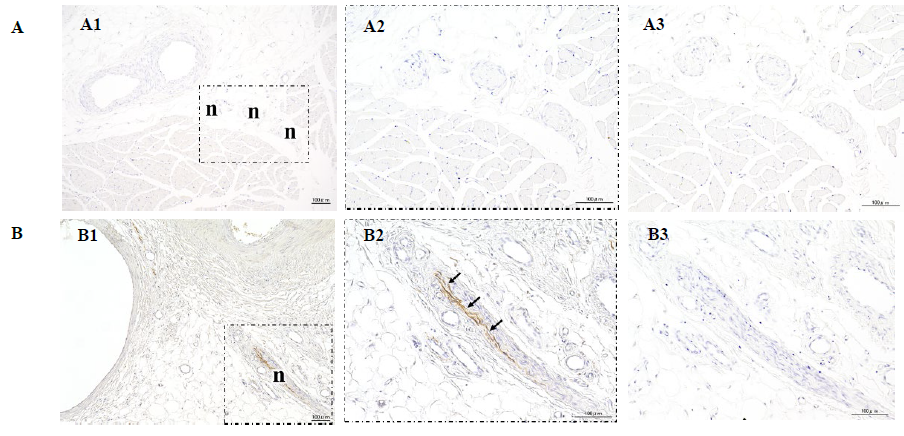
Figure 1 Nerve adjacent to the artery (tyrosine hydroxylase immunohistochemistry) A: histological analysis of nerve fibers under Hegu (LI4)-D by tyrosine hydroxylase immunohistochemistry staining (scale bar = 100 μm); A1: nerve fibers of the nerve adjacent to the artery under Hegu (LI4)-D; A2: enlarged photograph of the dotted rectangle in A1. Sympathetic fibers were little present in the nerve; A3: negative control shows absence of tyrosine hydroxylase antibody. B: histological analysis of nerve fibers under Hegu (LI4)-P by tyrosine hydroxylase immunohistochemistry staining (Scale bar = 100 μm); B1: nerve fibers of the nerve adjacent to the artery under Hegu (LI4)-P. Sympathetic fibers were present in the nerve. Brown dots are sympathetic fibers; B2: enlarged photograph of the dotted rectangle in B1. Black arrowheads also indicate sympathetic fibers; B3: negative control shows absence of tyrosine hydroxylase antibody; n: nerve fibers of the nerve adjacent to the artery.
Figure 1 Nerve adjacent to the artery (tyrosine hydroxylase immunohistochemistry) A: histological analysis of nerve fibers under Hegu (LI4)-D by tyrosine hydroxylase immunohistochemistry staining (scale bar = 100 μm); A1: nerve fibers of the nerve adjacent to the artery under Hegu (LI4)-D; A2: enlarged photograph of the dotted rectangle in A1. Sympathetic fibers were little present in the nerve; A3: negative control shows absence of tyrosine hydroxylase antibody. B: histological analysis of nerve fibers under Hegu (LI4)-P by tyrosine hydroxylase immunohistochemistry staining (Scale bar = 100 μm); B1: nerve fibers of the nerve adjacent to the artery under Hegu (LI4)-P. Sympathetic fibers were present in the nerve. Brown dots are sympathetic fibers; B2: enlarged photograph of the dotted rectangle in B1. Black arrowheads also indicate sympathetic fibers; B3: negative control shows absence of tyrosine hydroxylase antibody; n: nerve fibers of the nerve adjacent to the artery.
Table 1 Test-retest reliability for mechanical properties of Hegu (LI4)-D and Hegu (LI4)-P
| Item | AP | T1 ($\bar{x} \pm s$ ) | T2 ($\bar{x} \pm s$ ) | Average of T1 and T2 | ICC | 95% CI | SEM |
|---|---|---|---|---|---|---|---|
| Tone (Hz) | LI4-D | 16.74±2.14 | 16.82±2.01 | 16.78±2.06 | 0.96 | 16.32, 17.24 | 0.02 |
| LI4-P | 19.72±3.07 | 19.61±2.81 | 19.66±2.90 | 0.93 | 19.01, 20.32 | 0.03 | |
| Stiffness (N/m) | LI4-D | 303.40±73.60 | 329.00±74.93 | 326.20±73.65 | 0.97 | 309.8, 342.6 | 0.02 |
| LI4-P | 475.83±101.47 | 474.53±108.98 | 475.18±103.56 | 0.94 | 451.9, 498.5 | 0.03 | |
| Elasticity | LI4-D | 1.26±0.21 | 1.29±0.24 | 1.28±0.22 | 0.93 | 1.23, 1.32 | 0.03 |
| LI4-P | 1.45±0.21 | 1.42±0.18 | 1.43±0.19 | 0.81 | 1.39, 1.48 | 0.05 | |
| Relaxation (ms) | LI4-D | 15.18±1.87 | 15.11±1.86 | 15.14±1.85 | 0.96 | 14.73, 15.56 | 0.02 |
| LI4-P | 11.88±2.13 | 12.08±2.05 | 11.98±2.04 | 0.90 | 11.52, 12.44 | 0.03 | |
| Creep | LI4-D | 0.93±0.09 | 0.93±0.09 | 0.93±0.09 | 0.92 | 0.91, 0.95 | 0.03 |
| LI4-P | 0.76±0.12 | 0.78±0.11 | 0.77±0.11 | 0.82 | 0.75, 0.80 | 0.04 |
Table 1 Test-retest reliability for mechanical properties of Hegu (LI4)-D and Hegu (LI4)-P
| Item | AP | T1 ($\bar{x} \pm s$ ) | T2 ($\bar{x} \pm s$ ) | Average of T1 and T2 | ICC | 95% CI | SEM |
|---|---|---|---|---|---|---|---|
| Tone (Hz) | LI4-D | 16.74±2.14 | 16.82±2.01 | 16.78±2.06 | 0.96 | 16.32, 17.24 | 0.02 |
| LI4-P | 19.72±3.07 | 19.61±2.81 | 19.66±2.90 | 0.93 | 19.01, 20.32 | 0.03 | |
| Stiffness (N/m) | LI4-D | 303.40±73.60 | 329.00±74.93 | 326.20±73.65 | 0.97 | 309.8, 342.6 | 0.02 |
| LI4-P | 475.83±101.47 | 474.53±108.98 | 475.18±103.56 | 0.94 | 451.9, 498.5 | 0.03 | |
| Elasticity | LI4-D | 1.26±0.21 | 1.29±0.24 | 1.28±0.22 | 0.93 | 1.23, 1.32 | 0.03 |
| LI4-P | 1.45±0.21 | 1.42±0.18 | 1.43±0.19 | 0.81 | 1.39, 1.48 | 0.05 | |
| Relaxation (ms) | LI4-D | 15.18±1.87 | 15.11±1.86 | 15.14±1.85 | 0.96 | 14.73, 15.56 | 0.02 |
| LI4-P | 11.88±2.13 | 12.08±2.05 | 11.98±2.04 | 0.90 | 11.52, 12.44 | 0.03 | |
| Creep | LI4-D | 0.93±0.09 | 0.93±0.09 | 0.93±0.09 | 0.92 | 0.91, 0.95 | 0.03 |
| LI4-P | 0.76±0.12 | 0.78±0.11 | 0.77±0.11 | 0.82 | 0.75, 0.80 | 0.04 |
| 1. | World Health Organization. WHO standard acupuncture point locations in the western Pacific region. Geneva: World Health Organization, 2008: 1-258. |
| 2. | Yamada K, Hoshino T, Watari N. Relation between substance P-immunoreactive nerve fibers and lymphatic system in the human Goukoku (LI4)-corresponding area. J Jpn Soc Acupunct Moxibustion 1994; 44: 149-54. |
| 3. | Watari N, Kurono Y, Ishigami T, et al. morphological analysis of mouse acupuncture points. J Jpn Soc Acupunct Moxibustion 1982; 31: 310-4. |
| 4. | Katai S, Shinohara S, Sakaguchi S, et al. The aim of WHO and the circumstances and prospects of activity of the second Japan acupuncture points committee. JJSAM 2006; 56: 755-66. |
| 5. | Omole FS, Lin JS, Chu T, et al. Raynaud’s phenomenon, cytokines and acupuncture: a case report. Acupunct Med 2012; 30: 139-41. |
| 6. | Furuse N, Tsuru H and Sumiya E. A literature review on acupuncture for eye strain (asthenopia). J Jpn Soc Integr Med 2020; 13: 12-23. |
| 7. | Gaido KK. The complete detailed guide to meridian points. Tokyo: Ishiyaku Publishers, 2009: 29. |
| 8. |
Ernst M, Lee MHM. Sympathetic vasomotor changes induced by manual and electrical acupuncture of the hoku point visualized by thermography. Pain 1985; 21: 25-33.
DOI PMID |
| 9. | Sato R, Fujimoto T, Mukouyama M, et al. The effect of indirect moxibustion on cerebral circulation. Neurosonology 2000; 13: 175-8. |
| 10. | Fukuno A, Tsuru H, Ikushima M, et al. Acupuncture stimulation effects to the sensitivity threshold of the retina. JJSAM 2006; 56: 628-35. |
| 11. | Song JG, Li HH, Cao YF, et al. Electroacupuncture improves survival in rats with lethal endotoxemia via the autonomic nervous system. Anesthesiology 2012; 116: 406-14. |
| 12. | Chang TT, Feng YN, Zhu Y, et al. Objective assessment of regional stiffness in achilles tendon in different ankle joint positions using the MyotonPRO. Clinical Trial Med Sci Monit 2020; 26: e926407. |
| 13. | Li YP, Liu CL, Zhang ZJ. Feasibility of using a portable myotonpro device to quantify the elastic properties of skeletal muscle. Med Sci Monit 2022; 28: e934121. |
| 14. | Yu S, Lin L, Liang H, et al. Gender difference in effects of proprioceptive neuromuscular facilitation stretching on flexibility and stiffness of hamstring muscle. Front Physiol 2022; 13: 918176. |
| 15. |
Cruz-Montecinos C, Antúnez-Riveros MA, Tapia C, et al. Gender differences on effects of forearm rotation on compressive stiffness of flexor carpi ulnaris during submaximal handgrip contractions. J Anat 2023; 243: 886-91.
DOI PMID |
| 16. | Zhang Y, Chen M, Liu H, et al. Effect of different isometric trunk extension intensities on the muscle stiffness of the lumbar and lower limbs. Front Physiol 2024; 14: 1337170. |
| 17. | Shan X, Otsuka S, Yakura T, et al. Morphological and mechanical properties of the human triceps surae aponeuroses taken from elderly cadavers: implications for muscle-tendon interactions. PLoS One 2019; 14: e0211485. |
| 18. | Shan X, Umemoto K, Ishikawa T, et al. Biomechanical assessment of gastrocnemii and Achilles tendon using MyotonPRO: in vivo measurements, and preliminary in situ measurements using formalin-fixed tissues. Connect Tissue Res 2024; 65: 16-25. |
| 19. | Balogh B, Valencak J, Vesely M, et al. The nerve of Henle: an anatomic and immunohistochemical study. J Hand Surg Am 1999; 24: 1103-8. |
| 20. | Nguyen AP, Detrembleur C, Fisette P, et al. MyotonPro is a valid device for assessing wrist biomechanical stiffness in healthy young adults. Front Sports Act Living 2022; 4: 797975. |
| 21. |
Roch M, Morin M, Gaudreault N. The MyotonPRO: a reliable tool for quantifying the viscoelastic properties of a trigger point on the infraspinatus in non-traumatic chronic shoulder pain. J Bodyw Mov Ther 2020; 24: 379-85.
DOI PMID |
| 22. |
Orner S, Kratzer W, Schmidberger J, et al. Quantitative tissue parameters of Achilles tendon and plantar fascia in healthy subjects using a handheld myotonometer. J Bodyw Mov Ther 2018; 22: 105-11.
DOI PMID |
| 23. |
Koo TK, Li MY. A guideline of selecting and reporting intraclass correlation coefficients for reliability research. J Chiropr Med 2016; 15: 155-63.
DOI PMID |
| 24. |
Hopkins WG. Measures of reliability in sports medicine and science. Sports Med 2000; 30: 1-15.
DOI PMID |
| 25. |
Wong YM. An understanding of anatomy under the LI4 acupuncture point. Acupunct Med 2013; 31: 333.
DOI PMID |
| 26. | Wong YM, Hobara H. Hand acupuncture and vascular injury. J Nippon Med Sch 2012; 79: 246-7. |
| 27. | Arima Y. Objectification of hardness information of palpation. Bull Meiji Univ Orient Med 1997; 21: 25-9. |
| 28. | Yamanaka I, Watsuji T. Study of transport point hardness: comparison of healthy and unhealthy groups. J Jpn Trad Acupunct Moxibustion Soc 2022; 48: 235-48. |
| 29. | Agyapong-Badu S, Warner M, Samuel D, et al. Measurement of ageing effects on muscle tone and mechanical properties of rectus femoris and biceps brachii in healthy males and females using a novel hand-held myometric device. Arch Gerontol Geriatr 2016; 62: 59-67. |
| 30. | Umemoto K, Naito M, Tano K, et al. Comment on "acupuncture point "Hegu" (LI4) is close to the vascular branch from the superficial branch of the radial nerve. Evid Based Complement Alternat Med 2021; 2021: 9857079. |
| 31. | Umemoto K, Naito M, Tano K, et al. Acupuncture point "Hegu" (LI4) is close to the vascular branch from the superficial branch of the radial nerve. Evid Based Complement Alternat Med 2019; 2019: 6879076. |
| 32. | Kramer JG, Todd TW. The distribution of nerves to the arteries of the arm, with a discussion of the clinical values of results. Anat Rec 1914; 8: 243-55. |
| 33. |
Pick J. The innervation of the arteries in the upper limb of man. Anat Rec 1958; 130: 103-23.
PMID |
| 34. | Umemoto K, Naito M, Hatayama N, et al. A part of the medial branch of the deep peroneal nerve distributes the dorsal pedis artery and its distribution area is close to the acupuncture point LR3 (Taichong). Evid Based Complement Alternat Med 2020; 2020: 6760958. |
| 35. | Rankin G, Stokes M. Reliability of assessment tools in rehabilitation: an illustration of appropriate statistical analyses. Clin Rehabil 1998; 12: 18799. |
| 36. |
Stratford PW, Goldsmith CH. Use of the standard error as a reliability index of interest: an applied example using elbow flexor strength data. Phys Ther 1997; 77: 745-50.
DOI PMID |
| Viewed | ||||||
|
Full text |
|
|||||
|
Abstract |
|
|||||
