
Journal of Traditional Chinese Medicine ›› 2022, Vol. 42 ›› Issue (5): 764-772.DOI: 10.19852/j.cnki.jtcm.20220519.003
• Research Articles • Previous Articles Next Articles
Shunxin decoction (顺心组方) improves diastolic function in rats with heart failure with preserved ejection fraction induced by abdominal aorta constriction through cyclic guanosine monophosphate-dependent protein kinase Signaling Pathway
ZHANG Jiaying1, WEI Xiangxiang1, LI Xuefeng1( ), YUAN Yang1, DOU Yinghuan1, SHI Yanbin1, XIE Ping2, ZHOU Mengru1, ZHAO Junnan1, LI Miao1, ZHANG Shuwen1, ZHU Rui1, TIAN Ying1, TAN Hao1, TIAN Feifei1
- 1 School of basic medical sciences, Institute of Integrated Chinese and Western Medicine,Lanzhou University, Lanzhou 730000, China
2 Department of Cardiology, Gansu Provincial hospital, Lanzhou 730000, China
-
Received:2021-07-22Accepted:2021-10-12Online:2022-10-15Published:2022-05-19 -
Contact:LI Xuefeng -
About author:Dr. LI Xuefeng, School of basic medical sciences, Lanzhou University, Lanzhou 730000, China. lixuefeng@lzu.du.cn Telephone: +86-931-8915092
-
Supported by:Lanzhou Science and Technology Planning Project: Study on a New Traditional Chinese Herb Preparation for Treating HFpEF (No. 2017-4-125) and Belt and Road Special Project of Lanzhou University: Study on Countermeasures of Gansu Traditional Chinese Medicine Industry Entering Five Central Asian Countries(2018ldbrzd004)

Cite this article
ZHANG Jiaying, WEI Xiangxiang, LI Xuefeng, YUAN Yang, DOU Yinghuan, SHI Yanbin, XIE Ping, ZHOU Mengru, ZHAO Junnan, LI Miao, ZHANG Shuwen, ZHU Rui, TIAN Ying, TAN Hao, TIAN Feifei. Shunxin decoction (顺心组方) improves diastolic function in rats with heart failure with preserved ejection fraction induced by abdominal aorta constriction through cyclic guanosine monophosphate-dependent protein kinase Signaling Pathway[J]. Journal of Traditional Chinese Medicine, 2022, 42(5): 764-772.
share this article
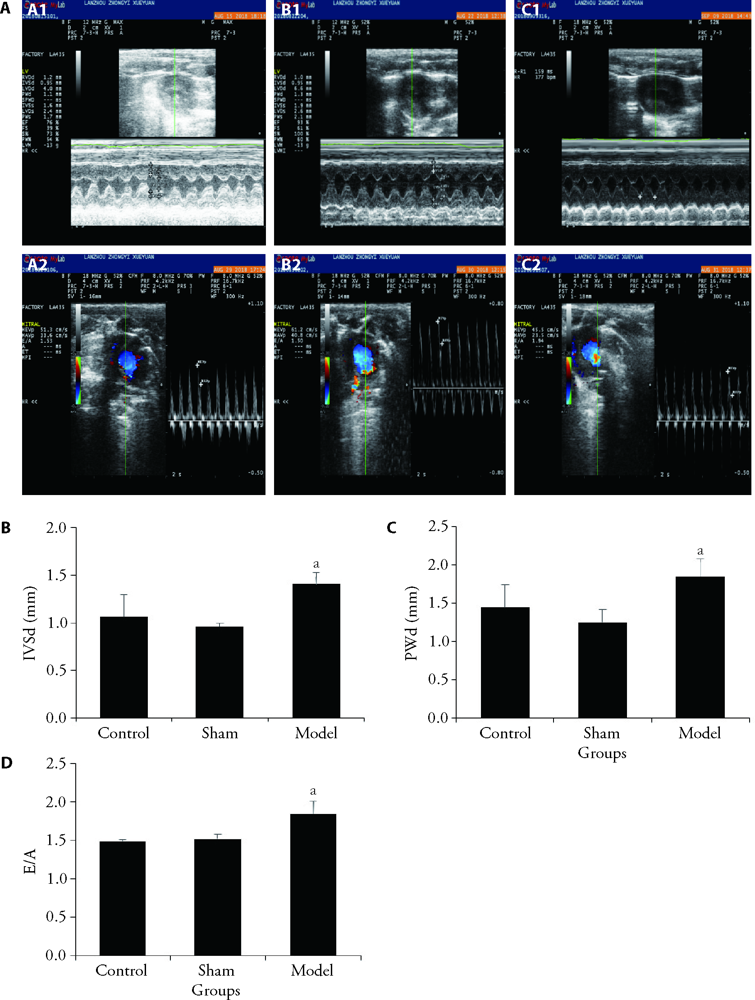
Figure 1 Cardiac function in rats in each group after three months of surgery A: echocardiography, include A1-C2. A1, A2: control group; B1, B2: sham group; C1, C2: model group. B: IVSd comparison; C: PWd comparison; D: E/A comparison. aP < 0.01, vs control group. IVSd: interventricular septal thickness at end-diastole; PWd: the posterior wall thickness at end-diastole; E value: the peak blood flow in the early mitral diastolic period; A value: late mitral diastolic period; E/A= E value/ A value.
Figure 1 Cardiac function in rats in each group after three months of surgery A: echocardiography, include A1-C2. A1, A2: control group; B1, B2: sham group; C1, C2: model group. B: IVSd comparison; C: PWd comparison; D: E/A comparison. aP < 0.01, vs control group. IVSd: interventricular septal thickness at end-diastole; PWd: the posterior wall thickness at end-diastole; E value: the peak blood flow in the early mitral diastolic period; A value: late mitral diastolic period; E/A= E value/ A value.
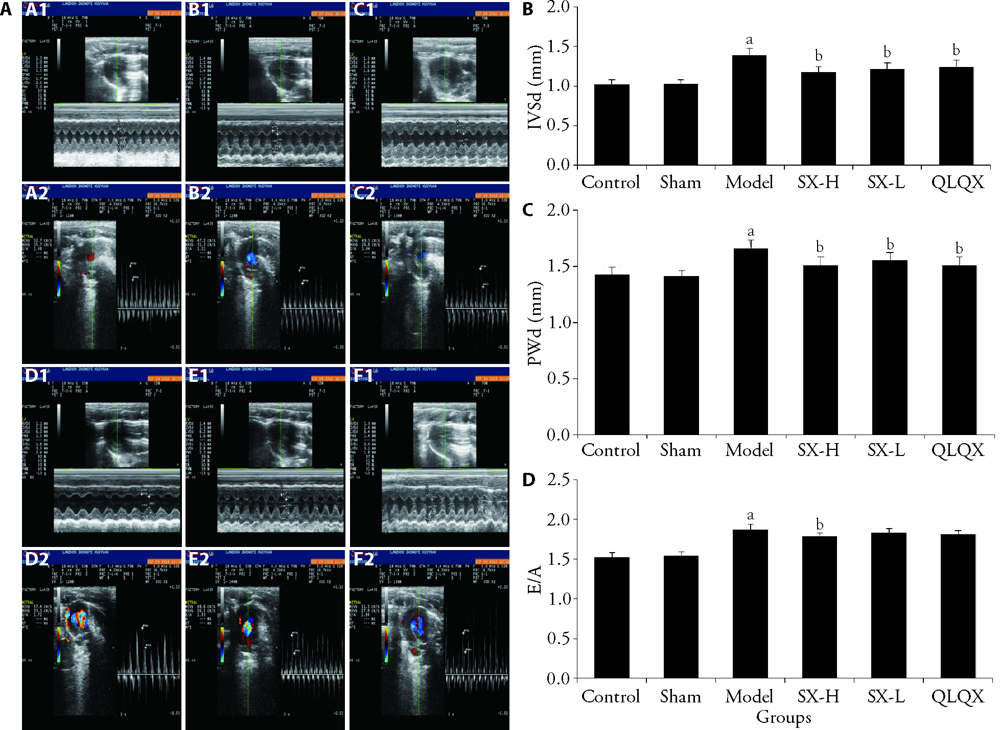
Figure 2 Cardiac function in rats in each group after drug intervention A: echocardiography, include A1-F2. A1, A2: control group; B1, B2: sham group; C1, C2: model group; D1, D2: Shunxin high-dose group; E1, E2: Shunxin low-dose group; F1, F2: Qiliqiangxin group. B: IVSd comparison; C: PWd comparison; D: E/A comparison. Control, sham surgery and model groups: treated only with normal saline; Shunxin decoction high-dose group: treated with Shunxin decoction 42.81 g/kg, Shunxin decoction low-dose group: treated with Shunxin decoction 14.27 g/kg, and Qiliqiangxin capsule intervention group: treated with Qiliqiangxin capsule 0.375 g/kg, every group by intragastric gavage for 14 d. aP < 0.01, vs control group; bP < 0.01, vs model group. IVSd: interventricular septal thickness at end-diastole; PWd: the posterior wall thickness at end-diastole; E value: the peak blood flow in the early mitral diastolic period; A value: late mitral diastolic period; E/A= E value/ A value.
Figure 2 Cardiac function in rats in each group after drug intervention A: echocardiography, include A1-F2. A1, A2: control group; B1, B2: sham group; C1, C2: model group; D1, D2: Shunxin high-dose group; E1, E2: Shunxin low-dose group; F1, F2: Qiliqiangxin group. B: IVSd comparison; C: PWd comparison; D: E/A comparison. Control, sham surgery and model groups: treated only with normal saline; Shunxin decoction high-dose group: treated with Shunxin decoction 42.81 g/kg, Shunxin decoction low-dose group: treated with Shunxin decoction 14.27 g/kg, and Qiliqiangxin capsule intervention group: treated with Qiliqiangxin capsule 0.375 g/kg, every group by intragastric gavage for 14 d. aP < 0.01, vs control group; bP < 0.01, vs model group. IVSd: interventricular septal thickness at end-diastole; PWd: the posterior wall thickness at end-diastole; E value: the peak blood flow in the early mitral diastolic period; A value: late mitral diastolic period; E/A= E value/ A value.

Figure 3 Morphological observation of rat myocardium in each group A: hematoxylin-eosin staining (magnification ×400); B: Cardiac index, vs control, aP < 0.05; C: Masson staining (magnification ×400); D: Cardiac CVF, vs control, aP < 0.05. A1, A2: control group; B1, B2: sham group; C1, C2: model group; D1, D2: Shunxin high-dose group; E1, E2: Shunxin low-dose group; F1, F2: Qiliqiangxin group. E: a: ultrastructure of rat myocardium (×10 000); b: ultrastructure of myocardial mitochondria (×20 000); c: ultrastructure of myocardial myofibrils (×20 000). CVF: collagen volume fraction. Control, sham surgery and model groups: treated only with normal saline; Shunxin decoction high-dose group: treated with Shunxin decoction 42.81 g/kg, Shunxin decoction low-dose group: treated with Shunxin decoction 14.27 g/kg, and Qiliqiangxin capsule intervention group: treated with Qiliqiangxin capsule 0.375 g/kg, every group by intragastric gavage for 14 d.
Figure 3 Morphological observation of rat myocardium in each group A: hematoxylin-eosin staining (magnification ×400); B: Cardiac index, vs control, aP < 0.05; C: Masson staining (magnification ×400); D: Cardiac CVF, vs control, aP < 0.05. A1, A2: control group; B1, B2: sham group; C1, C2: model group; D1, D2: Shunxin high-dose group; E1, E2: Shunxin low-dose group; F1, F2: Qiliqiangxin group. E: a: ultrastructure of rat myocardium (×10 000); b: ultrastructure of myocardial mitochondria (×20 000); c: ultrastructure of myocardial myofibrils (×20 000). CVF: collagen volume fraction. Control, sham surgery and model groups: treated only with normal saline; Shunxin decoction high-dose group: treated with Shunxin decoction 42.81 g/kg, Shunxin decoction low-dose group: treated with Shunxin decoction 14.27 g/kg, and Qiliqiangxin capsule intervention group: treated with Qiliqiangxin capsule 0.375 g/kg, every group by intragastric gavage for 14 d.
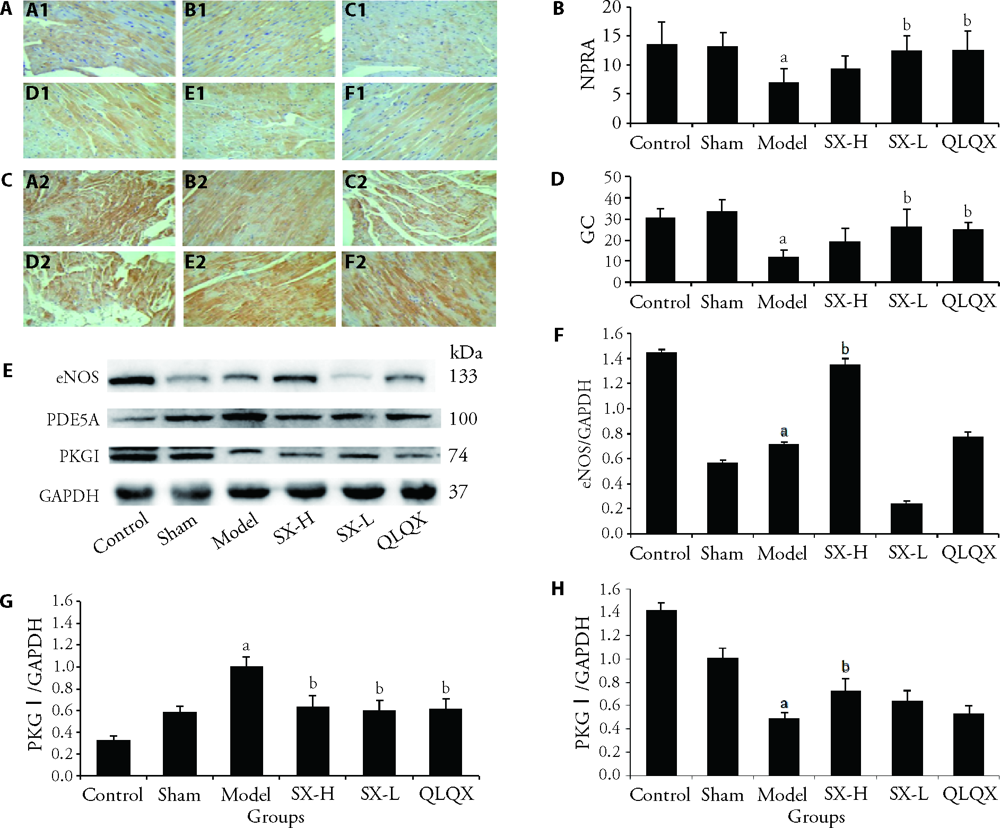
Figure 4 Expression of major target moleculars of cGMP-PKG pathway in each group A: immunohistochemical method used to detect the expression of myocardial NPRA in rats (magnification × 400); B: comparison of myocardial NPRA in rats among groups, vs control, aP < 0.01; vs model, bP < 0.01; C: immunohistochemical method used to detect the expression of myocardial GC in rats, vs control, aP < 0.01; vs model, bP < 0.01; D: comparisons of myocardial GC in rats among groups; E: WB detection of myocardial eNOS; PDE5A; and PKG I expressions in rats; F: eNOS; G: PDE5A, vs control, aP < 0.01; vs model, bP < 0.01; H: PKGⅠ, vs control, aP < 0.01; vs model, bP < 0.05. A1, A2: control group; B1, B2: sham group; C1, C2: model group; D1, D2: Shunxin high-dose group; E1, E2: Shunxin low-dose group; F1, F2: Qiliqiangxin group. Control, sham surgery and model groups: treated only with normal saline; Shunxin decoction high-dose group: treated with Shunxin decoction 42.81 g/kg, Shunxin decoction low-dose group: treated with Shunxin decoction 14.27 g/kg, and Qiliqiangxin capsule intervention group: treated with Qiliqiangxin capsule 0.375 g/kg, every group by intragastric gavage for 14 d. NPRA: natriuretic peptide receptor A; GC: guanylate cyclase; eNOS: endothelial nitric oxide synthase; PDE5A: phosphodiesterase 5A; PKG I: cyclic guanosine monophosphate-dependent protein kinase 1.
Figure 4 Expression of major target moleculars of cGMP-PKG pathway in each group A: immunohistochemical method used to detect the expression of myocardial NPRA in rats (magnification × 400); B: comparison of myocardial NPRA in rats among groups, vs control, aP < 0.01; vs model, bP < 0.01; C: immunohistochemical method used to detect the expression of myocardial GC in rats, vs control, aP < 0.01; vs model, bP < 0.01; D: comparisons of myocardial GC in rats among groups; E: WB detection of myocardial eNOS; PDE5A; and PKG I expressions in rats; F: eNOS; G: PDE5A, vs control, aP < 0.01; vs model, bP < 0.01; H: PKGⅠ, vs control, aP < 0.01; vs model, bP < 0.05. A1, A2: control group; B1, B2: sham group; C1, C2: model group; D1, D2: Shunxin high-dose group; E1, E2: Shunxin low-dose group; F1, F2: Qiliqiangxin group. Control, sham surgery and model groups: treated only with normal saline; Shunxin decoction high-dose group: treated with Shunxin decoction 42.81 g/kg, Shunxin decoction low-dose group: treated with Shunxin decoction 14.27 g/kg, and Qiliqiangxin capsule intervention group: treated with Qiliqiangxin capsule 0.375 g/kg, every group by intragastric gavage for 14 d. NPRA: natriuretic peptide receptor A; GC: guanylate cyclase; eNOS: endothelial nitric oxide synthase; PDE5A: phosphodiesterase 5A; PKG I: cyclic guanosine monophosphate-dependent protein kinase 1.
| 1. | Ponikowski P, Voors AA, Anker SD, et al. 2016 ESC guidelines for the diagnosis and treatment of acute and chronic heart failure: the task force for the diagnosis and treatment of acute and chronic heart failure of the european society of Cardiology (ESC). Developed with the special contribution of the heart failure association (HFA) of the ESC. Eur J Heart Fail 2016; 18: 891-975. |
| 2. |
van Heerebeek L, Paulus WJ. Understanding heart failure with preserved ejection fraction: where are we today? Neth Heart J 2016; 24: 227-36.
DOI PMID |
| 3. | Yancy CW, Jessup M, Bozkurt B, et al. 2013 ACCF/AHA guideline for the management of heart failure: a report of the american college of cardiology foundation/American heart association task force on practice guidelines. J Am Coll Cardiol 2013; 62: e147-239. |
| 4. |
Silberman GA, Fan TH, Liu H, et al. Uncoupled cardiac nitric oxide synthase mediates diastolic dysfunction. Circulation 2010; 121: 519-28.
DOI PMID |
| 5. | Xu Q, Liu HJ, Liu XH. Meta-analysis on the therapeutic effect of Qiliqiangxin capsule in the treatment of heart failure with preserved ejection fraction. Yi Nan Bing Za Zhi 2015; 14: 898-901. |
| 6. |
Wang J, Yang R, Zhang F, et al. The effect of Chinese herbal medicine on quality of life and exercise tolerance in heart failure with preserved ejection fraction: a systematic review and Meta-analysis of randomized controlled trials. Front Physiol 2018; 9: 1420.
DOI URL |
| 7. |
Dou Y, Li X, Shi Y, et al. Preparation, optimization and in vitro-in vivo evaluation of Shunxin sustained release granules. Chin Med 2019; 14: 36.
DOI URL |
| 8. |
Ku HC, Su MJ. DPP 4 deficiency preserved cardiac function in abdominal aortic banding rats. PLoS One 2014; 9: e85634.
DOI URL |
| 9. |
Németh BT, Mátyás C, Oláh A, et al. Cinaciguat prevents the development of pathologic hypertrophy in a rat model of left ventricular pressure overload. Sci Rep 2016; 6: 37166.
DOI URL |
| 10. |
LeWinter MM, Meyer M. Mechanisms of diastolic dysfunction in heart failure with a preserved ejection fraction: If it's not one thing it's another. Circ Heart Fail 2013; 6: 1112-5.
DOI PMID |
| 11. |
van Heerebeek L, Hamdani N, Falcão-Pires I, et al. Low myocardial protein kinase G activity in heart failure with preserved ejection fraction. Circulation 2012; 126: 830-9.
DOI PMID |
| 12. |
Frantz S, Klaiber M, Baba HA, et al. Stress-dependent dilated cardiomyopathy in mice with cardiomyocyte-restricted inactivation of cyclic GMP-dependent protein kinase I. Eur Heart J 2013; 34: 1233-44.
DOI URL |
| 13. |
Nanayakkara S, Kaye DM. Targets for heart failure with preserved ejection fraction. Clin Pharmacol Ther 2017; 102: 228-37.
DOI PMID |
| 14. |
Mohammed SF, Hussain S, Mirzoyev SA, Edwards WD, Maleszewski JJ, Redfield MM. Coronary microvascular rarefaction and myocardial fibrosis in heart failure with preserved ejection fraction. Circulation 2015; 131: 550-9.
DOI PMID |
| 15. |
Takimoto E, Champion HC, Li M, et al. Chronic inhibition of cyclic GMP phosphodiesterase 5a prevents and reverses cardiac hypertrophy. Nat Med 2005; 11: 214-22.
DOI PMID |
| 16. |
Takimoto E. Cyclic GMP-dependent signaling in cardiac myocytes. Circ J 2012; 76: 1819-25.
PMID |
| 17. |
Hou J, Kang YJ. Regression of pathological cardiac hypertrophy: signaling pathways and therapeutic targets. Pharmacol Ther 2012; 135: 337-54.
DOI URL |
| 18. |
Liu Y, Xu W, Xiong Y, Du G, Qin X. Evaluations of the effect of huangqi against heart failure based on comprehensive echocardiography index and metabonomics. Phytomedicine 2018; 50: 205-12.
DOI URL |
| 19. |
Lin XP, Cui HJ, Yang AL, Luo JK, Tang T. Astragaloside IV improves vasodilatation function by regulating the PI3K/Akt/ eNOS signaling pathway in rat aorta endothelial cells. J Vasc Res 2018; 55: 169-76.
DOI URL |
| 20. |
Nizamutdinova IT, Jin YC, Kim JS, et al. Paeonol and paeoniflorin, the main active principles of paeonia albiflora, protect the heart from myocardial ischemia/reperfusion injury in rats. Planta Med 2008; 74: 14-8.
DOI PMID |
| 21. |
Xin QQ, Yang BR, Zhou HF, et al. Paeoniflorin Promotes Angiogenesis in a Vascular Insufficiency model of zebrafish in vivo and in human umbilical vein endothelial cells in vitro. Chin J Integr Med 2018; 24: 494-501.
DOI URL |
| 22. | Guo M, Liu Y, Shi D. Cardiovascular actions and therapeutic potential of tetramethylpyrazine (active component isolated from rhizoma chuanxiong): roles and mechanisms. Biomed Res Int 2016; 2016: 2430329. |
| 23. |
Wang Y, Guo G, Yang BR, et al. Synergistic effects of chuanxiong-chishao herb-pair on promoting angiogenesis at network pharmacological and pharmacodynamic levels. Chin J Integr Med 2017; 23: 654-62.
DOI PMID |
| 24. |
Gao Y, Zhang K, Zhu F, et al. Salvia miltiorrhiza (Danshen) inhibits L-type calcium current and attenuates calcium transient and contractility in rat ventricular myocytes. J Ethnopharmacol 2014; 158 Pt A: 397-403.
DOI URL |
| 25. |
Wang L, Yu J, Fordjour PA, et al. Danshen injection prevents heart failure by attenuating post-infarct remodeling. J Ethnopharmacol 2017; 205: 22-32.
DOI URL |
| 26. | Lü M, Wang TY, Tian XX, et al. Interaction of anti-thrombotic and anti-inflammatory activities of commonly used Traditional Chinese Medicine for promoting blood circulation and removing blood stasis revealed by network pharmacology analysis. Yao Xue Xue Bao 2015; 50: 1135-41. |
| 27. | Guan J, Wang Q, Sun Y, et al. Simultaneous determination of two active components in glycyrrhiza uralensis fisch. and its processed products by UFLC. Jilin Yi Yao Xue Yuan Xue Bao 2018; 39: 241-3. |
| 28. |
Du D, Yan J, Ren J, et al. Synthesis, biological evaluation, and molecular modeling of glycyrrhizin derivatives as potent high-mobility group box-1 inhibitors with anti-heart-failure activity in vivo. J Med Chem 2013; 56: 97-108.
DOI URL |
| 29. | Chen HH, Zhao P, Tian J, et al. The effects of Guizhi Gancao decoction on pressure overload-induced heart failure and posttranslational modifications of tubulin in mice. Evid Based Complement Alternat Med 2017; 2017: 2915247. |
| 30. |
Senni M, Greene SJ, Butler J, Fonarow GC, Gheorghiade M. Drug development for heart failure with preserved ejection fraction: what pieces are missing from the puzzle? Can J Cardiol 2017; 33: 768-76.
DOI URL |
| 31. |
Tsai EJ, Liu Y, Koitabashi N, et al. Pressure-overload-induced subcellular relocalization/oxidation of soluble guanylyl cyclase in the heart modulates enzyme stimulation. Circ Res 2012; 110: 295-303.
DOI URL |
| 32. |
Zhang M, Takimoto E, Hsu S, et al. Myocardial remodeling is controlled by myocyte-targeted gene regulation of phospho-diesterase type 5. J Am Coll Cardiol 2010; 56: 2021-30.
DOI URL |
| 33. |
Borlaug BA, Lewis GD, McNulty SE, et al. Effects of sildenafil on ventricular and vascular function in heart failure with preserved ejection fraction. Circ Heart Fail 2015; 8: 533-41.
DOI PMID |
| 34. |
Hammond J, Balligand JL. Nitric oxide synthase and cyclic GMP signaling in cardiac myocytes: from contractility to remodeling. J Mol Cell Cardiol 2012; 52: 330-40.
DOI PMID |
| 35. |
Tao L, Shen S, Fu S, et al. Traditional Chinese Medication Qiliqiangxin attenuates cardiac remodeling after acute myocardial infarction in mice. Sci Rep 2015; 5: 8374.
DOI URL |
| Viewed | ||||||
|
Full text |
|
|||||
|
Abstract |
|
|||||