
Journal of Traditional Chinese Medicine ›› 2026, Vol. 46 ›› Issue (4): 972-981.DOI: 10.19852/j.cnki.jtcm.2026.04.017
• Original Articles • Previous Articles Next Articles
Construction of a nomogram for anxiety and depression in patients with Sjögren’s syndrome by combining tongue and pulse characteristics: a cross-sectional study based on a prospective cohort
SHAN Xueyan1,2, HE Jiale1, GUO Zilin1, PANG Fengtao1, LIU Ruihua3, LIU Ying4, JIANG Ping4, JI Wei5, YU Jing6, ZHOU Xinyao1( ), TANG Xiaopo1()
- 1
Department of Rheumatology ,Guang’anmen Hospital, China Academy of Chinese Medical Sciences Beijing 100053, China
2Graduate School ,Beijing University of Chinese Medicine Beijing 100029, China
3Department of Rheumatology ,Shaanxi Provincial People's Hospital Xi’an 710068, China
4Department of Rheumatology ,Affiliated Hospital of Shandong University of Traditional Chinese Medicine Jinan 250011, China
5Department of Rheumatology ,Jiangsu Provincial Hospital of Traditional Chinese Medicine Nanjing 210029, China
6Department of Rheumatology ,Affiliated Hospital of Liaoning University of Traditional Chinese Medicine Shenyang 110031, China
-
Received:2025-07-27Accepted:2025-11-18Online:2026-08-15Published:2026-08-08 -
Contact:Prof. ZHOU Xinyao, Prof. TANG Xiaopo, Department of Rheumatology, Guang’anmen Hospital, Chinese Academy of Chinese Medical Sciences, Beijing 100053, China. xyz_1102@126.com;
tangxiaopo@163.com,Telephone: +86-138-10380455; +86-131-2158-1066
-
Supported by:Scientific and Technological Innovation Project of China Academy of Chinese Medical Sciences: Development of a Stratified Prevention and Treatment Strategy and Chronic Disease Management Model Based on Traditional Chinese Medicine for Multisystem Comorbidities in Sjögren’s Syndrome(CI2026A01503)

Cite this article
SHAN Xueyan, HE Jiale, GUO Zilin, PANG Fengtao, LIU Ruihua, LIU Ying, JIANG Ping, JI Wei, YU Jing, ZHOU Xinyao, TANG Xiaopo. Construction of a nomogram for anxiety and depression in patients with Sjögren’s syndrome by combining tongue and pulse characteristics: a cross-sectional study based on a prospective cohort[J]. Journal of Traditional Chinese Medicine, 2026, 46(4): 972-981.
share this article
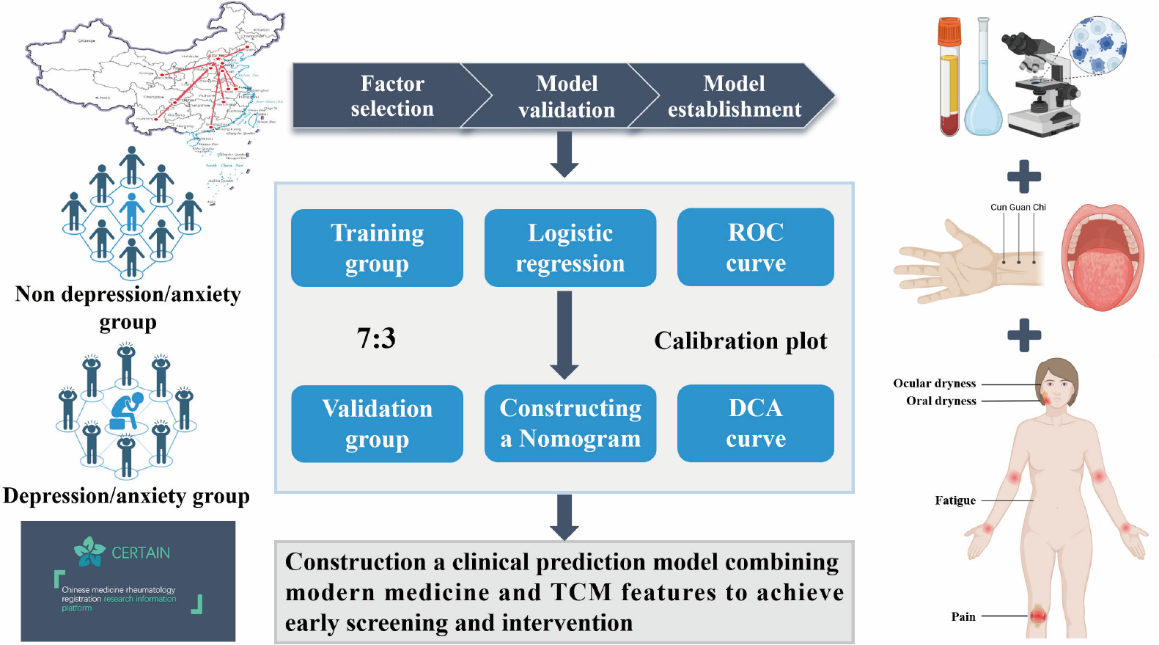
Figure 1 Research Flowchart ROC: receiver operating characteristic; DCA: decision curve analysis. The flowchart was generated using R version 3.6.3 (R Foundation for Statistical Computing, Vienna, Austria).
Figure 1 Research Flowchart ROC: receiver operating characteristic; DCA: decision curve analysis. The flowchart was generated using R version 3.6.3 (R Foundation for Statistical Computing, Vienna, Austria).
Table 1 Comparison of immunological markers between groups of anxiety and non-anxiety patients [n (%)]
| Item | Non-anxiety (n = 242) | Anxiety (n = 202) | P value |
|---|---|---|---|
| ANA | 199 (82.2) | 163 (80.7) | 0.677 |
| SSA | 165 (68.2) | 151 (74.8) | 0.128 |
| SSB | 72 (29.8) | 76 (37.6) | 0.080 |
| Ro-52 | 149 (61.6) | 148 (73.3) | 0.009a |
Table 1 Comparison of immunological markers between groups of anxiety and non-anxiety patients [n (%)]
| Item | Non-anxiety (n = 242) | Anxiety (n = 202) | P value |
|---|---|---|---|
| ANA | 199 (82.2) | 163 (80.7) | 0.677 |
| SSA | 165 (68.2) | 151 (74.8) | 0.128 |
| SSB | 72 (29.8) | 76 (37.6) | 0.080 |
| Ro-52 | 149 (61.6) | 148 (73.3) | 0.009a |
Table 2 Comparison of laboratory test results between depression and non-depression patients
| Item | Non-depression (n =257) | Depression (n =187) | P value |
|---|---|---|---|
| WBC (×1012/L) | 5.05±1.91 | 7.75±3.17 | 0.248 |
| RBC (×1012/L) | 4.15±0.53 | 4.08±0.52 | 0.119 |
| Hb (g/L) | 129.72±75.69 | 122.11±15.30 | 0.176 |
| PLT (×109/L) | 213.07±73.34 | 193.81±16.30 | 0.006a |
| ESR (mm/h) | 26.97±22.46 | 29.59±17.30 | 0.226 |
| CRP (mg/L) | 3.36±11.03 | 4.87±18.30 | 0.187 |
| IgG (g/L) | 17.52±6.01 | 26.26±19.30 | 0.205 |
| IgM (g/L) | 1.19±0.73 | 1.34±20.30 | 0.205 |
| IgA (g/L) | 3.10±1.21 | 3.41±21.30 | 0.376 |
| C3 (g/L) | 1.31±4.68 | 1.64±22.30 | 0.595 |
| C4 (g/L) | 0.25±0.11 | 0.34±23.30 | 0.264 |
| ALB(g/L) | 42.46±3.34 | 42.60±24.30 | 0.646 |
Table 2 Comparison of laboratory test results between depression and non-depression patients
| Item | Non-depression (n =257) | Depression (n =187) | P value |
|---|---|---|---|
| WBC (×1012/L) | 5.05±1.91 | 7.75±3.17 | 0.248 |
| RBC (×1012/L) | 4.15±0.53 | 4.08±0.52 | 0.119 |
| Hb (g/L) | 129.72±75.69 | 122.11±15.30 | 0.176 |
| PLT (×109/L) | 213.07±73.34 | 193.81±16.30 | 0.006a |
| ESR (mm/h) | 26.97±22.46 | 29.59±17.30 | 0.226 |
| CRP (mg/L) | 3.36±11.03 | 4.87±18.30 | 0.187 |
| IgG (g/L) | 17.52±6.01 | 26.26±19.30 | 0.205 |
| IgM (g/L) | 1.19±0.73 | 1.34±20.30 | 0.205 |
| IgA (g/L) | 3.10±1.21 | 3.41±21.30 | 0.376 |
| C3 (g/L) | 1.31±4.68 | 1.64±22.30 | 0.595 |
| C4 (g/L) | 0.25±0.11 | 0.34±23.30 | 0.264 |
| ALB(g/L) | 42.46±3.34 | 42.60±24.30 | 0.646 |
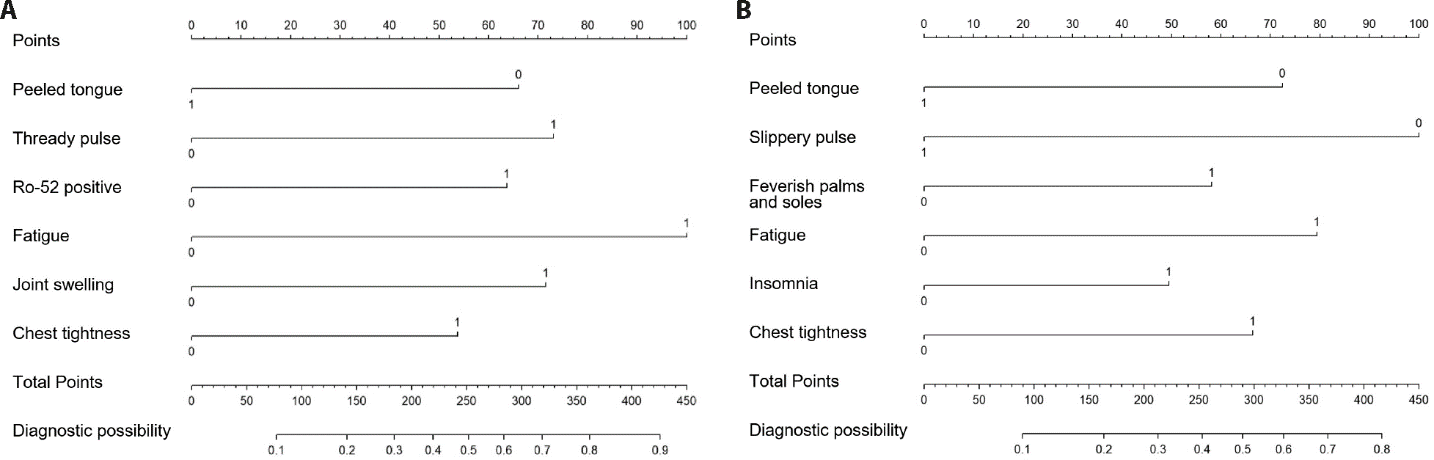
Figure 2 Prediction nomograms for anxiety and depression in SS patients A: diagnosed anxiety; B: diagnosed depression. SS: Sjögren’s syndrome.
Figure 2 Prediction nomograms for anxiety and depression in SS patients A: diagnosed anxiety; B: diagnosed depression. SS: Sjögren’s syndrome.
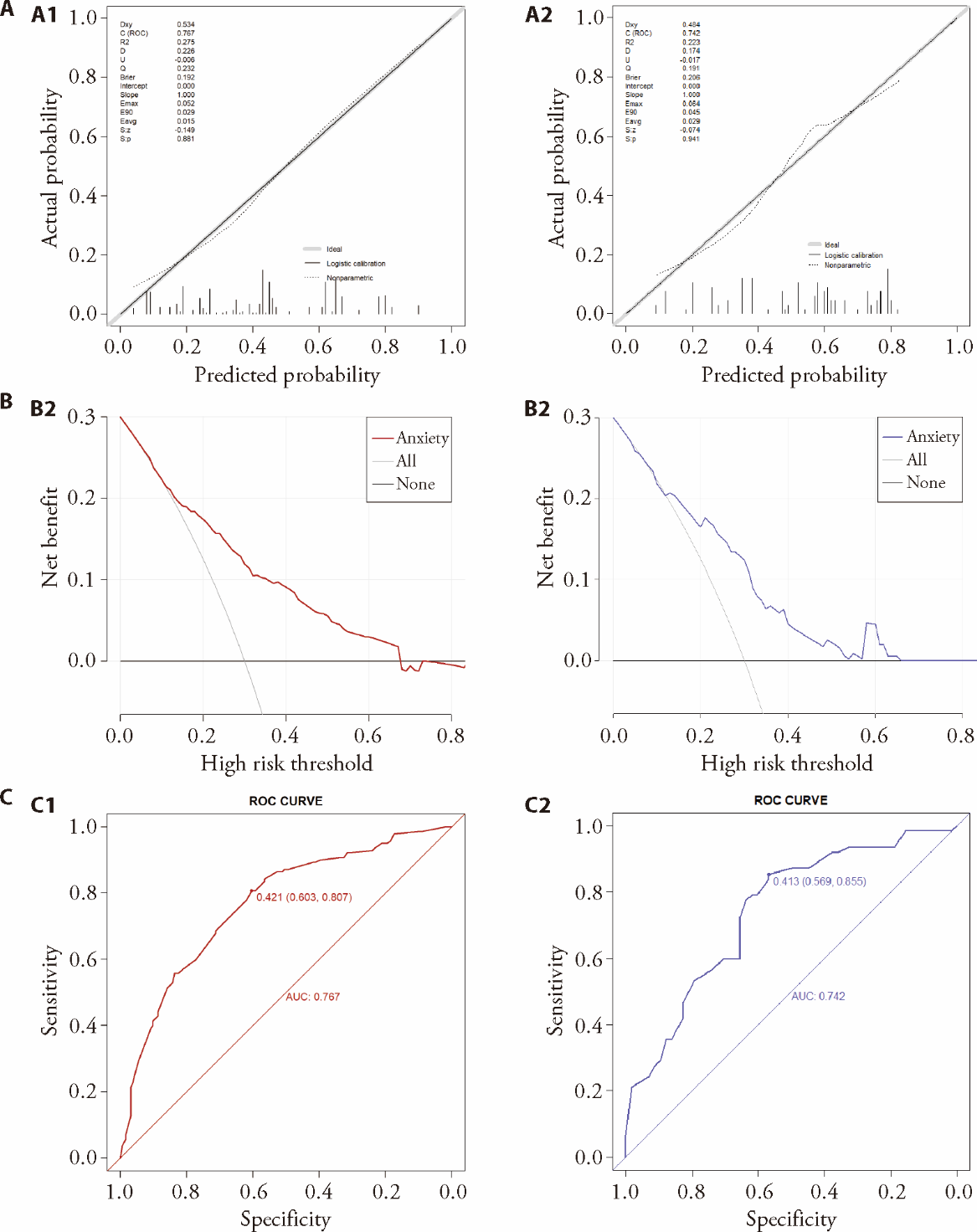
Figure 3 ROC curves and AUC for Nomogram A A: calibration curves for Nomogram A; A1: training cohort; A2: validation cohort; B: decision curve analysis for Nomogram A; B1: training cohort; B2: validation cohort; C: receiver operating characteristic curves for Nomogram A; C1: training cohort; C2: validation cohort; Nomogram A was developed to predict anxiety. The training cohort included 324 patients and was used for model development, and the validation cohort included 120 patients and was used for model validation. Calibration curves were used to evaluate agreement between predicted and observed probabilities. Decision curve analysis was used to assess clinical net benefit across a range of threshold probabilities. Receiver operating characteristic curves and the corresponding areas under the curves were used to evaluate model discrimination. The diagonal line in the calibration plots represents perfect calibration; the “All” and “None” lines in the decision curves represent the assumptions that all or no patients would experience the outcome, respectively. AUC: area under the curve; DCA: decision curve analysis; ROC: receiver operating characteristic.
Figure 3 ROC curves and AUC for Nomogram A A: calibration curves for Nomogram A; A1: training cohort; A2: validation cohort; B: decision curve analysis for Nomogram A; B1: training cohort; B2: validation cohort; C: receiver operating characteristic curves for Nomogram A; C1: training cohort; C2: validation cohort; Nomogram A was developed to predict anxiety. The training cohort included 324 patients and was used for model development, and the validation cohort included 120 patients and was used for model validation. Calibration curves were used to evaluate agreement between predicted and observed probabilities. Decision curve analysis was used to assess clinical net benefit across a range of threshold probabilities. Receiver operating characteristic curves and the corresponding areas under the curves were used to evaluate model discrimination. The diagonal line in the calibration plots represents perfect calibration; the “All” and “None” lines in the decision curves represent the assumptions that all or no patients would experience the outcome, respectively. AUC: area under the curve; DCA: decision curve analysis; ROC: receiver operating characteristic.
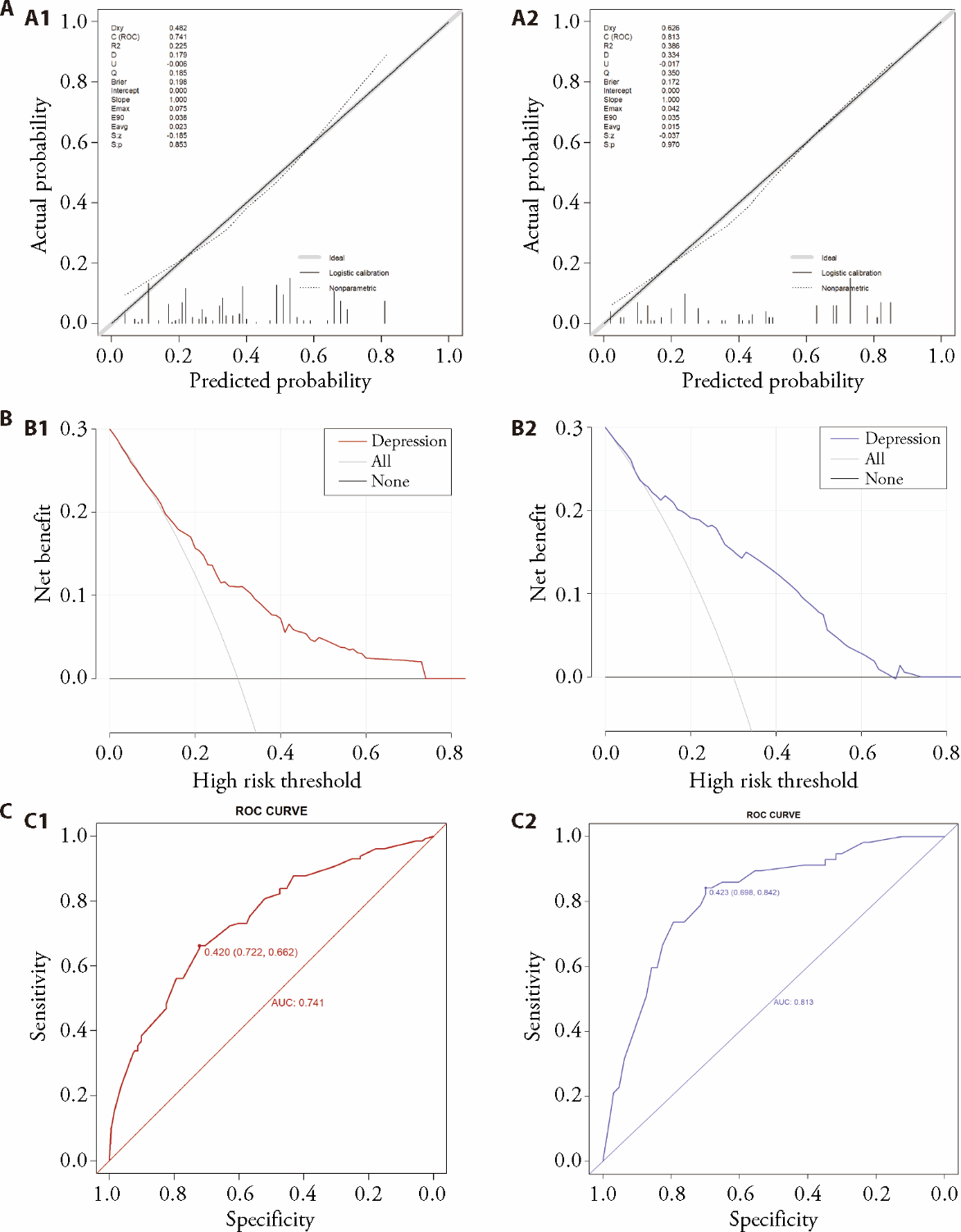
Figure 4 ROC curves and AUC for Nomogram B A: calibration curves for Nomogram B; A1: training cohort; A2: validation cohort; B: decision curve analysis for Nomogram B; B1: training cohort; B2: validation cohort; C: receiver operating characteristic curves for Nomogram B; C1: training cohort; C2: validation cohort. Nomogram B was developed to predict depression. The training cohort included 324 patients and was used for model development, and the validation cohort included 120 patients and was used for model validation. Calibration curves were used to evaluate agreement between predicted and observed probabilities. Decision curve analysis was used to assess clinical net benefit across a range of threshold probabilities. Receiver operating characteristic curves and the corresponding areas under the curves were used to evaluate model discrimination. The diagonal line in the calibration plots represents perfect calibration; the “All” and “None” lines in the decision curves represent the assumptions that all or no patients would experience the outcome, respectively. AUC: area under the curve; DCA: decision curve analysis; ROC: receiver operating characteristic.
Figure 4 ROC curves and AUC for Nomogram B A: calibration curves for Nomogram B; A1: training cohort; A2: validation cohort; B: decision curve analysis for Nomogram B; B1: training cohort; B2: validation cohort; C: receiver operating characteristic curves for Nomogram B; C1: training cohort; C2: validation cohort. Nomogram B was developed to predict depression. The training cohort included 324 patients and was used for model development, and the validation cohort included 120 patients and was used for model validation. Calibration curves were used to evaluate agreement between predicted and observed probabilities. Decision curve analysis was used to assess clinical net benefit across a range of threshold probabilities. Receiver operating characteristic curves and the corresponding areas under the curves were used to evaluate model discrimination. The diagonal line in the calibration plots represents perfect calibration; the “All” and “None” lines in the decision curves represent the assumptions that all or no patients would experience the outcome, respectively. AUC: area under the curve; DCA: decision curve analysis; ROC: receiver operating characteristic.
| 1. |
Ramos-Casals M, Brito-Zerón P, Bombardieri S, et al. EULAR recommendations for the management of Sjögren’s syndrome with topical and systemic therapies. Ann Rheum Dis 2020; 79: 3-18.
DOI PMID |
| 2. |
Lee JJ, Park YJ, Park M, Yim HW, Park SH, Kwok SK. Longitudinal analysis of symptom-based clustering in patients with primary Sjogren’s syndrome: a prospective cohort study with a 5-year follow-up period. J Transl Med 2021; 19: 394.
DOI |
| 3. |
Beydon M, McCoy S, Nguyen Y, Sumida T, Mariette X, Seror R. Epidemiology of Sjögren syndrome. Nat Rev Rheumatol 2024; 20: 158-69.
DOI |
| 4. |
Zeng W, Zhou X, Yu S, et al. The future of targeted treatment of primary Sjögren’s syndrome: a focus on extra-glandular pathology. Int J Mol Sci 2022; 23: 14135.
DOI URL |
| 5. |
Nguyen Y, Nocturne G, Henry J, et al. Identification of distinct subgroups of Sjögren’s disease by cluster analysis based on clinical and biological manifestations: data from the cross-sectional Paris-Saclay and the prospective ASSESS cohorts. Lancet Rheumatol 2024; 6: e216-25.
DOI URL |
| 6. |
Tarn JR, Howard-Tripp N, Lendrem DW, et al. Symptom-based stratification of patients with primary Sjögren’s syndrome: multi-dimensional characterisation of international observational cohorts and reanalyses of randomised clinical trials. Lancet Rheumatol 2019; 1: e85-94.
DOI URL |
| 7. | Omma A, Tecer D, Kucuksahin O, Sandikci SC, Yildiz F, Erten S. Do the European League Against Rheumatism (EULAR) Sjögren’s syndrome outcome measures correlate with impaired quality of life, fatigue, anxiety and depression in primary Sjögren’s syndrome? Arch Med Sci 2018; 14: 830-7. |
| 8. |
Huang T, Li Y, Luo Y, Zhou Y, Zhao Y, Liu Y. Research progress on the pathogenesis and quality of life of patients with primary Sjögren’s syndrome complicated by depression. Clin Exp Rheumatol 2022; 40: 647-54.
DOI URL |
| 9. |
Milic V, Grujic M, Barisic J, et al. Personality, depression and anxiety in primary Sjogren’s syndrome-Association with sociodemographic factors and comorbidity. PLoS One 2019; 14: e0210466.
DOI URL |
| 10. |
Schoon H, Slack E, Pearce M, Ng WF, Hackett KL. Activity interference in patients with Sjögren’s syndrome: a cross-sectional study of 149 patients in the UK. Rheumatology (Oxford) 2022; 61: 4065-75.
DOI URL |
| 11. |
Li XX, Maitiyaer M, Tan Q, et al. Emerging biologic frontiers for Sjogren’s syndrome: unveiling novel approaches with emphasis on extra glandular pathology. Front Pharmacol 2024; 15: 1377055.
DOI URL |
| 12. |
Omdal R, Mellgren SI, Norheim KB. Pain and fatigue in primary Sjögren’s syndrome. Rheumatology (Oxford) 2021; 60: 3099-106.
DOI URL |
| 13. |
Collins A, Lendrem D, Wason J, et al. Revisiting the JOQUER trial: stratification of primary Sjögren’s syndrome and the clinical and interferon response to hydroxychloroquine. Rheumatol Int 2021; 41: 1593-600.
DOI PMID |
| 14. |
McCoy SS, Woodham M, Bartels CM, et al. Symptom-based cluster analysis categorizes Sjögren’s disease subtypes: an international cohort study highlighting disease severity and treatment discordance. Arthritis Rheumatol 2022; 74: 1569-79.
DOI URL |
| 15. | Sandoval-Flores MG, Chan-Campos I, Hernández-Molina G. Factors influencing the EULAR Sjögren’s syndrome patient-reported index in primary Sjögren’s syndrome. Clin Exp Rheumatol 2021; 133: 153-8. |
| 16. |
Noguchi K, Saito I, Namiki T, Yoshimura Y, Nakaguchi T. Reliability of non-contact tongue diagnosis for Sjögren’s syndrome using machine learning method. Sci Rep 2023; 13: 1334.
DOI PMID |
| 17. |
Bustos-Lobato L, Rus MJ, Saúco C, Simon-Soro A. Oral microbial biomap in the drought environment: Sjogren’s syndrome. Mol Oral Microbiol 2023; 38: 400-7.
DOI URL |
| 18. | Song J, Wang Q, Xu X, Lü C. Predictive value of fissured tongue in functional dyspepsia combined with depression. Gastroenterol Res Pract 2019; 2019: 4596560. |
| 19. |
Hsiao KY, Kang JH, Wu YS, Chang HH, Yang CT. Peripheral pulse harmonic analysis and its clinical application: a systematic review. J Tradit Complement Med 2023; 14: 223-36.
DOI URL |
| 20. |
Chen CC, Lin SC, Young MS, Yang CL. Accumulated mental stress study using the meridians of Traditional Chinese Medicine with photoplethysmography. J Altern Complement Med 2014; 20: 860-7.
DOI URL |
| 21. | Shiboski CH, Shiboski SC, Seror R, et al. 2016 American College of Rheumatology/European League Against Rheumatism classification criteria for primary Sjögren’s syndrome: a consensus and data-driven methodology involving three international patient cohorts. Ann Rheum Dis 2017; 76: 9-16. |
| 22. | Seror R, Theander E, Brun JG, et al. Validation of EULAR primary Sjögren’s syndrome disease activity (ESSDAI) and patient indexes (ESSPRI). Ann Rheum Dis 2015; 74: 859-66. |
| 23. |
Wintermann GB, Rosendahl J, Weidner K, Strauß B, Hinz A, Petrowski K. Fatigue in chronically critically ill patients following intensive care-reliability and validity of the multidimensional fatigue inventory (MFI-20). Health Qual Life Outcomes 2018; 16: 37.
DOI |
| 24. |
Zigmond AS, Snaith RP. The hospital anxiety and depression scale. Acta Psychiatrica Scandinavica 1983; 67: 361-70.
DOI PMID |
| 25. |
Hsieh MC, Hsu CW, Lu MC, Koo M. Increased risks of psychiatric disorders in patients with primary Sjögren’s syndrome - a secondary cohort analysis of nationwide, population-based health claim data. Clin Rheumatol 2019; 38: 3195-203.
DOI |
| 26. |
Baldini C, Fulvio G, La Rocca G, Ferro F. Update on the pathophysiology and treatment of primary Sjögren syndrome. Nat Rev Rheumatol 2024; 20: 473-91.
DOI PMID |
| 27. |
Zeng L, He Q, Deng Y, et al. Efficacy and safety of iguratimod in the treatment of rheumatic and autoimmune diseases: a meta-analysis and systematic review of 84 randomized controlled trials. Front Pharmacol 2023; 14: 1189142.
DOI URL |
| 28. |
Mikdashi J, Handwerger B. Predictors of neuropsychiatric damage in systemic lupus erythematosus: data from the Maryland lupus cohort. Rheumatology (Oxford) 2004; 43: 1555-60.
DOI URL |
| 29. |
Sayre EC, Esdaile JM, Kopec JA, et al. Specific manifestations of knee osteoarthritis predict depression and anxiety years in the future: Vancouver longitudinal study of early knee osteoarthritis. BMC Musculoskelet Disord 2020; 21: 467.
DOI |
| 30. |
Rodwell N, Hassett G, Bird P, Pincus T, Descallar J, Gibson KA. RheuMetric quantitative 0 to 10 physician estimates of inflammation, damage, and distress in rheumatoid arthritis: validation against reference measures. ACR Open Rheumatol 2023; 5: 511-21.
DOI URL |
| 31. |
Pucino V, Turner JD, Nayar S, et al. Sjögren’s and non-Sjögren’s sicca share a similar symptom burden but with a distinct symptom-associated proteomic signature. RMD Open 2022; 8: e002119.
DOI URL |
| 32. | Salehi M, Zamiri A, Kim J, Texeira C, Shah K, Gunturu S. Exploring the psychiatric manifestations of primary Sjögren’s syndrome: a narrative review. Int J Rheumatol 2024; 2024: 5520927. |
| 33. |
Andrianopoulou A, Zikou AK, Astrakas LG, et al. Functional connectivity and microstructural changes of the brain in primary Sjögren syndrome: the relationship with depression. Acta Radiol 2020; 61: 1684-94.
DOI URL |
| 34. |
Wu GL, Li TY. Focus on effects of chinese medicine on improving anxiety-depression and quality of life of patients with primary Sjögren’s syndrome. Chin J Integr Med 2020; 26: 486-9.
DOI |
| 35. |
Pan D, Guo Y, Fan Y, Wan H. Development and application of Traditional Chinese Medicine using AI machine learning and deep learning strategies. Am J Chin Med 2024; 52: 605-23.
DOI URL |
| 36. |
Zhang Q, Zhou J, Zhang B. Graph based multichannel feature fusion for wrist pulse diagnosis. IEEE J Biomed Health Inform 2021; 25: 3732-43.
DOI URL |
| 37. |
He C, Liao Q, Fu P, et al. Microbiological characteristics of different tongue coatings in adults. BMC Microbiol 2022; 22: 214.
DOI PMID |
| 38. | Matos LC, Machado JP, Monteiro FJ, Greten HJ. Can Traditional Chinese Medicine diagnosis be parameterized and standardized? a narrative review. Healthcare (Basel) 2021; 9: 177. |
| 39. |
Guo C, Jiang Z, He H, Liao Y, Zhang D. Wrist pulse signal acquisition and analysis for disease diagnosis: a review. Comput Biol Med 2022; 143: 105312.
DOI URL |
| 40. |
Chi X, Wang S, Baloch Z, et al. Research progress on classical Traditional Chinese Medicine formula Lily Bulb and Rehmannia decoction in the treatment of depression. Biomed Pharmacother 2019; 112: 108616.
DOI URL |
| 41. |
Pan MH, Zhu SR, Duan WJ, et al. “Shanghuo” increases disease susceptibility: modern significance of an old TCM theory. J Ethnopharmacol 2020; 250: 112491.
DOI URL |
| 42. | Meng Y, Liu L, Zheng Y, et al. Traditional Chinese Medicine constitution identification based on objective facial and tongue features: a Delphi study and a diagnostic nomogram for blood stasis constitution. Evid Based Complement Alternat Med 2022; 2022: 6950529. |
| [1] | LUO Qiaoyun, HAN Yuanshan, LIU Yang, TANG Lin, WANG Tianyu, WANG Yuhong, ZHAO Hongqing. Baihe Dihuang decoction (百合地黄汤) activates cannabinoid type 2 receptor to regulate microglial polarization and alleviate anxiety-like behavior in chronic restraint stress mice [J]. Journal of Traditional Chinese Medicine, 2026, 46(4): 798-808. |
| [2] | JING Yunjia, YE Zhaoyi, ZHU Yan, GAO Xin, CHEN Xi, WANG Kaixuan, HUANG Dafeng, HU Yue, JIANG Jiancong. Activation of the nucleus nuclear factor erythroid 2-related factor 2 via ghrelin/growth hormone secretagogue receptor 1a signaling by Yueju pill (越鞠丸) confers cardioprotective and antidepressant effects [J]. Journal of Traditional Chinese Medicine, 2026, 46(3): 517-529. |
| [3] | LI Kexin, YANG Jinzu, XIAO Kunlin, DUAN Shaojie, XIAO Kunmin. Tongue-coating microbiome as a predictor of solid tumors: an updated scoping review of clinical studies [J]. Journal of Traditional Chinese Medicine, 2026, 46(2): 501-508. |
| [4] | ZHOU Mi, BU Huaien, WANG Dongjun, ZHANG Naijin, SUN Xuan, TIAN Zhikui, WANG Hongwu. Efficacy of Tongxie Yaofang (痛泻要方) compared with pinaverium bromide on irritable bowel syndrome with liver depression and spleen deficiency: a systematic review and Meta-analysis [J]. Journal of Traditional Chinese Medicine, 2026, 46(1): 14-21. |
| [5] | XU Yuqin, YUAN Jinjun, ZHU Yanxian, CHEN Chen, MA Xiaoming, JIANG Jiaona, HUANG Xingxian, LUO Wenshu, LIU Fan, YANG Zhuoxin, ZHOU Yumei. Observation of the efficacy and safety of acupuncture for postpartum depression [J]. Journal of Traditional Chinese Medicine, 2025, 45(6): 1405-1413. |
| [6] | FAN Mengyue, YAO Lin, ZHANG Guoqing, WANG Ruixue, CHEN Kexin, FAN Yujing, WANG Ziming, FU Jia, CHEN Yongjun, WANG Taiyi. Study on subtyping and Traditional Chinese Medicine treatment of depression based on machine learning and text mining [J]. Journal of Traditional Chinese Medicine, 2025, 45(5): 1152-1163. |
| [7] | LI Weijia, LU Jing, MA Chao, LIU Mengmeng, PEI Ke, CHEN Hongyan, LIN Zhe, LYU Guangfu. Hamayou (Oviductus Ranae) protein hydrolysate ameliorates depression by regulating the mitogen-activated protein kinase pathway [J]. Journal of Traditional Chinese Medicine, 2025, 45(3): 493-507. |
| [8] | ZHANG Yang, LYU Wang, XU Xin, LI Jie, HU Shengli, WANG Ying. Clinical effect of Shugan Jieyu San (疏肝解郁散) for improving liver function and alleviating depression in patients with triple negative breast cancer [J]. Journal of Traditional Chinese Medicine, 2025, 45(3): 633-638. |
| [9] | LI Yajing, WANG Baoying, SHAO Wenxue, LU Shuaifei, SU Pan, BAI Ming, XU Erping, LI Yucheng. Quantitative proteomic analysis of the brain reveals the potential antidepressant mechanism of Jiawei Danzhi Xiaoyao San (加味丹栀逍遥散) in a chronic unpredictable mild stress mouse model of depression [J]. Journal of Traditional Chinese Medicine, 2025, 45(1): 22-31. |
| [10] | Faiq Amin, Saara Ahmad, Muhammad Wasim, Asra Khan, Fazal Manzoor Arain, Zehra Batool, Saiqa Tabassum, Saima Khaliq, Noreen Samad, Saida Haider. Antidepressive and anxiolytic effects of a combination of Saffron and Chamomile in rats and their relationship with serotonin using in vivo methods [J]. Journal of Traditional Chinese Medicine, 2025, 45(1): 49-56. |
| [11] | LIU Tongtong, ZHANG Xi, YANG Hui, LIN Xiaoyuan, LIU Jian, ZHANG Xiuli, GUO Dongwei, ZHAO Hongqing, ZOU Manshu, LEI Chang, LONG Hongping, LUO Yan, XIANG Yun, GE Jinwen, WANG Yuhong, MENG Pan. Luteolin promotes neuronogenesis in hippocampus of chronic unpredictable mild stress rats and primary hippocampus of fetal rats [J]. Journal of Traditional Chinese Medicine, 2024, 44(4): 670-679. |
| [12] | JIN Shenyi, LIU Yahua, HAN Xu, CAI Mengjie, XU Jiatuo, LU Hao, CHEN Qingguang. Dark red tongue color formation caused by hyperglycemia is attributed to decreased blood flow of tongue tissue partially due to nuclear factor-kappa B pathway activation [J]. Journal of Traditional Chinese Medicine, 2023, 43(6): 1118-1125. |
| [13] | WANG Yaqi, ZHAO Weibo, WANG Yixing, ZHAO Haihong, ZHOU Yaoyao, YAN Yun, WU Taotao, LUO Bin, WANG Ji. Traditional Chinese Medicine constitution among patients with allergic rhinitis and its correlation with anxiety and depression [J]. Journal of Traditional Chinese Medicine, 2023, 43(6): 1252-1258. |
| [14] | MA Fangfang, ZHANG Hewei, LI Bingxue, CHENG Peiyu, YU Mingwei, WANG Xiaomin. Acupuncture and moxibustion for malignant tumor patients with psychological symptoms of insomnia, anxiety and depression: a systematic review and Meta-analysis [J]. Journal of Traditional Chinese Medicine, 2023, 43(3): 441-456. |
| [15] | ZOU Xinshuang, SHI Lei, YIN Hailong, LI Haiping, WANG Mengheng, SONG Wanci, LUO Laichun, WU Hezhen, YANG Yanfang, ZAN Junfeng, LIU Yanwen, DAN Hanxiong, YIN Qiang, YOU Pengtao. Compound Gaoziban tablet (复方高滋斑片) alleviates depression via toll-like receptor 4/myeloid differentiation factor 88/nuclear factor-kappa B pathway [J]. Journal of Traditional Chinese Medicine, 2022, 42(6): 956-964. |
| Viewed | ||||||
|
Full text |
|
|||||
|
Abstract |
|
|||||
