
Journal of Traditional Chinese Medicine ›› 2026, Vol. 46 ›› Issue (4): 832-843.DOI: 10.19852/j.cnki.jtcm.2026.04.006
• Original Articles • Previous Articles Next Articles
Electroacupuncture enhances CD8+ T cells recruitment via modulating sympathetic nervous system to suppress tumor growth in mice bearing triple-negative breast cancer
TIAN Yehong1, ZHANG Qiaoli2, ZHANG Rui1, GAO Tao1, LI Nanzhi1, HUANG Jinchang2, JIANG Xin2( ), QIU Xiaowei3()
- 1
College of Acupuncture and Tuina ,Shaanxi University of Chinese Medicine Xianyang 712000, China
2Department of Acupuncture and Minimally Invasive Oncology ,The Third Affiliated Hospital of Beijing University of Chinese Medicine Beijing 100029, China
3Department of Encephalopathy Medicine ,BeiJing Chaoyang Intergrative Medicine Rescue and First Aid Hospital Beijing 100022, China
-
Received:2025-06-16Accepted:2025-11-04Online:2026-08-15Published:2026-08-08 -
Contact:QIU Xiaowei, Department of Encephalopathy Medicine, Beijing Chaoyang Intergrative Medicine Rescue and First Aid Hospital, Beijing 100022, China. dcqiuxiaowei@sina.com;
JIANG Xin, Department of Acupuncture and Minimally Invasive Oncology, the Third Affiliated Hospital of Beijing University of Chinese Medicine, Beijing 100029, China. jxbucm@163.com,Telephone: +86-18182538201; +86-18311371983
-
Supported by:National Natural Science Foundation of China: Exploring the Anti-tumor Mechanism of Peritumoral Needling Promoting CD8+ T Lymphocyte Recruitment of Breast Cancer Based on Neural Reprogramming(82305396);Scientific Research Project of Shaanxi Academy of Basic Research: Study on the Mechanism of Sympathetic Nerve Reprogramming Promoting CD8+ T Cell Recruitment in Triple-negative Breast Cancer Mice for Peritumoral Electroacupuncture Based on Histone Deacetylase 1 (HDAC1) Histone Modification(22JHQ089)

Cite this article
TIAN Yehong, ZHANG Qiaoli, ZHANG Rui, GAO Tao, LI Nanzhi, HUANG Jinchang, JIANG Xin, QIU Xiaowei. Electroacupuncture enhances CD8+ T cells recruitment via modulating sympathetic nervous system to suppress tumor growth in mice bearing triple-negative breast cancer[J]. Journal of Traditional Chinese Medicine, 2026, 46(4): 832-843.
share this article

Figure 1 EA inhibited tumor growth and increased the recruitment of CD8+ T cells in mice with TNBC A: tumor growth curve; B: bioluminescence imaging; C: total fluorescence flux of the tumor burden; D: comparison of tumor weight; E: FCM analysis of CD8+ T cells in the blood; F: proportions of CD8+ T cells in the blood; G: FCM analysis of CD8+ T cells in the spleen; H: proportions of CD8+ T cells in the spleen; I: FCM analysis of CD8+ T cells in the tumor; J: proportions of CD8+ T cells in the tumor; K: representative IF images of CD8 (red) and CCL5 (green) in the tumor tissue (× 200); L: proportions of CD8+ T cells in the tumor by IF staining; M: relative expression of CCL5 in the tumor by IF staining; N: tumorous levels of the CCL5 by ELISA; O: serum CCL5 by ELISA; B1, E1, G1, I1, K1: model group; B2, E2, G2, I2, K2: EA group. EA group: underwent peritumoral EA with 2/30 Hz alternating frequencies under isoflurane anesthesia; Model group: only anesthetized with the same concentration of isoflurane. EA: electroacupuncture; TNBC: triple-negative breast cancer; 4T1-luc: luciferase-labeled 4T1 cell line; FCM: flow cytometry; IF: immunofluorescence; CCL5: C-C motif chemokine ligand 5; ELISA: enzyme-linked immunosorbent assay; DAPI: 4',6-diamidino-2-phenylindole. All quantitative data are expressed as mean ± standard error of the mean (n = 6); intergroup comparisons were performed based on Shapiro-Wilk normality and Levene’s homogeneity tests, with Student’s t-test for eligible data and Welch’s t-test or Wilcoxon rank-sum test otherwise. aP < 0.01 and bP < 0.001, compared with the model group.
Figure 1 EA inhibited tumor growth and increased the recruitment of CD8+ T cells in mice with TNBC A: tumor growth curve; B: bioluminescence imaging; C: total fluorescence flux of the tumor burden; D: comparison of tumor weight; E: FCM analysis of CD8+ T cells in the blood; F: proportions of CD8+ T cells in the blood; G: FCM analysis of CD8+ T cells in the spleen; H: proportions of CD8+ T cells in the spleen; I: FCM analysis of CD8+ T cells in the tumor; J: proportions of CD8+ T cells in the tumor; K: representative IF images of CD8 (red) and CCL5 (green) in the tumor tissue (× 200); L: proportions of CD8+ T cells in the tumor by IF staining; M: relative expression of CCL5 in the tumor by IF staining; N: tumorous levels of the CCL5 by ELISA; O: serum CCL5 by ELISA; B1, E1, G1, I1, K1: model group; B2, E2, G2, I2, K2: EA group. EA group: underwent peritumoral EA with 2/30 Hz alternating frequencies under isoflurane anesthesia; Model group: only anesthetized with the same concentration of isoflurane. EA: electroacupuncture; TNBC: triple-negative breast cancer; 4T1-luc: luciferase-labeled 4T1 cell line; FCM: flow cytometry; IF: immunofluorescence; CCL5: C-C motif chemokine ligand 5; ELISA: enzyme-linked immunosorbent assay; DAPI: 4',6-diamidino-2-phenylindole. All quantitative data are expressed as mean ± standard error of the mean (n = 6); intergroup comparisons were performed based on Shapiro-Wilk normality and Levene’s homogeneity tests, with Student’s t-test for eligible data and Welch’s t-test or Wilcoxon rank-sum test otherwise. aP < 0.01 and bP < 0.001, compared with the model group.
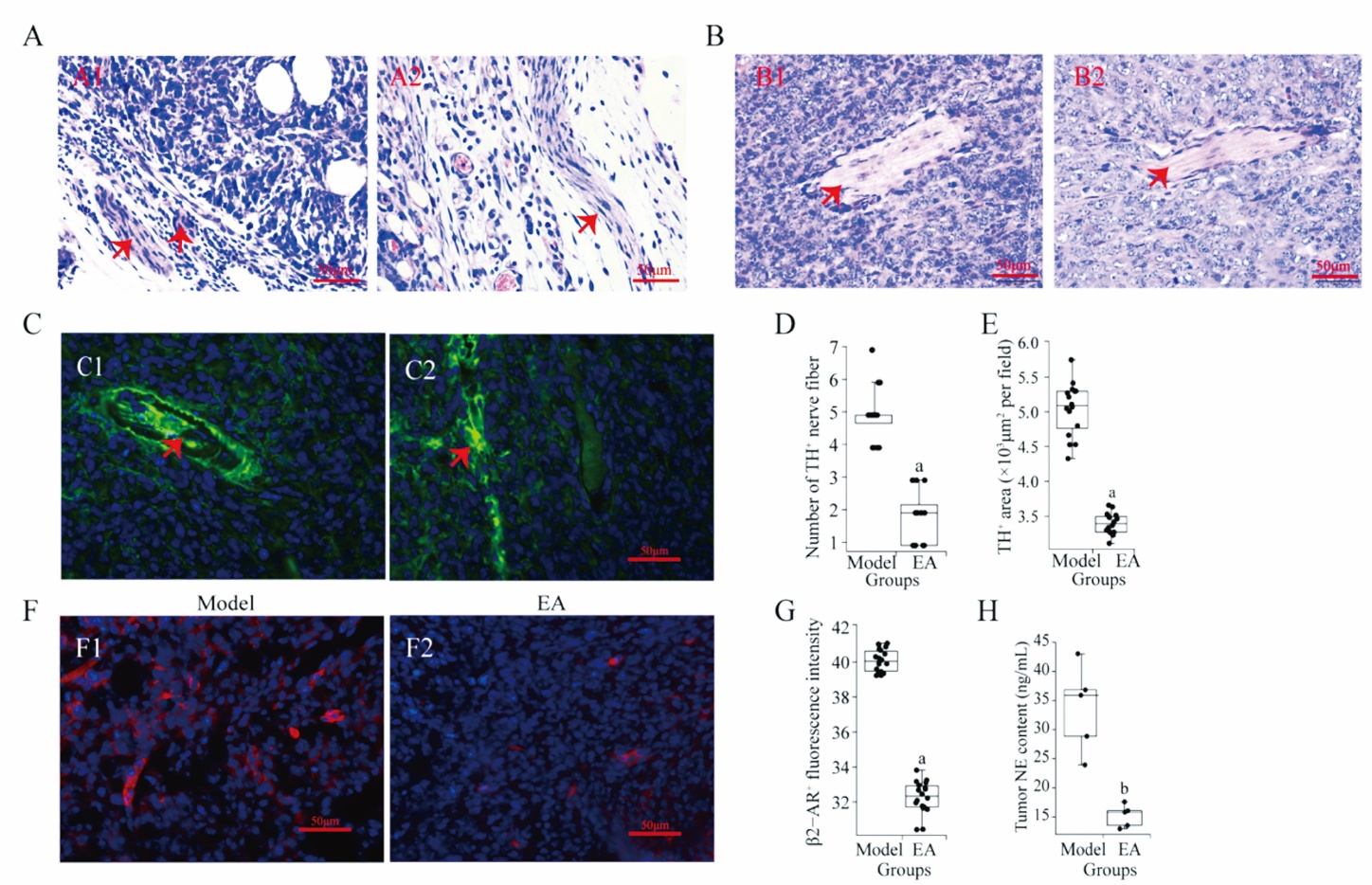
Figure 2 EA decreased intratumoral sympathetic innervation in tumor-bearing mice A: HE-stained images of peritumoral connective tissue (× 200); B: HE-stained images of tumor stroma (× 200); C: IF-stained images of TH (green) and DAPI (blue) in the tumor tissue (× 200); D: number of TH-marked sympathetic nerve; E: TH+ expression area per microscope field; F: representative IF images of β2-AR (red) and DAPI (blue) in the tumor tissue (× 200); G: relative expression of β2-AR in the mouse tumor by IF; H: tumorous levels of NE by ELISA; A1, B1, C1, F1: model group; A2, B2, C2, F2: EA group. EA group: underwent peritumoral EA with 2/30 Hz alternating frequencies under isoflurane anesthesia; Model group: only anesthetized with the same concentration of isoflurane. EA: electroacupuncture; HE: hematoxylin-eosin; TH: tyrosine hydrolase; DAPI: 4',6-diamidino-2-phenylindole; β2-AR: beta-2 adrenergic receptor; IF: immunofluorescence; NE: norepinephrine; ELISA: enzyme-linked immunosorbent assay. All quantitative data are presented as mean ± standard error of the mean (n = 6); intergroup comparisons were carried out based on Shapiro-Wilk normality and Levene’s homogeneity tests, with Student’s t-test for eligible data and Welch’s t-test or Wilcoxon rank-sum test otherwise. aP < 0.001 and bP < 0.01, compared with the model group.
Figure 2 EA decreased intratumoral sympathetic innervation in tumor-bearing mice A: HE-stained images of peritumoral connective tissue (× 200); B: HE-stained images of tumor stroma (× 200); C: IF-stained images of TH (green) and DAPI (blue) in the tumor tissue (× 200); D: number of TH-marked sympathetic nerve; E: TH+ expression area per microscope field; F: representative IF images of β2-AR (red) and DAPI (blue) in the tumor tissue (× 200); G: relative expression of β2-AR in the mouse tumor by IF; H: tumorous levels of NE by ELISA; A1, B1, C1, F1: model group; A2, B2, C2, F2: EA group. EA group: underwent peritumoral EA with 2/30 Hz alternating frequencies under isoflurane anesthesia; Model group: only anesthetized with the same concentration of isoflurane. EA: electroacupuncture; HE: hematoxylin-eosin; TH: tyrosine hydrolase; DAPI: 4',6-diamidino-2-phenylindole; β2-AR: beta-2 adrenergic receptor; IF: immunofluorescence; NE: norepinephrine; ELISA: enzyme-linked immunosorbent assay. All quantitative data are presented as mean ± standard error of the mean (n = 6); intergroup comparisons were carried out based on Shapiro-Wilk normality and Levene’s homogeneity tests, with Student’s t-test for eligible data and Welch’s t-test or Wilcoxon rank-sum test otherwise. aP < 0.001 and bP < 0.01, compared with the model group.
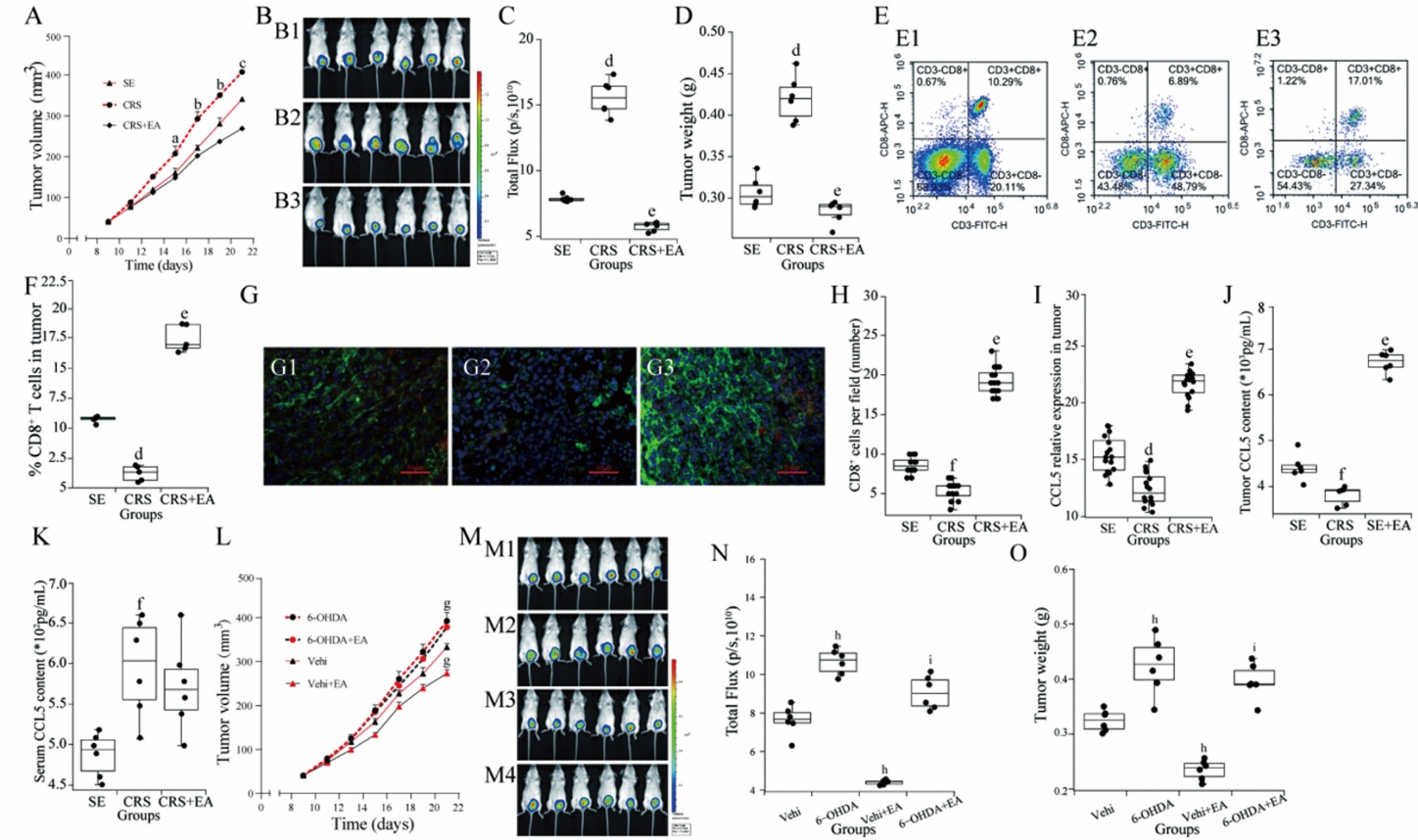
Figure 3 EA recruited CD8+ T cells to alleviate tumor progression from chronic stress-induced sympathetic activation, while sympathetic denervation abolished the antitumor effect A: tumor growth curve under exposure of CRS; B: bioluminescence imaging of the tumor; C: total fluorescence flux of the tumor; D: comparison of tumor weight; E: FCM analysis of tumorous CD8+ T cells; F: proportions of tumorous CD8+ T cells; G: IF images of CD8 (red) and CCL5 (green) in the tumor tissue (× 200); H: proportions of tumorous CD8+ T cells by IF; I: relative expression of tumorous CCL5 by IF; J: tumorous levels of the CCL5 by ELISA; K: serum CCL5 by ELISA; L: tumor growth curve following the sympathetic denervation; M: bioluminescence imaging; N: total fluorescence intensity of the tumor; O: comparison of tumor weight; B1, E1, G1: SE group; B2, E2, G2: CRS group; B3, E3, G3: CRS + EA group; M1: vehi group; M2: 6-OHDA group; M3: vehi + EA group; M4: 6-OHDA + EA group. SE group: raised in the standard environment; CRS group: underwent 2-h daily restraint stress from 1 week before 4T1-luc cell inoculation until experiment end; CRS + EA group: received peritumoral EA stimulation based on the CRS group; vehi group: received 0.2 mL saline with 0.01% ascorbate; 6-OHDA group: received 100 mg/kg 6-OHDA to ablate sympathetic innervation; vehi + EA group: received peritumoral EA based on the vehi group; 6-OHDA + EA: received peritumoral EA based on the 6-OHDA group. EA: electroacupuncture; CRS: chronic restraint stress; FCM: flow cytometry; IF: immunofluorescence; CCL5: C-C motif chemokine ligand 5; ELISA: enzyme-linked immunosorbent assay; 6-OHDA: 6-hydroxydopamine; Vehi: vehicle; SE: standard environment. All quantitative data are presented as mean ± standard error of the mean (n = 6); multiple groups were compared using one-way analysis of variance (ANOVA), followed by Welch's ANOVA, Tukey's honestly significant difference, or the Kruskal-Wallis test as needed; the Games-Howell test was used for post hoc analysis after ANOVA to assess group mean differences. aP < 0.05, bP < 0.01 and cP < 0.001, compared with the CRS + EA group; dP < 0.001, compared with the SE group; eP < 0.001, compared with the CRS group; fP < 0.01, compared with the SE group; gP < 0.05 and hP < 0.001, compared with the vehi group; iP < 0.001, compared with the vehi + EA group.
Figure 3 EA recruited CD8+ T cells to alleviate tumor progression from chronic stress-induced sympathetic activation, while sympathetic denervation abolished the antitumor effect A: tumor growth curve under exposure of CRS; B: bioluminescence imaging of the tumor; C: total fluorescence flux of the tumor; D: comparison of tumor weight; E: FCM analysis of tumorous CD8+ T cells; F: proportions of tumorous CD8+ T cells; G: IF images of CD8 (red) and CCL5 (green) in the tumor tissue (× 200); H: proportions of tumorous CD8+ T cells by IF; I: relative expression of tumorous CCL5 by IF; J: tumorous levels of the CCL5 by ELISA; K: serum CCL5 by ELISA; L: tumor growth curve following the sympathetic denervation; M: bioluminescence imaging; N: total fluorescence intensity of the tumor; O: comparison of tumor weight; B1, E1, G1: SE group; B2, E2, G2: CRS group; B3, E3, G3: CRS + EA group; M1: vehi group; M2: 6-OHDA group; M3: vehi + EA group; M4: 6-OHDA + EA group. SE group: raised in the standard environment; CRS group: underwent 2-h daily restraint stress from 1 week before 4T1-luc cell inoculation until experiment end; CRS + EA group: received peritumoral EA stimulation based on the CRS group; vehi group: received 0.2 mL saline with 0.01% ascorbate; 6-OHDA group: received 100 mg/kg 6-OHDA to ablate sympathetic innervation; vehi + EA group: received peritumoral EA based on the vehi group; 6-OHDA + EA: received peritumoral EA based on the 6-OHDA group. EA: electroacupuncture; CRS: chronic restraint stress; FCM: flow cytometry; IF: immunofluorescence; CCL5: C-C motif chemokine ligand 5; ELISA: enzyme-linked immunosorbent assay; 6-OHDA: 6-hydroxydopamine; Vehi: vehicle; SE: standard environment. All quantitative data are presented as mean ± standard error of the mean (n = 6); multiple groups were compared using one-way analysis of variance (ANOVA), followed by Welch's ANOVA, Tukey's honestly significant difference, or the Kruskal-Wallis test as needed; the Games-Howell test was used for post hoc analysis after ANOVA to assess group mean differences. aP < 0.05, bP < 0.01 and cP < 0.001, compared with the CRS + EA group; dP < 0.001, compared with the SE group; eP < 0.001, compared with the CRS group; fP < 0.01, compared with the SE group; gP < 0.05 and hP < 0.001, compared with the vehi group; iP < 0.001, compared with the vehi + EA group.
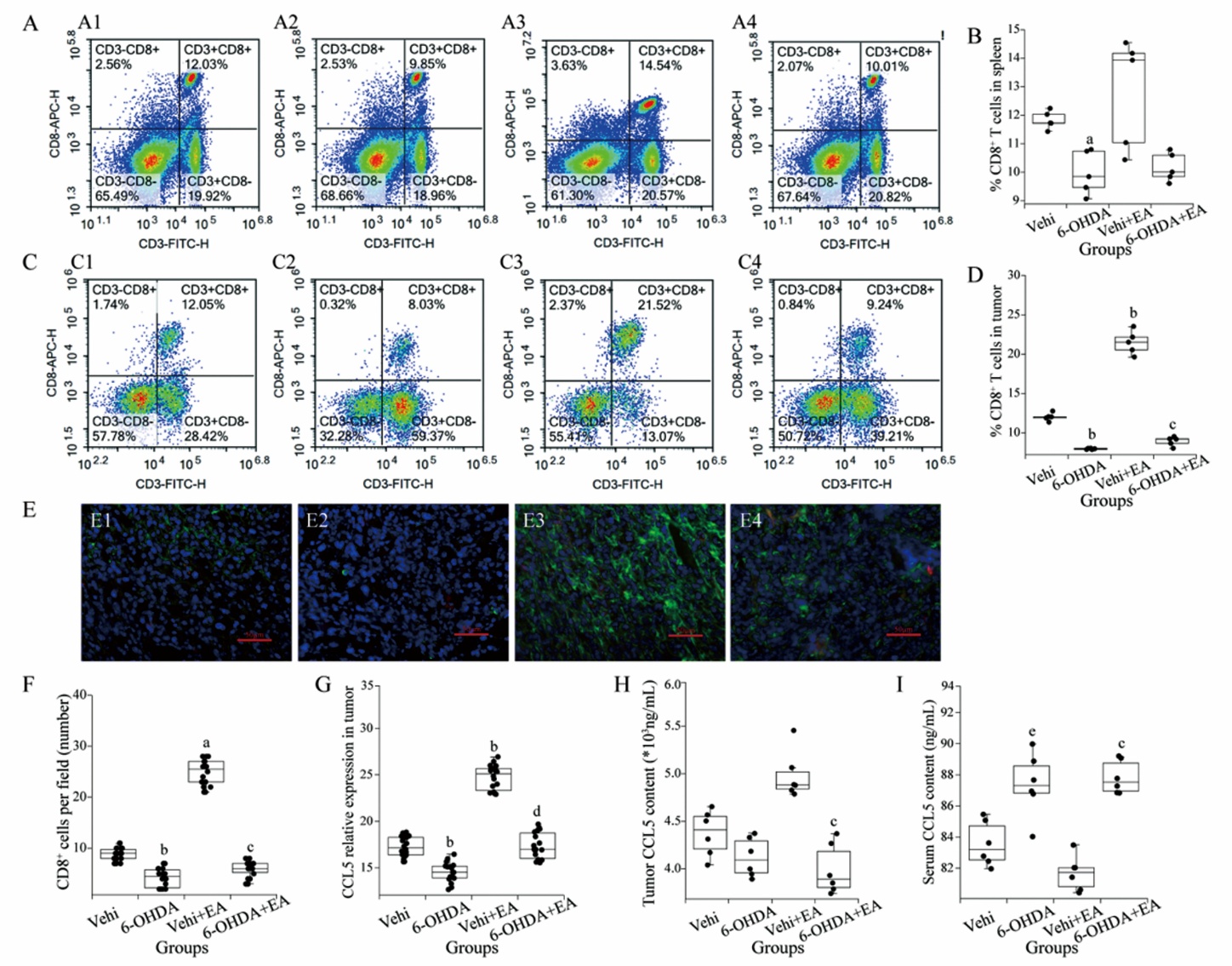
Figure 4 Chemical sympathetic ablation hindered CD8+ T cells recruitment of EA A: FCM analysis of CD8+ T cells in spleen; B: proportions of CD8+ T cells in the spleen; C: FCM analysis of CD8+ T cells in the tumor; D: proportions of CD8+ T cells in the tumor; E: representative IF images of CD8 (red), CCL5 (green) and DAPI (blue) in the tumor tissue (× 200); F: proportions of CD8+ T cells in the tumor of mice detected by IF staining; G: relative expression of CCL5 in the tumor of mice detected by IF; H: tumorous levels of the CCL5 detected by ELISA; I: serum CCL5 detected by ELISA; A1, C1, E1: vehi group; A2, C2, E2: 6-OHDA group; A3, C3, E3: vehi + EA group; A4, C4, E4: 6-OHDA+EA group. vehi group: received 0.2 mL saline with 0.01% ascorbate; 6-OHDA group: received 100 mg/kg 6-OHDA to ablate sympathetic innervation; vehi + EA group: received peritumoral EA based on the vehi group; 6-OHDA + EA: received peritumoral EA based on the 6-OHDA group. EA: electroacupuncture; FCM: flow cytometry; IF: immunofluorescence; CCL5: C-C motif chemokine ligand 5; DAPI: 4',6-diamidino-2-phenylindole; 6-OHDA: 6-hydroxydopamine; ELISA: enzyme-linked immunosorbent assay; Vehi: vehicle. All quantitative data are presented as mean ± standard error of the mean (n = 6); multiple groups were compared using one-way analysis of variance, followed by Tukey's honestly significant difference. aP < 0.05 and bP < 0.001, compared with the vehi group; cP < 0.001, compared with the vehi + EA group; dP < 0.001, compared with the 6-OHDA group; eP < 0.01, compared with the vehi group.
Figure 4 Chemical sympathetic ablation hindered CD8+ T cells recruitment of EA A: FCM analysis of CD8+ T cells in spleen; B: proportions of CD8+ T cells in the spleen; C: FCM analysis of CD8+ T cells in the tumor; D: proportions of CD8+ T cells in the tumor; E: representative IF images of CD8 (red), CCL5 (green) and DAPI (blue) in the tumor tissue (× 200); F: proportions of CD8+ T cells in the tumor of mice detected by IF staining; G: relative expression of CCL5 in the tumor of mice detected by IF; H: tumorous levels of the CCL5 detected by ELISA; I: serum CCL5 detected by ELISA; A1, C1, E1: vehi group; A2, C2, E2: 6-OHDA group; A3, C3, E3: vehi + EA group; A4, C4, E4: 6-OHDA+EA group. vehi group: received 0.2 mL saline with 0.01% ascorbate; 6-OHDA group: received 100 mg/kg 6-OHDA to ablate sympathetic innervation; vehi + EA group: received peritumoral EA based on the vehi group; 6-OHDA + EA: received peritumoral EA based on the 6-OHDA group. EA: electroacupuncture; FCM: flow cytometry; IF: immunofluorescence; CCL5: C-C motif chemokine ligand 5; DAPI: 4',6-diamidino-2-phenylindole; 6-OHDA: 6-hydroxydopamine; ELISA: enzyme-linked immunosorbent assay; Vehi: vehicle. All quantitative data are presented as mean ± standard error of the mean (n = 6); multiple groups were compared using one-way analysis of variance, followed by Tukey's honestly significant difference. aP < 0.05 and bP < 0.001, compared with the vehi group; cP < 0.001, compared with the vehi + EA group; dP < 0.001, compared with the 6-OHDA group; eP < 0.01, compared with the vehi group.
| 1. |
Zagami P, Carey LA. Triple negative breast cancer: Pitfalls and progress. NPJ breast cancer 2022; 8: 95.
DOI PMID |
| 2. |
Obidiro O, Battogtokh G, Akala EO. Triple negative breast cancer treatment options and limitations: future outlook. Pharmaceutics 2023; 15: 1796.
DOI URL |
| 3. |
Xiong N, Wu H, Yu Z. Advancements and challenges in triple-negative breast cancer: a comprehensive review of therapeutic and diagnostic strategies. Front Oncol 2024; 14: 1405491.
DOI URL |
| 4. |
Michaels E, Chen N, Nanda R. The role of immunotherapy in triple-negative breast cancer (TNBC). Clin Breast Cancer 2024; 24: 263-70.
DOI PMID |
| 5. |
Sun YP, Ke YL, Li X. Prognostic value of CD8+ tumor-infiltrating T cells in patients with breast cancer: a systematic review and Meta-analysis. Oncol Lett 2023; 25: 39.
DOI URL |
| 6. |
Leon-Ferre RA, Jonas SF, Salgado R, et al. Tumor-infiltrating lymphocytes in triple-negative breast cancer. JAMA 2024; 331: 1135-44.
DOI PMID |
| 7. |
Feng D, Pu D, Ren J, et al. CD8+ T-cell exhaustion: impediment to triple-negative breast cancer (TNBC) immunotherapy. Biochim Biophys Acta Rev Cancer 2024; 1879: 189193.
DOI URL |
| 8. |
Gutierrez-Leal I, Caballero-Hernández D, Orozco-Flores AA, et al. Role of the sympathetic nervous system in cancer-associated cachexia and tumor progression in tumor-bearing BALB/c mice. BMC Neurosci 2024; 25: 37.
DOI PMID |
| 9. |
Garramona FT, Cunha TF, Vieira JS, et al. Increased sympathetic nervous system impairs prognosis in lung cancer patients: a scoping review of clinical studies. Lung Cancer Manag 2023; 12: Lmt63.
DOI PMID |
| 10. |
Sloan EK, Priceman SJ, Cox BF, et al. The sympathetic nervous system induces a metastatic switch in primary breast cancer. Cancer Res 2010; 70: 7042-52.
DOI PMID |
| 11. | Reavis HD, Gysler SM, McKenney GB, et al. Norepinephrine induces anoikis resistance in high-grade serous ovarian cancer precursor cells. JCI Insight 2024; 9: e170961. |
| 12. |
Farooq MA, Ajmal I, Hui X, Chen Y, Ren Y, Jiang W. β2-Adrenergic receptor mediated inhibition of T cell function and its implications for CAR-T cell therapy. Int J Mol Sci 2023; 24: 12837.
DOI URL |
| 13. | Yang C, He Y, Chen F, Zhang F, Shao D, Wang Z. Leveraging β-adrenergic receptor signaling blockade for improved cancer immunotherapy through biomimetic nanovaccine. Small 2023; 19: e2207029. |
| 14. |
Qiao G, Chen M, Mohammadpour H, et al. Chronic adrenergic stress contributes to metabolic dysfunction and an exhausted phenotype in T Cells in the tumor microenvironment. Cancer immunology research 2021; 9: 651-64.
DOI PMID |
| 15. |
Li W, Wan J, Chen C, et al. Dissecting the role of cell signaling versus CD8+ T cell modulation in propranolol antitumor activity. J Mol Med (Berl) 2022; 100: 1299-306.
DOI |
| 16. |
Gandhi S, Pandey MR, Attwood K, et al. Phase I clinical trial of combination propranolol and pembrolizumab in locally advanced and metastatic melanoma: safety, tolerability, and preliminary evidence of antitumor activity. Clin Cancer Res 2021; 27: 87-95.
DOI PMID |
| 17. |
Tian Y, Qiu X, Qi X, et al. Electroacupuncture promotes apoptosis and inhibits axonogenesis by activating p75 neurotrophin receptor for triple-negative breast xenograft in mice. J Chem Neuroanat 2022; 124: 102133.
DOI URL |
| 18. |
Wan YX, Qi XW, Lian YY, et al. Electroacupuncture facilitates vascular normalization by inhibiting Glyoxalase1 in endothelial cells to attenuate glycolysis and angiogenesis in triple-negative breast cancer. Cancer Lett 2024; 598: 217094.
DOI URL |
| 19. |
Zhang Z, Yu Q, Zhang X, et al. Electroacupuncture regulates inflammatory cytokines by activating the vagus nerve to enhance antitumor immunity in mice with breast tumors. Life Sci 2021; 272: 119259.
DOI URL |
| 20. |
Qi X, Lian Y, Fan Z, et al. Electroacupuncture normalized tumor vasculature by downregulating glyoxalase-1 to polarize tumor-associated macrophage to M1 phenotype in triple-negative breast cancer. Int Immunopharmacol 2025; 147: 113988.
DOI URL |
| 21. |
Pei LX, Yi Y, Guo J, et al. The effectiveness and safety of acupuncture/electroacupuncture for chemotherapy-induced peripheral neuropathy: a systematic review and Meta-analysis. Acupunct Med 2023; 41: 73-85.
DOI URL |
| 22. |
Zhang J, Wu W, Ren Y, Yuan Y, Jia L. Electroacupuncture for the treatment of cancer pain: a systematic review and Meta-analysis of randomized clinical trials. Front Pain Res 2023; 4: 1186506.
DOI URL |
| 23. |
Han QQ, Fu Y, Le JM, et al. The therapeutic effects of acupuncture and electroacupuncture on cancer-related symptoms and side-effects. J Cancer 2021; 12: 7003-9.
DOI URL |
| 24. |
Wang Y, Liu F, Du X, et al. Combination of anti-PD-1 and electroacupuncture induces a potent antitumor immune response in microsatellite-stable colorectal cancer. Cancer immunology research 2024; 12: 26-35.
DOI URL |
| 25. |
Lin HC, Hsu HC, Liao HY, Chen ALP, Lin YW. Electroacupuncture modulates programmed cell death 1 ligand 1 on peripheral and central nervous systems in a mouse fibromyalgia pain model. Biomedicines 2025; 13: 396.
DOI URL |
| 26. |
Saraswati W, Dahlan EG, Saputra K, Sutrisno TC. Effect of electroacupuncture on natural-killer cells and tumor size in patients with cervical squamous-cell carcinoma: a randomized controlled trial. Med Acupunct 2019; 31: 29-36.
DOI PMID |
| 27. | Tian Y, Ma Y, Li X, et al. Electroacupuncture combined with HDAC1 inhibitor suppress tumor growth via improving the recruitment of intratumor CD8+ T cells for triple-negative breast cancer in mice. Front Oncol 2025; 15. |
| 28. | National Research Council. Guide for the care and use of laboratory animals: eighth edition. Washington: The National Academies Press 2011; 12-35. |
| 29. |
Palazzolo S, Hadla M, Russo Spena C, et al. An effective multi-stage liposomal DNA origami nanosystem for in vivo cancer therapy. Cancers (Basel) 2019; 11: 1997.
DOI URL |
| 30. |
Sun J, Guo Y, Zhang Q, et al. Chronic restraint stress disturbs meiotic resumption through APC/C-mediated cyclin B1 excessive degradation in mouse oocytes. Cell Cycle 2018; 17: 1591-601.
DOI PMID |
| 31. |
Szpunar MJ, Belcher EK, Dawes RP, Madden KS. Sympathetic innervation, norepinephrine content, and norepinephrine turnover in orthotopic and spontaneous models of breast cancer. Brain Behav Immun 2016; 53: 223-33.
DOI PMID |
| 32. | Dong W, He B, Cao Y, et al. Low-dose SAHA enhances CD8+ T cell-mediated antitumor immunity by boosting MHC I expression in non-small cell lung cancer. Cellular oncology (Dordrecht) 2024: 249-64. |
| 33. |
Kamiya A, Hayama Y, Kato S, et al. Genetic manipulation of autonomic nerve fiber innervation and activity and its effect on breast cancer progression. Nat Neurosci 2019; 22: 1289-305.
DOI PMID |
| 34. |
Kappos EA, Engels PE, Tremp M, et al. Denervation leads to volume regression in breast cancer. J Plast Reconstr Aesthet Surg 2018; 71: 833-9.
DOI PMID |
| 35. |
Coelho M, Soares-Silva C, Brandão D, Marino F, Cosentino M, Ribeiro L. β-Adrenergic modulation of cancer cell proliferation: available evidence and clinical perspectives. J Cancer Res Clin Oncol 2017; 143: 275-91.
DOI PMID |
| 36. |
Thapa S, Cao X. Nervous regulation: beta-2-adrenergic signaling in immune homeostasis, cancer immunotherapy, and autoimmune diseases. Cancer Immunol Immunother 2023; 72: 2549-56.
DOI PMID |
| 37. |
Mohammadpour H, MacDonald CR, Qiao G, et al. β2 adrenergic receptor-mediated signaling regulates the immunosuppressive potential of myeloid-derived suppressor cells. J Clin Invest 2019; 129: 5537-52.
DOI PMID |
| 38. |
MacDonald C, Ministero S, Pandey M, et al. Comparing thermal stress reduction strategies that influence MDSC accumulation in tumor bearing mice. Cellular immunology 2021; 361: 104285.
DOI URL |
| 39. |
Switzer B, Puzanov I, Gandhi S, Repasky EA. Targeting beta-adrenergic receptor pathways in melanoma: how stress modulates oncogenic immunity. Melanoma research 2024; 34: 89-95.
DOI URL |
| 40. |
Zhang H, Yang Y, Cao Y, Guan J. Effects of chronic stress on cancer development and the therapeutic prospects of adrenergic signaling regulation. Biomed Pharmacother 2024; 175: 116609.
DOI URL |
| 41. | Chen L, Xu G, Song X, et al. A novel antagonist of the CCL5/CCR5 axis suppresses the tumor growth and metastasis of triple-negative breast cancer by CCR5-YAP1 regulation. Cancer Lett 2024; 583: 216635. |
| 42. |
Li L, Wang H, Zhang S, et al. Statins inhibit paclitaxel-induced PD-L1 expression and increase CD8+ T cytotoxicity for better prognosis in breast cancer. Int J Surg 2024; 110: 4716-26.
DOI PMID |
| 43. |
Zheng QM, Li YY, Wang YP, Li GX, Zhao MM, Sun ZG. Association between CD8+ tumor-infiltrating lymphocytes and prognosis of non-small cell lung cancer patients treated with PD-1/PD-L1 inhibitors: a systematic review and Meta-analysis. Expert Rev Anticancer Ther 2023; 23: 643-59.
DOI URL |
| 44. |
Chen X, Xu R, He D, et al. CD8+ T effector and immune checkpoint signatures predict prognosis and responsiveness to immunotherapy in bladder cancer. Oncogene 2021; 40: 6223-34.
DOI |
| 45. |
Liao K, Yang Q, Xu Y, et al. Identification of signature of tumor-infiltrating CD8 T lymphocytes in prognosis and immunotherapy of colon cancer by machine learning. Clinical immunology (Orlando, Fla) 2023; 257: 109811.
DOI URL |
| 46. |
Luo J, Cheng K, Ji X, et al. Anlotinib enhanced CD8+ T cell infiltration via induction of CCL5 improves the efficacy of PD-1/PD-L1 blockade therapy in lung cancer. Cancer Lett 2024; 591: 216892.
DOI URL |
| 47. |
Castoldi A, Lee J, de Siqueira Carvalho D, Souto FO. CD8+ T cell metabolic changes in breast cancer. Biochim Biophys Acta Mol Basis Dis 2023; 1869: 166565.
DOI URL |
| 48. |
Feng B, Li R, Li W, Tang L. Metabolic immunoengineering approaches to enhance CD8+ T cell-based cancer immunotherapy. Cell systems 2024; 15: 1225-44.
DOI URL |
| 49. |
Viel S, Vivier E, Walzer T, Marçais A. Targeting metabolic dysfunction of CD 8 T cells and natural killer cells in cancer. Nat Rev Drug Discov 2025; 24: 190-208.
DOI |
| 50. |
Sun J, Wang YM, Lyu J, et al. Effect of electroacupuncture on hypertensive and sympathetic excitability mechanism mediated by the paraventricular nucleus of the hypothalamus in spontaneous hypertensive rats. J Tradit Chin Med 2025; 45: 586-96.
DOI |
| 51. |
Qin JF, Jin FJ, Li N, et al. Adrenergic receptor β2 activation by stress promotes breast cancer progression through macrophages M2 polarization in tumor microenvironment. BMB reports 2015; 48: 295-300.
DOI URL |
| 52. |
Hinkle L, Liu Y, Meng C, et al. The sympathetic nervous system modulates cancer vaccine activity through monocyte-derived cells. J Immunol 2021; 207: 3131-40.
DOI PMID |
| 53. |
Zhao X, Li F, Cheng C, et al. Social isolation promotes tumor immune evasion via β2-adrenergic receptor. Brain Behav Immun 2025; 123: 607-18.
DOI URL |
| 54. | Tian Y, Jiang X, Zhao W, et al. Acupuncture enhances anticancer effects of cyclophosphamide on 4T1 tumors via suppression of angiogenesis in BALB/c mice. J Tradit Chin Med Sci 2017; 4: 216-21. |
| [1] | XU Huichao, HAO Jianheng, CHANG Boya, WANG Danni, LI Rangqian, CAO Yuxia, WANG Haijun, JI Laixi. Electroacupuncture alleviates intestinal inflammation in rats with ulcerative colitis by regulating colonic cell autophagy and gut microbiota [J]. Journal of Traditional Chinese Medicine, 2026, 46(4): 894-906. |
| [2] | QU Yuanyuan, FENG Chuwen, SUN Weibo, SHAO Yuying, LU Jing, GUO Shuhao, LI Binbin, YANG Tiansong. Effect of “Tongdu Yupi Tiaoshen” electroacupuncture on behavioral performance and hippocampal structure and function in chronic fatigue syndrome rats [J]. Journal of Traditional Chinese Medicine, 2026, 46(3): 605-616. |
| [3] | JIA Ao, LIU Shuang, GAO Tingting, ZHANG Haoran, GAO Wenyuan, WU Xiongzhi. Mechanisms of Gualou Beimu Yin (瓜蒌贝母饮) in suppressing the development and metastasis of triple-negative breast cancer: an integrated study based on network pharmacology, transcriptomics, and metabolomics [J]. Journal of Traditional Chinese Medicine, 2026, 46(1): 149-159. |
| [4] | SHOU Yin, JIANG Juntao, HU Jianlin, JI Wei, CHEN Chunyan, HU Li, MA Yuhang, ZHANG Bimeng. Electroacupuncture alleviates type 2 diabetes mellitus by promoting plasma-derived exosomal circular RNA of enhancer of zeste homolog 1 expression [J]. Journal of Traditional Chinese Medicine, 2025, 45(6): 1228-1237. |
| [5] | ZHAO Ping, HE Xingbo, HAN Xudong, CHEN Xinyue, LI Zhanglong, SONG Jike, XING Wenjia, WU Jiangfeng, GUO Bin, BI Hongsheng. Mechanism of electroacupuncture involve in lens-induced myopia guinea pigs by inhibiting wnt/β-catenin signaling pathway [J]. Journal of Traditional Chinese Medicine, 2025, 45(4): 796-805. |
| [6] | ZHENG Ruwen, DONG Xu, WANG Tianyi, FENG Liyuan, ZHANG Hongyan, HUO Hong, ZHANG Ying, ZHANG Qianshi, ZHU Xingyan, WANG Dongyan. Electroacupuncture versus conventional acupuncture of scalp motor area for post-stroke wrist dyskinesia and its effect on muscle function: a randomized, controlled clinical trial [J]. Journal of Traditional Chinese Medicine, 2025, 45(4): 852-859. |
| [7] | SUN Jiao, WANG Yueming, LYU Jian, LIU Xin, YUE Bingnan, LI Yinyin, LIU Jipeng, SUN Yize, LIU Qingguo, YAN Liu. Effect of electroacupuncture on hypertensive and sympathetic excitability mechanism mediated by the paraventricular nucleus of the hypothalamus in spontaneous hypertensive rats [J]. Journal of Traditional Chinese Medicine, 2025, 45(3): 586-596. |
| [8] | ZHANG Yang, LYU Wang, XU Xin, LI Jie, HU Shengli, WANG Ying. Clinical effect of Shugan Jieyu San (疏肝解郁散) for improving liver function and alleviating depression in patients with triple negative breast cancer [J]. Journal of Traditional Chinese Medicine, 2025, 45(3): 633-638. |
| [9] | LI Yongfeng, CHEN Xinyi, REN Wei, QIAO Haifa. Electroacupuncture stimulation of auricular concha region improves loss of control over stress induced depression-like behavior by modulating 5-hydroxytryptamine 1A receptor [J]. Journal of Traditional Chinese Medicine, 2025, 45(2): 326-334. |
| [10] | HU Junwei, FENG Jiwei, LI Wen, LIU Lumin, LI Xu, XU Ge, LIU Jiandang, CHEN Yuelai. Electroacupuncture improves cyclophosphamide-induced bladder overactivity by reducing mechanotransduction in the rat urothelium [J]. Journal of Traditional Chinese Medicine, 2025, 45(2): 348-358. |
| [11] | LI Siting, WANG Shaojun, YIN Yehui, DE Gejing, LI Caicai, WANG Ziyan, CAO Wenjie. Electroacupuncture alleviates zymosan-induced colorectal hypersensitivity [J]. Journal of Traditional Chinese Medicine, 2025, 45(1): 32-38. |
| [12] | Emre Bulut, Didem Özkal Eminoğlu, Yasemin Çayır. Effect of electroacupuncture on pain after periodontal flap surgery: a randomized controlled trial [J]. Journal of Traditional Chinese Medicine, 2025, 45(1): 184-191. |
| [13] | ZHANG Boyang, ZHOU Yang, FENG Liyuan, SUI Dan, HE Lei, TONG Dan, WANG Ruoyu, SUI Xue, SONG Jing, WANG Dongyan. A neural regulation mechanism of head electroacupuncture on brain network of patients with stroke related sleep disorders [J]. Journal of Traditional Chinese Medicine, 2024, 44(6): 1268-1276. |
| [14] | XI Hanqing, LI Xia, ZHANG Ziyi, CUI Xiang, JING Xianghong, ZHU Bing, GAO Xinyan. Neuro- and immuno-modulation mediated by the cardiac sympathetic nerve: a novel insight into the anti-ischemic efficacy of acupuncture [J]. Journal of Traditional Chinese Medicine, 2024, 44(5): 1058-1066. |
| [15] | XU Yingshan, WU Chunxiao, YU Wei, GUO Hongji, LU Liming, XU Nenggui, TANG Chunzhi. Systematic review and Meta-analysis of brain plasticity associated with electroacupuncture in experimental ischemic stroke [J]. Journal of Traditional Chinese Medicine, 2024, 44(5): 859-870. |
| Viewed | ||||||
|
Full text |
|
|||||
|
Abstract |
|
|||||
