
Journal of Traditional Chinese Medicine ›› 2026, Vol. 46 ›› Issue (5): 1230-1239.DOI: 10.19852/j.cnki.jtcm.2026.05.015
• Original Articles • Previous Articles Next Articles
Multi-target therapeutic mechanism of Qianlie Shule granule (前列舒乐颗粒) against chronic prostatitis: network pharmacology-guided experimental validation
LIU Shengjing1, FENG Qiujian1, Elena Colonnello2, Andrea Sansone2, Susanna Dolci3, WANG Chunlin2, WANG Fu1, GUO Jun1, GUO Boda4( ), Emmanuele A. Jannini2()
- 1
Department of Andrology ,Xiyuan Hospital of China Academy of Chinese Medical Sciences Beijing 100091, China
2Chair of Endocrinology and Medical Sexology (ENDOSEX) ,Department of Systems Medicine, University of Rome Tor Vergata Rome 00133, Italy
3Chair of Anatomy ,Department of Biomedicine and Prevention, University of Rome Tor Vergata Rome 00133, Italy
4Department of Urology ,Peking University Third Hospital Beijing 100191, China
-
Received:2025-07-12Accepted:2025-12-05Online:2026-10-15Published:2026-10-09 -
Contact:Emmanuele A. Jannini, Full Professor of Endocrinology & Medical Sexology (ENDOSEX), Department of Systems Medicine, University of Rome Tor Vergata, Roma 00133, Italy. eajannini@gmail.com; Guo Boda, Department of Urology, Peking University Third Hospital, Beijing 100191, China. guoboda@126.com. Telephone: +86-10-82267017 -
Supported by:China Association for Science and Technology: Young Elite Scientists Sponsorship Program(YESS20240193);China Scholarship Council(202308110213);Next Generation European Union Grant Funded by the Ministry of University and Research, National Recovery and Resilience Plan: a Multiscale Integrated Approach to the Study of the Nervous System in Health and Disease(PE0000006);Projects of National Interest Grant of the Ministry of University and Research: the Endocrine, Vascular and Sexual Crosstalk in People Living with Human Immunodeficiency Virus: Exploratory Trial on the Role of Phosphodiesterase 5 Inhibitors(2022AWB8T4);Projects of National Interest Grant of the Ministry of University and Research: Exploring the Role of Medicines in the Induction as Well as the Management of Sexual Dysfunction Through Analysis of Big Data and Smart Data(P2022SE38P_004);Projects of National Interest Grant of the Ministry of University and Research(P2022CE79J_004);National Administration of Traditional Chinese Medicine: High-Level Key Discipline Construction Project of Traditional Chinese Medicine(zyyzdxk-2023238)

Cite this article
LIU Shengjing, FENG Qiujian, Elena Colonnello, Andrea Sansone, Susanna Dolci, WANG Chunlin, WANG Fu, GUO Jun, GUO Boda, Emmanuele A. Jannini. Multi-target therapeutic mechanism of Qianlie Shule granule (前列舒乐颗粒) against chronic prostatitis: network pharmacology-guided experimental validation[J]. Journal of Traditional Chinese Medicine, 2026, 46(5): 1230-1239.
share this article
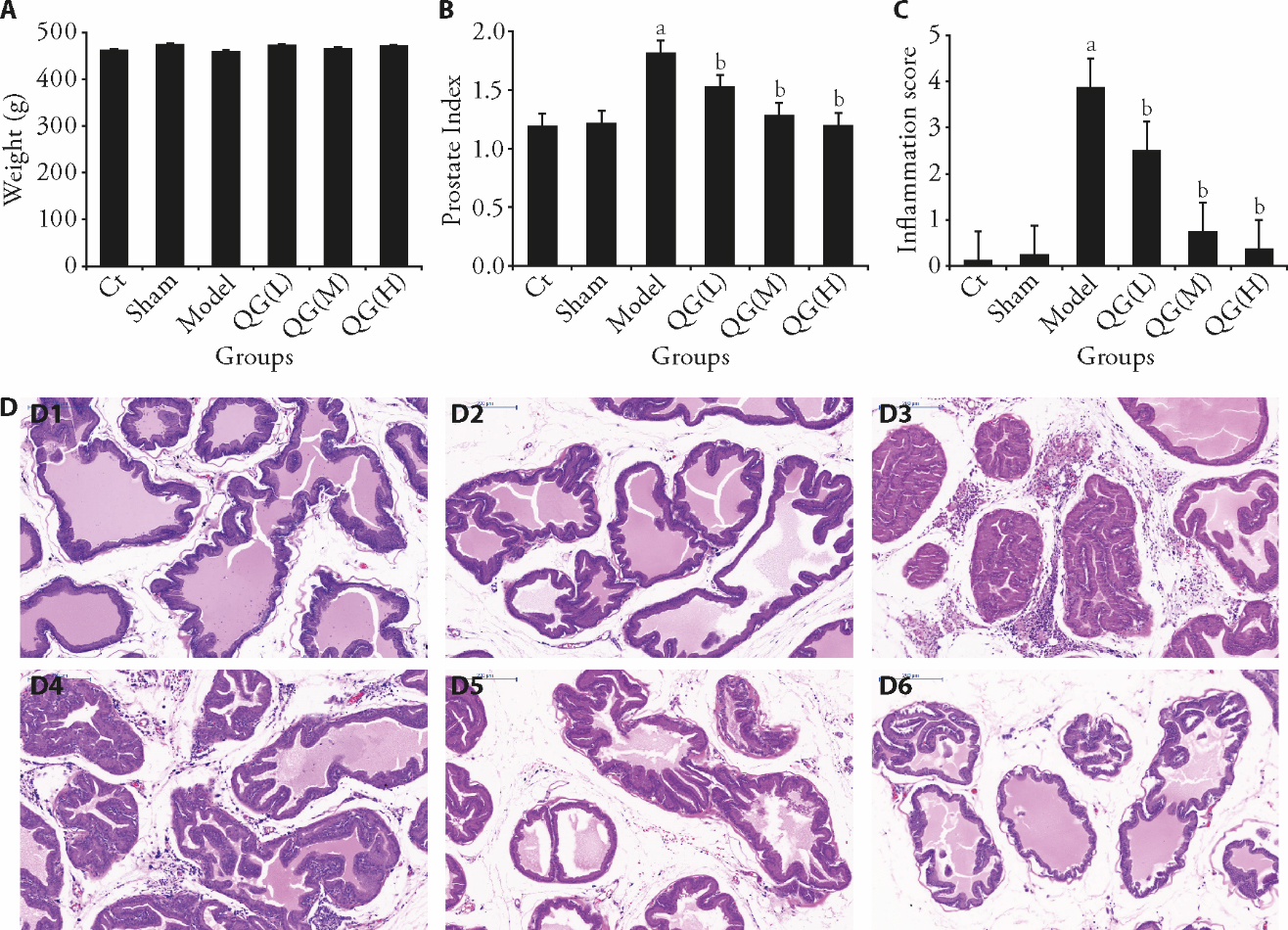
Figure 1 QG attenuates the prostate histological damage A: Body weight among groups; B: prostate index among groups; C: histological scores of HE-stained prostate tissues; D: histological analysis of prostate tissues by HE staining (× 200, scale bars = 200 μm). D1: control group; D2: sham group; D3: model group; D4: QG-low dose group; D5: QG-middle dose group; D6: QG-high dose group. Model group: CP model rats administered water by gavage; QG-low dose group CP model rats administered QG at 0.54 g·kg-1·d-1 by gavage for 4 weeks; QG-middle dose group: CP model rats administered QG at 1.08 g·kg-1·d-1 by gavage for 4 weeks; QG-high dose group: CP model rats administered QG at 2.16 g·kg-1·d-1 by gavage for 4 weeks. QG: Qianlie Shule granules; HE: hematoxylin and eosin. Data are presented as mean ± standard deviation (n = 8). Statistical differences were determined by one-way analysis of variance. Compared with control group, aP < 0.05; compared with model group, bP < 0.05.
Figure 1 QG attenuates the prostate histological damage A: Body weight among groups; B: prostate index among groups; C: histological scores of HE-stained prostate tissues; D: histological analysis of prostate tissues by HE staining (× 200, scale bars = 200 μm). D1: control group; D2: sham group; D3: model group; D4: QG-low dose group; D5: QG-middle dose group; D6: QG-high dose group. Model group: CP model rats administered water by gavage; QG-low dose group CP model rats administered QG at 0.54 g·kg-1·d-1 by gavage for 4 weeks; QG-middle dose group: CP model rats administered QG at 1.08 g·kg-1·d-1 by gavage for 4 weeks; QG-high dose group: CP model rats administered QG at 2.16 g·kg-1·d-1 by gavage for 4 weeks. QG: Qianlie Shule granules; HE: hematoxylin and eosin. Data are presented as mean ± standard deviation (n = 8). Statistical differences were determined by one-way analysis of variance. Compared with control group, aP < 0.05; compared with model group, bP < 0.05.

Figure 2 QG inhibits prostate inflammation and enhances antioxidant capacity in CP rats A: IL-1β, IL-6, CXCL1, and MCP-1 levels in prostate tissues; A1: IL-1β; A2: IL-6; A3: CXCL1; A4: MCP-1; B: CD45+ cell infiltration in prostatic tissues and quantitative analysis; B1: prostate tissues of the control group; B2: prostate tissues of the sham group; B3: prostate tissues of the model group; B4: prostate tissues of the QG-low dose group; B5: prostate tissues of the QG-middle dose group; B6: prostate tissues of the QG-high dose group; B7: quantitative analysis of CD45+ cell infiltration in prostatic tissues among groups; Control group: administered water by gavage; sham group: received saline injection into the prostate and administered water by gavage; model group: CP model rats administered water by gavage; QG-low dose group: CP model rats administered QG at 0.54 g·kg-1·d-1 by gavage for 4 weeks; QG-middle dose group: CP model rats administered QG at 1.08 g·kg-1·d-1 by gavage for 4 weeks; QG-high dose group: CP model rats administered QG at 2.16 g·kg-1·d-1 by gavage for 4 weeks. C: MDA, T-SOD, and GSH-PX levels in prostate tissues; C1: MDA; C2: T-SOD; C3: GSH-PX. CP: chronic prostatitis; IL-1β: interleukin-1 beta; IL-6: interleukin-6; CXCL1: C-X-C motif chemokine ligand 1; MCP-1: monocyte chemoattractant protein 1; CD45: leukocyte common antigen; MDA: malondialdehyde; T-SOD: total superoxide dismutase; GSH-PX: glutathione peroxidase; QG: Qianlie Shule granules. Data are presented as mean ± standard deviation (n = 8). Statistical differences were determined by one-way analysis of variance. Compared with control group, aP < 0.05; compared with model group, bP < 0.05.
Figure 2 QG inhibits prostate inflammation and enhances antioxidant capacity in CP rats A: IL-1β, IL-6, CXCL1, and MCP-1 levels in prostate tissues; A1: IL-1β; A2: IL-6; A3: CXCL1; A4: MCP-1; B: CD45+ cell infiltration in prostatic tissues and quantitative analysis; B1: prostate tissues of the control group; B2: prostate tissues of the sham group; B3: prostate tissues of the model group; B4: prostate tissues of the QG-low dose group; B5: prostate tissues of the QG-middle dose group; B6: prostate tissues of the QG-high dose group; B7: quantitative analysis of CD45+ cell infiltration in prostatic tissues among groups; Control group: administered water by gavage; sham group: received saline injection into the prostate and administered water by gavage; model group: CP model rats administered water by gavage; QG-low dose group: CP model rats administered QG at 0.54 g·kg-1·d-1 by gavage for 4 weeks; QG-middle dose group: CP model rats administered QG at 1.08 g·kg-1·d-1 by gavage for 4 weeks; QG-high dose group: CP model rats administered QG at 2.16 g·kg-1·d-1 by gavage for 4 weeks. C: MDA, T-SOD, and GSH-PX levels in prostate tissues; C1: MDA; C2: T-SOD; C3: GSH-PX. CP: chronic prostatitis; IL-1β: interleukin-1 beta; IL-6: interleukin-6; CXCL1: C-X-C motif chemokine ligand 1; MCP-1: monocyte chemoattractant protein 1; CD45: leukocyte common antigen; MDA: malondialdehyde; T-SOD: total superoxide dismutase; GSH-PX: glutathione peroxidase; QG: Qianlie Shule granules. Data are presented as mean ± standard deviation (n = 8). Statistical differences were determined by one-way analysis of variance. Compared with control group, aP < 0.05; compared with model group, bP < 0.05.
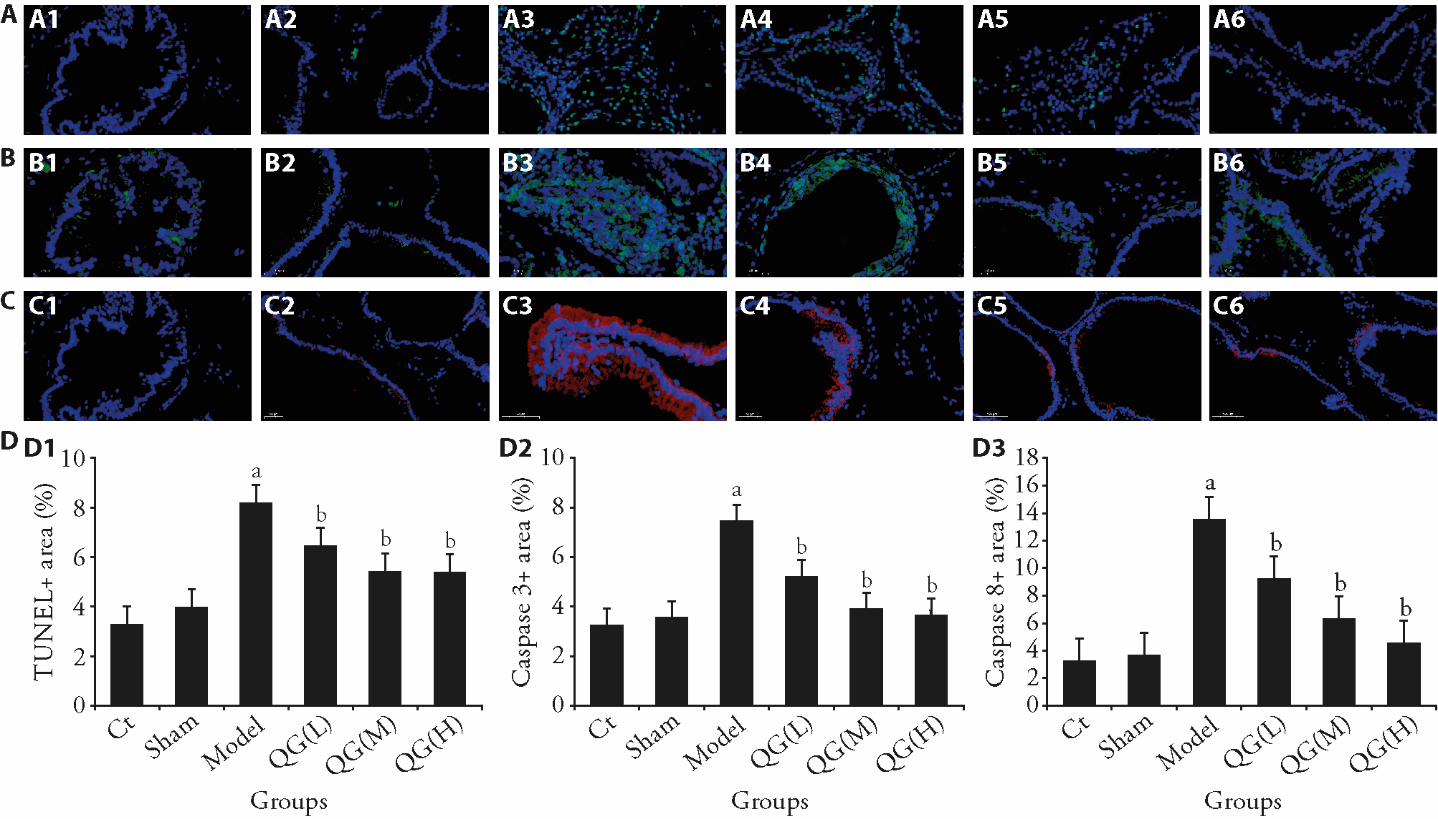
Figure 3 QG inhibits apoptosis and Caspase 3 and Caspase 8 expression A: TUNEL staining of prostate tissue sections in each group; TUNEL-positive nuclei are labeled with FITC (green), and nuclei are counterstained with DAPI (blue); B: immunofluorescence staining of Caspase 3 in prostate sections; C: immunofluorescence staining of Caspase 8 in prostate sections; A1, B1, C1: control group; A2, B2, C2: sham group; A3, B3, C3: model group; A4, B4, C4: QG-low dose group; A5, B5, C5: QG-middle dose group; A6, B6, C6: QG-high dose group; Control group: administered water by gavage; sham group: received saline injection into the prostate and administered water by gavage; model group: CP model rats administered water by gavage; QG-low dose group: CP model rats administered QG at 0.54 g·kg-1·d-1 by gavage for 4 weeks; QG-middle dose group: CP model rats administered QG at 1.08 g·kg-1·d-1 by gavage for 4 weeks; QG-high dose group: CP model rats administered QG at 2.16 g·kg-1·d-1 by gavage for 4 weeks. D: quantitative analysis of TUNEL-positive cells and immunofluorescence intensity of Caspase 3 and Caspase 8; D1: quantitative analysis of TUNEL-positive cells; D2: immunofluorescence intensity of Caspase 3; D3: immunofluorescence intensity of Caspase 8. TUNEL: terminal deoxynucleotidyl transferase dUTP nick-end labeling; FITC: fluorescein isothiocyanate; DAPI: 4′,6-diamidino-2-phenylindole; QG: Qianlie Shule granules. Data are presented as mean ± standard deviation (n = 3). Statistical differences were determined by one-way analysis of variance. Compared with control group, aP < 0.05; compared with model group, bP < 0.05.
Figure 3 QG inhibits apoptosis and Caspase 3 and Caspase 8 expression A: TUNEL staining of prostate tissue sections in each group; TUNEL-positive nuclei are labeled with FITC (green), and nuclei are counterstained with DAPI (blue); B: immunofluorescence staining of Caspase 3 in prostate sections; C: immunofluorescence staining of Caspase 8 in prostate sections; A1, B1, C1: control group; A2, B2, C2: sham group; A3, B3, C3: model group; A4, B4, C4: QG-low dose group; A5, B5, C5: QG-middle dose group; A6, B6, C6: QG-high dose group; Control group: administered water by gavage; sham group: received saline injection into the prostate and administered water by gavage; model group: CP model rats administered water by gavage; QG-low dose group: CP model rats administered QG at 0.54 g·kg-1·d-1 by gavage for 4 weeks; QG-middle dose group: CP model rats administered QG at 1.08 g·kg-1·d-1 by gavage for 4 weeks; QG-high dose group: CP model rats administered QG at 2.16 g·kg-1·d-1 by gavage for 4 weeks. D: quantitative analysis of TUNEL-positive cells and immunofluorescence intensity of Caspase 3 and Caspase 8; D1: quantitative analysis of TUNEL-positive cells; D2: immunofluorescence intensity of Caspase 3; D3: immunofluorescence intensity of Caspase 8. TUNEL: terminal deoxynucleotidyl transferase dUTP nick-end labeling; FITC: fluorescein isothiocyanate; DAPI: 4′,6-diamidino-2-phenylindole; QG: Qianlie Shule granules. Data are presented as mean ± standard deviation (n = 3). Statistical differences were determined by one-way analysis of variance. Compared with control group, aP < 0.05; compared with model group, bP < 0.05.
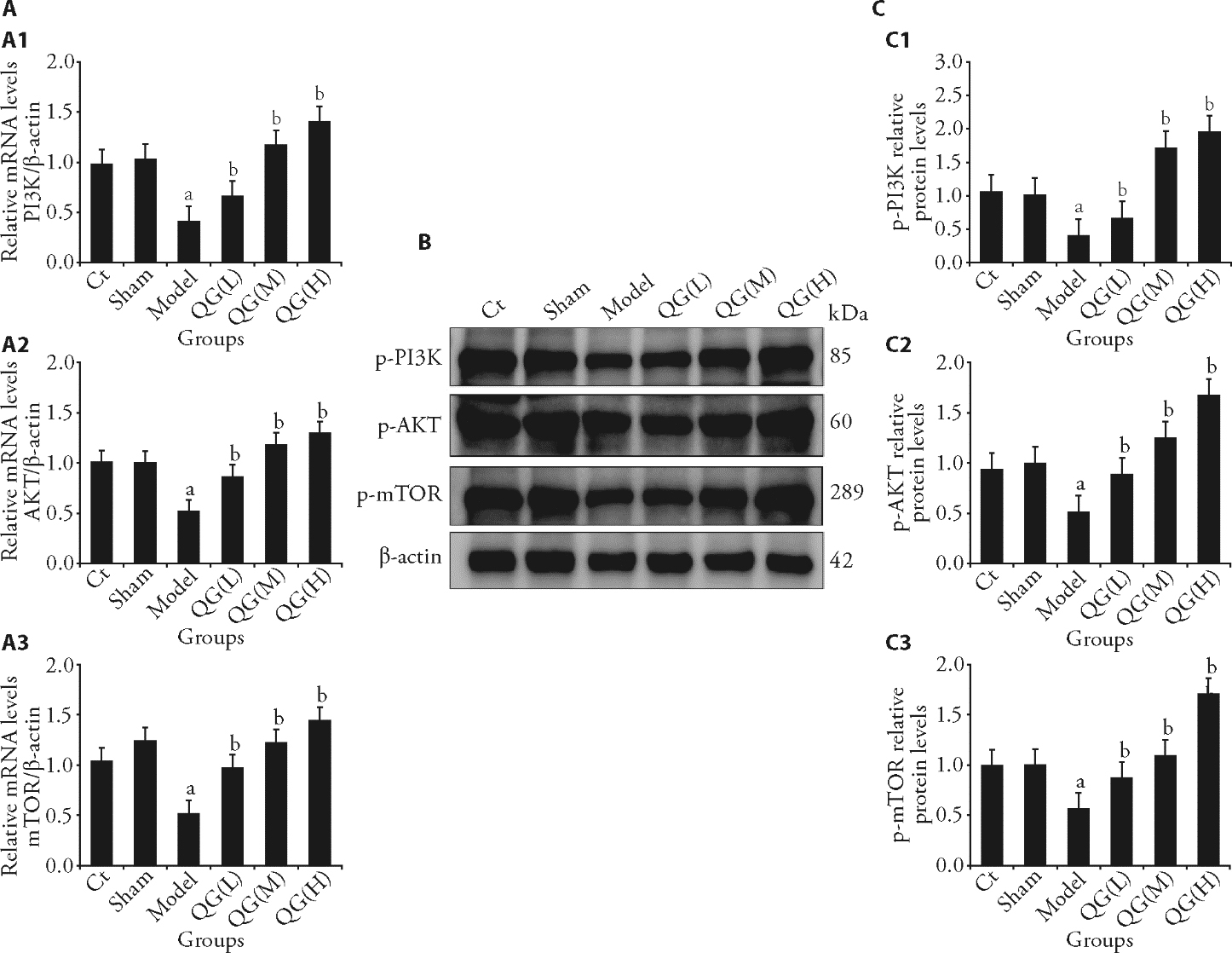
Figure 4 QG activates PI3K/Akt/mTOR signaling pathway in prostate tissue A: relative mRNA expression of PI3K, AKT, and mTOR measured by RT-qPCR using the 2-ΔΔCt method with β-actin as the reference gene (n = 8); A1: PI3K; A2: AKT; A3: mTOR; B: Representative Western blots of p-PI3K, p-Akt, and p-mTOR; β-actin served as the loading control (n = 3); C: quantitative analysis of p-PI3K, p-Akt, and p-mTOR protein levels; C1: p-PI3K; C2: p-Akt; C3: p-mTOR. Control group: administered water by gavage; sham group: received saline injection into the prostate and administered water by gavage; model group: CP model rats administered water by gavage; QG-low dose group: CP model rats administered QG at 0.54 g·kg-1·d-1 by gavage for 4 weeks; QG-middle dose group: CP model rats administered QG at 1.08 g·kg-1·d-1 by gavage for 4 weeks; QG-high dose group: CP model rats administered QG at 2.16 g·kg-1·d-1 by gavage for 4 weeks. RT-qPCR: real-time quantitative polymerase chain reaction; PI3K: phosphatidylinositol 3-kinase; AKT: protein kinase B; mTOR: mechanistic target of rapamycin; p-PI3K: phosphorylated PI3K; p-Akt: phosphorylated Akt; p-mTOR: phosphorylated mTOR; QG: Qianlie Shule granules. Data are presented as mean ± standard deviation. Statistical differences were determined by one-way analysis of variance followed by Tukey’s post hoc test. Compared with control group, aP < 0.05; compared with model group, bP < 0.05.
Figure 4 QG activates PI3K/Akt/mTOR signaling pathway in prostate tissue A: relative mRNA expression of PI3K, AKT, and mTOR measured by RT-qPCR using the 2-ΔΔCt method with β-actin as the reference gene (n = 8); A1: PI3K; A2: AKT; A3: mTOR; B: Representative Western blots of p-PI3K, p-Akt, and p-mTOR; β-actin served as the loading control (n = 3); C: quantitative analysis of p-PI3K, p-Akt, and p-mTOR protein levels; C1: p-PI3K; C2: p-Akt; C3: p-mTOR. Control group: administered water by gavage; sham group: received saline injection into the prostate and administered water by gavage; model group: CP model rats administered water by gavage; QG-low dose group: CP model rats administered QG at 0.54 g·kg-1·d-1 by gavage for 4 weeks; QG-middle dose group: CP model rats administered QG at 1.08 g·kg-1·d-1 by gavage for 4 weeks; QG-high dose group: CP model rats administered QG at 2.16 g·kg-1·d-1 by gavage for 4 weeks. RT-qPCR: real-time quantitative polymerase chain reaction; PI3K: phosphatidylinositol 3-kinase; AKT: protein kinase B; mTOR: mechanistic target of rapamycin; p-PI3K: phosphorylated PI3K; p-Akt: phosphorylated Akt; p-mTOR: phosphorylated mTOR; QG: Qianlie Shule granules. Data are presented as mean ± standard deviation. Statistical differences were determined by one-way analysis of variance followed by Tukey’s post hoc test. Compared with control group, aP < 0.05; compared with model group, bP < 0.05.
| [1] | Shoskes DA, DeWitt-Foy ME, Nickel JC. Management of chronic prostatitis/chronic pelvic pain syndrome. Eur Urol Focus 2019; 5: 2-4. |
| [2] | Clemens JQ, Mullins C, Ackerman AL, et al. Urologic chronic pelvic pain syndrome: insights from the MAPP research network. Nat Rev Urol 2019; 16: 187-200. |
| [3] | Liu SJ, Gao QH, Deng YJ, Zeng Y, Zhao M, Guo J. Knowledge domain and emerging trends in chronic prostatitis/chronic pelvic pain syndrome from 1970 to 2020: a scientometric analysis based on VOSviewer and CiteSpace. Ann Palliat Med 2022; 11: 1714-24. |
| [4] | Li HJ, Kang DY. Prevalence of sexual dysfunction in men with chronic prostatitis/chronic pelvic pain syndrome: a Meta-analysis. World J Urol 2016; 34: 1009-17. |
| [5] | Magistro G, Wagenlehner FM, Grabe M, Weidner W, Stief CG, Nickel JC. Contemporary management of chronic prostatitis/chronic pelvic pain syndrome. Eur Urol 2016; 69: 286-97. |
| [6] | Schoeb DS, Schlager D, Boeker M, et al. Surgical therapy of prostatitis: a systematic review. World J Urol 2017; 35: 1659-68. |
| [7] | Polackwich AS, Shoskes DA. Chronic prostatitis/chronic pelvic pain syndrome: a review of evaluation and therapy. Prostate Cancer Prostatic Dis 2016; 19: 132-8. |
| [8] | Zhu P, Su Z, Fan Q, Zhang C, Wang T. Network pharmacology and animal experiments revealed the protective effects of Guilong prescription (归龙方) on chronic prostatitis and its possible mechanisms. J Tradit Chin Med 2025; 45: 89-99. |
| [9] | Nickel JC. Chronic prostatitis/chronic pelvic pain syndrome: it is time to change our management and research strategy. BJU Int 2020; 125: 479-80. |
| [10] | Liu SJ, Zhao F, Deng YJ, et al. Investigating the multi-target therapeutic mechanism of Guihuang formula on chronic prostatitis. J Ethnopharmacol 2022; 294: 115386. |
| [11] | Liu SJ, Deng YJ, Zeng Y, Zhao M, Guo J, Gao QH. Efficacy and safety of Guihuang formula in treating type Ⅲ prostatitis patients with dampness-heat and blood stasis syndrome: a randomized controlled trial. Chin J Integr Med 2022; 28: 879-84. |
| [12] | Shaohu Z, Jun G, Gang C, Zhiwei W, Bin Y. Qianlie Shule granule for chronic prostatitis: a multicenter self-controlled clinical trial. Zhong Guo Nan Ke Xue 2019; 33: 48-51. |
| [13] | Zhang B, Wang X, Li Y, Wu M, Wang SY, Li S. Matrine is identified as a novel macropinocytosis inducer by a network target approach. Front Pharmacol 2018; 9: 10. |
| [14] | Li S. Exploring Traditional Chinese Medicine by a novel therapeutic concept of network target. Chin J Integr Med 2016; 22: 647-52. |
| [15] | Zhang R, Zhu X, Bai H, Ning K. Network pharmacology databases for Traditional Chinese Medicine: review and assessment. Front Pharmacol 2019; 10: 123. |
| [16] | Li S, Zhang B, Zhang N. Network target for screening synergistic drug combinations with application to Traditional Chinese Medicine. BMC Syst Biol 2011; 5 Suppl 1: S10. |
| [17] | Ru J, Li P, Wang J, et al. TCMSP: a database of systems pharmacology for drug discovery from herbal medicines. J Cheminform 2014; 6: 13. |
| [18] | Liu SJ, Guo BD, Gao QH, et al. Ursolic acid alleviates chronic prostatitis via regulating NLRP3 inflammasome-mediated Caspase-1/GSDMD pyroptosis pathway. Phytother Res 2024; 38: 82-97. |
| [19] | Janhavi P, Divyashree S, Sanjailal KP, Muthukumar SP. DoseCal: a virtual calculator for dosage conversion between human and different animal species. Arch Physiol Biochem 2022; 128: 426-30. |
| [20] | Zhang LG, Chen J, Meng JL, et al. Effect of alcohol on chronic pelvic pain and prostatic inflammation in a mouse model of experimental autoimmune prostatitis. Prostate 2019; 79: 1439-49. |
| [21] | Yang F, Meng L, Han P, et al. New therapy with XLQ® to suppress chronic prostatitis through its anti-inflammatory and antioxidative activities. J Cell Physiol 2019; 234: 17570-7. |
| [22] | Schwartz ES, La JH, Young EE, Feng B, Joyce S, Gebhart GF. Chronic prostatitis induces bladder hypersensitivity and sensitizes bladder afferents in the mouse. J Urol 2016; 196: 892-901. |
| [23] | Ho DR, Chang PJ, Lin WY, et al. Beneficial effects of inflammatory cytokine-targeting aptamers in an animal model of chronic prostatitis. Int J Mol Sci 2020; 21: 3953. |
| [24] | Said MM, Bosland MC. The anti-inflammatory effect of montelukast, a cysteinyl leukotriene receptor-1 antagonist, against estradiol-induced nonbacterial inflammation in the rat prostate. Naunyn Schmiedebergs Arch Pharmacol 2017; 390: 197-205. |
| [25] | Ren J, Jo Y, Picton LK, Su LL, Raulet DH, Garcia KC. Induced 45 proximity potentiates natural killer cell receptor antagonism. ACS Synth Biol 2022; 11: 3426-39. |
| [26] | Liu J, Yu J, Peng X. Poria cocos polysaccharides alleviates chronic nonbacterial prostatitis by preventing oxidative stress, regulating hormone production, modifying gut microbiota, and remodeling the DNA methylome. J Agric Food Chem 2020; 68: 12661-70. |
| [27] | Zia A, Farkhondeh T, Pourbagher-Shahri AM, Samarghandian S. The role of curcumin in aging and senescence: molecular mechanisms. Biomed Pharmacother 2021; 134: 111119. |
| [28] | Yilmaz MI, Romano M, Basarali MK, et al. The effect of corrected inflammation, oxidative stress and endothelial dysfunction on FMD levels in patients with selected chronic diseases: a quasi-experimental study. Sci Rep 2020; 10: 9018. |
| [29] | Chen H, Xie Y, Deng C, et al. The anti-inflammatory and antioxidative effects of Ningmitai capsule in the experimental autoimmune prostatitis rat model. Evid Based Complement Alternat Med 2020; 2020: 5847806. |
| [30] | Meng LQ, Yang FY, Wang MS, et al. Quercetin protects against chronic prostatitis in rat model through NF-κB and MAPK signaling pathways. Prostate 2018; 78: 790-800. |
| [31] | Nadendla EK, Tweedell RE, Kasof G, Kanneganti TD. Caspases: structural and molecular mechanisms and functions in cell death, innate immunity, and disease. Cell Discov 2025; 11: 42. |
| [32] | Guo Y, Bao C, Ma D, et al. Network-based combinatorial CRISPR-Cas9 screens identify synergistic modules in human cells. ACS Synth Biol 2019; 8: 482-90. |
| [33] | Luo Z, Dong J, Wu J. Impact of icariin and its derivatives on inflammatory diseases and relevant signaling pathways. Int Immunopharmacol 2022; 108: 108861. |
| [34] | Breser ML, Salazar FC, Rivero VE, Motrich RD. Immunological mechanisms underlying chronic pelvic pain and prostate inflammation in chronic pelvic pain syndrome. Front Immunol 2017; 8: 898. |
| [35] | Facio F, Colonnello E, Alzweri L, et al. Infection, inflammation, and sexual function in male and female patients - recommendations from the Fifth International Consultation on Sexual Medicine (ICSM 2024). Sex Med Rev 2025; 13: 301-17. |
| [36] | Jang TL, Schaeffer AJ. The role of cytokines in prostatitis. World J Urol 2003; 21: 95-9. |
| [37] | Wang LL, Huang YH, Yan CY, et al. N-acetylcysteine ameliorates prostatitis via miR-141 regulating Keap1/Nrf2 signaling. Inflammation 2016; 39: 938-47. |
| [38] | Nakatsumi H, Matsumoto M, Nakayama KI. Noncanonical pathway for regulation of CCL2 expression by an mTORC1-FOXK1 axis promotes recruitment of tumor-associated macrophages. Cell Rep 2017; 21: 2471-86. |
| [39] | Ai D, Jiang H, Westerterp M, et al. Disruption of mammalian target of rapamycin complex 1 in macrophages decreases chemokine gene expression and atherosclerosis. Circ Res 2014; 114: 1576-84. |
| [40] | Kang SW, Park JH, Seok H, et al. The effects of Korea Red Ginseng on inflammatory cytokines and apoptosis in rat model with chronic nonbacterial prostatitis. Biomed Res Int 2019; 2019: 2462561. |
| Viewed | ||||||
|
Full text |
|
|||||
|
Abstract |
|
|||||