
Journal of Traditional Chinese Medicine ›› 2026, Vol. 46 ›› Issue (3): 629-640.DOI: 10.19852/j.cnki.jtcm.20260304.001
• Original Articles • Previous Articles Next Articles
Evaluation of the anti-apoptotic, anti-platelet aggregation, and pro-angiogenic properties of Naoshuantong capsule (脑栓通) in ischemic stroke: insights from network pharmacology and animal experiments
LI Chuanpeng1,2,3, YAO Yaoyao1,2,4, XU Yingzhi1,2,4, JIANG Ping1,2,4, FENG Luda1,2,4, GAO Ying1,2,3,4( ), DONG Xinglu1,2,4()
- 1
Department of Neurology ,Dongzhimen Hospital, Beijing University of Chinese Medicine Beijing 100700, China
2Institute for Brain Disorders ,Beijing University of Chinese Medicine Beijing 100700, China
3Key Laboratory of Chinese Internal Medicine of Ministry of Education and Beijing ,Dongzhimen Hospital Affiliated to Beijing University of Chinese Medicine Beijing 100700, China
4Chinese Medicine Key Research Room of Brain Disorders Syndrome and Treatment of the National Administration of Traditional Chinese Medicine Beijing 100700, China
-
Received:2025-03-07Accepted:2025-08-18Online:2026-06-15Published:2026-03-04 -
Contact:Prof. GAO Ying, Department of Neurology, Dongzhimen Hospital, Beijing University of Chinese Medicine, Beijing 100007, China. gaoying973@163.com;
Dr. DONG Xinglu, Department of Neurology, Dongzhimen Hospital, Beijing University of Chinese Medicine, Beijing 100007, China. arthasdxl@163.com, Telephone: +86-10-84013258 -
Supported by:Research on the Mechanism of Naoshuantong capsule in Treatment of Ischemic Stroke Based on Network Pharmacology(601249);National Natural Science Foundation of China (Young Scientists Fund), “Study on the Effects and Mechanisms of Detoxification and Collateral-Unblocking Therapy on Ischemic Stroke by Regulating Mitochondria-associated ER membranes Ca2+ Homeostasis via the Inositol 1,4,5-trisphosphate Receptor Type 1-Glucose-regulated Protein 75-Voltage-dependent Anion Channel 1 Complex”(82405317);Beijing Municipal level Traditional Chinese Medicine Expert Academic Experience Inheritance Work Project(202279);Research on the Phar macological Mechanism of Naoshuantong Capsule in the Treatment of Ischemic Stroke and Cerebral Small Vessel Disease(601418qt)

Cite this article
LI Chuanpeng, YAO Yaoyao, XU Yingzhi, JIANG Ping, FENG Luda, GAO Ying, DONG Xinglu. Evaluation of the anti-apoptotic, anti-platelet aggregation, and pro-angiogenic properties of Naoshuantong capsule (脑栓通) in ischemic stroke: insights from network pharmacology and animal experiments[J]. Journal of Traditional Chinese Medicine, 2026, 46(3): 629-640.
share this article
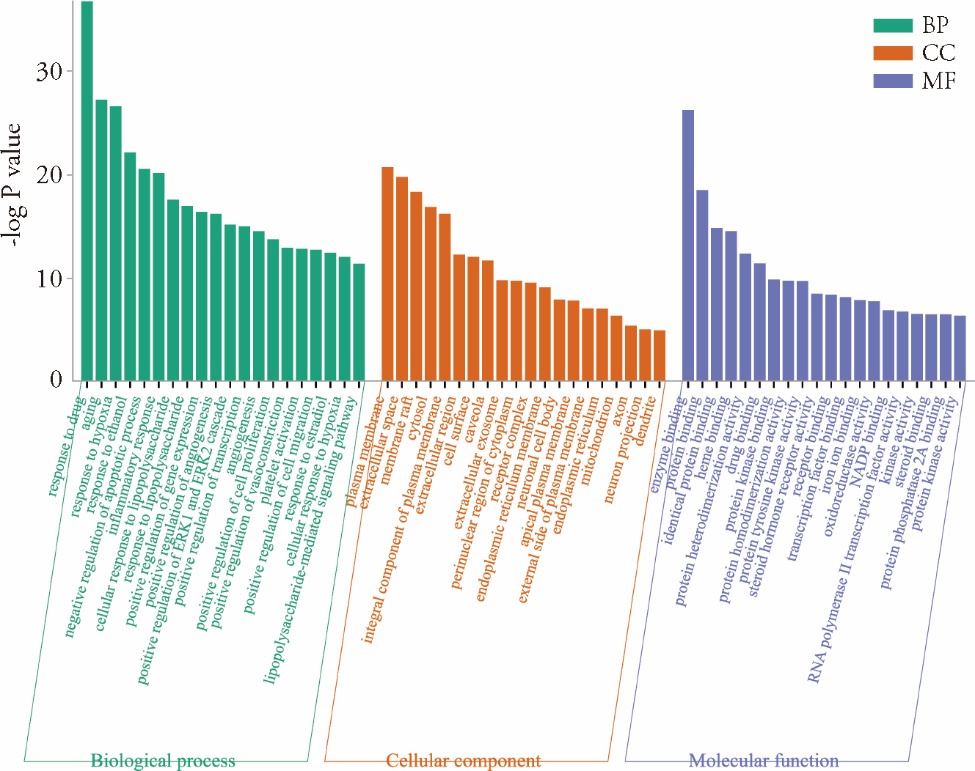
Figure 1 The GO enrichment analyses The top 20 of GO enrichment of intersection targets for BPs, CCs, and MFs. GO: gene ontology; BPs: biological processes; CCs: cellular components; MFs: molecular functions.
Figure 1 The GO enrichment analyses The top 20 of GO enrichment of intersection targets for BPs, CCs, and MFs. GO: gene ontology; BPs: biological processes; CCs: cellular components; MFs: molecular functions.
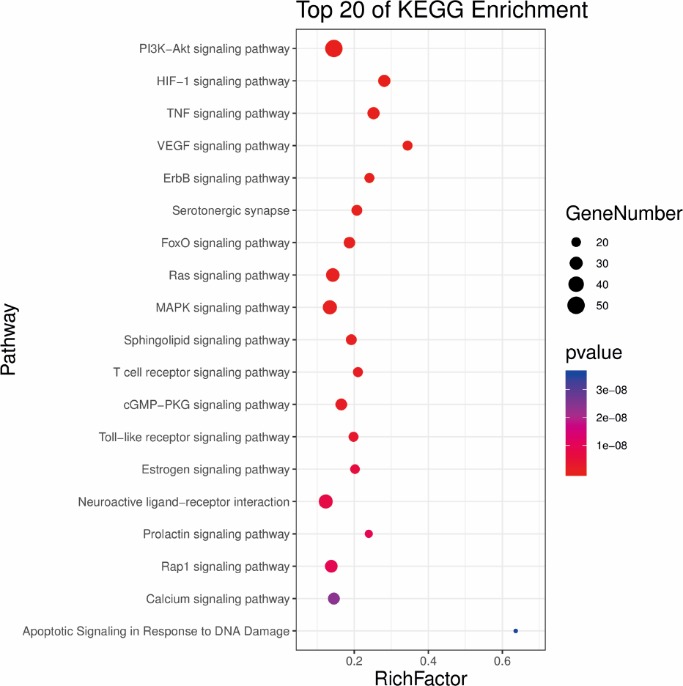
Figure 2 Top 20 pathways of KEGG pathway analyses of intersection targets. KEGG: kyoto encyclopedia of genes and genomes; PI3K-AKT: phosphoinositide 3-kinase-serine-threonine protein kinase; HIF-1: hypoxia-inducible factor 1; TNF: tumor necrosis factor, VEGF: vascular endothelial growth factor, ErbB: erb-b2 receptor tyrosine kinase family, serotonergic synapse; FoxO: forkhead box O; Ras: rat sarcoma viral oncogene; MAPK: mitogen-activated protein kinase; cGMP-PKG: cyclic guanosine monophosphate-protein kinase g signaling pathway; RAP1: ras-related protein 1; cAMP: cyclic adenosine monophosphate.
Figure 2 Top 20 pathways of KEGG pathway analyses of intersection targets. KEGG: kyoto encyclopedia of genes and genomes; PI3K-AKT: phosphoinositide 3-kinase-serine-threonine protein kinase; HIF-1: hypoxia-inducible factor 1; TNF: tumor necrosis factor, VEGF: vascular endothelial growth factor, ErbB: erb-b2 receptor tyrosine kinase family, serotonergic synapse; FoxO: forkhead box O; Ras: rat sarcoma viral oncogene; MAPK: mitogen-activated protein kinase; cGMP-PKG: cyclic guanosine monophosphate-protein kinase g signaling pathway; RAP1: ras-related protein 1; cAMP: cyclic adenosine monophosphate.
Table 1 The Binding energy of AKT1, PI3K, and VEGFA with the corresponding compound
| Ingredient | Core targets | Binding energy (kcal/mol) |
|---|---|---|
| Naringenin | AKT1 | -8.076 |
| PI3K | -7.804 | |
| VEGFA | -6.345 | |
| Baicalein | AKT1 | -8.954 |
| PI3K | -7.951 | |
| VEGFA | -6.400 | |
| Ellagic acid | AKT1 | -9.039 |
| PI3K | -8.152 | |
| VEGFA | -6.300 | |
| Paeoniflorin | AKT1 | -6.452 |
| PI3K | -8.600 | |
| VEGFA | -6.935 |
Table 1 The Binding energy of AKT1, PI3K, and VEGFA with the corresponding compound
| Ingredient | Core targets | Binding energy (kcal/mol) |
|---|---|---|
| Naringenin | AKT1 | -8.076 |
| PI3K | -7.804 | |
| VEGFA | -6.345 | |
| Baicalein | AKT1 | -8.954 |
| PI3K | -7.951 | |
| VEGFA | -6.400 | |
| Ellagic acid | AKT1 | -9.039 |
| PI3K | -8.152 | |
| VEGFA | -6.300 | |
| Paeoniflorin | AKT1 | -6.452 |
| PI3K | -8.600 | |
| VEGFA | -6.935 |
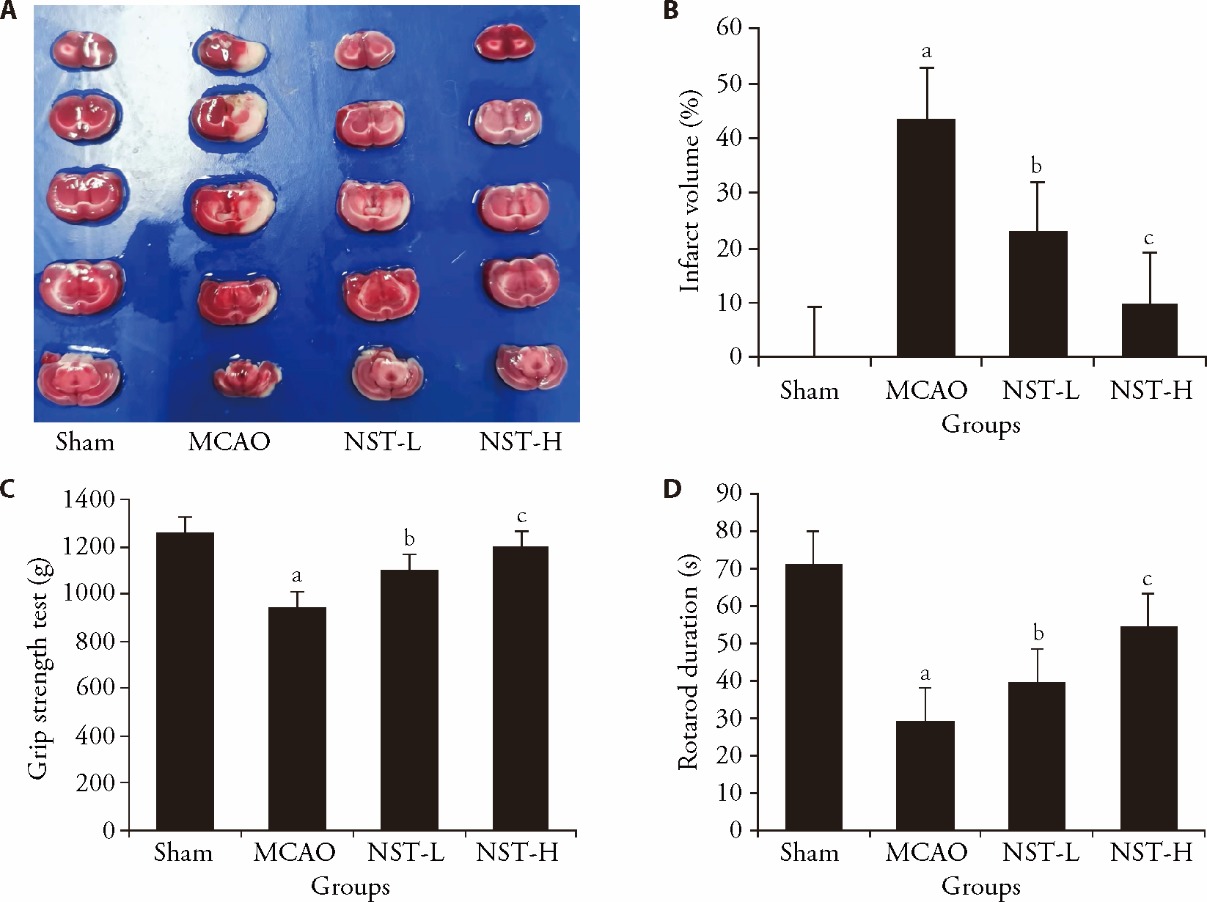
Figure 3 The NST relieves cerebral ischemia-reperfusion injury and improves motor performance A: representative pictures of TTC staining; B: quantitative analysis of infarct volumes; C: the effect of NST on grip strength test; D: rotarod duration. Sham: sham surgery group; MCAO: middle cerebral artery occlusion group; NST-L: Naoshuantong low-dose group (0.5 g·kg-1;·d-1; of NST for 7 d); NST-H: Naoshuantong high-dose group (1 g·kg-1;·d-1; of NST for 7 d). NST: Naoshuantong; TTC: 2,3,5-triphenyltetrazolium chloride; One-way analysis of variance was employed to compare the mean between groups for statistical testing. Data are presented as mean ± standard error of the mean (n = 3-5). Compared with sham group, aP < 0.01; compared with MCAO group, bP < 0.05, cP < 0.01.
Figure 3 The NST relieves cerebral ischemia-reperfusion injury and improves motor performance A: representative pictures of TTC staining; B: quantitative analysis of infarct volumes; C: the effect of NST on grip strength test; D: rotarod duration. Sham: sham surgery group; MCAO: middle cerebral artery occlusion group; NST-L: Naoshuantong low-dose group (0.5 g·kg-1;·d-1; of NST for 7 d); NST-H: Naoshuantong high-dose group (1 g·kg-1;·d-1; of NST for 7 d). NST: Naoshuantong; TTC: 2,3,5-triphenyltetrazolium chloride; One-way analysis of variance was employed to compare the mean between groups for statistical testing. Data are presented as mean ± standard error of the mean (n = 3-5). Compared with sham group, aP < 0.01; compared with MCAO group, bP < 0.05, cP < 0.01.
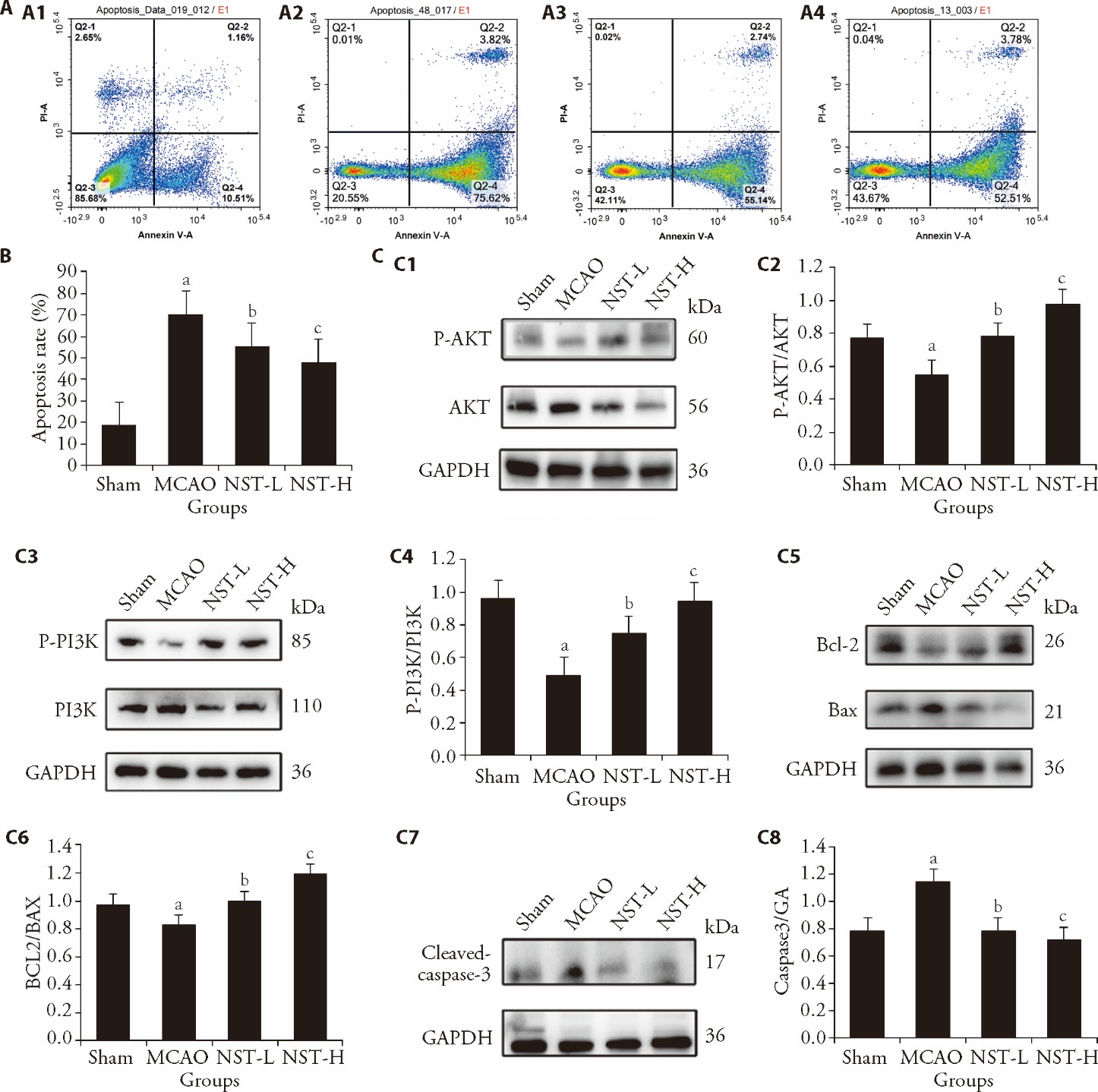
Figure 4 NST regulates related proteins of the PI3K-AKT pathway A: representative pictures of apoptosis detection in MCAO rats; A1: sham group; A2: MCAO group; A3: NST-L group; A4: NST-H group; B: quantitative analysis of apoptosis in MCAO rats; C: quantitative analysis of P-AKT/AKT, P-PI3K/PI3K, Bcl-2/Bax, and cleaved-caspase-3/GPAHD in Western blotting and representative Western blot analysis of P-AKT, AKT, P-PI3K, PI3K, Bcl-2, Bax, cleaved-caspase-3, and GPAHD; C1: representative Western blot analysis of P-AKT/ AKT; C2: quantitative analysis of P-AKT/AKT; C3: representative Western blot analysis of P-PI3K/PI3K; C4: quantitative analysis of P-PI3K/PI3K; C5: representative Western blot analysis of Bcl-2/Bax; C6: quantitative analysis of Bcl-2/Bax; C7: representative Western blot analysis of cleaved-caspase-3; C8: quantitative analysis of cleaved-caspase-3/GPAHD. NST: Naoshuantong; MCAO: middle cerebral artery occlusion; AKT: akt serine/threonine kinase; P-AKT: phosphorylated-akt; PI3K: phosphoinositide 3-Kinase; P-PI3K: phosphorylated-phosphoinositide 3-kinase; Bcl-2: b-cell lymphoma 2; Bax: bcl-2 associated x protein; GAPHD: glyceraldehyde-3-phosphate dehydrogenase. Sham: sham surgery group; MCAO: middle cerebral artery occlusion group; NST-L: Naoshuantong low-dose group (0.5 g·kg-1;·d-1; of NST for 7 d); NST-H: Naoshuantong high-dose group (1 g·kg-1;·d-1; of NST for 7 d). One-way analysis of variance was employed to compare the mean between groups for statistical testing. Data are presented as mean ± standard error of the mean (n = 5). Compared with sham group, aP < 0.05; compared with MCAO group, bP < 0.05, cP < 0.01.
Figure 4 NST regulates related proteins of the PI3K-AKT pathway A: representative pictures of apoptosis detection in MCAO rats; A1: sham group; A2: MCAO group; A3: NST-L group; A4: NST-H group; B: quantitative analysis of apoptosis in MCAO rats; C: quantitative analysis of P-AKT/AKT, P-PI3K/PI3K, Bcl-2/Bax, and cleaved-caspase-3/GPAHD in Western blotting and representative Western blot analysis of P-AKT, AKT, P-PI3K, PI3K, Bcl-2, Bax, cleaved-caspase-3, and GPAHD; C1: representative Western blot analysis of P-AKT/ AKT; C2: quantitative analysis of P-AKT/AKT; C3: representative Western blot analysis of P-PI3K/PI3K; C4: quantitative analysis of P-PI3K/PI3K; C5: representative Western blot analysis of Bcl-2/Bax; C6: quantitative analysis of Bcl-2/Bax; C7: representative Western blot analysis of cleaved-caspase-3; C8: quantitative analysis of cleaved-caspase-3/GPAHD. NST: Naoshuantong; MCAO: middle cerebral artery occlusion; AKT: akt serine/threonine kinase; P-AKT: phosphorylated-akt; PI3K: phosphoinositide 3-Kinase; P-PI3K: phosphorylated-phosphoinositide 3-kinase; Bcl-2: b-cell lymphoma 2; Bax: bcl-2 associated x protein; GAPHD: glyceraldehyde-3-phosphate dehydrogenase. Sham: sham surgery group; MCAO: middle cerebral artery occlusion group; NST-L: Naoshuantong low-dose group (0.5 g·kg-1;·d-1; of NST for 7 d); NST-H: Naoshuantong high-dose group (1 g·kg-1;·d-1; of NST for 7 d). One-way analysis of variance was employed to compare the mean between groups for statistical testing. Data are presented as mean ± standard error of the mean (n = 5). Compared with sham group, aP < 0.05; compared with MCAO group, bP < 0.05, cP < 0.01.
| 1. |
Thayabaranathan T, Kim J, Cadilhac DA, et al. Global stroke statistics 2022. Int J Stroke 2022; 17: 946-56.
DOI URL |
| 2. |
Sun T, Chen S, Wu K, Sun M, Zhang X, You C. Trends in incidence and mortality of stroke in China from 1990 to 2019. Front Neurol 2021; 12: 759221.
DOI URL |
| 3. | Tu W J, Hua Y, Yan F, et al. Prevalence of stroke in China, 2013-2019: a population-based study. Lancet Reg Health West Pac 2022; 28: 100550. |
| 4. |
Mosconi MG, Paciaroni M. Treatments in ischemic stroke: current and future. Eur Neurol 2022; 85: 349-66.
DOI URL |
| 5. |
Charbonnier G, Bonnet L, Biondi A, Moulin T. Intracranial bleeding after reperfusion therapy in acute ischemic stroke. Front Neurol 2020; 11: 629920.
DOI URL |
| 6. |
Nie X, Wang D, Pu Y, et al. Endovascular treatment with or without intravenous alteplase for acute ischaemic stroke due to basilar artery occlusion. Stroke Vasc Neurol 2022; 7: 190-9.
DOI URL |
| 7. |
Huang CX, Gao Y, Yu Q, Feng LQ. Herbal compound Naoshuantong capsule attenuates retinal injury in ischemia/reperfusion rat model by inhibiting apoptosis. Int J Clin Exp Med 2015; 8: 12252-63.
PMID |
| 8. |
Zhang H, Xing Y, Chang J, et al. Efficacy and safety of Naoshuantong capsule in the treatment of ischemic stroke: a Meta-analysis. Front Pharmacol 2019; 10: 1133.
DOI PMID |
| 9. |
Yang R, Liu C, Li Q, et al. Artificial intelligence based identification of the functional role of hirudin in diabetic erectile dysfunction treatment. Pharmacol Res 2021; 163: 105244.
DOI URL |
| 10. |
Zhang Y, Mao X, Guo Q, et al. Pathway of ppar-gamma coactivators in thermogenesis: a pivotal Traditional Chinese Medicine-associated target for individualized treatment of rheumatoid arthritis. Oncotarget 2016; 7: 15885-900.
DOI PMID |
| 11. |
Zuo J, Wang X, Liu Y, et al. Integrating network pharmacology and metabolomics study on anti-rheumatic mechanisms and antagonistic effects against methotrexate-induced toxicity of Qing-luo-yin. Front Pharmacol 2018; 9: 1472.
DOI PMID |
| 12. |
Zhao J, Lü C, Wu Q, et al. Computational systems pharmacology reveals an antiplatelet and neuroprotective mechanism of Deng-zhan-xi-xin injection in the treatment of ischemic stroke. Pharmacol Res 2019; 147: 104365.
DOI URL |
| 13. |
Cui Q, Zhang YL, Ma YH, et al. A network pharmacology approach to investigate the mechanism of Shuxuening injection in the treatment of ischemic stroke. J Ethnopharmacol 2020; 257: 112891.
DOI URL |
| 14. | Chinese Pharmacopoeia Commission. Pharmacopoeia of the People's Republic of China. 2020 ed. Beijing: China Medical Science Press, 2020: 1-5576. |
| 15. |
Rucker V, Heuschmann PU, O'Flaherty M, et al. Twenty-year time trends in long-term case-fatality and recurrence rates after ischemic stroke stratified by etiology. Stroke 2020; 51: 2778-85.
DOI PMID |
| 16. |
Wang Y J, Li Z X, Gu H Q, et al. China stroke statistics: an update on the 2019 report from the national center for healthcare quality management in neurological diseases, China national clinical research center for neurological diseases, the Chinese stroke association, national center for chronic and non-communicable disease control and prevention, Chinese center for disease control and prevention and institute for global neuroscience and stroke collaborations. Stroke Vasc Neurol 2022; 7: 415-50.
DOI URL |
| 17. |
Duloquin G, Graber M, Baptiste L, et al. Management of ischemic stroke in the acute phase. Rev Med Interne 2022; 43: 286-92.
DOI URL |
| 18. |
Liu H, Jing J, Wang A, et al. Stroke recurrence and antiplatelets in posterior versus anterior circulation minor stroke or transient ischemic attack. Stroke 2023; 54: 964-72.
DOI PMID |
| 19. |
Zhang W, Wu Y, Chen H, Yu D, Zhao J, Chen J. Neuroprotective effects of sox 5 against ischemic stroke by regulating VEGF/PI3K/AKT pathway. Gene 2021; 767: 145148.
DOI URL |
| 20. |
Hong M, Shi H, Wang N, Tan HY, Wang Q, Feng Y. Dual effects of chinese herbal medicines on angiogenesis in cancer and ischemic stroke treatments: role of HIF-1 network. Front Pharmacol 2019; 10: 696.
DOI PMID |
| 21. |
Hsu CC, Kuo TW, Liu WP, Chang CP, Lin HJ. Calycosin preserves BDNF/TRKB signaling and reduces post-stroke neurological injury after cerebral ischemia by reducing accumulation of hypertrophic and TNF-alpha-containing microglia in rats. J Neuroimmune Pharmacol 2020; 15: 326-39.
DOI |
| 22. |
Borlongan MC, Kingsbury C, Salazar FE, et al. IL-2/IL-2R antibody complex enhances treg-induced neuroprotection by dampening TNF-alpha inflammation in an in vitro stroke model. Neuromolecular Med 2021; 23: 540-8.
DOI |
| 23. | Zhang W, Ren CH, Gao C, Xu J, Wu XD, Yang Y. Systematic understanding of mechanism of Shenfu decoction improve the prognosis of ischemic stroke using a network pharmacology and animal experiment approach. J Tradit Chin Med 2025; 45: 1078-86. |
| 24. |
Wu MY, Yiang GT, Liao WT, et al. Current mechanistic concepts in ischemia and reperfusion injury. Cell Physiol Biochem 2018; 46: 1650-67.
DOI URL |
| 25. |
Khoshnam SE, Winlow W, Farzaneh M, Farbood Y, Moghaddam HF. Pathogenic mechanisms following ischemic stroke. Neurol Sci 2017; 38: 1167-86.
DOI PMID |
| 26. |
Uzdensky AB. Apoptosis regulation in the penumbra after ischemic stroke: expression of pro- and antiapoptotic proteins. Apoptosis 2019; 24: 687-702.
DOI PMID |
| 27. |
Cui Y, Liu M, Zuo L, Wang H, Liu J. Fraxetin protects rat brains from the cerebral stroke via promoting angiogenesis and activating PI3K/AKT pathway. Immunopharmacol Immunotoxicol 2022; 44: 400-9.
DOI URL |
| 28. |
Zheng T, Jiang TT, Ma HX, Zhu YP, Wang MX. Targeting PI3K/AKT in cerebral ischemia reperfusion injury alleviation: from signaling networks to targeted therapy. Mol Neurobiol 2024; 61: 7930-49.
DOI PMID |
| 29. |
Kilic U, Caglayan AB, Beker MC, et al. Particular phosphorylation of PI3K/AKT on THr308 via PDK-1 and PTEN mediates melatonin's neuroprotective activity after focal cerebral ischemia in mice. Redox Biol 2017; 12: 657-65.
DOI URL |
| 30. |
Zhao GC, Yuan YL, Chai FR, Ji FJ. Effect of melilotus officinalis extract on the apoptosis of brain tissues by altering cerebral thrombosis and inflammatory mediators in acute cerebral ischemia. Biomed Pharmacother 2017; 89: 1346-52.
DOI URL |
| 31. |
Liu JF, Su G, Chen LX, et al. Irisin attenuates apoptosis following ischemia-reperfusion injury through improved mitochondria dynamics and ROS suppression mediated through the PI3K/Akt/mTOR axis. Mol Neurobiol 2023; 60: 4261-72.
DOI |
| 32. |
Yang Y, Zhang XJ, Li LT, et al. Apelin-13 protects against apoptosis by activating amp-activated protein kinase pathway in ischemia stroke. Peptides 2016; 75: 96-100.
DOI PMID |
| 33. |
Hovhannesyan RA, Hovhannisyan IG. Platelet aggregation and interleukins indicators impacting the outcomes of ischemic stroke. J Stroke Cerebrovasc Dis 2019; 28: 2038-44.
DOI PMID |
| 34. |
Stegner D, Klaus V, Nieswandt B. Platelets as modulators of cerebral ischemia/reperfusion injury. Front Immunol 2019; 10: 2505.
DOI PMID |
| 35. |
Koo YK, Kim JM, Koo JY, et al. Platelet anti-aggregatory and blood anti-coagulant effects of compounds isolated from paeonia lactiflora and paeonia suffruticosa. Pharmazie 2010; 65: 624-8.
PMID |
| 36. |
Deng L, Zhang F, Wu Y, et al. RGD-modified nanocarrier-mediated targeted delivery of HIF-1α-AA plasmid DNA to cerebrovascular endothelial cells for ischemic stroke treatment. ACS Biomater Sci Eng 2019; 5: 6254-64.
DOI URL |
| 37. |
Huang W, Shao M, Liu H, et al. Fibroblast growth factor 21 enhances angiogenesis and wound healing of human brain microvascular endothelial cells by activating ppargamma. J Pharmacol Sci 2019; 140: 120-7.
DOI URL |
| 38. |
Hatakeyama M, Ninomiya I, Kanazawa M. Angiogenesis and neuronal remodeling after ischemic stroke. Neural Regen Res 2020; 15: 16-9.
DOI PMID |
| 39. | Luo S, Yang F, Chen YC, et al. Sanhua Tang (三化汤) protects against ischemic stroke by preventing blood-brain barrier injury: a network pharmacology and in vivo experiments. J Tradit Chin Med 2024; 44: 794-803. |
| Viewed | ||||||
|
Full text |
|
|||||
|
Abstract |
|
|||||
