
Journal of Traditional Chinese Medicine ›› 2026, Vol. 46 ›› Issue (4): 927-940.DOI: 10.19852/j.cnki.jtcm.2026.04.013
• Original Articles • Previous Articles Next Articles
Mechanism of Yangxin Dawa Yimixike Mi Gao (养心达瓦) for myocardial ischemia/reperfusion injury: an integrative study of network pharmacology and in vivo and in vitro validation
DONG Yuwei1, RAN Qingzhi2, ABDULLA Rahima1, MAITINUER Maiwulanjiang1, TIAN Fang1, AISA Haji Akber1( )
)
- 1
State Key Laboratory Basis of Xinjiang Indigenous Medicinal Plants Resource Utilization ,Xinjiang Technical Institute of Physics and Chemistry, Chinese Academy of Sciences, Urumqi 830000, China, School of Chemical Sciences, University of Chinese Academy of Sciences Beijing 100049, China
2Center for Experimental Medicine ,China Academy of Chinese Medical Sciences Beijing 100700, China
-
Received:2025-10-22Accepted:2026-04-27Online:2026-08-15Published:2026-08-08 -
Contact:AISA Haji Akber, State Key Laboratory Basis of Xinjiang Indigenous Medicinal Plants Resource Utilization, Xinjiang Technical Institute of Physics and Chemistry, Chinese Academy of Sciences, Urumqi 830000, China; School of Chemical Sciences, University of Chinese Academy of Sciences, Beijing 100049, China haji@ms.xjb.ac.cn.,Telephone: +86-991-3835679

Cite this article
DONG Yuwei, RAN Qingzhi, ABDULLA Rahima, MAITINUER Maiwulanjiang, TIAN Fang, AISA Haji Akber. Mechanism of Yangxin Dawa Yimixike Mi Gao (养心达瓦) for myocardial ischemia/reperfusion injury: an integrative study of network pharmacology and in vivo and in vitro validation[J]. Journal of Traditional Chinese Medicine, 2026, 46(4): 927-940.
share this article

Figure 1 Effect of YXDW on myocardial I/R injury in rats A: HCG in rat heart before and after modeling; A1: coronary ligation; A2: post-coronary ligation; A1, A2: 25 ms/div, 500 uv, 0.2 s, 30 Hz; B: histopathological changes in myocardium of I/R injured mice; B1: Normal; B2: Model; B3: Fosinopril; B4: YXDW-L; B5: YXDW-M; B6: YXDW-H; C: histogram of CK-MB level and histogram of LDH levels; C1: CK-MB level; C2: LDH levels. Rats were assigned to six groups (n = 15/group): Normal, Model, Fosinopril, YXDW low-dose (YXDW-L), medium-dose (YXDW-Z), and high-dose (YXDW-H). The Normal group received no I/R surgery, whereas the remaining groups underwent 30 min of myocardial ischemia followed by 45 min of reperfusion. Beginning 2 h after reperfusion, rats received vehicle, fosinopril (3.60 mg/kg), or YXDW at 0.27, 0.54, or 1.08 g/kg by oral gavage once daily for 14 d. YXDW: Yangxin Dawa Yimixike Mi Gao; I/R: ischemia/reperfusion; HCG: electrocardiogram; CK-MB: creatine kinase-myocardial band; LDH: lactate dehydrogenase. Statistical analysis was performed using one-way analysis of variance followed by Tukey’s multiple comparisons test. Data are presented as mean ± standard deviation. aP < 0.05, compared with the Normal group; bP < 0.05, compared with the Model group; cP < 0.05, compared with the YXDW-L group.
Figure 1 Effect of YXDW on myocardial I/R injury in rats A: HCG in rat heart before and after modeling; A1: coronary ligation; A2: post-coronary ligation; A1, A2: 25 ms/div, 500 uv, 0.2 s, 30 Hz; B: histopathological changes in myocardium of I/R injured mice; B1: Normal; B2: Model; B3: Fosinopril; B4: YXDW-L; B5: YXDW-M; B6: YXDW-H; C: histogram of CK-MB level and histogram of LDH levels; C1: CK-MB level; C2: LDH levels. Rats were assigned to six groups (n = 15/group): Normal, Model, Fosinopril, YXDW low-dose (YXDW-L), medium-dose (YXDW-Z), and high-dose (YXDW-H). The Normal group received no I/R surgery, whereas the remaining groups underwent 30 min of myocardial ischemia followed by 45 min of reperfusion. Beginning 2 h after reperfusion, rats received vehicle, fosinopril (3.60 mg/kg), or YXDW at 0.27, 0.54, or 1.08 g/kg by oral gavage once daily for 14 d. YXDW: Yangxin Dawa Yimixike Mi Gao; I/R: ischemia/reperfusion; HCG: electrocardiogram; CK-MB: creatine kinase-myocardial band; LDH: lactate dehydrogenase. Statistical analysis was performed using one-way analysis of variance followed by Tukey’s multiple comparisons test. Data are presented as mean ± standard deviation. aP < 0.05, compared with the Normal group; bP < 0.05, compared with the Model group; cP < 0.05, compared with the YXDW-L group.

Figure 2 Biomedical experimental validation A: Masson staining; B: tunel apoptosis staining; C: cardiac ultrasound; A1, B1: Normal; A2, B2: Model; A3, B3: Fosinopril; A4, B4: YXDW-L; A5, B5: YXDW-M; A6, B6: YXDW-H; C1: echocardiographic LVESD; C2: echocardiographic LVFS; C3: echocardiographic LVEF. Rats were assigned to six groups (n = 15/group): Normal, Model, Fosinopril, YXDW low-dose (YXDW-L), medium-dose (YXDW-Z), and high-dose (YXDW-H). The Normal group received no I/R surgery, whereas the remaining groups underwent 30 min of myocardial ischemia followed by 45 min of reperfusion. Beginning 2 h after reperfusion, rats received vehicle, fosinopril (3.60 mg/kg), or YXDW at 0.27, 0.54, or 1.08 g/kg by oral gavage once daily for 14 d. YXDW: Yangxin Dawa Yimixike Mi Gao; I/R: ischemia/reperfusion; LVESD: left ventricular end-systolic diameter; LVFS: left ventricular fractional shortening; LVEF: left ventricular ejection fraction. Statistical analysis was performed using one-way analysis of variance followed by Tukey’s multiple comparisons test. Data are presented as mean ± standard deviation. aP < 0.05, compared with the Normal group; bP < 0.05, compared with the Model group; cP < 0.05, compared with the YXDW-L group.
Figure 2 Biomedical experimental validation A: Masson staining; B: tunel apoptosis staining; C: cardiac ultrasound; A1, B1: Normal; A2, B2: Model; A3, B3: Fosinopril; A4, B4: YXDW-L; A5, B5: YXDW-M; A6, B6: YXDW-H; C1: echocardiographic LVESD; C2: echocardiographic LVFS; C3: echocardiographic LVEF. Rats were assigned to six groups (n = 15/group): Normal, Model, Fosinopril, YXDW low-dose (YXDW-L), medium-dose (YXDW-Z), and high-dose (YXDW-H). The Normal group received no I/R surgery, whereas the remaining groups underwent 30 min of myocardial ischemia followed by 45 min of reperfusion. Beginning 2 h after reperfusion, rats received vehicle, fosinopril (3.60 mg/kg), or YXDW at 0.27, 0.54, or 1.08 g/kg by oral gavage once daily for 14 d. YXDW: Yangxin Dawa Yimixike Mi Gao; I/R: ischemia/reperfusion; LVESD: left ventricular end-systolic diameter; LVFS: left ventricular fractional shortening; LVEF: left ventricular ejection fraction. Statistical analysis was performed using one-way analysis of variance followed by Tukey’s multiple comparisons test. Data are presented as mean ± standard deviation. aP < 0.05, compared with the Normal group; bP < 0.05, compared with the Model group; cP < 0.05, compared with the YXDW-L group.
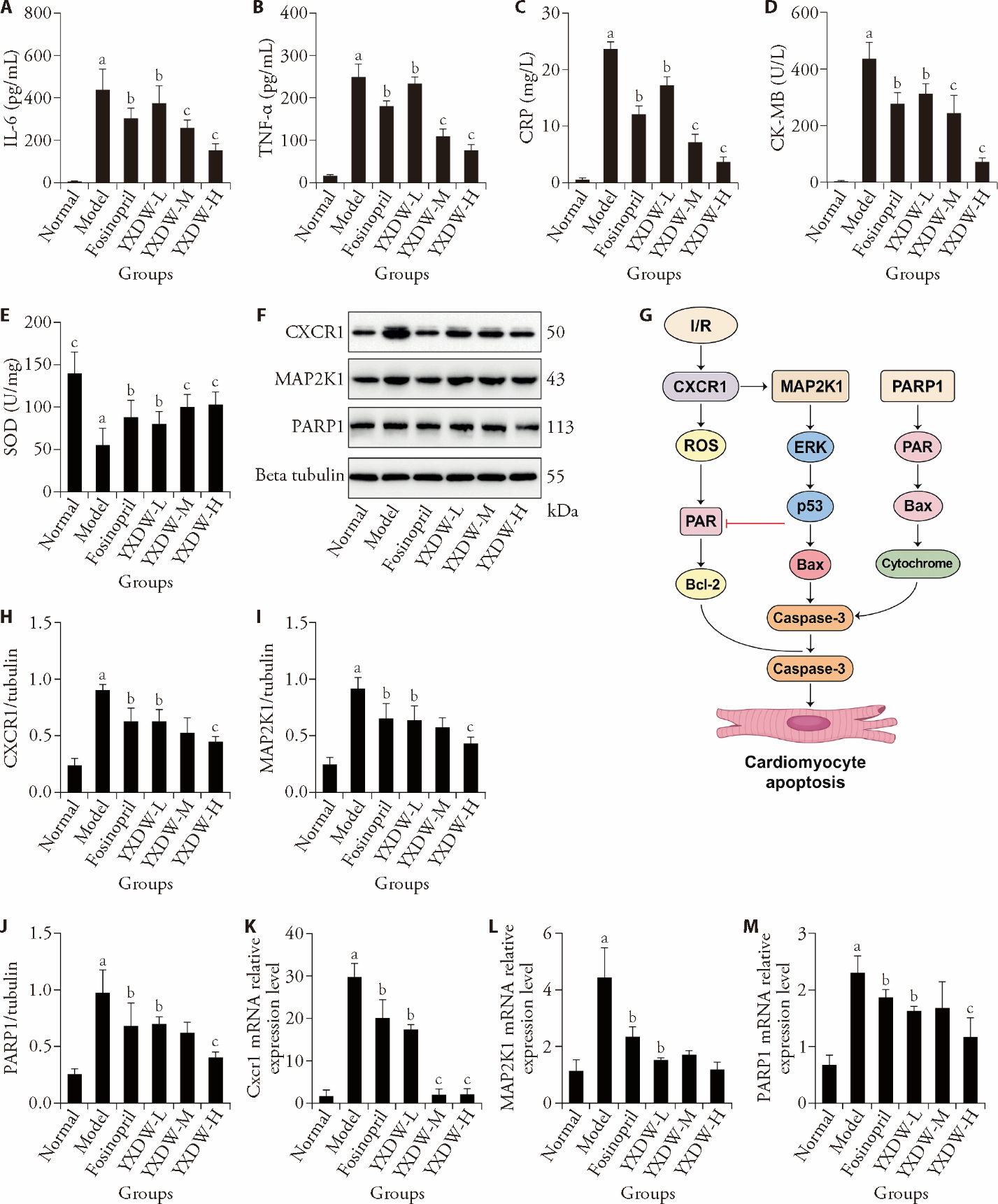
Figure 3 Changes in the levels of apoptotic factor, Western blot, and mRNA in rats in various groups under I/R injury by YXDW A: expression of IL-6 levels; B: expression of TNF-α levels; C: expression of CRP levels; D: expression of CK-MB levels; E: expression of SOD levels; F: representative Western blot image showing protein bands; G: role of the CXCR1-MAP2K1-PARP1 axis in the pathogenesis of ischemia/reperfusion injury; H: CXCR1 relative protein expression; I: MAP2K1 relative protein expression; J: PARP1 relative protein expression; K: CXCR1 relative mRNA expression; L: MAP2K1 relative mRNA expression; M: PARP1 relative mRNA expression. Rats were assigned to six groups (n = 15/group): YXDW low-dose (YXDW-L), medium-dose (YXDW-Z), and high-dose (YXDW-H). The Normal group received no I/R surgery, whereas the remaining groups underwent 30 min of myocardial ischemia followed by 45 min of reperfusion. Beginning 2 h after reperfusion, rats received vehicle, fosinopril (3.60 mg/kg), or YXDW at 0.27, 0.54, or 1.08 g/kg by oral gavage once daily for 14 d. YXDW: Yangxin Dawa Yimixike Mi Gao; I/R: ischemia/reperfusion; IL-6: interleukin-6; TNF-α: tumor necrosis factor-alpha; CRP: C-reactive protein; CK-MB: creatine kinase-MB isoenzyme; SOD: superoxide dismutase; CXCR1: C-X-C motif chemokine receptor 1; MAP2K1: mitogen-activated protein kinase kinase 1; PARP1: poly(ADP-ribose) polymerase 1; mRNA: messenger RNA. Statistical analysis was performed using one-way analysis of variance followed by Tukey’s multiple comparisons test. Data are presented as mean ± standard deviation. aP <0.05, compared with the Normal group; bP < 0.05, compared with the Model group; cP < 0.05, compared with the YXDW-L group.
Figure 3 Changes in the levels of apoptotic factor, Western blot, and mRNA in rats in various groups under I/R injury by YXDW A: expression of IL-6 levels; B: expression of TNF-α levels; C: expression of CRP levels; D: expression of CK-MB levels; E: expression of SOD levels; F: representative Western blot image showing protein bands; G: role of the CXCR1-MAP2K1-PARP1 axis in the pathogenesis of ischemia/reperfusion injury; H: CXCR1 relative protein expression; I: MAP2K1 relative protein expression; J: PARP1 relative protein expression; K: CXCR1 relative mRNA expression; L: MAP2K1 relative mRNA expression; M: PARP1 relative mRNA expression. Rats were assigned to six groups (n = 15/group): YXDW low-dose (YXDW-L), medium-dose (YXDW-Z), and high-dose (YXDW-H). The Normal group received no I/R surgery, whereas the remaining groups underwent 30 min of myocardial ischemia followed by 45 min of reperfusion. Beginning 2 h after reperfusion, rats received vehicle, fosinopril (3.60 mg/kg), or YXDW at 0.27, 0.54, or 1.08 g/kg by oral gavage once daily for 14 d. YXDW: Yangxin Dawa Yimixike Mi Gao; I/R: ischemia/reperfusion; IL-6: interleukin-6; TNF-α: tumor necrosis factor-alpha; CRP: C-reactive protein; CK-MB: creatine kinase-MB isoenzyme; SOD: superoxide dismutase; CXCR1: C-X-C motif chemokine receptor 1; MAP2K1: mitogen-activated protein kinase kinase 1; PARP1: poly(ADP-ribose) polymerase 1; mRNA: messenger RNA. Statistical analysis was performed using one-way analysis of variance followed by Tukey’s multiple comparisons test. Data are presented as mean ± standard deviation. aP <0.05, compared with the Normal group; bP < 0.05, compared with the Model group; cP < 0.05, compared with the YXDW-L group.
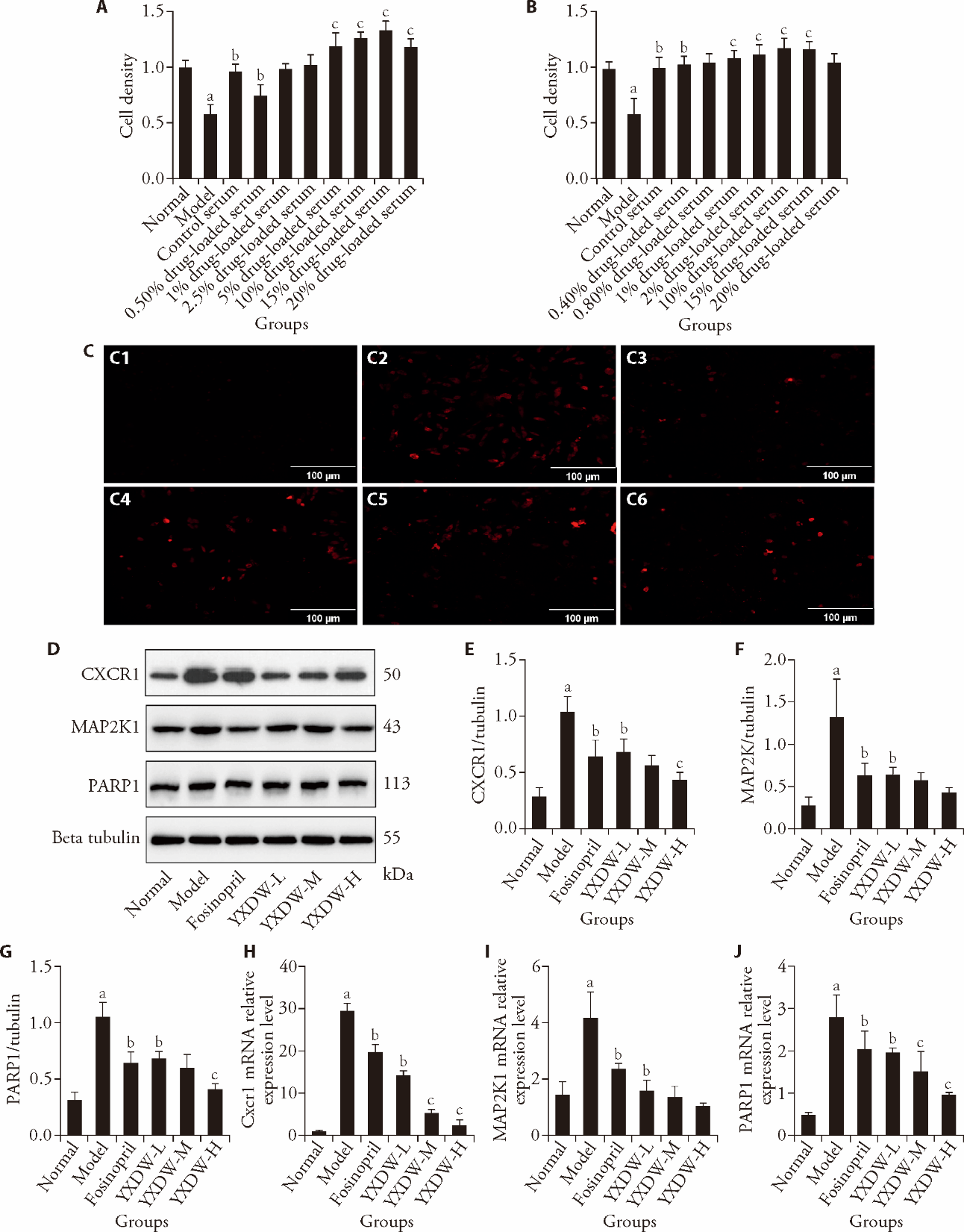
Figure 4 Effect of YXDW on H/R damage in H9C2 cells A: H9C2 cytotoxicity assay; B: H9C2 cell administration concentration CCK-8 assay; C: H9C2 cell apoptosis staining; C1: Normal; C2: Model; C3: Fosinopril; C4: YXDW-L; C5: YXDW-M; C6: YXDW-H; D: representative Western blot image showing protein bands; E: CXCR1 relative protein expression; F: MAP2K1 relative protein expression; G: PARP1 relative protein expression; H: CXCR1 relative mRNA expression; I: MAP2K1 relative mRNA expression; J: PARP1 relative mRNA expression. For A, H9c2 cells were treated with control serum or drug-loaded serum at concentrations of 0.5%, 1%, 2.5%, 5%, 10%, 15%, and 20%. The normal and model groups were included as controls. Cell density was assessed after treatment to evaluate the cytotoxicity and appropriate concentration range of the drug-loaded serum; for B, H9c2 cells were treated with control serum or different concentrations of drug-loaded serum (0.40%-20%), and cell viability was determined using the CCK-8 assay. The 5% drug-containing serum was designated as the low-dose group (YXDW-L), the 10% drug-containing serum as the medium-dose group (YXDW-M), and the 15% drug-containing serum as the high-dose group (YXDW-H); for E-J, rats were assigned to six groups (n = 15/group): YXDW low-dose (YXDW-L), medium-dose (YXDW-Z), and high-dose (YXDW-H). The Normal group received no I/R surgery, whereas the remaining groups underwent 30 min of myocardial ischemia followed by 45 min of reperfusion. Beginning 2 h after reperfusion, rats received vehicle, fosinopril (3.60 mg/kg), or YXDW at 0.27, 0.54, or 1.08 g/kg by oral gavage once daily for 14 d. YXDW: Yangxin Dawa Yimixike Mi Gao; I/R: ischemia/reperfusion; CCK-8: cell counting kit-8; YXDW-L: low-dose YXDW; YXDW-M: medium-dose YXDW; YXDW-H: high-dose YXDW; CXCR1: C-X-C motif chemokine receptor 1; MAP2K1: mitogen-activated protein kinase kinase 1; PARP1: poly(ADP-ribose) polymerase 1; mRNA: messenger RNA. Statistical analysis was performed using one-way analysis of variance followed by Tukey’s multiple comparisons test. Data are presented as mean ± standard deviation. aP < 0.05, compared with the Normal group; bP < 0.05, compared with the Model group; cP < 0.05, compared with the YXDW-L group.
Figure 4 Effect of YXDW on H/R damage in H9C2 cells A: H9C2 cytotoxicity assay; B: H9C2 cell administration concentration CCK-8 assay; C: H9C2 cell apoptosis staining; C1: Normal; C2: Model; C3: Fosinopril; C4: YXDW-L; C5: YXDW-M; C6: YXDW-H; D: representative Western blot image showing protein bands; E: CXCR1 relative protein expression; F: MAP2K1 relative protein expression; G: PARP1 relative protein expression; H: CXCR1 relative mRNA expression; I: MAP2K1 relative mRNA expression; J: PARP1 relative mRNA expression. For A, H9c2 cells were treated with control serum or drug-loaded serum at concentrations of 0.5%, 1%, 2.5%, 5%, 10%, 15%, and 20%. The normal and model groups were included as controls. Cell density was assessed after treatment to evaluate the cytotoxicity and appropriate concentration range of the drug-loaded serum; for B, H9c2 cells were treated with control serum or different concentrations of drug-loaded serum (0.40%-20%), and cell viability was determined using the CCK-8 assay. The 5% drug-containing serum was designated as the low-dose group (YXDW-L), the 10% drug-containing serum as the medium-dose group (YXDW-M), and the 15% drug-containing serum as the high-dose group (YXDW-H); for E-J, rats were assigned to six groups (n = 15/group): YXDW low-dose (YXDW-L), medium-dose (YXDW-Z), and high-dose (YXDW-H). The Normal group received no I/R surgery, whereas the remaining groups underwent 30 min of myocardial ischemia followed by 45 min of reperfusion. Beginning 2 h after reperfusion, rats received vehicle, fosinopril (3.60 mg/kg), or YXDW at 0.27, 0.54, or 1.08 g/kg by oral gavage once daily for 14 d. YXDW: Yangxin Dawa Yimixike Mi Gao; I/R: ischemia/reperfusion; CCK-8: cell counting kit-8; YXDW-L: low-dose YXDW; YXDW-M: medium-dose YXDW; YXDW-H: high-dose YXDW; CXCR1: C-X-C motif chemokine receptor 1; MAP2K1: mitogen-activated protein kinase kinase 1; PARP1: poly(ADP-ribose) polymerase 1; mRNA: messenger RNA. Statistical analysis was performed using one-way analysis of variance followed by Tukey’s multiple comparisons test. Data are presented as mean ± standard deviation. aP < 0.05, compared with the Normal group; bP < 0.05, compared with the Model group; cP < 0.05, compared with the YXDW-L group.
| 1. | Chen W, Bian W, Zhou Y, Zhang J. Cardiac fibroblasts and myocardial regeneration. Front Bioeng Biotechnol 2021; 9: 59. |
| 2. |
Murphy SP, Kakkar R, McCarthy CP, Januzzi JL Jr. Inflammation in heart failure: JACC state-of-the-art review. J Am Coll Cardiol 2020; 75: 1324-40.
DOI PMID |
| 3. |
Dutka M, Bobiński R, Ulman-Włodarz I, et al. Various aspects of inflammation in heart failure. Heart Fail Rev 2020; 25: 537-48.
DOI PMID |
| 4. |
Harouki N, Nicol L, Remy-Jouet I, et al. The IL-1β antibody gevokizumab limits cardiac remodeling and coronary dysfunction in rats with heart failure. JACC Basic Transl Sci 2017; 2: 418-30.
DOI PMID |
| 5. | Nijat D, Abdulla R, Liu GY, Luo YQ, Aisa HA. Identification and quantification of Meiguihua oral solution using liquid chromatography combined with hybrid quadrupole-orbitrap and triple quadrupole mass spectrometers. J Chromatogr B Analyt Technol Biomed Life Sci 2020; 1139: 121992. |
| 6. | Zhao YM, Zhang YL, Wang GZ, et al. Network pharmacology-based analysis of the antithrombotic clinical efficacy and antithrombotic mechanism of Huoxue Jiedu prescription in the treatment of polycythemia vera with heat toxin and blood stasis syndrome. J Tradit Chin Med 2025; 45: 1353-65. |
| 7. |
Abdulla R, Mansur S, Lai H, et al. Qualitative analysis of polyphenols in macroporous resin pretreated pomegranate husk extract by HPLC-QTOF-MS. Phytochem Anal 2017; 28: 465-73.
DOI URL |
| 8. |
Cádiz-Gurrea MdlL, Fernández-Arroyo S, Joven J, Segura-Carretero A. Comprehensive characterization by UHPLC-ESI-Q-TOF-MS from an Eryngium bourgatii extract and their antioxidant and anti-inflammatory activities. Food Res Int 2013; 50: 197-204.
DOI URL |
| 9. |
Turghun C, Bakri M, Abdulla R, Ma Q, Aisa HA. Comprehensive characterisation of phenolics from Nitraria sibirica leaf extracts by UHPLC-quadrupole-orbitrap-MS and evaluation of their anti-hypertensive activity. J Ethnopharmacol 2020; 261: 113019.
DOI URL |
| 10. |
Liu GF, Huang XL, Zhong WX, et al. Global acupuncture randomized controlled trials: Evaluating status, guideline impact, and future research trends. World J Acupunct Moxibust 2025; 35: 331-40.
DOI URL |
| 11. | Wang J, Jia Z, Zhang Z, et al. Analysis of chemical constituents of melastoma dodecandrum Lour. by UPLC-ESI-Q-exactive focus-MS/MS. Molecules 2017; 22: 476. |
| 12. |
Westman PC, Lipinski MJ, Luger D, et al. Inflammation as a driver of adverse left ventricular remodeling after acute myocardial infarction. J Am Coll Cardiol 2016; 67: 2050-60.
DOI PMID |
| 13. |
Cen W, Chen Z, Gu N, Hoppe R. Prevention of AMI induced ventricular remodeling: inhibitory effects of heart-protecting musk pill on IL-6 and TNF-alpha. Evid Based Complement Alternat Med 2017; 2017: 3217395.
DOI URL |
| 14. | Mangoni AA, Zinellu A, Sotgia S, Carru C, Piga M, Erre GL. Protective effects of methotrexate against proatherosclerotic cytokines: a review of the evidence. Mediators Inflamm 2017; 2017: 9632846. |
| 15. | Polonschii C, Potara M, Iancu M, et al. Progress in the optical sensing of cardiac biomarkers. Biosensors (Basel) 2023; 13: 632. |
| 16. |
Larsson SC, Butterworth AS, Burgess S. Mendelian randomization for cardiovascular diseases: principles and applications. Eur Heart J 2023; 44: 4913-24.
DOI PMID |
| 17. |
Velazquez EJ, Morrow DA, DeVore AD, et al. Angiotensin-neprilysin inhibition in acute decompensated heart failure. N Engl J Med 2019; 380: 539-48.
DOI URL |
| 18. |
Burgess S, Thompson SG. Interpreting findings from Mendelian randomization using the MR-Egger method. Eur J Epidemiol 2017; 32: 377-89.
DOI PMID |
| 19. |
Kintu C, Soremekun O, Kamiza AB, et al. The causal effects of lipid traits on kidney function in Africans: bidirectional and multivariable Mendelian-randomization study. EBioMedicine 2023; 90: 104537.
DOI URL |
| 20. |
Ullah H, Sommella E, Minno AD, et al. Combination of chemically characterized pomegranate extract and hydrophilic vitamins against prolonged fatigue: a monocentric, randomized, double-blind, placebo-controlled clinical trial. Nutrients 2023; 15: 2883.
DOI URL |
| 21. |
Yang S, Bi Y, Wei Y, et al. Muscone attenuates susceptibility to ventricular arrhythmia by inhibiting NLRP3 inflammasome activation in rats after myocardial infarction. J Biochem Mol Toxicol 2023; 37: e23458.
DOI URL |
| 22. |
Du Y, Gu X, Meng H, et al. Muscone improves cardiac function in mice after myocardial infarction by alleviating cardiac macrophage-mediated chronic inflammation through inhibition of NF-κB and NLRP3 inflammasome. Am J Transl Res 2018; 10: 4235-46.
PMID |
| 23. |
Yuan C, Chen Z, Zhou Q. Crocin inhibits KBTBD7 to prevent excessive inflammation and cardiac dysfunction following myocardial infarction. Mol Med Rep 2023; 27: 20.
DOI URL |
| 24. |
Ali A, Saqib F. Ethnopharmacological basis and pharmacodynamics prospectives for folkloric claims of Rosa webbiana Wall. ex Royle in diarrhea and asthma via in vitro, in vivo and in silico techniques. J Ethnopharmacol 2023; 317: 116696.
DOI URL |
| 25. |
Briston T, Selwood DL, Szabadkai G, Duchen MR. Mitochondrial permeability transition: a molecular lesion with multiple drug targets. Trends Pharmacol Sci 2019; 40: 50-70.
DOI PMID |
| 26. |
Saito T, Nah J, Oka SI, et al. An alternative mitophagy pathway mediated by Rab9 protects the heart against ischemia. J Clin Invest 2019; 129: 802-19.
DOI PMID |
| 27. |
Cambier S, Gouwy M, Proost P. The chemokines CXCL8 and CXCL12: molecular and functional properties, role in disease and efforts towards pharmacological intervention. Cell Mol Immunol 2023; 20: 217-51.
DOI PMID |
| 28. |
Liu Q, Li A, Tian Y, et al. The CXCL8-CXCR1/2 pathways in cancer. Cytokine Growth Factor Rev 2016; 31: 61-71.
DOI URL |
| 29. |
Gupta K, Perkerson RB 3rd, Parsons TM, et al. Secretome from iPSC-derived MSCs exerts proangiogenic and immunosuppressive effects to alleviate radiation-induced vascular endothelial cell damage. Stem Cell Res Ther 2024; 15: 230.
DOI PMID |
| 30. |
Fan Q, Tao R, Zhang H, et al. Dectin-1 contributes to myocardial ischemia/reperfusion injury by regulating macrophage polarization and neutrophil infiltration. Circulation 2019; 139: 663-78.
DOI PMID |
| 31. |
Parodi M, Centonze G, Murianni F, et al. Hybrid epithelial-mesenchymal status of lung cancer dictates metastatic success through differential interaction with NK cells. J Immunother Cancer 2024; 12: e007895.
DOI URL |
| 32. |
Lin J, Cui KY, Li YJ, et al. The analgesic effect and ATP release at acupuncture points in response to acupuncture with different parameters on arthritis rats. World J Acupunct Moxibust 2025; 35: 254-61.
DOI URL |
| 33. |
Abidi E, Diab R, Zahreddine R, et al. Estrogen administration enhances the adverse effects of cigarette smoking on the heart in cycling female mice. Biol Sex Differ 2024; 15: 100.
DOI PMID |
| 34. |
Li L, Zhong S, Li R, et al. Aldehyde dehydrogenase 2 and PARP1 interaction modulates hepatic HDL biogenesis by LXRα-mediated ABCA1 expression. JCI Insight 2022; 7: e155869.
DOI URL |
| 35. |
Li YL, Li SD, Wu Y, et al. China Association of Acupuncture and Moxibustion leading the development of acupuncture-moxibustion discipline: Achievement and practice. World J Acupunct Moxibust 2025; 35: 393-7.
DOI URL |
| 36. |
Zhang JY, Zhang Q, Li N, Wang ZJ, Lu JQ, Qiao YJ. Diagnostic fragment-ion-based and extension strategy coupled to DFIs intensity analysis for identification of chlorogenic acids isomers in Flos Lonicerae japonicae by HPLC-ESI-MS(n). Talanta 2013; 104: 1-9.
DOI URL |
| 37. |
Aihaiti K, Li J, Yaermaimaiti S, Liu L, Xin X, Aisa HA. Non-volatile compounds of Hyssopus cuspidatus Boriss and their antioxidant and antimicrobial activities. Food Chem 2022; 374: 131638.
DOI URL |
| Viewed | ||||||
|
Full text |
|
|||||
|
Abstract |
|
|||||