
Journal of Traditional Chinese Medicine ›› 2026, Vol. 46 ›› Issue (4): 907-915.DOI: 10.19852/j.cnki.jtcm.2026.04.011
• Original Articles • Previous Articles Next Articles
Antihypertensive effect of acupuncture involve reshaping gut microbiota and alleviating gut inflammation in spontaneously hypertensive rats
ZHENG Jie1, DING Zhimin2, CHEN Tingyu1, LÜ Zhuan3, ZHANG Lihong1, LIU Yongtao3, ZHANG Yasu1, JIN Xiaoqin1, WANG Xinyu1, LIU Bin1, FENG Xiaodong1( )
)
- 1
School of Rehabilitation Medicine ,Henan University of Chinese Medicine Zhengzhou 450046, China
2College of Rehabilitation Medicine ,Fujian University of Traditional Chinese Medicine Fuzhou 350122, China
3Department of Rehabilitation ,the First Affiliated Hospital of Henan University of Chinese Medicine Zhengzhou 450000, China
-
Received:2025-08-09Accepted:2026-04-13Online:2026-08-15Published:2026-08-08 -
Contact:Prof. FENG Xiaodong, School of Rehabilitation Medicine, Henan University of Chinese Medicine, Zhengzhou 450046, China. fxd0502@163.com,Telephone: +86-15516164325; +86-15303828605
-
About author:ZHENG Jie and DING Zhimin are co-first authors and contributed equally to this work -
Supported by:Provincial Natural Science Foundation of Henan: Mechanism Underlying Antihypertensive Effect of Acupuncture at Renying (ST9) and Zusanli (ST36) in Spontaneously Hypertensive Rats Based on Gut-immune Axis(202300410260);Key Research Project Program of Higher Education Institutions in Henan Province: Investigation of the Neuroprotective Mechanism of Acupuncture at Renying (ST9) and Zusanli (ST36) in Hypertension via the Gut-Brain Axis(25B360011);Special Project for Scientific Research on Traditional Chinese Medicine of the "Double First-class" Founding Disciplines of Henan Province(HSRP-DFCTCM-T-9)

Cite this article
ZHENG Jie, DING Zhimin, CHEN Tingyu, LÜ Zhuan, ZHANG Lihong, LIU Yongtao, ZHANG Yasu, JIN Xiaoqin, WANG Xinyu, LIU Bin, FENG Xiaodong. Antihypertensive effect of acupuncture involve reshaping gut microbiota and alleviating gut inflammation in spontaneously hypertensive rats[J]. Journal of Traditional Chinese Medicine, 2026, 46(4): 907-915.
share this article
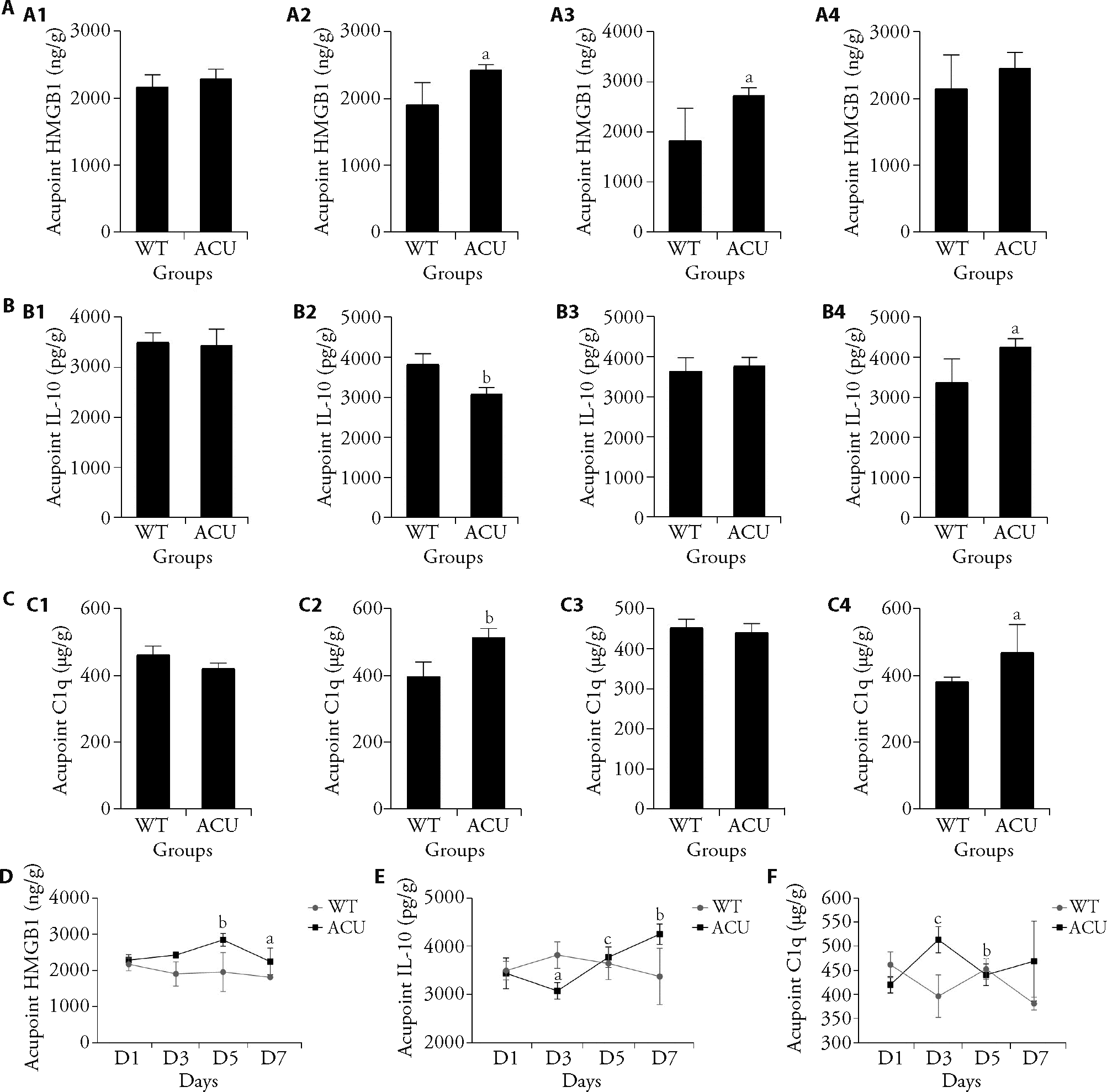
Figure 1 Effect of acupuncture on HMGB1, IL-10, and C1q proteins at Zusanli (ST36) A: concentration of HMGB1 proteins; B: concentration of IL-10 proteins; C: concentration of C1q proteins; A1, B1, C1: D1 after acupuncture; A2, B2, C2: D3 after acupuncture; A3, B3, C3: D5 after acupuncture; A4, B4, C4: D7 after acupuncture; D-F: the temporal changes of HMGB1, IL-10 and C1q proteins after acupuncture (D3 vs D1, D5 vs D3, D7 vs D5). D: HMGB1 proteins; E: IL-10 proteins; F: C1q proteins. WT group: wild-type mice without acupuncture intervention, ACU group: wild-type mice receiving bilateral Zusanli (ST36) acupuncture stimulation. Acupuncture was performed at Zusanli (ST36) using sterilized stainless-steel filiform needles in 8-min daily sessions for 1, 3, 5, or 7 d. HMGB1: high mobility group box 1; IL-10: interleukin-10; C1q: complement component 1q; D: day. Data are presented as mean ± standard deviation (n = 5-7 per group). The t-test was used for data analysis between two groups. aP < 0.05, bP < 0.01, cP < 0.001 versus the WT group.
Figure 1 Effect of acupuncture on HMGB1, IL-10, and C1q proteins at Zusanli (ST36) A: concentration of HMGB1 proteins; B: concentration of IL-10 proteins; C: concentration of C1q proteins; A1, B1, C1: D1 after acupuncture; A2, B2, C2: D3 after acupuncture; A3, B3, C3: D5 after acupuncture; A4, B4, C4: D7 after acupuncture; D-F: the temporal changes of HMGB1, IL-10 and C1q proteins after acupuncture (D3 vs D1, D5 vs D3, D7 vs D5). D: HMGB1 proteins; E: IL-10 proteins; F: C1q proteins. WT group: wild-type mice without acupuncture intervention, ACU group: wild-type mice receiving bilateral Zusanli (ST36) acupuncture stimulation. Acupuncture was performed at Zusanli (ST36) using sterilized stainless-steel filiform needles in 8-min daily sessions for 1, 3, 5, or 7 d. HMGB1: high mobility group box 1; IL-10: interleukin-10; C1q: complement component 1q; D: day. Data are presented as mean ± standard deviation (n = 5-7 per group). The t-test was used for data analysis between two groups. aP < 0.05, bP < 0.01, cP < 0.001 versus the WT group.

Figure 2 Acupuncture-induced C1q involved in regulating the inflammatory responses at Zusanli (ST36) A: representative hematoxylin-eosin staining images of Zusanli (ST36) tissues (Nuclei: blue, cytoplasm: red, Scale bar = 50 µm, n = 3, magnification × 40); A1-A3: the epidermis, dermis layers of the WT, ACU, and C1q-/-+ACU groups; A1:WT groups; A2: ACU groups; A3: C1q-/-+ACU groups; A4-A6: the muscle layers of the WT, ACU, and C1q-/-+ACU groups; A4: WT groups; A5: ACU groups; A6: C1q-/-+ACU groups; B: single-label immunofluorescence of p-p65 (p-p65: green, 1:100, DAPI: blue, Scale bar = 10 µm, n = 3, magnification × 40). B1-B3: representative merged images showing p-p65 with DAPI; B1: WT groups; B2: ACU groups; B3: C1q-/-+ACU groups; C: quantification of p-p65-positive cells by immunofluorescence (n = 3); D: protein concentration of HMGB1 at Zusanli (ST36) measured by ELISA (n = 5-6); E: protein concentration of IL-10 at Zusanli (ST36) measured by ELISA (n = 5-6). WT group: wild-type mice without acupuncture intervention, ACU group: wild-type mice receiving bilateral Zusanli (ST36) acupuncture stimulation, C1q-/-+ACU group: C1q knockout mice receiving acupuncture. Acupuncture was performed at Zusanli (ST36) using sterilized stainless-steel filiform needles in 8-min daily sessions for 7 d. HMGB1: high mobility group box 1; IL-10: interleukin-10; ELISA: enzyme-linked immunosorbent assay; p-p65: phosphorylated p65. Data are presented as mean ± standard deviation. One-way analysis of variance was used for multiple groups comparisons. If the data followed a normal distribution, the least significant difference test was used; otherwise, Dunnett’s T3 test was used. aP < 0.05, cP < 0.01 versus the WT group; bP < 0.05 versus the ACU group.
Figure 2 Acupuncture-induced C1q involved in regulating the inflammatory responses at Zusanli (ST36) A: representative hematoxylin-eosin staining images of Zusanli (ST36) tissues (Nuclei: blue, cytoplasm: red, Scale bar = 50 µm, n = 3, magnification × 40); A1-A3: the epidermis, dermis layers of the WT, ACU, and C1q-/-+ACU groups; A1:WT groups; A2: ACU groups; A3: C1q-/-+ACU groups; A4-A6: the muscle layers of the WT, ACU, and C1q-/-+ACU groups; A4: WT groups; A5: ACU groups; A6: C1q-/-+ACU groups; B: single-label immunofluorescence of p-p65 (p-p65: green, 1:100, DAPI: blue, Scale bar = 10 µm, n = 3, magnification × 40). B1-B3: representative merged images showing p-p65 with DAPI; B1: WT groups; B2: ACU groups; B3: C1q-/-+ACU groups; C: quantification of p-p65-positive cells by immunofluorescence (n = 3); D: protein concentration of HMGB1 at Zusanli (ST36) measured by ELISA (n = 5-6); E: protein concentration of IL-10 at Zusanli (ST36) measured by ELISA (n = 5-6). WT group: wild-type mice without acupuncture intervention, ACU group: wild-type mice receiving bilateral Zusanli (ST36) acupuncture stimulation, C1q-/-+ACU group: C1q knockout mice receiving acupuncture. Acupuncture was performed at Zusanli (ST36) using sterilized stainless-steel filiform needles in 8-min daily sessions for 7 d. HMGB1: high mobility group box 1; IL-10: interleukin-10; ELISA: enzyme-linked immunosorbent assay; p-p65: phosphorylated p65. Data are presented as mean ± standard deviation. One-way analysis of variance was used for multiple groups comparisons. If the data followed a normal distribution, the least significant difference test was used; otherwise, Dunnett’s T3 test was used. aP < 0.05, cP < 0.01 versus the WT group; bP < 0.05 versus the ACU group.
Figure 3 Mechanism of C1q regulation of the inflammatory response at Zusanli (ST36) A: representative Western blot bands showing protein expression of RAGE, LAIR-1, and SHP-1 at Zusanli (ST36) (n = 5-6); B: quantification of LAIR-1 normalized to GAPDH; C: quantification of RAGE normalized to GAPDH; D: quantification of SHP-1normalized to GAPDH; E: double-label immunofluorescence of M1 macrophages (M0: F4/80, red, 1:50; M1: CD86, green, 1:100; Merged: F4/80, CD86, and DAPI; Scale bar = 100 µm; magnification ×40, n = 3); E1: F4/80-label of WT groups; E2: F4/80-label of ACU groups; E3: F4/80-label of C1q-/-+ACU groups, E4: CD86-label of WT groups; E5: CD86-label of ACU groups; E6: CD86-label of C1q-/-+ACU groups; E7: merged of WT groups; E8: merged of ACU groups; E9: merged of C1q-/-+ACU groups, F: double-label immunofluorescence of M2 macrophages (M0: F4/80, red, 1:50; M2: CD206, green, 1:50, Merged: F4/80, CD206, and DAPI; Scale bar = 100 µm; magnification ×40, n = 3); F1: F4/80-label of WT groups; F2: F4/80-label of ACU groups; F3: F4/80-label of C1q-/-+ACU groups, F4: CD206-label of WT groups; F5: CD206-label of ACU groups; F6: CD206-label of C1q-/-+ACU groups; F7: merged of WT groups; F8: merged of ACU groups; F9: merged of C1q-/-+ACU groups; G : quantitative immunofluorescence analysis of M1 macrophages at Zusanli (ST36) (n = 3); H: quantitative immunofluorescence analysis of M2 macrophages at Zusanli (ST36) (n = 3). WT group: wild-type mice without acupuncture intervention, ACU group: wild-type mice receiving bilateral Zusanli (ST36) acupuncture stimulation, C1q-/-+ACU group: C1q knockout mice receiving acupuncture. Acupuncture was performed at Zusanli (ST36) using sterilized stainless-steel filiform needles in 8-min daily sessions for 7 d. RAGE: the receptor for advanced glycation end-products; LAIR-1: leukocyte-associated immunoglobulin-like receptor 1; SHP-1: src homology 2 domain-containing protein tyrosine phosphatase 1; GAPDH: glyceraldehyde-3-phosphate dehydrogenase; M0: Naïve Macrophage; M1: classical activated macrophages; M2: alternatively activated macrophages. Data are presented as mean ± standard deviation. One-way analysis of variance was used for multiple groups comparisons. If the data followed a normal distribution, the least significant difference test was used; otherwise, Dunnett’s T3 test was used. cP < 0.01, aP < 0.001 versus the WT group; bP < 0.05, dP < 0.001 versus the ACU group.
Figure 3 Mechanism of C1q regulation of the inflammatory response at Zusanli (ST36) A: representative Western blot bands showing protein expression of RAGE, LAIR-1, and SHP-1 at Zusanli (ST36) (n = 5-6); B: quantification of LAIR-1 normalized to GAPDH; C: quantification of RAGE normalized to GAPDH; D: quantification of SHP-1normalized to GAPDH; E: double-label immunofluorescence of M1 macrophages (M0: F4/80, red, 1:50; M1: CD86, green, 1:100; Merged: F4/80, CD86, and DAPI; Scale bar = 100 µm; magnification ×40, n = 3); E1: F4/80-label of WT groups; E2: F4/80-label of ACU groups; E3: F4/80-label of C1q-/-+ACU groups, E4: CD86-label of WT groups; E5: CD86-label of ACU groups; E6: CD86-label of C1q-/-+ACU groups; E7: merged of WT groups; E8: merged of ACU groups; E9: merged of C1q-/-+ACU groups, F: double-label immunofluorescence of M2 macrophages (M0: F4/80, red, 1:50; M2: CD206, green, 1:50, Merged: F4/80, CD206, and DAPI; Scale bar = 100 µm; magnification ×40, n = 3); F1: F4/80-label of WT groups; F2: F4/80-label of ACU groups; F3: F4/80-label of C1q-/-+ACU groups, F4: CD206-label of WT groups; F5: CD206-label of ACU groups; F6: CD206-label of C1q-/-+ACU groups; F7: merged of WT groups; F8: merged of ACU groups; F9: merged of C1q-/-+ACU groups; G : quantitative immunofluorescence analysis of M1 macrophages at Zusanli (ST36) (n = 3); H: quantitative immunofluorescence analysis of M2 macrophages at Zusanli (ST36) (n = 3). WT group: wild-type mice without acupuncture intervention, ACU group: wild-type mice receiving bilateral Zusanli (ST36) acupuncture stimulation, C1q-/-+ACU group: C1q knockout mice receiving acupuncture. Acupuncture was performed at Zusanli (ST36) using sterilized stainless-steel filiform needles in 8-min daily sessions for 7 d. RAGE: the receptor for advanced glycation end-products; LAIR-1: leukocyte-associated immunoglobulin-like receptor 1; SHP-1: src homology 2 domain-containing protein tyrosine phosphatase 1; GAPDH: glyceraldehyde-3-phosphate dehydrogenase; M0: Naïve Macrophage; M1: classical activated macrophages; M2: alternatively activated macrophages. Data are presented as mean ± standard deviation. One-way analysis of variance was used for multiple groups comparisons. If the data followed a normal distribution, the least significant difference test was used; otherwise, Dunnett’s T3 test was used. cP < 0.01, aP < 0.001 versus the WT group; bP < 0.05, dP < 0.001 versus the ACU group.
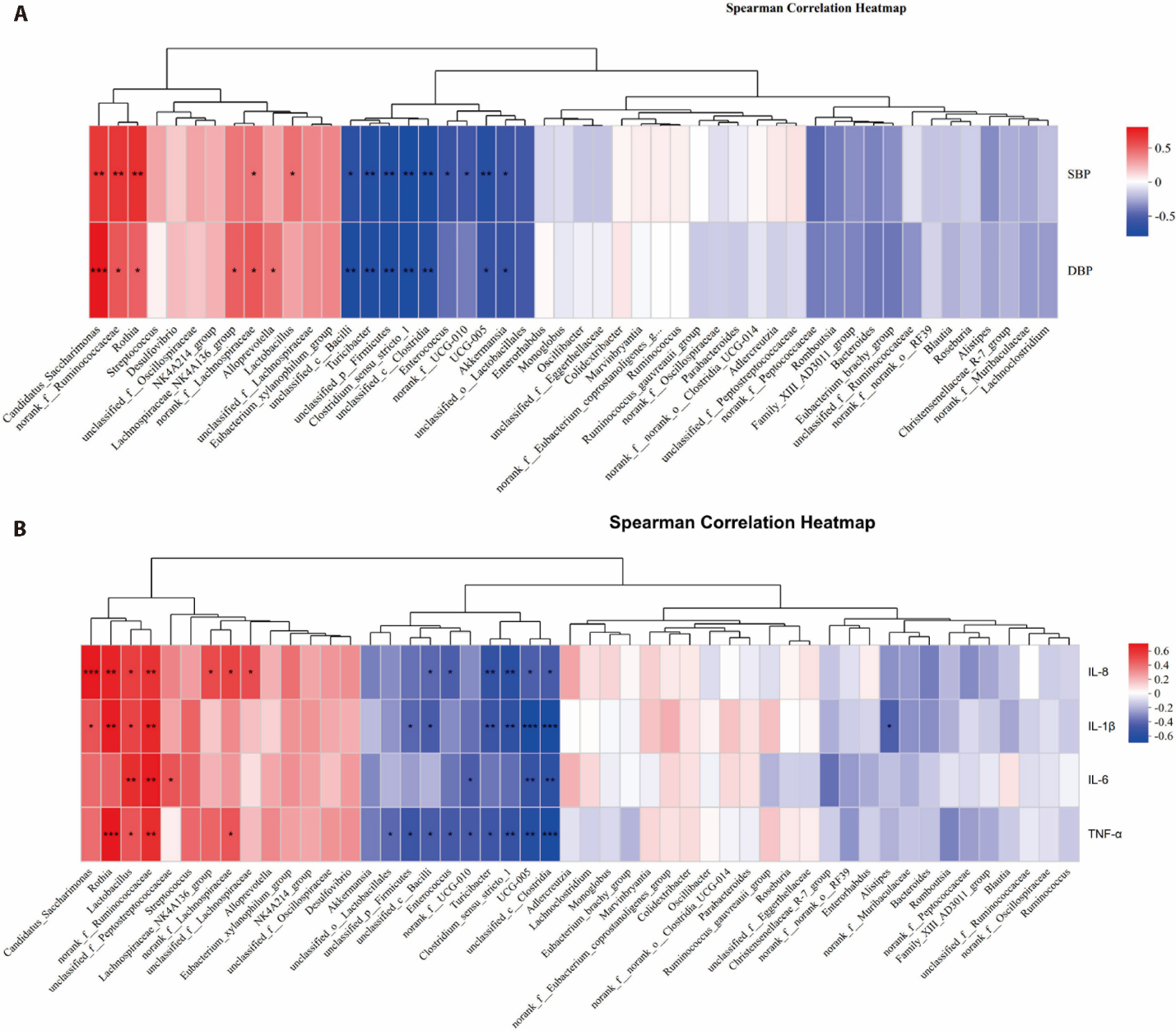
Figure 4 Gut microbiota correlations with blood pressure and inflammatory cytokines A: Spearman’s correlation between gut genera and blood pressure, including SBP and DBP; B: Spearman’s correlation between gut genera and serum inflammatory cytokines, including IL-6, IL-8, IL-1β and TNF-α. WKY and SHR groups: restrained and fixed without any intervention; SHR+A group: treated with acupuncture at bilateral Renying (ST9) and Zusanli (ST36); SHR+SA group: treated with sham acupuncture at non-meridian non-acupuncture points adjacent to bilateral Renying (ST9) and Zusanli (ST36). SBP: systolic blood pressure; DBP: diastolic blood pressure; WKY: Wistar-Kyoto rats; SHRs: spontaneously hypertensive rats; SEM: standard error of the mean. Data are presented as mean ± SEM and Spearman’s correlation analysis was adopted (n = 6 per group). Comparisons between indicators on the horizontal and vertical axes, *P < 0.05; **P < 0.01; ***P < 0.001.
Figure 4 Gut microbiota correlations with blood pressure and inflammatory cytokines A: Spearman’s correlation between gut genera and blood pressure, including SBP and DBP; B: Spearman’s correlation between gut genera and serum inflammatory cytokines, including IL-6, IL-8, IL-1β and TNF-α. WKY and SHR groups: restrained and fixed without any intervention; SHR+A group: treated with acupuncture at bilateral Renying (ST9) and Zusanli (ST36); SHR+SA group: treated with sham acupuncture at non-meridian non-acupuncture points adjacent to bilateral Renying (ST9) and Zusanli (ST36). SBP: systolic blood pressure; DBP: diastolic blood pressure; WKY: Wistar-Kyoto rats; SHRs: spontaneously hypertensive rats; SEM: standard error of the mean. Data are presented as mean ± SEM and Spearman’s correlation analysis was adopted (n = 6 per group). Comparisons between indicators on the horizontal and vertical axes, *P < 0.05; **P < 0.01; ***P < 0.001.
| 1. |
Fisher NDL, Curfman G. Hypertension-a public health challenge of global proportions. JAMA 2018; 320: 1757-9.
DOI PMID |
| 2. | Liu X, Yang SN, Xu Y. Effect of Yang-deficiency constitution on cognitive impairment in cerebral small vessel disease and its neuroimaging mechanism. J Tradit Chin Med 2025; 45: 1144-51. |
| 3. |
Zhang DS, Chen L, Mazhar M, Xue JY, Liu P, Liu MN. Application of promoting blood circulation and resolving blood stasis in intracerebral hemorrhage: a traditional method gradually being reconsidered. J Tradit Chin Med 2025; 45: 458-72.
DOI |
| 4. |
Lu J, Lu Y, Wang X, et al. Prevalence, awareness, treatment, and control of hypertension in China: data from 1·7 million adults in a population-based screening study (China PEACE Million Persons Project). Lancet 2017; 390: 2549-58.
DOI PMID |
| 5. |
Kusumawardani LA, Andrajati R, Nusaibah A. Drug-related problems in hypertensive patients: a cross-sectional study from indonesia. J Res Pharm Pract 2020; 9: 140-5.
DOI PMID |
| 6. |
Chen Y, Chen Z, Liang L, et al. Multi-kingdom gut microbiota dysbiosis is associated with the development of pulmonary arterial hypertension. EBioMedicine 2025; 115: 105686.
DOI URL |
| 7. |
Kim S, Goel R, Kumar A, et al. Imbalance of gut microbiome and intestinal epithelial barrier dysfunction in patients with high blood pressure. Clin Sci (Lond) 2018; 132: 701-18.
DOI PMID |
| 8. |
Xu X, Jin H, Li X, et al. Fecal microbiota transplantation regulates blood pressure by altering gut microbiota composition and intestinal mucosal barrier function in spontaneously hypertensive rats. Probiotics Antimicrob Proteins 2025; 17: 4066-79.
DOI |
| 9. |
Li J, Zhao F, Wang Y, et al. Gut microbiota dysbiosis contributes to the development of hypertension. Microbiome 2017; 5: 14.
DOI PMID |
| 10. |
Dinakis E, O'Donnell JA, Marques FZ. The gut-immune axis during hypertension and cardiovascular diseases. Acta Physiol (Oxf) 2024; 240: e14193.
DOI URL |
| 11. |
Chen D, Jia P, Wang M, et al. Liensinine can improve vascular remodeling in hypertension through the ferroptosis-related TLR4 inflammatory pathway. J Mol Med (Berl) 2025; 104: 13.
DOI |
| 12. |
Bomfim GF, Echem C, Martins CB, et al. Toll-like receptor 4 inhibition reduces vascular inflammation in spontaneously hypertensive rats. Life Sci 2015; 122: 1-7.
DOI PMID |
| 13. |
Yeom M, Ahn S, Hahm DH, et al. Acupuncture ameliorates atopic dermatitis by modulating gut barrier function in a gut microbiota-dependent manner in mice. J Integr Med 2024; 22: 600-13.
DOI PMID |
| 14. |
Yan H, Hua Y, Ni J, et al. Acupuncture ameliorates inflammation by regulating gut microbiota in acute ischemic stroke. IBRO Neurosci Rep 2025; 18: 443-52.
DOI PMID |
| 15. | Ding Z, Chen T, Zhang L, et al. Effects of acupuncture on fecal short-chain fatty acids and TLR4/MyD88/NF-κB signaling pathway in spontaneously hypertensive rats. Zhong Guo Zhen Jiu 2024; 44: 661-8. |
| 16. |
Calderón-Zamora L, Canizalez-Román A, León-Sicairos N, et al. Changes in expression of orphan receptors GPR99 and GPR107 during the development and establishment of hypertension in spontaneously hypertensive rats. J Recept Signal Transduct Res 2021; 41: 558-65.
DOI URL |
| 17. |
Yan YX, Shao MJ, Qi Q, et al. Artemisinin analogue SM934 ameliorates DSS-induced mouse ulcerative colitis via suppressing neutrophils and macrophages. Acta Pharmacol Sin 2018; 39: 1633-44.
DOI URL |
| 18. |
Edgar RC. UPARSE: highly accurate OTU sequences from microbial amplicon reads. Nat Methods 2013; 10: 996-8.
DOI PMID |
| 19. |
Wang Q, Garrity GM, Tiedje JM, Cole JR. Naive Bayesian classifier for rapid assignment of rRNA sequences into the new bacterial taxonomy. Appl Environ Microbiol 2007; 73: 5261-7.
DOI URL |
| 20. | Dong A, Cui Y, Wang W, et al. Effects of acupuncture on endothelial active factors and related autonomic neurotransmitters in spontaneous hypertension rats. Zhong Guo Zhen Jiu 2024; 44: 931-8. |
| 21. |
Yang Z, Wang Q, Liu Y, et al. Gut microbiota and hypertension: association, mechanisms and treatment. Clin Exp Hypertens 2023; 45: 2195135.
DOI URL |
| 22. |
Schloss PD, Westcott SL, Ryabin T, et al. Introducing mothur: open-source, platform-independent, community-supported software for describing and comparing microbial communities. Appl Environ Microbiol 2009; 75: 7537-41.
DOI URL |
| 23. |
Cassol I, Ibañez M, Bustamante JP. Key features and guidelines for the application of microbial alpha diversity metrics. Sci Rep 2025; 15: 622.
DOI |
| 24. |
Santisteban MM, Qi Y, Zubcevic J, et al. Hypertension-linked pathophysiological alterations in the gut. Circ Res 2017; 120: 312-23.
DOI URL |
| 25. | Mostafavi Abdolmaleky H, Zhou JR. Gut microbiota dysbiosis, oxidative stress, inflammation, and epigenetic alterations in metabolic diseases. Antioxidants (Basel) 2024; 13: 985. |
| 26. |
Aron-Wisnewsky J, Warmbrunn MV, Nieuwdorp M, Clément K. Metabolism and metabolic disorders and the microbiome: The intestinal microbiota associated with obesity, lipid Metabolism, and metabolic health-pathophysiology and therapeutic strategies. Gastroenterology 2021; 160: 573-99.
DOI PMID |
| 27. |
Wang B, Chen X, Chen Z, et al. Stable colonization of Akkermansia muciniphila educates host intestinal microecology and immunity to battle against inflammatory intestinal diseases. Exp Mol Med 2023; 55: 55-68.
DOI PMID |
| 28. | Hsu CN, Hou CY, Chang CI, Tain YL. Resveratrol butyrate ester protects adenine-treated rats against hypertension and kidney disease by regulating the gut-kidney axis. Antioxidants (Basel) 2021; 11: 83. |
| 29. |
Guzik TJ, Nosalski R, Maffia P, Drummond GR. Immune and inflammatory mechanisms in hypertension. Nat Rev Cardiol 2024; 21: 396-416.
DOI PMID |
| 30. |
Xiao L, Harrison DG. Inflammation in hypertension. Can J Cardiol 2020; 36: 635-47.
DOI PMID |
| 31. |
Si W, Zhao Y, Wu Y, et al. High-salt diets, intestinal barrier, and hypertension: a mechanistic review and the promise of dietary therapy. Nutrients 2025; 17: 3688.
DOI URL |
| [1] | SHI Ling, YANG Chengcheng, HUANG Li, DENG Linwen. Effect of acupuncture and moxibustion combined with core stabilization training on the function of transverse abdominal muscle and pelvic floor muscle in women with postpartum pelvic pain [J]. Journal of Traditional Chinese Medicine, 2026, 46(4): 1009-1017. |
| [2] | TIAN Yehong, ZHANG Qiaoli, ZHANG Rui, GAO Tao, LI Nanzhi, HUANG Jinchang, JIANG Xin, QIU Xiaowei. Electroacupuncture enhances CD8+ T cells recruitment via modulating sympathetic nervous system to suppress tumor growth in mice bearing triple-negative breast cancer [J]. Journal of Traditional Chinese Medicine, 2026, 46(4): 832-843. |
| [3] | KANG Xiaochun, WU Sinuo, LI Ningcen, XU Wenyue, XU Zhifang, Thong Yikchih, LI Peiyun, TU Shiwei, MA Ning, LI Yanwei, DOU Baomin, TAN Wenjun, GUO Jing, GUO Yi, PAN Xingfang, LÜ Zhongxi. Regulatory effects and mechanisms of the acupuncture-induced complement component 1q on the high mobility group box 1 -receptor for advanced glycation end products-nuclear factor kappa-B pathway at Zusanli (ST36) [J]. Journal of Traditional Chinese Medicine, 2026, 46(4): 844-853. |
| [4] | LIU Yutong, YANG Yan, XU Huiying, LI Lei, GE Fei, CHEN Meijuan. Jianchang No. 1 (健肠1号) formula alleviates irritable bowel syndrome with diarrhea via improving gut microbiota and regulating toll-like receptors/nuclear factor-kappa B signaling pathway in bowel syndrome with diarrhea rats [J]. Journal of Traditional Chinese Medicine, 2026, 46(4): 883-893. |
| [5] | XU Huichao, HAO Jianheng, CHANG Boya, WANG Danni, LI Rangqian, CAO Yuxia, WANG Haijun, JI Laixi. Electroacupuncture alleviates intestinal inflammation in rats with ulcerative colitis by regulating colonic cell autophagy and gut microbiota [J]. Journal of Traditional Chinese Medicine, 2026, 46(4): 894-906. |
| [6] | LU Xiaoxiao, XU Yipeng, ZHOU Minjie, ZHANG Chengshun, CAI Dingjun, ZHAO Zhengyu. Role of gamma-aminobutyric acid-ergic neurons in the thalamic reticular nucleus in regulating sleep-wake cycles in mice treated with acupuncture for insomnia [J]. Journal of Traditional Chinese Medicine, 2026, 46(3): 552-560. |
| [7] | CHEN Ying, QIAO Jiajun, LU Yuyuan, XUE Chongxiang, XIA Zhongyuan. Mechanism of Buzhong Yiqi decoction (补中益气汤) for Hashimoto's thyroiditis: insights from gut microbiota and metabolomics [J]. Journal of Traditional Chinese Medicine, 2026, 46(3): 571-583. |
| [8] | ZHANG Quanhui, ZENG Jinlan, SU Liang, WANG Yi, DENG Yongwen, ZHANG Xiuchai. Shenling Baizhu powder (参苓白术散) reduced the oxidative stress and mitochondrial damage during ulcerative colitis via the Kelch-like ECH-associated protein 1-NF-E2-related factor 2/nuclear factor kappa B pathway [J]. Journal of Traditional Chinese Medicine, 2026, 46(3): 584-593. |
| [9] | QU Yuanyuan, FENG Chuwen, SUN Weibo, SHAO Yuying, LU Jing, GUO Shuhao, LI Binbin, YANG Tiansong. Effect of “Tongdu Yupi Tiaoshen” electroacupuncture on behavioral performance and hippocampal structure and function in chronic fatigue syndrome rats [J]. Journal of Traditional Chinese Medicine, 2026, 46(3): 605-616. |
| [10] | WANG Xin, CAO Xue, QIN Yuning, SUN Minglin, YUE Lihong, TIAN Yukun, WANG Guangjun, LIU Xinglong, WANG Zirong, Labasangzhu , LIU Jia. Effect of electro-thumbtack needles on symptoms during high-altitude exposure: a pilot, single-blind, randomized, controlled study [J]. Journal of Traditional Chinese Medicine, 2026, 46(3): 674-683. |
| [11] | GONG Yu, HAO Xiaomin, LIU Qingguo, TIAN Junjian, LIU Yu. Clinical characteristics of acupoint sensitization in patients with essential hypertension: a cross-sectional matched case-control study [J]. Journal of Traditional Chinese Medicine, 2026, 46(3): 684-694. |
| [12] | SONG Ying, YOU Yalin, LIAO Yiru, HU Luodan, WANG Danna, NIE Guangning. Cheek acupuncture therapy combined with Chinese herbal medicine for female chronic pelvic pain: a retrospective study [J]. Journal of Traditional Chinese Medicine, 2026, 46(3): 726-732. |
| [13] | JIAN Jiawei, DING Zhimin, ZHUANG Yueyang, WANG Junzi, YANG Minguang, LIU Weilin. Acupuncture-driven exosomes: an emerging therapy [J]. Journal of Traditional Chinese Medicine, 2026, 46(3): 768-778. |
| [14] | ZHUANG Zifeng, WO Choying, CHEN Hongling, XIE Hailiang, ZHAO Canghuan, ZHANG Di, QING Peng. Acupuncture inhibits astrocytic hyperactivation via the p38 mitogen-activated protein kinase/mitogen- and stress-activated protein kinase 1 signaling pathway in cerebral ischemia-reperfusion injury [J]. Journal of Traditional Chinese Medicine, 2026, 46(2): 316-325. |
| [15] | LI Yuejie, YANG Guang, LIU Luping, YANG Jingwen, LIU Cunzhi. Impact of body mass index on the efficacy of acupuncture treatment of postprandial distress syndrome: secondary analysis of a randomized clinical trial [J]. Journal of Traditional Chinese Medicine, 2026, 46(2): 439-446. |
| Viewed | ||||||
|
Full text |
|
|||||
|
Abstract |
|
|||||
