
Journal of Traditional Chinese Medicine ›› 2026, Vol. 46 ›› Issue (2): 439-446.DOI: 10.19852/j.cnki.jtcm.2026.02.016
• Original Articles • Previous Articles Next Articles
Impact of body mass index on the efficacy of acupuncture treatment of postprandial distress syndrome: secondary analysis of a randomized clinical trial
LI Yuejie1, YANG Guang2, LIU Luping1, YANG Jingwen2( ), LIU Cunzhi2()
- 1
School of Acupuncture-Moxibustion and Tuina ,Shandong University of Traditional Chinese Medicine Jinan 250355, China
2International Acupuncture and Moxibustion Innovation Institute ,School of Acupuncture-Moxibustion and Tuina, Beijing University of Chinese Medicine Beijing 100029, China
-
Received:2025-06-10Accepted:2026-01-14Online:2026-04-15Published:2026-04-04 -
Contact:Prof. LIU Cunzhi, International Acupuncture and Moxibustion Innovation Institute, School of Acupuncture-Moxibustion and Tuina, Beijing University of Chinese Medicine, Beijing 100029, China. lcz623780@126.com; Prof. YANG Jingwen, International Acupuncture and Moxibustion Innovation Institute, School of Acupuncture-Moxibustion and Tuina, Beijing University of Chinese Medicine, Beijing 100029, China. yangjw0626@126.com; Telephone: +86-15901261692; +86-18511020484; +86-17864190404 -
Supported by:Beijing Municipal Science and Technology Commission-funded Project: a Multicenter, Randomized Controlled Clinical Trial of “Lao Shi Zhen” Acupuncture for the Treatment of Postprandial Distress Syndrome(Z161100000516007)

Cite this article
LI Yuejie, YANG Guang, LIU Luping, YANG Jingwen, LIU Cunzhi. Impact of body mass index on the efficacy of acupuncture treatment of postprandial distress syndrome: secondary analysis of a randomized clinical trial[J]. Journal of Traditional Chinese Medicine, 2026, 46(2): 439-446.
share this article
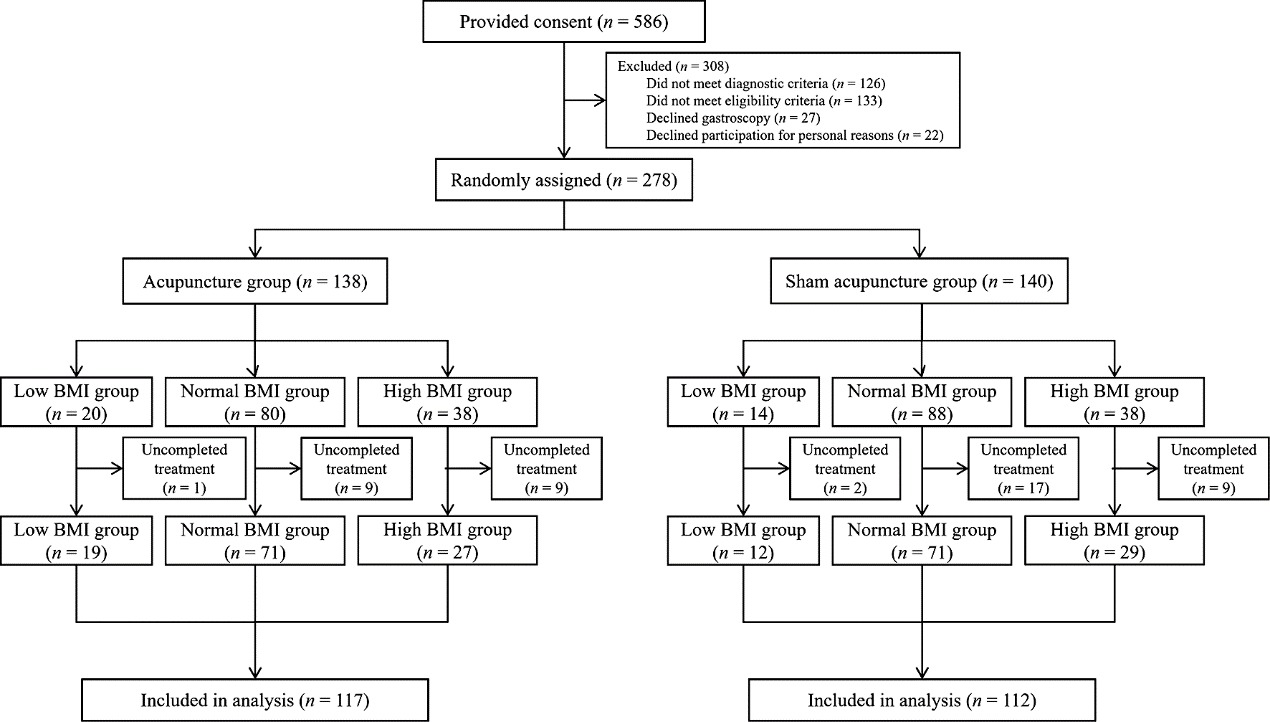
Figure 1 Study flow diagram. BMI: body mass index.
Figure 1 Study flow diagram. BMI: body mass index.
Table 1 Participant baseline characteristics
| Item | Low-BMI | Normal-BMI | High-BMI | |
|---|---|---|---|---|
| Mean age (years, $ \bar{x} \pm s$) | 36.8±10.5 | 42.4±14.1 | 42.6±11.5 | |
| Sex [n (%)] | Female | 14 (73.7) | 57 (80.3) | 15 (55.6) |
| Male | 5 (26.3) | 14 (19.7) | 12 (44.4) | |
| Education (years, $ \bar{x} \pm s$) | 14.8±2.1 | 15.2±3.5 | 14.6±2.8 | |
| Mean disease duration (months, $ \bar{x} \pm s$) | 57.2±48.6 | 52.3±53.6 | 69.7±74.6 | |
| Marital status [n (%)] | Married | 14 (73.7) | 50 (70.4) | 22 (81.5) |
| Single | 5 (26.3) | 21 (29.6) | 5 (18.5) | |
| Occupation | Mental work | 16 (84.2) | 62 (87.3) | 24 (88.9) |
| Manual work | 3 (15.8) | 9 (12.7) | 3 (11.1) | |
| Endoscopy findings [n (%)] a | Normal | 1 (8.3) | 0 (0.0) | 5 (26.3) |
| Chronic superficial gastritis | 8 (66.7) | 30 (71.4) | 9 (47.4) | |
| Chronic nonatrophic gastritis | 3 (25.0) | 12 (28.6) | 5 (26.3) | |
| Helicobacter pylori status [n (%)] b | Positive | 5 (26.3) | 13 (20.0) | 7 (29.2) |
| Negative | 14 (73.7) | 52 (80.0) | 17 (70.8) | |
Table 1 Participant baseline characteristics
| Item | Low-BMI | Normal-BMI | High-BMI | |
|---|---|---|---|---|
| Mean age (years, $ \bar{x} \pm s$) | 36.8±10.5 | 42.4±14.1 | 42.6±11.5 | |
| Sex [n (%)] | Female | 14 (73.7) | 57 (80.3) | 15 (55.6) |
| Male | 5 (26.3) | 14 (19.7) | 12 (44.4) | |
| Education (years, $ \bar{x} \pm s$) | 14.8±2.1 | 15.2±3.5 | 14.6±2.8 | |
| Mean disease duration (months, $ \bar{x} \pm s$) | 57.2±48.6 | 52.3±53.6 | 69.7±74.6 | |
| Marital status [n (%)] | Married | 14 (73.7) | 50 (70.4) | 22 (81.5) |
| Single | 5 (26.3) | 21 (29.6) | 5 (18.5) | |
| Occupation | Mental work | 16 (84.2) | 62 (87.3) | 24 (88.9) |
| Manual work | 3 (15.8) | 9 (12.7) | 3 (11.1) | |
| Endoscopy findings [n (%)] a | Normal | 1 (8.3) | 0 (0.0) | 5 (26.3) |
| Chronic superficial gastritis | 8 (66.7) | 30 (71.4) | 9 (47.4) | |
| Chronic nonatrophic gastritis | 3 (25.0) | 12 (28.6) | 5 (26.3) | |
| Helicobacter pylori status [n (%)] b | Positive | 5 (26.3) | 13 (20.0) | 7 (29.2) |
| Negative | 14 (73.7) | 52 (80.0) | 17 (70.8) | |
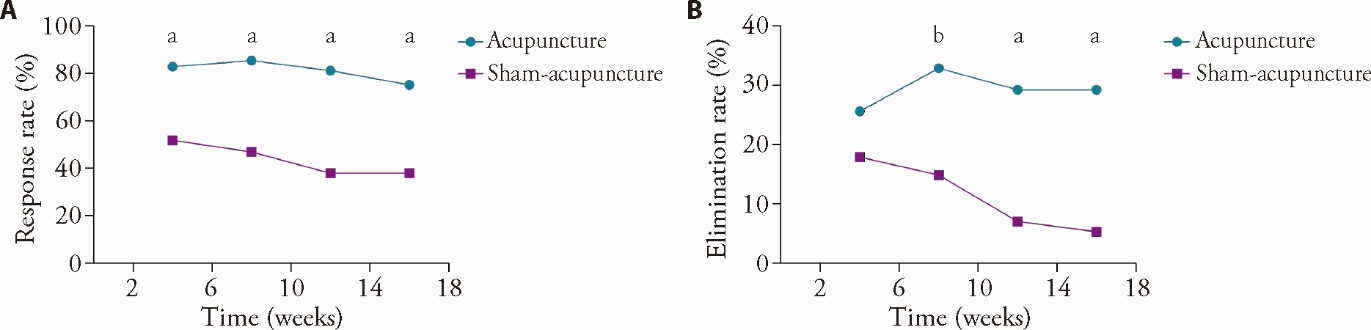
Figure 2 Response rate and elimination rate at all patients A: response rate of acupuncture and sham-acupuncture at weeks 4, 8, 12 and 16; B: elimination rate of acupuncture and sham-acupuncture at weeks 4, 8, 12 and 16. The acupuncture group was given twelve 20-min acupuncture sessions. The sham-acupuncture group was given superficial skin penetration (2 to 3 mm in depth) at non-acupoints group without De Qi manipulations. Statistical analyses were measured by independent-sample t-test to analyze the differences between the groups. Data were shown as percentages of patients (acupuncture group: n = 117; sham-acupuncture group: n = 112). aP < 0.001, compared with sham-acupuncture group; bP < 0.01, compared with sham-acupuncture group.
Figure 2 Response rate and elimination rate at all patients A: response rate of acupuncture and sham-acupuncture at weeks 4, 8, 12 and 16; B: elimination rate of acupuncture and sham-acupuncture at weeks 4, 8, 12 and 16. The acupuncture group was given twelve 20-min acupuncture sessions. The sham-acupuncture group was given superficial skin penetration (2 to 3 mm in depth) at non-acupoints group without De Qi manipulations. Statistical analyses were measured by independent-sample t-test to analyze the differences between the groups. Data were shown as percentages of patients (acupuncture group: n = 117; sham-acupuncture group: n = 112). aP < 0.001, compared with sham-acupuncture group; bP < 0.01, compared with sham-acupuncture group.
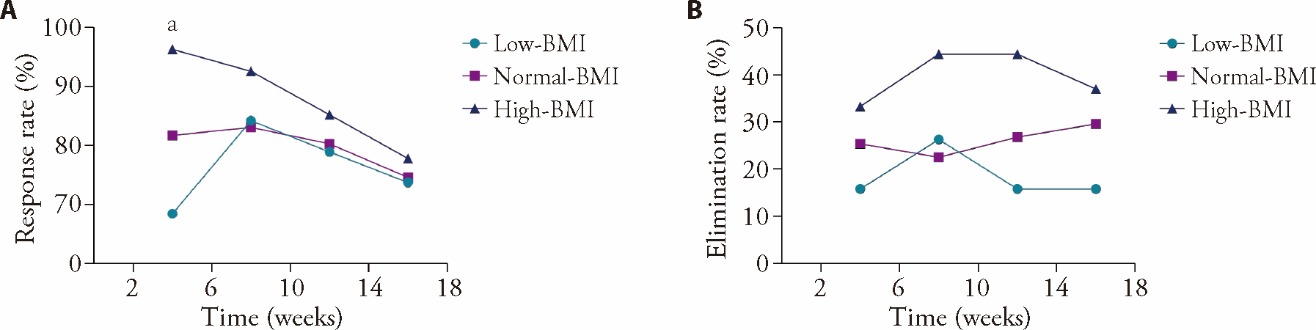
Figure 3 Response rate and elimination rate based on overall treatment effect A: response rate based on overall treatment effect of low-BMI group, normal-BMI and high-BMI group at weeks 4, 8, 12 and 16; B: elimination rate based on overall treatment effect of low-BMI group, normal-BMI and high-BMI group at weeks 4, 8, 12 and 16. The low-BMI group was defined as patients who received acupuncture treatment with a baseline BMI < 18.5 kg/m². The normal-BMI group was defined as patients who received acupuncture treatment with a baseline BMI between 18.5-23.9 kg/m². The high-BMI was defined as patients who received acupuncture treatment with a baseline BMI > 23.9 kg/m². BMI: body mass index. Statistical analyses were measured by Pearson’s χ2 test, with post-hoc pairwise comparisons adjusted by Bonferroni correction when significant differences were detected. Data were shown as percentages of patients (low-BMI group: n = 19; normal-BMI group: n = 71; high-BMI group: n = 27). aP < 0.0125 vs high-BMI.
Figure 3 Response rate and elimination rate based on overall treatment effect A: response rate based on overall treatment effect of low-BMI group, normal-BMI and high-BMI group at weeks 4, 8, 12 and 16; B: elimination rate based on overall treatment effect of low-BMI group, normal-BMI and high-BMI group at weeks 4, 8, 12 and 16. The low-BMI group was defined as patients who received acupuncture treatment with a baseline BMI < 18.5 kg/m². The normal-BMI group was defined as patients who received acupuncture treatment with a baseline BMI between 18.5-23.9 kg/m². The high-BMI was defined as patients who received acupuncture treatment with a baseline BMI > 23.9 kg/m². BMI: body mass index. Statistical analyses were measured by Pearson’s χ2 test, with post-hoc pairwise comparisons adjusted by Bonferroni correction when significant differences were detected. Data were shown as percentages of patients (low-BMI group: n = 19; normal-BMI group: n = 71; high-BMI group: n = 27). aP < 0.0125 vs high-BMI.
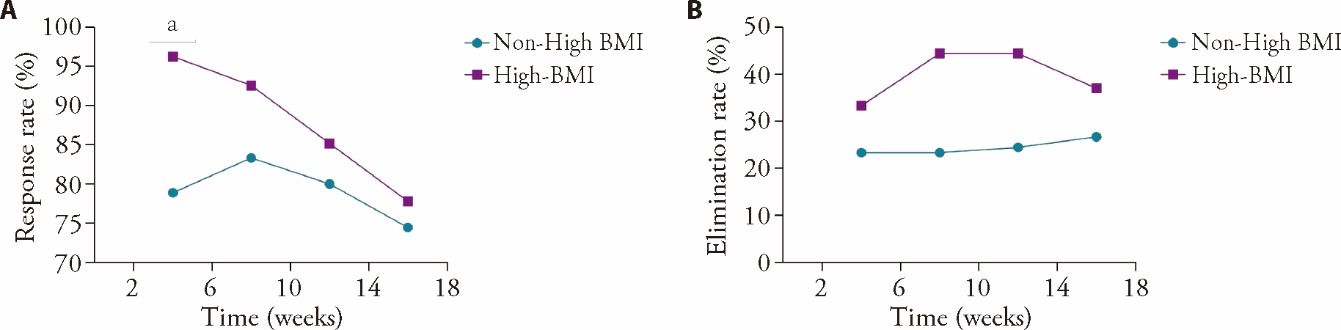
Figure 4 Response rate and elimination rate based on the sensitivity analysis A: response rate based on the sensitivity analysis of non-high BMI group and high BMI group at weeks 4, 8, 12 and 16; B: elimination rate based on the sensitivity analysis of non-high BMI group and high BMI group at weeks 4, 8, 12 and 16. The non-high BMI group was defined as patients who received acupuncture treatment with a baseline BMI ≤ 23.9 kg/m². The high-BMI was defined as patients who received acupuncture treatment with a baseline BMI > 23.9 kg/m². BMI: body mass index. Statistical analyses were measured by independent-sample t-test to analyse the differences between the groups. Data were shown as percentages of patients (non-high BMI group: n = 90; high-BMI group: n = 27). aP < 0.05, compared with high-BMI group.
Figure 4 Response rate and elimination rate based on the sensitivity analysis A: response rate based on the sensitivity analysis of non-high BMI group and high BMI group at weeks 4, 8, 12 and 16; B: elimination rate based on the sensitivity analysis of non-high BMI group and high BMI group at weeks 4, 8, 12 and 16. The non-high BMI group was defined as patients who received acupuncture treatment with a baseline BMI ≤ 23.9 kg/m². The high-BMI was defined as patients who received acupuncture treatment with a baseline BMI > 23.9 kg/m². BMI: body mass index. Statistical analyses were measured by independent-sample t-test to analyse the differences between the groups. Data were shown as percentages of patients (non-high BMI group: n = 90; high-BMI group: n = 27). aP < 0.05, compared with high-BMI group.
Table 2 Primary and secondary outcomes for the BMI group
| Outcome | OR | 95% CI | P value | ||
|---|---|---|---|---|---|
| Primary outcome | Response rate at week 4 | 1.186 | 1.010, 1.394 | 0.038a | |
| Secondary outcome | Response rate | Week 8 | 1.090 | 0.932, 1.275 | 0.282 |
| Week 12 | 1.040 | 0.902, 1.198 | 0.589 | ||
| Week 16 | 0.997 | 0.881, 1.128 | 0.960 | ||
| Elimination rate | Week 4 | 1.081 | 0.960, 1.217 | 0.199 | |
| Week 8 | 1.090 | 0.971, 1.224 | 0.144 | ||
| Week 12 | 1.126 | 1.002, 1.265 | 0.047a | ||
| Week 16 | 1.088 | 0.970, 1.220 | 0.150 | ||
| Early satiation | 1.055 | 0.946, 1.177 | 0.337 | ||
| Postprandial fullness | 1.085 | 0.970, 1.212 | 0.152 | ||
| Upper abdominal bloating | 1.063 | 0.956, 1.183 | 0.258 | ||
Table 2 Primary and secondary outcomes for the BMI group
| Outcome | OR | 95% CI | P value | ||
|---|---|---|---|---|---|
| Primary outcome | Response rate at week 4 | 1.186 | 1.010, 1.394 | 0.038a | |
| Secondary outcome | Response rate | Week 8 | 1.090 | 0.932, 1.275 | 0.282 |
| Week 12 | 1.040 | 0.902, 1.198 | 0.589 | ||
| Week 16 | 0.997 | 0.881, 1.128 | 0.960 | ||
| Elimination rate | Week 4 | 1.081 | 0.960, 1.217 | 0.199 | |
| Week 8 | 1.090 | 0.971, 1.224 | 0.144 | ||
| Week 12 | 1.126 | 1.002, 1.265 | 0.047a | ||
| Week 16 | 1.088 | 0.970, 1.220 | 0.150 | ||
| Early satiation | 1.055 | 0.946, 1.177 | 0.337 | ||
| Postprandial fullness | 1.085 | 0.970, 1.212 | 0.152 | ||
| Upper abdominal bloating | 1.063 | 0.956, 1.183 | 0.258 | ||
| 1. |
Ford AC, Mahadeva S, Carbone MF, Lacy BE, Talley NJ. Functional dyspepsia. Lancet 2020; 396: 1689-702.
DOI PMID |
| 2. |
Van Den Houte K, Carbone F, Tack J. Postprandial distress syndrome: stratification and management. Expert Rev Gastroenterol Hepatol 2019; 13: 37-46.
DOI URL |
| 3. |
Gwee KA, Lee YY, Suzuki H, et al. Asia-Pacific guidelines for managing functional dyspepsia overlapping with other gastrointestinal symptoms. J Gastroenterol Hepatol 2023; 38: 197-209.
DOI URL |
| 4. |
Wauters L, Talley NJ, Walker MM, Tack J, Vanuytsel T. Novel concepts in the pathophysiology and treatment of functional dyspepsia. Gut 2020; 69: 591-600.
DOI PMID |
| 5. |
Xiong L, Gong X, Siah KT, et al. Rome foundation Asian working team report: Real world treatment experience of Asian patients with functional bowel disorders. J Gastroenterol Hepatol 2017; 32: 1450-6.
DOI URL |
| 6. |
Enck P, Azpiroz F, Boeckxstaens G, et al. Functional dyspepsia. Nat Rev Dis Primers 2017; 3: 17081.
DOI PMID |
| 7. |
Takahashi T. Acupuncture for functional gastrointestinal disorders. J Gastroenterol 2006; 41: 408-17.
DOI PMID |
| 8. |
Liao X, Tian Y, Zhang Y, et al. Acupuncture for functional dyspepsia: Bayesian Meta-analysis. Complement Ther Med 2024; 82: 103051.
DOI URL |
| 9. |
Wang XY, Wang H, Guan YY, Cai RL, Shen GM. Acupuncture for functional gastrointestinal disorders: a systematic review and Meta-analysis. J Gastroenterol Hepatol. 2021; 36: 3015-26.
DOI URL |
| 10. |
Ko SJ, Kuo B, Kim SK, et al. Individualized acupuncture for symptom relief in functional dyspepsia: a randomized controlled trial. J Altern Complement Med 2016; 22: 997-1006.
DOI URL |
| 11. |
Lima FA, Ferreira LE, Pace FH. Acupuncture effectiveness as a complementary therapy in functional dyspepsia patients. Arq Gastroenterol 2013; 50: 202-7.
DOI PMID |
| 12. |
Zhang B, Hu Y, Shi X, et al. Integrative effects and vagal mechanisms of transcutaneous electrical acustimulation on gastroesophageal motility in patients with gastroesophageal reflux disease. Am J Gastroenterol 2021; 116: 1495-505.
DOI PMID |
| 13. |
Yang NN, Tan CX, Lin LL, et al. Potential mechanisms of acupuncture for functional dyspepsia based on pathophysiology. Front Neurosci 2021; 15: 781215.
DOI URL |
| 14. |
Yang JW, Wang LQ, Zou X, et al. Effect of acupuncture for postprandial distress syndrome: a randomized clinical trial. Ann Intern Med 2020; 172: 777-85.
DOI URL |
| 15. |
Jiang LY, Tian J, Yang YN, Jia SH, Shu Q. Acupuncture for obesity and related diseases: insight for regulating neural circuit. J Integr Med 2024; 22: 93-101.
DOI URL |
| 16. | Wang LH, Huang W, Wei D, et al. Mechanisms of acupuncture therapy for simple obesity: an evidence-based review of clinical and animal studies on simple obesity. Evid Based Complement Alternat Med 2019; 2019: 5796381. |
| 17. |
Wujie YE, Yawei Y, Da Z, et al. Effectiveness of combining Qingyanyin formulated granules with press needles in treating abdominal obesity: a multicenter randomized controlled trial. J Tradit Chin Med 2025; 45: 107-14.
DOI |
| 18. |
Ford AC, Marwaha A, Sood R, Moayyedi P. Global prevalence of, and risk factors for, uninvestigated dyspepsia: a Meta-analysis. Gut 2015; 64: 1049-57.
DOI PMID |
| 19. |
Bouchoucha M, Fysekidis M, Julia C, et al. Functional gastrointestinal disorders in obese patients. The importance of the enrollment source. Obes Surg 2015; 25: 2143-52.
DOI PMID |
| 20. |
Delgado-Aros S, Locke GR 3rd, Camilleri M, et al. Obesity is associated with increased risk of gastrointestinal symptoms: a population-based study. Am J Gastroenterol 2004; 99: 1801-6.
DOI PMID |
| 21. |
Bouchoucha M, Fysekidis M, Julia C, et al. Body mass index association with functional gastrointestinal disorders: differences between genders. Results from a study in a tertiary center. J Gastroenterol 2016; 51: 337-45.
DOI PMID |
| 22. |
Le Pluart D, Sabaté JM, Bouchoucha M, Hercberg S, Benamouzig R, Julia C. Functional gastrointestinal disorders in 35 447 adults and their association with body mass index. Aliment Pharmacol Ther 2015; 41: 758-67.
DOI URL |
| 23. |
Lee J, Chang CL, Lin JB, et al. The effect of body mass index and weight change on late gastrointestinal toxicity in locally advanced cervical cancer treated with intensity-modulated radiotherapy. Int J Gynecol Cancer 2018; 28: 1377-86.
DOI PMID |
| 24. |
van Zutphen M, Kampman E, Giovannucci EL, van Duijnhoven FJB. Lifestyle after colorectal cancer diagnosis in relation to survival and recurrence: a review of the literature. Curr Colorectal Cancer Rep 2017; 13: 370-401.
DOI PMID |
| 25. |
Eusebi LH, Ratnakumaran R, Yuan Y, Solaymani-Dodaran M, Bazzoli F, Ford AC. Global prevalence of, and risk factors for, gastro-oesophageal reflux symptoms: a Meta-analysis. Gut 2018; 67: 430-40.
DOI PMID |
| 26. | Guidelines for medical nutrition treatment of overweight/obesity in China (2021). Asia Pac J Clin Nutr. 2022; 31: 450-82. |
| 27. |
Pavlov VA. The evolving obesity challenge: targeting the vagus nerve and the inflammatory reflex in the response. Pharmacol Ther 2021; 222: 107794.
DOI URL |
| 28. |
Oh JE, Kim SN. Anti-inflammatory effects of acupuncture at ST36 point: a literature review in animal studies. Front Immunol 2021; 12: 813748.
DOI URL |
| 29. |
Liu S, Wang Z, Su Y, et al. A neuroanatomical basis for electroacupuncture to drive the vagal-adrenal axis. Nature 2021; 598: 641-5.
DOI |
| 30. |
Kwaifa IK, Bahari H, Yong YK, Noor SM. Endothelial dysfunction in obesity-induced inflammation: molecular mechanisms and clinical implications. Biomolecules 2020; 10: 291.
DOI URL |
| 31. |
Wang MN, Zhai MX, Wang YT, et al. Mechanism of acupuncture in treating obesity: advances and prospects. Am J Chin Med 2024; 52: 1-33.
DOI URL |
| 32. |
Jung J, Lee SM, Lee MJ, et al. Lipidomics reveals that acupuncture modulates the lipid metabolism and inflammatory interaction in a mouse model of depression. Brain Behav Immun 2021; 94: 424-36.
DOI PMID |
| 33. |
Spence JD, Pilote L. Importance of sex and gender in atherosclerosis and cardiovascular disease. Atherosclerosis 2015; 241: 208-10.
DOI PMID |
| 34. |
Westerman S, Wenger N. Gender differences in atrial fibrillation: a review of epidemiology, management, and outcomes. Curr Cardiol Rev 2019; 15: 136-44.
DOI PMID |
| 35. | Cerri S, Mus L, Blandini F. Parkinson's disease in women and men: what's the difference? J Parkinsons Dis 2019; 9: 501-15. |
| 36. |
Kim YS, Kim N. Functional dyspepsia: a narrative review with a focus on sex-gender differences. J Neurogastroenterol Motil 2020; 26: 322-34.
DOI URL |
| 37. |
Narayanan SP, Anderson B, Bharucha AE. Sex- and gender-related differences in common functional gastroenterologic disorders. Mayo Clin Proc 2021; 96: 1071-89.
DOI PMID |
| 38. | Liebert A, Seyedsadjadi N, Pang V, Litscher G, Kiat H. Evaluation of gender differences in response to photobiomodulation therapy, including laser acupuncture: a narrative review and implication to precision medicine. Photobiomodul Photomed Laser Surg 2022; 40: 78-87. |
| 39. |
Yeo S, Rosen B, Bosch P, Noort MV, Lim S. Gender differences in the neural response to acupuncture: clinical implications. Acupunct Med 2016; 34: 364-72.
DOI PMID |
| [1] | ZHUANG Zifeng, WO Choying, CHEN Hongling, XIE Hailiang, ZHAO Canghuan, ZHANG Di, QING Peng. Acupuncture inhibits astrocytic hyperactivation via the p38 mitogen-activated protein kinase/mitogen- and stress-activated protein kinase 1 signaling pathway in cerebral ischemia-reperfusion injury [J]. Journal of Traditional Chinese Medicine, 2026, 46(2): 316-325. |
| [2] | LIN Lixia, LI Xin, LI Ling, YANG Pu, LU Liming, LIU Buping, SU Shengyong. Multiple acupuncture and moxibustion therapies for allergic rhinitis in adults: a network Meta-analysis of randomized controlled trials [J]. Journal of Traditional Chinese Medicine, 2026, 46(1): 1-13. |
| [3] | YUAN Menghua, SHAO Jianbin, YANG Yawei, ZHAO Yan, HU Xingang. Combined acupuncture and herb treatment improves intestinal flora inabdominally obese subjects based on 16s rRNA sequencing: a randomized controlled trial [J]. Journal of Traditional Chinese Medicine, 2026, 46(1): 205-210. |
| [4] | WANG Ci, CAO Yawen, WANG Jiaying, CHEN Jixin, MA Xue, WANG Xianliang, MAO Jingyuan. Efficacy and safety of acupuncture for arrythmias: an overview of systematic reviews and Meta-analyses [J]. Journal of Traditional Chinese Medicine, 2025, 45(6): 1178-1190. |
| [5] | SHOU Yin, JIANG Juntao, HU Jianlin, JI Wei, CHEN Chunyan, HU Li, MA Yuhang, ZHANG Bimeng. Electroacupuncture alleviates type 2 diabetes mellitus by promoting plasma-derived exosomal circular RNA of enhancer of zeste homolog 1 expression [J]. Journal of Traditional Chinese Medicine, 2025, 45(6): 1228-1237. |
| [6] | LIU Jingxuan, MO Qian, LEI Guowu, JIA Yejuan, LI Aiying, JIA Chunsheng, PAN Lijia. Four-dimensional data independent acquisition proteomics and metabolomics reveal mechanisms of hydrogen-rich water at Zusanli (ST36) point against triple-negative breast cancer in mice [J]. Journal of Traditional Chinese Medicine, 2025, 45(6): 1238-1253. |
| [7] | LYU Hequn, ZENG Chunli, ZHANG Hanrui, YANG Chen, SHEN Yan, PENG Yongjun. Effect of Xuanfei Tongqiao acupuncture on nasal inflammation in rats with allergic rhinitis: modulation of long non-coding RNA growth arrest-specific transcript 5 methylation modification [J]. Journal of Traditional Chinese Medicine, 2025, 45(6): 1263-1272. |
| [8] | ZHANG Qiongshuai, LI Yi, CAO Fang, ZHI Mujun, WANG Le, LIU Ruyao, FENG Juanjuan. Effect of acupuncture on brain microenvironment in rats with post-stroke limb spasticity based on single-cell transcriptome sequencing technology [J]. Journal of Traditional Chinese Medicine, 2025, 45(6): 1273-1282. |
| [9] | XU Yuqin, YUAN Jinjun, ZHU Yanxian, CHEN Chen, MA Xiaoming, JIANG Jiaona, HUANG Xingxian, LUO Wenshu, LIU Fan, YANG Zhuoxin, ZHOU Yumei. Observation of the efficacy and safety of acupuncture for postpartum depression [J]. Journal of Traditional Chinese Medicine, 2025, 45(6): 1405-1413. |
| [10] | WANG Yue, LIU Xingxing, GUO Yi, GUO Yongming, YUAN Gongming, ZHANG Yu, ZHENG Zhiyu, XU Yuan, LI Yuan. Characterization of acupuncture on central amino acid metabolism based on targeted neurotransmitter analysis in mice with inflammatory pain [J]. Journal of Traditional Chinese Medicine, 2025, 45(5): 1019-1027. |
| [11] | GUO Jixing, JI Changchun, XIE Chaoju, RAO Xiang, SUN Zhangyin, XING Yu, ZHANG Rongni, QU Qiangqiang, DONG Youpeng, YANG Jinsheng. Various acupuncture therapies for managing nonspecific low back pain: a network Meta-analysis [J]. Journal of Traditional Chinese Medicine, 2025, 45(5): 954-962. |
| [12] | ZHAO Ping, HE Xingbo, HAN Xudong, CHEN Xinyue, LI Zhanglong, SONG Jike, XING Wenjia, WU Jiangfeng, GUO Bin, BI Hongsheng. Mechanism of electroacupuncture involve in lens-induced myopia guinea pigs by inhibiting wnt/β-catenin signaling pathway [J]. Journal of Traditional Chinese Medicine, 2025, 45(4): 796-805. |
| [13] | ZHENG Ruwen, DONG Xu, WANG Tianyi, FENG Liyuan, ZHANG Hongyan, HUO Hong, ZHANG Ying, ZHANG Qianshi, ZHU Xingyan, WANG Dongyan. Electroacupuncture versus conventional acupuncture of scalp motor area for post-stroke wrist dyskinesia and its effect on muscle function: a randomized, controlled clinical trial [J]. Journal of Traditional Chinese Medicine, 2025, 45(4): 852-859. |
| [14] | SONG Jianfei, QIN Zhengyuan, GU Xinlu, ZHANG Yan, LI Xingrui. Efficacy of acupuncture combined with upper limb rehabilitation robot-assisted training for neuroplasticity and functional recovery of patients with stroke: a prospective cohort study based on functional near-infrared spectroscopy technology [J]. Journal of Traditional Chinese Medicine, 2025, 45(4): 860-866. |
| [15] | Kanae Umemoto, SHAN Xiyao, Takuro Ishikawa, Tadashi Watsuji, Yasuharu Watanabe, Munekazu Naito. Novel insight into the site-specificity of Hegu (LI4): morphological, biomechanical, and histological analyses [J]. Journal of Traditional Chinese Medicine, 2025, 45(4): 867-872. |
| Viewed | ||||||
|
Full text |
|
|||||
|
Abstract |
|
|||||