
Journal of Traditional Chinese Medicine ›› 2026, Vol. 46 ›› Issue (4): 844-853.DOI: 10.19852/j.cnki.jtcm.20251201.001
• Original Articles • Previous Articles Next Articles
Regulatory effects and mechanisms of the acupuncture-induced complement component 1q on the high mobility group box 1 -receptor for advanced glycation end products-nuclear factor kappa-B pathway at Zusanli (ST36)
KANG Xiaochun1, WU Sinuo1, LI Ningcen2, XU Wenyue1, XU Zhifang2, Thong Yikchih1, LI Peiyun1, TU Shiwei1, MA Ning3, LI Yanwei2, DOU Baomin1, TAN Wenjun4, GUO Jing5, GUO Yi2, PAN Xingfang2( ), LÜ Zhongxi2()
- 1
School of Acupuncture & Moxibustion and Tuina ,Tianjin University of Traditional Chinese Medicine Tianjin 301617, China
2Research Center of Experimental Acupuncture Science ,Tianjin University of Traditional Chinese Medicine, Tianjin 301617, China; School of Acupuncture & Moxibustion and Tuina, Tianjin University of Traditional Chinese Medicine Tianjin 301617, China
3Institute of Traditional Chinese Medicine ,Suzuka University of Medical Science Suzuka 5100226, Japan
4Key Laboratory of Intelligent Computing in Medical Image ,Ministry of Education, Northeastern University Shenyang 110189, China
5School of Automation ,Guangdong University of technology Guangzhou 510006, China
-
Received:2025-05-10Accepted:2025-09-30Online:2026-08-15Published:2025-12-01 -
Contact:Associate professor LÜ Zhongxi, full professor PAN Xingfang, School of Acupuncture & Moxibustion and Tuina, Tianjin University of Traditional Chinese Medicine, Tianjin 301617, China. 1025117807@qq.com;panxingfang@163.com -
About author:KANG Xiaochun and WU Sinuo are co-first authors and contributed equally to this work -
Supported by:National Key R&D Program of China: Efficacy and Safety Verification of Intelligent Traditional Chinese Medicine Acupuncture Robot System(2022YFB4703100);National Natural Science Foundation of China: Study on the Effect and Mechanism of C1q Protein in the Ordered and Controlled Inflammatory Response in Acupuncture Area(82105023);Mechanism of electroacupuncture-driven Surface-modified Graded Cell-derived Glycosylated Exo-miR-146a targeting T Cell Immunoglobulin and Mucin Domain-containing Protein 3 to Regulate Exhausted T Cells and Alleviate Sepsis Immunosuppression(82305370);Initial Dynamic Regulation Mechanism of Acupuncture Effect via Physicochemical Coupling Network in Acupoint Microenvironment(82030125);Young Elite Scientists Sponsorship Program by China Association of Chinese Medicine: Initiation Mechanism of Acupuncture Analgesia Mediated by High Mobility Group Box 1 at Acupoints(2023-QNRC2-B04)

Cite this article
KANG Xiaochun, WU Sinuo, LI Ningcen, XU Wenyue, XU Zhifang, Thong Yikchih, LI Peiyun, TU Shiwei, MA Ning, LI Yanwei, DOU Baomin, TAN Wenjun, GUO Jing, GUO Yi, PAN Xingfang, LÜ Zhongxi. Regulatory effects and mechanisms of the acupuncture-induced complement component 1q on the high mobility group box 1 -receptor for advanced glycation end products-nuclear factor kappa-B pathway at Zusanli (ST36)[J]. Journal of Traditional Chinese Medicine, 2026, 46(4): 844-853.
share this article
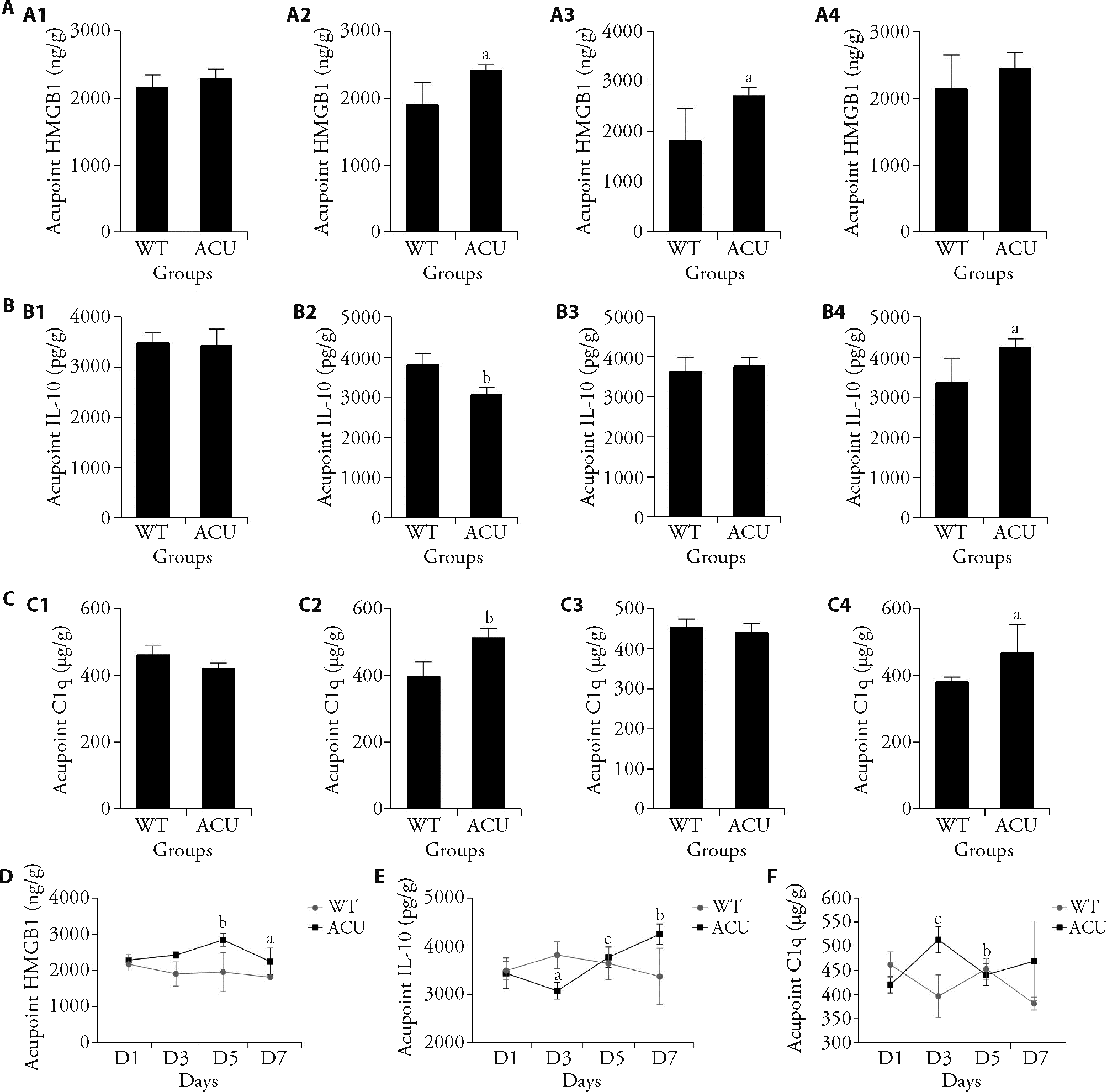
Figure 1 Effect of acupuncture on HMGB1, IL-10, and C1q proteins at Zusanli (ST36) A: concentration of HMGB1 proteins; B: concentration of IL-10 proteins; C: concentration of C1q proteins; A1, B1, C1: D1 after acupuncture; A2, B2, C2: D3 after acupuncture; A3, B3, C3: D5 after acupuncture; A4, B4, C4: D7 after acupuncture; D-F: the temporal changes of HMGB1, IL-10 and C1q proteins after acupuncture (D3 vs D1, D5 vs D3, D7 vs D5). D: HMGB1 proteins; E: IL-10 proteins; F: C1q proteins. WT group: wild-type mice without acupuncture intervention, ACU group: wild-type mice receiving bilateral Zusanli (ST36) acupuncture stimulation. Acupuncture was performed at Zusanli (ST36) using sterilized stainless-steel filiform needles in 8-min daily sessions for 1, 3, 5, or 7 d. HMGB1: high mobility group box 1; IL-10: interleukin-10; C1q: complement component 1q; D: day. Data are presented as mean ± standard deviation (n = 5-7 per group). The t-test was used for data analysis between two groups. aP < 0.05, bP < 0.01, cP < 0.001 versus the WT group.
Figure 1 Effect of acupuncture on HMGB1, IL-10, and C1q proteins at Zusanli (ST36) A: concentration of HMGB1 proteins; B: concentration of IL-10 proteins; C: concentration of C1q proteins; A1, B1, C1: D1 after acupuncture; A2, B2, C2: D3 after acupuncture; A3, B3, C3: D5 after acupuncture; A4, B4, C4: D7 after acupuncture; D-F: the temporal changes of HMGB1, IL-10 and C1q proteins after acupuncture (D3 vs D1, D5 vs D3, D7 vs D5). D: HMGB1 proteins; E: IL-10 proteins; F: C1q proteins. WT group: wild-type mice without acupuncture intervention, ACU group: wild-type mice receiving bilateral Zusanli (ST36) acupuncture stimulation. Acupuncture was performed at Zusanli (ST36) using sterilized stainless-steel filiform needles in 8-min daily sessions for 1, 3, 5, or 7 d. HMGB1: high mobility group box 1; IL-10: interleukin-10; C1q: complement component 1q; D: day. Data are presented as mean ± standard deviation (n = 5-7 per group). The t-test was used for data analysis between two groups. aP < 0.05, bP < 0.01, cP < 0.001 versus the WT group.

Figure 2 Acupuncture-induced C1q involved in regulating the inflammatory responses at Zusanli (ST36) A: representative hematoxylin-eosin staining images of Zusanli (ST36) tissues (Nuclei: blue, cytoplasm: red, Scale bar = 50 µm, n = 3, magnification × 40); A1-A3: the epidermis, dermis layers of the WT, ACU, and C1q-/-+ACU groups; A1:WT groups; A2: ACU groups; A3: C1q-/-+ACU groups; A4-A6: the muscle layers of the WT, ACU, and C1q-/-+ACU groups; A4: WT groups; A5: ACU groups; A6: C1q-/-+ACU groups; B: single-label immunofluorescence of p-p65 (p-p65: green, 1:100, DAPI: blue, Scale bar = 10 µm, n = 3, magnification × 40). B1-B3: representative merged images showing p-p65 with DAPI; B1: WT groups; B2: ACU groups; B3: C1q-/-+ACU groups; C: quantification of p-p65-positive cells by immunofluorescence (n = 3); D: protein concentration of HMGB1 at Zusanli (ST36) measured by ELISA (n = 5-6); E: protein concentration of IL-10 at Zusanli (ST36) measured by ELISA (n = 5-6). WT group: wild-type mice without acupuncture intervention, ACU group: wild-type mice receiving bilateral Zusanli (ST36) acupuncture stimulation, C1q-/-+ACU group: C1q knockout mice receiving acupuncture. Acupuncture was performed at Zusanli (ST36) using sterilized stainless-steel filiform needles in 8-min daily sessions for 7 d. HMGB1: high mobility group box 1; IL-10: interleukin-10; ELISA: enzyme-linked immunosorbent assay; p-p65: phosphorylated p65. Data are presented as mean ± standard deviation. One-way analysis of variance was used for multiple groups comparisons. If the data followed a normal distribution, the least significant difference test was used; otherwise, Dunnett’s T3 test was used. aP < 0.05, cP < 0.01 versus the WT group; bP < 0.05 versus the ACU group.
Figure 2 Acupuncture-induced C1q involved in regulating the inflammatory responses at Zusanli (ST36) A: representative hematoxylin-eosin staining images of Zusanli (ST36) tissues (Nuclei: blue, cytoplasm: red, Scale bar = 50 µm, n = 3, magnification × 40); A1-A3: the epidermis, dermis layers of the WT, ACU, and C1q-/-+ACU groups; A1:WT groups; A2: ACU groups; A3: C1q-/-+ACU groups; A4-A6: the muscle layers of the WT, ACU, and C1q-/-+ACU groups; A4: WT groups; A5: ACU groups; A6: C1q-/-+ACU groups; B: single-label immunofluorescence of p-p65 (p-p65: green, 1:100, DAPI: blue, Scale bar = 10 µm, n = 3, magnification × 40). B1-B3: representative merged images showing p-p65 with DAPI; B1: WT groups; B2: ACU groups; B3: C1q-/-+ACU groups; C: quantification of p-p65-positive cells by immunofluorescence (n = 3); D: protein concentration of HMGB1 at Zusanli (ST36) measured by ELISA (n = 5-6); E: protein concentration of IL-10 at Zusanli (ST36) measured by ELISA (n = 5-6). WT group: wild-type mice without acupuncture intervention, ACU group: wild-type mice receiving bilateral Zusanli (ST36) acupuncture stimulation, C1q-/-+ACU group: C1q knockout mice receiving acupuncture. Acupuncture was performed at Zusanli (ST36) using sterilized stainless-steel filiform needles in 8-min daily sessions for 7 d. HMGB1: high mobility group box 1; IL-10: interleukin-10; ELISA: enzyme-linked immunosorbent assay; p-p65: phosphorylated p65. Data are presented as mean ± standard deviation. One-way analysis of variance was used for multiple groups comparisons. If the data followed a normal distribution, the least significant difference test was used; otherwise, Dunnett’s T3 test was used. aP < 0.05, cP < 0.01 versus the WT group; bP < 0.05 versus the ACU group.

Figure 3 Mechanism of C1q regulation of the inflammatory response at Zusanli (ST36) A: representative Western blot bands showing protein expression of RAGE, LAIR-1, and SHP-1 at Zusanli (ST36) (n = 5-6); B: quantification of LAIR-1 normalized to GAPDH; C: quantification of RAGE normalized to GAPDH; D: quantification of SHP-1normalized to GAPDH; E: double-label immunofluorescence of M1 macrophages (M0: F4/80, red, 1:50; M1: CD86, green, 1:100; Merged: F4/80, CD86, and DAPI; Scale bar = 100 µm; magnification ×40, n = 3); E1: F4/80-label of WT groups; E2: F4/80-label of ACU groups; E3: F4/80-label of C1q-/-+ACU groups, E4: CD86-label of WT groups; E5: CD86-label of ACU groups; E6: CD86-label of C1q-/-+ACU groups; E7: merged of WT groups; E8: merged of ACU groups; E9: merged of C1q-/-+ACU groups, F: double-label immunofluorescence of M2 macrophages (M0: F4/80, red, 1:50; M2: CD206, green, 1:50, Merged: F4/80, CD206, and DAPI; Scale bar = 100 µm; magnification ×40, n = 3); F1: F4/80-label of WT groups; F2: F4/80-label of ACU groups; F3: F4/80-label of C1q-/-+ACU groups, F4: CD206-label of WT groups; F5: CD206-label of ACU groups; F6: CD206-label of C1q-/-+ACU groups; F7: merged of WT groups; F8: merged of ACU groups; F9: merged of C1q-/-+ACU groups; G : quantitative immunofluorescence analysis of M1 macrophages at Zusanli (ST36) (n = 3); H: quantitative immunofluorescence analysis of M2 macrophages at Zusanli (ST36) (n = 3). WT group: wild-type mice without acupuncture intervention, ACU group: wild-type mice receiving bilateral Zusanli (ST36) acupuncture stimulation, C1q-/-+ACU group: C1q knockout mice receiving acupuncture. Acupuncture was performed at Zusanli (ST36) using sterilized stainless-steel filiform needles in 8-min daily sessions for 7 d. RAGE: the receptor for advanced glycation end-products; LAIR-1: leukocyte-associated immunoglobulin-like receptor 1; SHP-1: src homology 2 domain-containing protein tyrosine phosphatase 1; GAPDH: glyceraldehyde-3-phosphate dehydrogenase; M0: Naïve Macrophage; M1: classical activated macrophages; M2: alternatively activated macrophages. Data are presented as mean ± standard deviation. One-way analysis of variance was used for multiple groups comparisons. If the data followed a normal distribution, the least significant difference test was used; otherwise, Dunnett’s T3 test was used. cP < 0.01, aP < 0.001 versus the WT group; bP < 0.05, dP < 0.001 versus the ACU group.
Figure 3 Mechanism of C1q regulation of the inflammatory response at Zusanli (ST36) A: representative Western blot bands showing protein expression of RAGE, LAIR-1, and SHP-1 at Zusanli (ST36) (n = 5-6); B: quantification of LAIR-1 normalized to GAPDH; C: quantification of RAGE normalized to GAPDH; D: quantification of SHP-1normalized to GAPDH; E: double-label immunofluorescence of M1 macrophages (M0: F4/80, red, 1:50; M1: CD86, green, 1:100; Merged: F4/80, CD86, and DAPI; Scale bar = 100 µm; magnification ×40, n = 3); E1: F4/80-label of WT groups; E2: F4/80-label of ACU groups; E3: F4/80-label of C1q-/-+ACU groups, E4: CD86-label of WT groups; E5: CD86-label of ACU groups; E6: CD86-label of C1q-/-+ACU groups; E7: merged of WT groups; E8: merged of ACU groups; E9: merged of C1q-/-+ACU groups, F: double-label immunofluorescence of M2 macrophages (M0: F4/80, red, 1:50; M2: CD206, green, 1:50, Merged: F4/80, CD206, and DAPI; Scale bar = 100 µm; magnification ×40, n = 3); F1: F4/80-label of WT groups; F2: F4/80-label of ACU groups; F3: F4/80-label of C1q-/-+ACU groups, F4: CD206-label of WT groups; F5: CD206-label of ACU groups; F6: CD206-label of C1q-/-+ACU groups; F7: merged of WT groups; F8: merged of ACU groups; F9: merged of C1q-/-+ACU groups; G : quantitative immunofluorescence analysis of M1 macrophages at Zusanli (ST36) (n = 3); H: quantitative immunofluorescence analysis of M2 macrophages at Zusanli (ST36) (n = 3). WT group: wild-type mice without acupuncture intervention, ACU group: wild-type mice receiving bilateral Zusanli (ST36) acupuncture stimulation, C1q-/-+ACU group: C1q knockout mice receiving acupuncture. Acupuncture was performed at Zusanli (ST36) using sterilized stainless-steel filiform needles in 8-min daily sessions for 7 d. RAGE: the receptor for advanced glycation end-products; LAIR-1: leukocyte-associated immunoglobulin-like receptor 1; SHP-1: src homology 2 domain-containing protein tyrosine phosphatase 1; GAPDH: glyceraldehyde-3-phosphate dehydrogenase; M0: Naïve Macrophage; M1: classical activated macrophages; M2: alternatively activated macrophages. Data are presented as mean ± standard deviation. One-way analysis of variance was used for multiple groups comparisons. If the data followed a normal distribution, the least significant difference test was used; otherwise, Dunnett’s T3 test was used. cP < 0.01, aP < 0.001 versus the WT group; bP < 0.05, dP < 0.001 versus the ACU group.
| 1. | Lyu ZX, Guo YM, Gong YN, et al. The role of neuroglial crosstalk and synaptic plasticity-mediated central sensitization in acupuncture analgesia. Neural Plast 2021; 2021: 1-18. |
| 2. |
Gong YN, Li NC, Lü ZX, et al. The neuro-immune microenvironment of acupoints-initiation of acupuncture effectiveness. J Leukoc Biol 2020; 108: 189-98.
DOI URL |
| 3. |
Park JY, Park JJ, Jeon S, et al. From peripheral to central: the role of ERK signaling pathway in acupuncture analgesia. J Pain 2014; 15: 535-49.
DOI URL |
| 4. |
Qu F, Cui YR, Zeng J, et al. Acupuncture induces adenosine in fibroblasts through energy metabolism and promotes proliferation by activating MAPK signaling pathway via adenosine(3) receptor. J Cell Physiol 2020; 235: 2441-51.
DOI URL |
| 5. |
Zhang K, Zhao X, Yang T, et al. Initiation of acupoint molecular mechanisms for manual acupuncture analgesia-nuclear factor κB signaling pathway. Chin J Integr Med 2021; 27: 933-9.
DOI PMID |
| 6. |
Agalave NM, Svensson CI. Extracellular high-mobility group box 1 protein (HMGB1) as a mediator of persistent pain. Mol Med 2015; 20: 569-78.
DOI PMID |
| 7. | Xi Q, Cui R, Jing G, Guo YM. A preliminary study on the role of local TLR4 in acupoint in the local inflammatory response after acupuncture. Tianjin Zhong Yi Yao 2015; 32: 88-92. |
| 8. |
Ding N, Wang F, Xiao H, Xu LX, She SZ. She S. Mechanical ventilation enhances HMGB1 expression in an LPS-induced lung injury model. Plos One 2013; 8: e74633.
DOI URL |
| 9. | Ghebrehiwet B, Hosszu KK, Valentino A, Peerschke EI. The C1q family of proteins: insights into the emerging non-traditional functions. Front Immunol 2012; 3; 52. |
| 10. |
Noble M, Pröschel C. The many roles of C1q. Elife 2020; 9: e61599.
DOI URL |
| 11. |
Son M, Porat A, He MZ, et al. C1q and HMGB1 reciprocally regulate human macrophage polarization. Blood 2016; 128: 2218-28.
PMID |
| 12. |
Fraser DA, Arora M, Bohlson SS, Lozano E, Tenner AJ. Generation of inhibitory NFkappaB complexes and phosphorylated cAMP response element-binding protein correlates with the anti-inflammatory activity of complement protein C1q in human monocytes. J Biol Chem 2007; 282: 7360-7.
DOI PMID |
| 13. |
Son M. Understanding the contextual functions of C1q and LAIR-1 and their applications. Exp Mol Med 2022; 54: 567-72.
DOI PMID |
| 14. |
Zhang K, Zhao X, Ding SS, et al. Applying complex network and cell-cell communication network diagram methods to explore the key cytokines and immune cells in local acupoint involved in acupuncture treating inflammatory pain. Evid Based Complement Alternat Med 2020; 2020: 2585960.
DOI URL |
| 15. | Li YM. In the search of mobile target for acupuncture: why is mast cell? Zhong Guo Zhen Jiu 2021; 41: 965-70. |
| 16. |
Wang ZG, Yi T, Long M, et al. Electro-acupuncture at Zusanli acupoint (ST36) suppresses inflammation in allergic contact dermatitis via triggering local IL-10 production and inhibiting p38 MAPK activation. Inflammation 2017; 40: 1351-64.
DOI URL |
| 17. |
Kolev M, Le Friec G, Kemper C. Complement-tapping into new sites and effector systems. Nat Rev Immunol 2014; 14: 811-20.
DOI |
| 18. |
Fraser DA, Bohlson SS, Jasinskiene N, et al. C1q and MBL, components of the innate immune system, influence monocyte cytokine expression. J Leukoc Biol 2006; 80: 107-16.
DOI URL |
| 19. |
Spivia W, Magno PS, Le P, Fraser DA. Complement protein C1q promotes macrophage anti-inflammatory M2-like polarization during the clearance of atherogenic lipoproteins. Inflamm Res 2014; 63: 885-93.
DOI PMID |
| 20. |
Benoit ME, Clarke EV, Morgado P, Fraser DA. Complement protein C1q directs macrophage polarization and limits inflammasome activity during the uptake of apoptotic cells. J Immunol 2012; 188: 5682-93.
DOI PMID |
| 21. | Son M, Santiago-Schwarz F, Al-Abed Y. C1q limits dendritic cell differentiation and activation by engaging LAIR-1. Proc Natl Acad Sci U S A 2012; 109: E3160-67. |
| 22. |
Wen LZ, Ding K, Wang ZR, et al. SHP-1 acts as a tumor suppressor in hepatocarcinogenesis and HCC progression. Cancer Res 2018; 78: 4680-91.
DOI URL |
| 23. |
Pesce M, Franceschelli S, Ferrone A, et al. The NF-kB regulates the SHP-1 expression in monocytes in congestive heart failure. Front Biosci (Landmark Ed) 2017; 22: 757-71.
PMID |
| 24. |
Takagane K, Umakoshi M, Itoh G, Kuriyama S, Goto A, Tanaka M. SKAP2 suppresses inflammation-mediated tumorigenesis by regulating SHP-1 and SHP-2. Oncogene 2022; 41: 1087-99.
DOI PMID |
| 25. | Deng DL, Xu F, Ma LL, et al. Electroacupuncture alleviates CFA-induced inflammatory pain via PD-L1/PD-1-SHP-1 pathway. Mol Neurobiol 2023; 60: 2922-36. |
| 26. |
Rojas A, Delgado-López F, Perez-Castro R, et al. HMGB1 enhances the protumoral activities of M2 macrophages by a RAGE-dependent mechanism. Tumour Biol 2016; 37: 3321-9.
DOI URL |
| 27. |
Liu TY, Xiang A, Peng T, et al. HMGB1-C1q complexes regulate macrophage function by switching between leukotriene and specialized proresolving mediator biosynthesis. Proc Natl Acad Sci USA 2019; 116: 23254-63.
DOI PMID |
| 28. |
Xu Y, Hong SH, Zhao X, et al. Acupuncture alleviates rheumatoid arthritis by immune-network modulation. Am J Chin Med 2018; 46: 997-1019.
DOI URL |
| 29. |
Saraiva M, O'Garra A. The regulation of IL-10 production by immune cells. Nat Rev Immunol 2010; 10: 170-81.
DOI PMID |
| 30. |
Van Beijnum JR, Buurman WA, Griffioen AW, Convergence and amplification of toll-like receptor (TLR) and receptor for advanced glycation end products (RAGE) signaling pathways via high mobility group B1 (HMGB1). Angiogenesis 2008; 11: 91-9.
DOI PMID |
| [1] | SHI Ling, YANG Chengcheng, HUANG Li, DENG Linwen. Effect of acupuncture and moxibustion combined with core stabilization training on the function of transverse abdominal muscle and pelvic floor muscle in women with postpartum pelvic pain [J]. Journal of Traditional Chinese Medicine, 2026, 46(4): 1009-1017. |
| [2] | TIAN Yehong, ZHANG Qiaoli, ZHANG Rui, GAO Tao, LI Nanzhi, HUANG Jinchang, JIANG Xin, QIU Xiaowei. Electroacupuncture enhances CD8+ T cells recruitment via modulating sympathetic nervous system to suppress tumor growth in mice bearing triple-negative breast cancer [J]. Journal of Traditional Chinese Medicine, 2026, 46(4): 832-843. |
| [3] | LIU Yutong, YANG Yan, XU Huiying, LI Lei, GE Fei, CHEN Meijuan. Jianchang No. 1 (健肠1号) formula alleviates irritable bowel syndrome with diarrhea via improving gut microbiota and regulating toll-like receptors/nuclear factor-kappa B signaling pathway in bowel syndrome with diarrhea rats [J]. Journal of Traditional Chinese Medicine, 2026, 46(4): 883-893. |
| [4] | XU Huichao, HAO Jianheng, CHANG Boya, WANG Danni, LI Rangqian, CAO Yuxia, WANG Haijun, JI Laixi. Electroacupuncture alleviates intestinal inflammation in rats with ulcerative colitis by regulating colonic cell autophagy and gut microbiota [J]. Journal of Traditional Chinese Medicine, 2026, 46(4): 894-906. |
| [5] | ZHENG Jie, DING Zhimin, CHEN Tingyu, LÜ Zhuan, ZHANG Lihong, LIU Yongtao, ZHANG Yasu, JIN Xiaoqin, WANG Xinyu, LIU Bin, FENG Xiaodong. Antihypertensive effect of acupuncture involve reshaping gut microbiota and alleviating gut inflammation in spontaneously hypertensive rats [J]. Journal of Traditional Chinese Medicine, 2026, 46(4): 907-915. |
| [6] | LU Xiaoxiao, XU Yipeng, ZHOU Minjie, ZHANG Chengshun, CAI Dingjun, ZHAO Zhengyu. Role of gamma-aminobutyric acid-ergic neurons in the thalamic reticular nucleus in regulating sleep-wake cycles in mice treated with acupuncture for insomnia [J]. Journal of Traditional Chinese Medicine, 2026, 46(3): 552-560. |
| [7] | ZHANG Quanhui, ZENG Jinlan, SU Liang, WANG Yi, DENG Yongwen, ZHANG Xiuchai. Shenling Baizhu powder (参苓白术散) reduced the oxidative stress and mitochondrial damage during ulcerative colitis via the Kelch-like ECH-associated protein 1-NF-E2-related factor 2/nuclear factor kappa B pathway [J]. Journal of Traditional Chinese Medicine, 2026, 46(3): 584-593. |
| [8] | QU Yuanyuan, FENG Chuwen, SUN Weibo, SHAO Yuying, LU Jing, GUO Shuhao, LI Binbin, YANG Tiansong. Effect of “Tongdu Yupi Tiaoshen” electroacupuncture on behavioral performance and hippocampal structure and function in chronic fatigue syndrome rats [J]. Journal of Traditional Chinese Medicine, 2026, 46(3): 605-616. |
| [9] | WANG Xin, CAO Xue, QIN Yuning, SUN Minglin, YUE Lihong, TIAN Yukun, WANG Guangjun, LIU Xinglong, WANG Zirong, Labasangzhu , LIU Jia. Effect of electro-thumbtack needles on symptoms during high-altitude exposure: a pilot, single-blind, randomized, controlled study [J]. Journal of Traditional Chinese Medicine, 2026, 46(3): 674-683. |
| [10] | SONG Ying, YOU Yalin, LIAO Yiru, HU Luodan, WANG Danna, NIE Guangning. Cheek acupuncture therapy combined with Chinese herbal medicine for female chronic pelvic pain: a retrospective study [J]. Journal of Traditional Chinese Medicine, 2026, 46(3): 726-732. |
| [11] | JIAN Jiawei, DING Zhimin, ZHUANG Yueyang, WANG Junzi, YANG Minguang, LIU Weilin. Acupuncture-driven exosomes: an emerging therapy [J]. Journal of Traditional Chinese Medicine, 2026, 46(3): 768-778. |
| [12] | ZHUANG Zifeng, WO Choying, CHEN Hongling, XIE Hailiang, ZHAO Canghuan, ZHANG Di, QING Peng. Acupuncture inhibits astrocytic hyperactivation via the p38 mitogen-activated protein kinase/mitogen- and stress-activated protein kinase 1 signaling pathway in cerebral ischemia-reperfusion injury [J]. Journal of Traditional Chinese Medicine, 2026, 46(2): 316-325. |
| [13] | LI Yuejie, YANG Guang, LIU Luping, YANG Jingwen, LIU Cunzhi. Impact of body mass index on the efficacy of acupuncture treatment of postprandial distress syndrome: secondary analysis of a randomized clinical trial [J]. Journal of Traditional Chinese Medicine, 2026, 46(2): 439-446. |
| [14] | LIN Lixia, LI Xin, LI Ling, YANG Pu, LU Liming, LIU Buping, SU Shengyong. Multiple acupuncture and moxibustion therapies for allergic rhinitis in adults: a network Meta-analysis of randomized controlled trials [J]. Journal of Traditional Chinese Medicine, 2026, 46(1): 1-13. |
| [15] | LIANG Zihao, GAO Jie, SONG Jinyun, ZHENG Qin, ZHAO Hongyu. Network pharmacological and experimental validation of the mechanism of Chaihu Guizhi Ganjiang decoction (柴胡桂枝干姜汤) regulating T helper cell 17/regulatory T cell balance to improve autoimmune hepatitis [J]. Journal of Traditional Chinese Medicine, 2026, 46(1): 110-118. |
| Viewed | ||||||
|
Full text |
|
|||||
|
Abstract |
|
|||||