
Journal of Traditional Chinese Medicine ›› 2026, Vol. 46 ›› Issue (3): 561-570.DOI: 10.19852/j.cnki.jtcm.2026.03.004
• Original Articles • Previous Articles Next Articles
Hepatoprotection of Jianpi Qingre Lishi prescription (健脾清热利湿法) on non-alcoholic steatohepatitis via miRNA-27/peroxisome proliferator-activated receptor gamma axis
XU Mengjun1, YAN Zixing1, CHEN Xi1, CAI Juanjuan1, ZHANG Haiou2( ), LIN Zhenwen1()
- 1
Department of Spleen and Stomach ,Fuzhou Hospital of Traditional Chinese Medicine Affiliated to Fujian University of Traditional Chinese Medicine Fuzhou 350001, China
2Department of Spleen and Stomach ,Fujian Provincial Second People's Hospital Fuzhou 350003, China
-
Received:2024-12-12Accepted:2025-10-10Online:2026-06-15Published:2026-06-08 -
Contact:Dr. ZHANG Haiou, Department of Spleen and Stomach, Fujian Provincial Second People's Hospital, Fuzhou 350003, China. 18950285266@163.com, Telephone: +86-18950285266;
Dr. LIN Zhenwen, Department of Spleen and Stomach, Fuzhou Hospital of Traditional Chinese Medicine Affiliated to Fujian University of Traditional Chinese Medicine, Fuzhou 350001, China. 1410967276@qq.com, Telephone: +86-15392001062 -
About author:First author contact:XU Mengjun and YAN Zixing are co-first authors and contributed equally to this work

Cite this article
XU Mengjun, YAN Zixing, CHEN Xi, CAI Juanjuan, ZHANG Haiou, LIN Zhenwen. Hepatoprotection of Jianpi Qingre Lishi prescription (健脾清热利湿法) on non-alcoholic steatohepatitis via miRNA-27/peroxisome proliferator-activated receptor gamma axis[J]. Journal of Traditional Chinese Medicine, 2026, 46(3): 561-570.
share this article

Figure 1 Effect of JQLP on pathological changes of liver tissues in MCD diet-induced NASH rats A: pathological changes of liver tissues (hematoxylin-eosin staining, × 200); B: adipogenesis in liver tissues (oil red O staining, × 200); A1, B1: BC group; A2, B2: model group; A3, B3: L-JQLP group; A4, B4: M-JQLP group; A5, B5: H-JQLP group; A6, B6: PC group. BC group: feeding using methionine- and choline-sufficient diet combined with the administration of normal saline; model group: feeding using methionine- and choline-deficient diet combined with the administration of normal saline; L-JQLP group: feeding using methionine- and choline-deficient diet combined with the administration of 6.489 g/kg of JQLP once daily for 8 weeks; M-JQLP group: feeding using methionine- and choline-deficient diet combined with the administration of 12.978 g/kg of JQLP once daily for 8 weeks; H-JQLP group: feeding using methionine- and choline-deficient diet combined with the administration of 19.467 g/kg of JQLP once daily for 8 weeks; PC group: feeding using methionine- and choline-deficient diet combined with the administration of 0.18 g/kg dosage of polyene phosphatidylcholine capsule once daily for 8 weeks. BC: blank control; L-JQLP: low-dose of Jianpi Qingre Lishi prescription; M-JQLP: medium-dose of Jianpi Qingre Lishi prescription; H-JQLP: high-dose of Jianpi Qingre Lishi prescription; PC: positive control.
Figure 1 Effect of JQLP on pathological changes of liver tissues in MCD diet-induced NASH rats A: pathological changes of liver tissues (hematoxylin-eosin staining, × 200); B: adipogenesis in liver tissues (oil red O staining, × 200); A1, B1: BC group; A2, B2: model group; A3, B3: L-JQLP group; A4, B4: M-JQLP group; A5, B5: H-JQLP group; A6, B6: PC group. BC group: feeding using methionine- and choline-sufficient diet combined with the administration of normal saline; model group: feeding using methionine- and choline-deficient diet combined with the administration of normal saline; L-JQLP group: feeding using methionine- and choline-deficient diet combined with the administration of 6.489 g/kg of JQLP once daily for 8 weeks; M-JQLP group: feeding using methionine- and choline-deficient diet combined with the administration of 12.978 g/kg of JQLP once daily for 8 weeks; H-JQLP group: feeding using methionine- and choline-deficient diet combined with the administration of 19.467 g/kg of JQLP once daily for 8 weeks; PC group: feeding using methionine- and choline-deficient diet combined with the administration of 0.18 g/kg dosage of polyene phosphatidylcholine capsule once daily for 8 weeks. BC: blank control; L-JQLP: low-dose of Jianpi Qingre Lishi prescription; M-JQLP: medium-dose of Jianpi Qingre Lishi prescription; H-JQLP: high-dose of Jianpi Qingre Lishi prescription; PC: positive control.
Table 1 Blood lipid contents and hepatic function of rats in each group ($\bar{x}$ ± s)
| Group | n | TC (mmol/L) | TG (mmol/L) | LDL-C (mmol/L) | HDL-C (mmol/L) | ALT (U/L) | AST (U/L) |
|---|---|---|---|---|---|---|---|
| BC | 20 | 1.02±0.11 | 0.53±0.05 | 0.32±0.05 | 1.23±0.28 | 15.38±2.70 | 12.29±2.37 |
| Model | 20 | 3.07±0.54a | 1.68±0.23a | 1.61±0.18a | 0.38±0.11a | 45.58±6.01a | 43.78±10.03a |
| L-JQLP | 20 | 1.92±0.30b | 1.18±0.08b | 0.95±0.09b | 0.43±0.09b | 36.98±5.27b | 37.55±13.66b |
| M-JQLP | 20 | 1.64±0.25b | 0.96±0.09b | 0.78±0.08b | 0.49±0.13b | 31.08±4.50b | 37.86±16.31b |
| H-JQLP | 20 | 1.44±0.26b | 0.77±0.09b | 0.72±0.08b | 0.59±0.12b | 28.58±3.98b | 36.42±19.21b |
| PC | 20 | 1.37±0.24b | 0.73±0.05b | 0.63±0.05b | 0.79±0.26b | 23.34±4.70b | 19.34±5.86b |
Table 1 Blood lipid contents and hepatic function of rats in each group ($\bar{x}$ ± s)
| Group | n | TC (mmol/L) | TG (mmol/L) | LDL-C (mmol/L) | HDL-C (mmol/L) | ALT (U/L) | AST (U/L) |
|---|---|---|---|---|---|---|---|
| BC | 20 | 1.02±0.11 | 0.53±0.05 | 0.32±0.05 | 1.23±0.28 | 15.38±2.70 | 12.29±2.37 |
| Model | 20 | 3.07±0.54a | 1.68±0.23a | 1.61±0.18a | 0.38±0.11a | 45.58±6.01a | 43.78±10.03a |
| L-JQLP | 20 | 1.92±0.30b | 1.18±0.08b | 0.95±0.09b | 0.43±0.09b | 36.98±5.27b | 37.55±13.66b |
| M-JQLP | 20 | 1.64±0.25b | 0.96±0.09b | 0.78±0.08b | 0.49±0.13b | 31.08±4.50b | 37.86±16.31b |
| H-JQLP | 20 | 1.44±0.26b | 0.77±0.09b | 0.72±0.08b | 0.59±0.12b | 28.58±3.98b | 36.42±19.21b |
| PC | 20 | 1.37±0.24b | 0.73±0.05b | 0.63±0.05b | 0.79±0.26b | 23.34±4.70b | 19.34±5.86b |
Table 2 Inflammatory mediators of rats in each group (pg/mL, $\bar{x}$ ± s)
| Group | n | TNF-α | IL-6 | IL-4 |
|---|---|---|---|---|
| BC | 20 | 78.5±9.1 | 6.6±1.3 | 15.3±2.4 |
| Model | 20 | 152.4±14.8a | 14.7±2.2a | 15.8±2.6 |
| L-JQLP | 20 | 135.7±16.3b | 9.1±1.6b | 18.0±2.6 |
| M-JQLP | 20 | 129.4±12.3b | 8.0±1.3b | 19.6±2.3 |
| H-JQLP | 20 | 116.3±13.7b | 7.4±1.4b | 23.6±2.8b |
| PC | 20 | 106.4±11.1b | 6.7±1.6b | 25.8±2.8b |
Table 2 Inflammatory mediators of rats in each group (pg/mL, $\bar{x}$ ± s)
| Group | n | TNF-α | IL-6 | IL-4 |
|---|---|---|---|---|
| BC | 20 | 78.5±9.1 | 6.6±1.3 | 15.3±2.4 |
| Model | 20 | 152.4±14.8a | 14.7±2.2a | 15.8±2.6 |
| L-JQLP | 20 | 135.7±16.3b | 9.1±1.6b | 18.0±2.6 |
| M-JQLP | 20 | 129.4±12.3b | 8.0±1.3b | 19.6±2.3 |
| H-JQLP | 20 | 116.3±13.7b | 7.4±1.4b | 23.6±2.8b |
| PC | 20 | 106.4±11.1b | 6.7±1.6b | 25.8±2.8b |
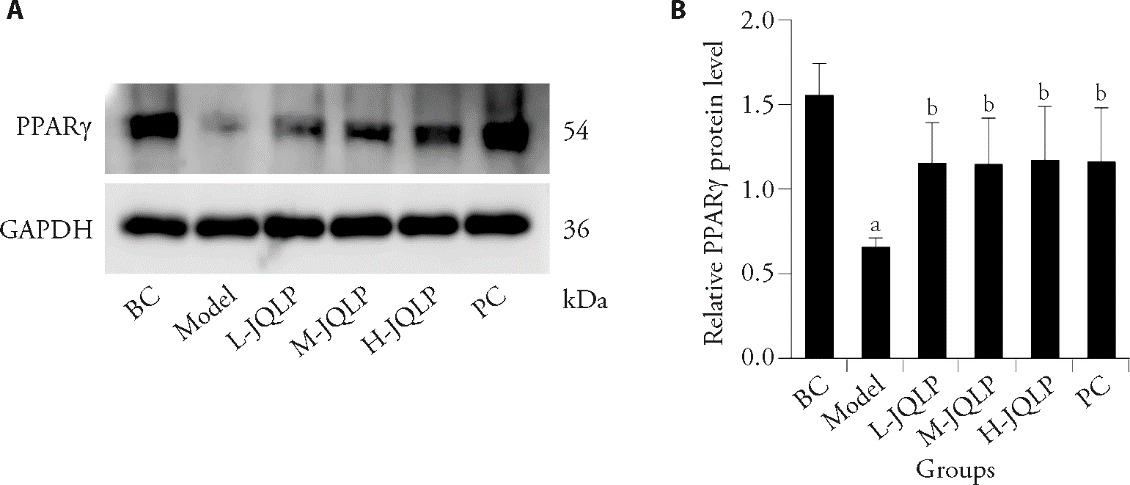
Figure 2 Expression level of PPARγ in liver tissues of rats in each group A: evaluation of PPARγ protein expression by Western blotting; B: quantification of the relative protein expression of PPARγ. BC group: feeding using methionine- and choline-sufficient diet combined with the administration of normal saline; Model group: feeding using methionine- and choline-deficient diet combined with the administration of normal saline; L-JQLP group: feeding using methionine- and choline-deficient diet combined with the administration of 6.489 g/kg of JQLP once daily for 8 weeks; M-JQLP group: feeding using methionine- and choline-deficient diet combined with the administration of 12.978 g/kg of JQLP once daily for 8 weeks; H-JQLP group: feeding using methionine- and choline-deficient diet combined with the administration of 19.467 g/kg of JQLP once daily for 8 weeks; PC group: feeding using methionine- and choline-deficient diet combined with the administration of 0.18 g/kg dosage of polyene phosphatidylcholine capsule once daily for 8 weeks. BC: blank control; L-JQLP: low-dose of Jianpi Qingre Lishi prescription; M-JQLP: medium-dose of Jianpi Qingre Lishi prescription; H-JQLP: high-dose of Jianpi Qingre Lishi prescription; PC: positive control; One-way analysis of variance was performed to determine inter-group differences, and Tukey's post-hoc comparison test to perform multiple comparisons between groups. aP < 0.05 vs the blank control group; bP < 0.05 vs the model group.
Figure 2 Expression level of PPARγ in liver tissues of rats in each group A: evaluation of PPARγ protein expression by Western blotting; B: quantification of the relative protein expression of PPARγ. BC group: feeding using methionine- and choline-sufficient diet combined with the administration of normal saline; Model group: feeding using methionine- and choline-deficient diet combined with the administration of normal saline; L-JQLP group: feeding using methionine- and choline-deficient diet combined with the administration of 6.489 g/kg of JQLP once daily for 8 weeks; M-JQLP group: feeding using methionine- and choline-deficient diet combined with the administration of 12.978 g/kg of JQLP once daily for 8 weeks; H-JQLP group: feeding using methionine- and choline-deficient diet combined with the administration of 19.467 g/kg of JQLP once daily for 8 weeks; PC group: feeding using methionine- and choline-deficient diet combined with the administration of 0.18 g/kg dosage of polyene phosphatidylcholine capsule once daily for 8 weeks. BC: blank control; L-JQLP: low-dose of Jianpi Qingre Lishi prescription; M-JQLP: medium-dose of Jianpi Qingre Lishi prescription; H-JQLP: high-dose of Jianpi Qingre Lishi prescription; PC: positive control; One-way analysis of variance was performed to determine inter-group differences, and Tukey's post-hoc comparison test to perform multiple comparisons between groups. aP < 0.05 vs the blank control group; bP < 0.05 vs the model group.
| 1. |
Nassir F. NAFLD: Mechanisms, treatments, and biomarkers. Biomolecules 2022; 12: 824.
DOI URL |
| 2. |
Pouwels S, Sakran N, Graham Y, et al. Non-alcoholic fatty liver disease (NAFLD): a review of pathophysiology, clinical management and effects of weight loss. BMC Endocr Disord 2022; 22: 63.
DOI PMID |
| 3. |
Fraile JM, Palliyil S, Barelle C, Porter AJ, Kovaleva M. Non-alcoholic steatohepatitis (NASH) - a review of a crowded clinical landscape, driven by a complex disease. Drug Des Devel Ther 2021; 15: 3997-4009.
DOI URL |
| 4. |
Younossi ZM, Golabi P. The global epidemiology of nonalcoholic fatty liver disease (NAFLD) and nonalcoholic steatohepatitis (NASH): a systematic review. Hepatology 2023; 77: 1335-47.
DOI PMID |
| 5. |
McCullough AJ. The clinical features, diagnosis and natural history of nonalcoholic fatty liver disease. Clin Liver Dis 2004; 8: 521-33, viii.
PMID |
| 6. |
Engin A. Nonalcoholic fatty liver disease and staging of hepatic fibrosis. Adv Exp Med Biol 2024; 1460: 539-74.
DOI PMID |
| 7. |
Duan Y, Pan X, Luo J, et al. Association of inflammatory cytokines with non-alcoholic fatty liver disease. Front Immunol 2022; 13: 880298.
DOI URL |
| 8. |
Wong VW, Chitturi S, Wong GL, et al. Pathogenesis and novel treatment options for non-alcoholic steatohepatitis. Lancet Gastroenterol Hepatol 2016; 1: 56-67.
DOI URL |
| 9. |
Qiu YY, Zhang J, Zeng FY, Zhu YZ. Roles of the peroxisome proliferator-activated receptors (PPARs) in the pathogenesis of nonalcoholic fatty liver disease (NAFLD). Pharmacol Res 2023; 192: 106786.
DOI URL |
| 10. |
Qiu Y, Gan M, Wang X, et al. The global perspective on peroxisome proliferator-activated receptor γ (PPARγ) in ectopic fat deposition: a review. Int J Biol Macromol 2023; 253: 127042.
DOI URL |
| 11. | AlNafea HM, Korish AA. Activation of the peroxisome proliferator-activated receptors (PPAR-α/γ) and the fatty acid metabolizing enzyme protein CPT1A by camel milk treatment counteracts the high-fat diet-induced nonalcoholic fatty liver disease. PPAR Res 2021; 2021: 5558731. |
| 12. |
Boliaki N, Henin G, Bale G, Lanthier N. Impact of peroxisome proliferator-activated receptor agonists on myosteatosis in the context of metabolic dysfunction-associated steatotic liver disease. Discov Med 2024; 36: 1139-53.
DOI |
| 13. |
Lakshman MR, Reyes-Gordillo K, Varatharajalu R, et al. Novel modulators of hepatosteatosis, inflammation and fibrogenesis. Hepatol Int 2014; 8 Suppl 2: 413-20.
DOI URL |
| 14. |
Hochreuter MY, Dall M, Treebak JT, Barrès R. MicroRNAs in non-alcoholic fatty liver disease: progress and perspectives. Mol Metab 2022; 65: 101581.
DOI URL |
| 15. |
Morishita A, Oura K. MicroRNAs and nonalcoholic steatohepatitis: a review. Int J Mol Sci 2023; 24: 14482.
DOI URL |
| 16. |
Zhang J, Powell CA, Kay MK, et al. Effect of chronic western diets on non-alcoholic fatty liver of male mice modifying the PPAR-γ pathway via miR-27b-5p regulation. Int J Mol Sci 2021; 22: 1822.
DOI URL |
| 17. |
Lin Q, Gao Z, Alarcon RM, Ye J, Yun Z. A role of miR-27 in the regulation of adipogenesis. FEBS J 2009; 276: 2348-58.
DOI PMID |
| 18. |
Wu H, Pula T, Tews D. microRNA-27a-3p but not -5p is a crucial mediator of human adipogenesis. Cells 2021; 10: 3205.
DOI URL |
| 19. |
Zhou Z, Zhang J, You L, et al. Application of herbs and active ingredients ameliorate non-alcoholic fatty liver disease under the guidance of Traditional Chinese Medicine. Front Endocrinol (Lausanne) 2022; 13: 1000727.
DOI URL |
| 20. |
Chen M, Xie Y, Gong S, et al. Traditional Chinese Medicine in the treatment of nonalcoholic steatohepatitis. Pharmacol Res 2021; 172: 105849.
DOI URL |
| 21. |
Hui D, Liu L, Azami NLB, et al. The spleen-strengthening and liver-draining herbal formula treatment of non-alcoholic fatty liver disease by regulation of intestinal flora in clinical trial. Front Endocrinol (Lausanne) 2022; 13: 1107071.
DOI URL |
| 22. |
Liang M, Huo M, Guo Y, et al. Aqueous extract of Artemisia capillaris improves non-alcoholic fatty liver and obesity in mice induced by high-fat diet. Front Pharmacol 2022; 13: 1084435.
DOI URL |
| 23. | Bai QY, Tao SM, Tian JH, Cao CR. Progress of research on effect and mechanism of Scutellariae Radix on preventing liver diseases. Zhong Guo Zhong Yao Za Zhi 2020; 45: 2808-16. |
| 24. | Wang SJ, Wei AL. Exploring the pathogenesis and therapy of liver cancer from "damp-heat insidious pathogen" to "cancer toxin". Zhong Guo Zhong Xi Yi Jie He Za Zhi 2013; 33: 266-9. |
| 25. | Xu Y, Wang Y, Gou XJ. Comparative efficacy of Chinese patent medicines for clearing heat and dampness in the treatment of NAFLD: a network Meta-analysis of real-world evidence. Evid Based Complement Alternat Med 2022; 2022: 4138555. |
| 26. |
Ru L, Wang XM, Niu JQ. The miR-23-27-24 cluster: an emerging target in NAFLD pathogenesis. Acta Pharmacol Sin 2022; 43: 1167-79.
DOI |
| 27. |
Chen H, Tan H, Wan J, et al. PPAR-γ signaling in nonalcoholic fatty liver disease: Pathogenesis and therapeutic targets. Pharmacol Ther 2023; 245: 108391.
DOI URL |
| 28. |
Alexander M, Loomis AK, van der Lei J, et al. Risks and clinical predictors of cirrhosis and hepatocellular carcinoma diagnoses in adults with diagnosed NAFLD: real-world study of 18 million patients in four European cohorts. BMC Med 2019; 17: 95.
DOI PMID |
| 29. |
Wei S, Wang L, Evans PC, Xu S. NAFLD and NASH: etiology, targets and emerging therapies. Drug Discov Today 2024; 29: 103910.
DOI URL |
| 30. |
Zhou H, Ma C, Wang C, et al. Research progress in use of Traditional Chinese Medicine monomer for treatment of non-alcoholic fatty liver disease. Eur J Pharmacol 2021; 898: 173976.
DOI URL |
| 31. |
Xi Z, Ningning X. Effects of long-term use of the heat-clearing, diuresis-promoting and collateral-mediating chinese drugs on changes of proteinuria in patients with chronic nephritis. J Tradit Chin Med 2006; 26: 213-7.
PMID |
| 32. |
Zhu X, Xu Q, Liu Z, et al. Qingre Lishi decoction ameliorates imiquimod-induced psoriasis-like skin lesions in SKH-1 mice by regulating the Treg-DC-Th17 axis and inhibiting MAPK-mediated DC maturation. J Ethnopharmacol 2024; 318: 116931.
DOI URL |
| 33. | Wang T, Liu X, Zhang W, et al. Traditional Chinese Medicine treats ulcerative colitis by regulating gut microbiota, signaling pathway and cytokine: future novel method option for pharmacotherapy. Heliyon 2024; 10: e27530. |
| 34. |
Palladini G, Di Pasqua LG. MCD diet rat model induces alterations in zinc and iron during NAFLD progression from steatosis to steatohepatitis. Int J Mol Sci 2022; 23: 6817.
DOI URL |
| 35. |
Santhekadur PK, Kumar DP, Sanyal AJ. Preclinical models of non-alcoholic fatty liver disease. J Hepatol 2018; 68: 230-7.
DOI PMID |
| 36. |
Nielsen MJ, Leeming DJ, Goodman Z, et al. Comparison of ADAPT, FIB-4 and APRI as non-invasive predictors of liver fibrosis and NASH within the CENTAUR screening population. J Hepatol 2021; 75: 1292-300.
DOI PMID |
| 37. |
Jimenez-Rivera C, Hadjiyannakis S, Davila J, et al. Prevalence and risk factors for non-alcoholic fatty liver in children and youth with obesity. BMC Pediatr 2017; 17: 113.
DOI PMID |
| 38. |
Yue SR, Tan YY, Zhang L, et al. Gynostemma pentaphyllum polysaccharides ameliorate non-alcoholic steatohepatitis in mice associated with gut microbiota and the TLR2/NLRP 3 pathway. Front Endocrinol (Lausanne) 2022; 13: 885039.
DOI URL |
| 39. |
Aghaei SM, Hosseini SM. Inflammation-related miRNAs in obesity, CVD, and NAFLD. Cytokine 2024; 182: 156724.
DOI URL |
| 40. |
Lu S, Wang Y, Liu J. Tumor necrosis factor-α signaling in nonalcoholic steatohepatitis and targeted therapies. J Genet Genomics 2022; 49: 269-78.
DOI URL |
| 41. |
Vachliotis ID, Polyzos SA. The role of tumor necrosis factor-alpha in the pathogenesis and treatment of nonalcoholic fatty liver disease. Curr Obes Rep 2023; 12: 191-206.
DOI PMID |
| 42. |
Li Z, Yang S, Lin H, et al. Probiotics and antibodies to TNF inhibit inflammatory activity and improve nonalcoholic fatty liver disease. Hepatology 2003; 37: 343-50.
DOI PMID |
| 43. |
Bocsan IC, Milaciu MV, Pop RM. Cytokines genotype-phenotype correlation in nonalcoholic steatohepatitis. Oxid Med Cell Longev 2017; 2017: 4297206.
DOI URL |
| 44. | Mas E, Danjoux M, Garcia V, et al. IL-6 deficiency attenuates murine diet-induced non-alcoholic steatohepatitis. PLoS One 2009; 4: e7929. |
| 45. |
Stiglund N, Hagström H, Stål P, Cornillet M, Björkström NK. Dysregulated peripheral proteome reveals NASH-specific signatures identifying patient subgroups with distinct liver biology. Front Immunol 2023; 14: 1186097.
DOI URL |
| 46. |
Chen YJ, Chueh LY, Lee SY, et al. Coordinated regulation of miR-27 by insulin/CREB/Hippo contributes to insulin resistance. Cell Signal 2021; 81: 109930.
DOI URL |
| 47. |
Chen WJ, Yin K, Zhao GJ, Fu YC, Tang CK. The magic and mystery of microRNA-27 in atherosclerosis. Atherosclerosis 2012; 222: 314-23.
DOI URL |
| 48. |
Deng K, Ren C, Fan Y, et al. miR-27a is an important adipogenesis regulator associated with differential lipid accumulation between intramuscular and subcutaneous adipose tissues of sheep. Domest Anim Endocrinol 2020; 71: 106393.
DOI URL |
| 49. |
Hsu CC, Lai CY, Lin CY, Yeh KY, Her GM. MicroRNA-27b depletion enhances endotrophic and intravascular lipid accumulation and induces adipocyte hyperplasia in zebrafish. Int J Mol Sci 2017; 19: 93.
DOI URL |
| 50. |
Kim SY, Kim AY, Lee HW, et al. miR-27a is a negative regulator of adipocyte differentiation via suppressing PPAR gamma expression. Biochem Biophys Res Commun 2010; 392: 323-8.
DOI URL |
| 51. |
Zhu Y, Zhang X, Ding X, et al. miR-27 inhibits adipocyte differentiation via suppressing CREB expression. Acta Biochim Biophys Sin (Shanghai) 2014; 46: 590-6.
DOI URL |
| 52. |
Kang T, Lu W, Xu W, et al. MicroRNA-27 (miR-27) targets prohibitin and impairs adipocyte differentiation and mitochondrial function in human adipose-derived stem cells. J Biol Chem 2013; 288: 34394-402.
DOI PMID |
| 53. |
Teimouri M, Hosseini H, Shabani M, et al. Inhibiting miR-27a and miR-142-5p attenuate nonalcoholic fatty liver disease by regulating Nrf2 signaling pathway. IUBMB Life 2020; 72: 361-72.
DOI PMID |
| 54. | Lee SM, Muratalla J, Sierra-Cruz M, Cordoba-Chacon J. Role of hepatic peroxisome proliferator-activated receptor γ in non-alcoholic fatty liver disease. J Endocrinol 2023; 257: e220155. |
| 55. |
Singh S, Kumar A, Gupta S, Agrawal R. Curative role of natural PPARγ agonist in non-alcoholic fatty liver disease (NAFLD). Tissue Barriers 2024; 12: 2289830.
DOI URL |
| 56. |
Tang J, Wang L, Shi M, et al. Study on the mechanism of Shuganzhi Tablet against nonalcoholic fatty liver disease and lipid regulation effects of its main substances in vitro. J Ethnopharmacol 2023; 316: 116780.
DOI URL |
| 57. |
Suolang PC, Liu BQ, Chen J, et al. Protective effect and mechanism of Qiwei Tiexie capsule on 3T3-L1 adipocytes cells and rats with nonalcoholic fatty liver disease by regulating LXRα, PPARγ, and NF-κB-iNOS-NO signaling pathways. J Ethnopharmacol 2019; 236: 316-25.
DOI URL |
| [1] | ZHANG Quanhui, ZENG Jinlan, SU Liang, WANG Yi, DENG Yongwen, ZHANG Xiuchai. Shenling Baizhu powder (参苓白术散) reduced the oxidative stress and mitochondrial damage during ulcerative colitis via the Kelch-like ECH-associated protein 1-NF-E2-related factor 2/nuclear factor kappa B pathway [J]. Journal of Traditional Chinese Medicine, 2026, 46(3): 584-593. |
| [2] | HAO Feng, SANG Jiajia, PENG Chuanyu, HU Jun, WU Zijian, HU Ling, GU Yihuang. Effect of moxibustion at Zusanli (ST36) on beclin 1-solute carrier family 7 member 11 gene ferroptosis-related proteins in synovial inflammation of rats with rheumatoid arthritis [J]. Journal of Traditional Chinese Medicine, 2026, 46(3): 594-604. |
| [3] | XU Pingyuan, ZHU Heng, ZHOU Ruonan, WEI Yaping, ZHU Ziwei, XU Fangyuan, XIANG Yingying, CAO Yue, SHEN Lixuan, WANG Ziwei, XUE Yingying, YU Xizhong, FANG Penghua, SHANG Wenbin. Beneficial effects of Huanglian Jiedu decoction (黄连解毒汤 ) on metabolic syndrome: a prospective randomized controlled clinical trial [J]. Journal of Traditional Chinese Medicine, 2026, 46(2): 411-417. |
| [4] | YU Fangning, LIN Li, TANG Xiao, HE Xiujuan, ZHANG Bo, CHEN Yukun, MA Yizhao, LIU Zeyu, YE Jinsheng, XU Xuying. Effect of Huiyang Shengji unguent (回阳生肌膏) on the NOD-like receptor family pyrin domain containing protein 3/caspase1/ gasdermin D pathway and lymphatic angiogenesis in patients with diabetic foot ulcer [J]. Journal of Traditional Chinese Medicine, 2026, 46(2): 427-438. |
| [5] | LI Hongzheng, LIN Guosheng, PENG Yuxuan, Churov Alexey Viktorovich, YANG Wenwen, WANG Jie, LU Jieming, LIAO Feifei, YU Ruotong, WEI Yue, ZHAO Zhiru, LU Aimei, LI Peng, SHEN Aling, LONG Linzi, QU Hua, FU Changgeng. Candidate biomarker identification for blood stasis syndrome among coronary artery disease patients using the Olink proteomics platform [J]. Journal of Traditional Chinese Medicine, 2026, 46(2): 490-500. |
| [6] | LI Dongqi, WANG Tongxing, WANG Zixuan, YAN Yihui, LI Jie, GU Jiaojiao, LI Cuiru, WANG Aili, SUN Lingling, MENG Yongjie, ZHANG Zeyu, HOU Yunlong, GAO Huailin. Improving glucose tolerance in obese rats: the role of Jinlida granules (津力达颗粒 ) in gut microbiota modulation [J]. Journal of Traditional Chinese Medicine, 2026, 46(1): 62-72. |
| [7] | WEI Mumu, YAN Xiaoyu, ZHANG Yujing, ZHANG Xinxin, YAN Yongbin. Soufeng Yuchuan formula (搜风愈喘方) alleviates asthma airway inflammation and suppresses the progression of asthma by inhibiting ferroptosis in airway epithelial cells [J]. Journal of Traditional Chinese Medicine, 2026, 46(1): 73-84. |
| [8] | ZOU Xiaoyun, WEI Minmin, JIA Shouning, QI Yongfu, LI Hailing, LIU Yan, SHI Xiujuan, LI Junru. Weimishu prescription (胃糜舒方) alleviates liver-stomach disharmony and chronic gastritis by reducing inflammation and regulating gastric stem cell differentiation [J]. Journal of Traditional Chinese Medicine, 2026, 46(1): 95-109. |
| [9] | LEI Xiaochun, LIU Cuizhen, LIN Xiujuan, XIE Xiangyu, KE Wei, QIU Zhenwen, TANG Hongmei, HUANG Yushen, ZHANG Lijuan, HUANG Baoyuan, WAN Xin, LI Detang. Effect of improved Yupingfeng powder prescription (玉屏风散加味) on interleukin-33/suppression of tumorigenicity 2 pathway in mice with ovalbumins-induced allergic rhinitis [J]. Journal of Traditional Chinese Medicine, 2025, 45(6): 1215-1227. |
| [10] | LI Keyao, SHU Ye, CHANG Jing, TANG Jianping, ZHANG Litao, WEI Zhu. Psoriasis intervention by Huai’er (Trametes): unveiling novel targets via network pharmacology [J]. Journal of Traditional Chinese Medicine, 2025, 45(6): 1317-1329. |
| [11] | WANG Wei, LONG Qi, FU Ling, WU Haiqiao. Jianpi Yifei Tongluo recipe (健脾益肺通络方剂) attenuates inflammation by promoting the expression of interferon regulatory factor 4 in the rat model of chronic obstructive pulmonary disease [J]. Journal of Traditional Chinese Medicine, 2025, 45(5): 1048-1058. |
| [12] | LI Weijia, LU Jing, MA Chao, LIU Mengmeng, PEI Ke, CHEN Hongyan, LIN Zhe, LYU Guangfu. Hamayou (Oviductus Ranae) protein hydrolysate ameliorates depression by regulating the mitogen-activated protein kinase pathway [J]. Journal of Traditional Chinese Medicine, 2025, 45(3): 493-507. |
| [13] | MIN Yu, ZHENG Meifeng, SUN Ju, PENG Zetong, CAO Zhixian, HUANG Xiaohua. Systematic acupuncture explains acupuncture at Baihui (GV20) and Fengchi (GB20) targeting the inflammatory response to regulate migraine [J]. Journal of Traditional Chinese Medicine, 2025, 45(3): 610-617. |
| [14] | YUAN Jiayao, WU Suhui, MENG Yufan, LI Hanbing, LI Genlin, XU Jiangyan. Yishen Tongluo formula (益肾通络方) ameliorates kidney injury via modulating inflammation and apoptosis in streptozotocin-induced diabetic kidney disease mice [J]. Journal of Traditional Chinese Medicine, 2025, 45(2): 254-265. |
| [15] | HUANG Jiaen, LUO Qing, DONG Gengting, PENG Weiwen, HE Jianhong, DAI Weibo. Xiahuo Pingwei San (夏藿平胃散) attenuated intestinal inflammation in dextran sulfate sodium-induced ulcerative colitis mice through inhibiting the receptor for advanced glycation end-products signaling pathway [J]. Journal of Traditional Chinese Medicine, 2025, 45(2): 311-325. |
| Viewed | ||||||
|
Full text |
|
|||||
|
Abstract |
|
|||||
