
Journal of Traditional Chinese Medicine ›› 2026, Vol. 46 ›› Issue (4): 941-950.DOI: 10.19852/j.cnki.jtcm.2026.04.014
• Original Articles • Previous Articles Next Articles
Efficacy and safety of Dingluo nasal drops (丁萝滴鼻剂) for the acute treatment of migraine: a pilot randomized trial
YAO Yuning, AN Yuqiu, LIU Jiaojiao, DU Boxuan, CAO Kegang( )
)
Department of Neurology ,Dongzhimen Hospital of Beijing University of Chinese Medicine Beijing 100007, China
-
Received:2025-02-11Accepted:2025-10-16Online:2026-08-15Published:2026-08-08 -
Contact:Prof. CAO Kegang, Department of Neurology, Dongzhimen Hospital of Beijing University of Chinese Medicine, Beijing 100007, China; kgdoctor@sina.com,Telephone: +86-11-84611969
-
Supported by:2022 Young Qihuang Scholars Training Program: Letter of Chinese Medicine Education([2022] 256);National Natural Science Foundation of China: Study on the Mechanism of the Treatment Method to Open the Oriffces and Alleviate Pain in Regulating G Protein-coupled Estrogen Receptor (GPER) to Antagonize Calcitonin Gene-related Peptide Receptors in Acute Migraine(82505542);Joint Program of Liaoning Provincial Science and Technology Plan (General Program of Natural Science Foundation): Study on the Mechanism of Dinglu Nasal Drops in Treating Acute Migraine Mediated by GPER-mitogen-activated Protein Kinase/Nuclear Factor Kappa-light-chain-enhancer of Activated B Cells Signaling Pathway(2024-MSLH-530)

Cite this article
YAO Yuning, AN Yuqiu, LIU Jiaojiao, DU Boxuan, CAO Kegang. Efficacy and safety of Dingluo nasal drops (丁萝滴鼻剂) for the acute treatment of migraine: a pilot randomized trial[J]. Journal of Traditional Chinese Medicine, 2026, 46(4): 941-950.
share this article
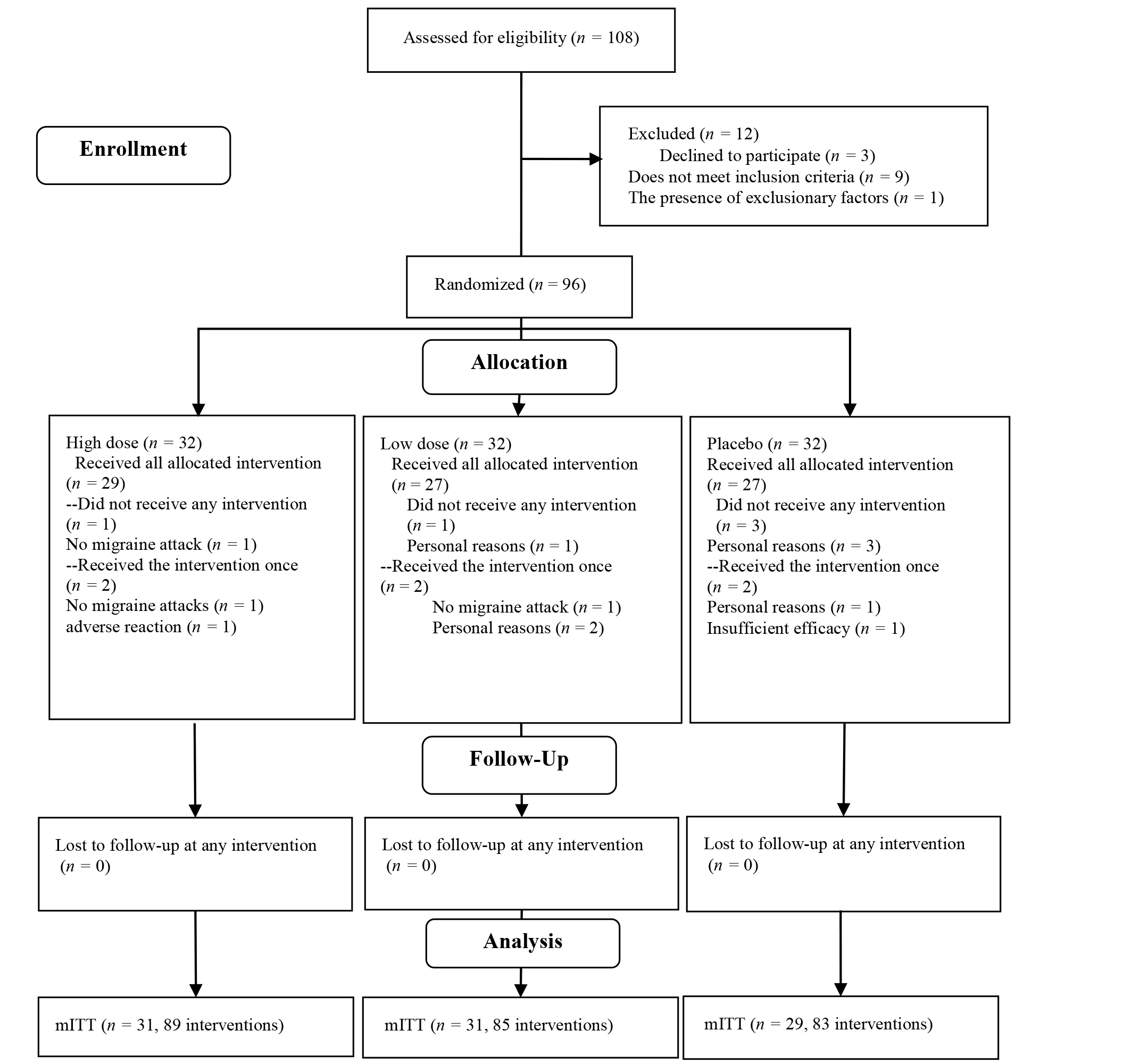
Figure 1 Flow diagram of the study subjects mITT: modified intention-to-treat.
Figure 1 Flow diagram of the study subjects mITT: modified intention-to-treat.
Table 1 Demographic and clinical characteristics of the participants in mITT population
| Item | Dingluo | Placebo | P value | |
|---|---|---|---|---|
| High dose | Low dose | |||
| Sex (M/F, n) | 9/22 | 6/25 | 5/24 | 0.496 |
| Age (years, $\bar{x}±s$) | 40±11 | 39±10 | 40±13 | 0.759 |
| BMI (kg/m2, $\bar{x}±s$) | 23±3 | 22±27 | 22±4 | 0.966 |
| Education (M/H/B/P, n) | 0/6/17/8 | 0/5/16/10 | 1/6/15/7 | 0.952 |
| Work and rest (R/I, n) | 45379 | 45497 | 45377 | 0.363 |
| Career (n) | 0/3/1/3/18/6 | 1/4/2/1/16/7 | 1/0/3/5/13/7 | 0.530 |
Table 1 Demographic and clinical characteristics of the participants in mITT population
| Item | Dingluo | Placebo | P value | |
|---|---|---|---|---|
| High dose | Low dose | |||
| Sex (M/F, n) | 9/22 | 6/25 | 5/24 | 0.496 |
| Age (years, $\bar{x}±s$) | 40±11 | 39±10 | 40±13 | 0.759 |
| BMI (kg/m2, $\bar{x}±s$) | 23±3 | 22±27 | 22±4 | 0.966 |
| Education (M/H/B/P, n) | 0/6/17/8 | 0/5/16/10 | 1/6/15/7 | 0.952 |
| Work and rest (R/I, n) | 45379 | 45497 | 45377 | 0.363 |
| Career (n) | 0/3/1/3/18/6 | 1/4/2/1/16/7 | 1/0/3/5/13/7 | 0.530 |
Table 2 Baseline demographic and clinical indicators of participants
| Item | Dingluo | Placebo (n = 29) | P value | |
|---|---|---|---|---|
| High dose (n = 31) | Low dose (n = 31) | |||
| Primary migraine type (MO/MA, n) | 28/3 | 28/3 | 25/4 | 0.839 |
| Duration [years, $\bar{x}±s$)] | 11.1±7.3 | 12.7±8.8 | 13.7±11.2 | 0.541 |
| Migraine attacks within 4 weeks ($\bar{x}±s$) | 4.6±1.8 | 4.9±2.1 | 4.6±1.9 | 0.709 |
| VAS ($\bar{x}±s$) | 5.8±1.4 | 5.7±1.7 | 5.3±2.0 | 0.119 |
| Mean VAS for last 3 migraine attacks ($\bar{x}±s$) | 6.3±1.4 | 6.2±1.6 | 5.9±1.8 | 0.592 |
| Use of analgesics ($\bar{x}±s$) | 0.8±1.3 | 1.2±1.4 | 1.1±1.5 | 0.440 |
| Headache area (n) | ||||
| Unilateral/ non-unilateral headache (n) | 13/18 | 14/17 | 8/21 | 0.336 |
| Temple/top/occipital/lateral/whole/orbits/fore of the head/face (n) | 10/7/2/12/5/4/7/0 | 13/6/7/10/2/5/7/1 | 13/8/5/7/4/3/7/1 | 0.916 |
| Historical bothersome symptom score ($\bar{x}±s$) | 0.7±1.2 | 0.6±0.8 | 0.6±0.9 | 0.403 |
| Nausea (n) | 7 | 6 | 9 | |
| Dizziness (n) | 7 | 5 | 4 | |
| Blurred vision (n) | 2 | 1 | 0 | |
| Photophobia (n) | 2 | 4 | 1 | |
| Tears (n) | 2 | 3 | 2 | |
| Flashes of light in the eyes (n) | 0 | 1 | 0 | |
| Phonophobia (n) | 0 | 0 | 1 | |
| Other (n) | 0 | 5 | 1 | |
| TCM patterns (n) | 30/13/27/19/25/25/18/18/9 | 30/14/25/15/23/22/20/16/17 | 27/17/23/17/25/22/17/16/10 | 0.995 |
Table 2 Baseline demographic and clinical indicators of participants
| Item | Dingluo | Placebo (n = 29) | P value | |
|---|---|---|---|---|
| High dose (n = 31) | Low dose (n = 31) | |||
| Primary migraine type (MO/MA, n) | 28/3 | 28/3 | 25/4 | 0.839 |
| Duration [years, $\bar{x}±s$)] | 11.1±7.3 | 12.7±8.8 | 13.7±11.2 | 0.541 |
| Migraine attacks within 4 weeks ($\bar{x}±s$) | 4.6±1.8 | 4.9±2.1 | 4.6±1.9 | 0.709 |
| VAS ($\bar{x}±s$) | 5.8±1.4 | 5.7±1.7 | 5.3±2.0 | 0.119 |
| Mean VAS for last 3 migraine attacks ($\bar{x}±s$) | 6.3±1.4 | 6.2±1.6 | 5.9±1.8 | 0.592 |
| Use of analgesics ($\bar{x}±s$) | 0.8±1.3 | 1.2±1.4 | 1.1±1.5 | 0.440 |
| Headache area (n) | ||||
| Unilateral/ non-unilateral headache (n) | 13/18 | 14/17 | 8/21 | 0.336 |
| Temple/top/occipital/lateral/whole/orbits/fore of the head/face (n) | 10/7/2/12/5/4/7/0 | 13/6/7/10/2/5/7/1 | 13/8/5/7/4/3/7/1 | 0.916 |
| Historical bothersome symptom score ($\bar{x}±s$) | 0.7±1.2 | 0.6±0.8 | 0.6±0.9 | 0.403 |
| Nausea (n) | 7 | 6 | 9 | |
| Dizziness (n) | 7 | 5 | 4 | |
| Blurred vision (n) | 2 | 1 | 0 | |
| Photophobia (n) | 2 | 4 | 1 | |
| Tears (n) | 2 | 3 | 2 | |
| Flashes of light in the eyes (n) | 0 | 1 | 0 | |
| Phonophobia (n) | 0 | 0 | 1 | |
| Other (n) | 0 | 5 | 1 | |
| TCM patterns (n) | 30/13/27/19/25/25/18/18/9 | 30/14/25/15/23/22/20/16/17 | 27/17/23/17/25/22/17/16/10 | 0.995 |
Table 3 Primary and secondary efficacy endpoints
| Item | Dingluo | Placebo (n = 83) | Risk difference or mean difference (95% CI) | |||
|---|---|---|---|---|---|---|
| High dose (n = 89) | Low dose (n = 85) | High dose vs placebo | Low dose vs placebo | High dose vs low dose | ||
| Primary | ||||||
| Pain freedom, 2 h | 13 (14.61) | 15(17.65) | 1(1.20) | 13.4 0(5.70, 21.11)a | 16.44 (8.00, 24.88)a | -3.04 (-13.97, 7.89) |
| Secondary | ||||||
| Pain freedom, 0.5 h | 5 (5.62) | 5 (5.88) | 4 (4.82) | 0.80 (-5.84, 7.44) | 1.06 (-5.74, 7.86) | -0.26 (-7.19, 6.66) |
| Pain freedom, 1 h | 8 (8.99) | 6 (7.06) | 1 (1.20) | 7.78 (1.39, 14.17) | 5.85 (-0.08, 11.78) | 1.93 (-6.13, 9.99) |
| Pain freedom, 4 h | 21 (23.60) | 24 (28.24) | 6 (7.23) | 16.37 (5.93, 26.8)a | 21.01 (9.93, 32.08)s | -4.64 (-17.65, 8.38) |
| Pain relief, 0.5 h | 56 (62.92) | 52 (61.18) | 14 (16.87) | 46.05 (33.19, 58.92)a | 44.31 (31.18, 57.43)s | 1.74 (-12.68, 16.17) |
| Pain relief, 1 h | 50 (56.18) | 53 (62.35) | 17 (20.48) | 35.70 (22.22, 49.18)a | 41.87 (28.40, 55.34)s | -6.17 (-20.75, 8.40) |
| Pain relief, 2 h | 57 (64.04) | 57 (67.06) | 20 (24.10) | 39.95 (26.38, 53.52)a | 42.96 (29.38, 56.55)s | -3.01 (-17.13, 11.10) |
| Pain relief, 4 h | 62 (69.66) | 62 (72.94) | 27 (32.53) | 37.13 (23.25, 51.02)a | 40.41 (26.60, 54.22)s | -3.28 (-16.71, 10.15) |
| Pain relief, 24 h | 84 (94.38) | 73 (85.88) | 61 (73.49) | 20.89 (10.26, 31.52)a | 12.39 (0.35, 24.43) | 8.5 (-0.31, 17.31) |
| Pain relief, 48 h | 85 (95.51) | 77 (90.59) | 68 (81.93) | 13.58 (4.25, 22.91)a | 8.66 (-1.69, 19.01) | 4.92 (-2.64, 12.47) |
| Exacerbation after relief, 1 h | 29 (32.58) | 16 (18.82) | 12 (14.46) | 18.13 (5.80, 30.46)a | 4.37 (-6.87, 15.6) | 13.76 (0.96, 26.56) |
| Exacerbation after relief, 2 h | 21 (23.60) | 16 (18.82) | 15 (18.07) | 5.52 (-6.57, 17.62) | 0.75 (-10.98, 12.48) | 4.77 (-7.35, 16.89) |
| No pain relapse from 4-24 h postdose | 83 (93.26) | 81 (95.29) | 82 (98.80) | -5.54 (-11.25, 0.18) | -3.50 (-8.58, 1.58) | -2.04 (-8.92, 4.85) |
| No pain relapse from 24-48 h postdose | 87 (97.75) | 83 (97.65) | 82 (98.80) | -1.04 (-4.91, 2.83) | -1.15 (-5.13, 2.84) | 0.11 (-4.35, 4.56) |
| Time of pain relief from postdose, min | 18.64±37.49 | 30.02±62.35 | 263.80±445.22 | -245.15 (-338.65, 151.66)a | -233.77 (-330.06, -137.48)s | -11.38 (-26.70, 3.93) |
| Bothersome symptom score, 0.5 h | 0.36±0.96 | 0.25±0.51 | 0.40±0.76 | -0.04 (-0.30, 0.22) | -0.15 (-0.35, 0.05) | 0.11 (-0.12, 0.34) |
| Bothersome symptom score, 1 h | 0.29±0.66 | 0.22±0.45 | 0.37±0.64 | -0.08 (-0.28, 0.11) | -0.15 (-0.32, 0.02) | 0.07 (-0.10, 0.24) |
| Bothersome symptom score, 2 h | 0.35±0.80 | 0.26±0.44 | 0.34±0.63 | 0.01 (-0.21, 0.23) | -0.08 (-0.24, 0.09) | 0.09 (-0.10, 0.28) |
| Bothersome symptom score, 4 h | 0.16±0.50 | 0.26±0.44 | 0.34±0.61 | -0.18 (-0.35, -0.01)a | -0.08 (-0.24, 0.08)b | -0.10 (-0.24, 0.04) |
Table 3 Primary and secondary efficacy endpoints
| Item | Dingluo | Placebo (n = 83) | Risk difference or mean difference (95% CI) | |||
|---|---|---|---|---|---|---|
| High dose (n = 89) | Low dose (n = 85) | High dose vs placebo | Low dose vs placebo | High dose vs low dose | ||
| Primary | ||||||
| Pain freedom, 2 h | 13 (14.61) | 15(17.65) | 1(1.20) | 13.4 0(5.70, 21.11)a | 16.44 (8.00, 24.88)a | -3.04 (-13.97, 7.89) |
| Secondary | ||||||
| Pain freedom, 0.5 h | 5 (5.62) | 5 (5.88) | 4 (4.82) | 0.80 (-5.84, 7.44) | 1.06 (-5.74, 7.86) | -0.26 (-7.19, 6.66) |
| Pain freedom, 1 h | 8 (8.99) | 6 (7.06) | 1 (1.20) | 7.78 (1.39, 14.17) | 5.85 (-0.08, 11.78) | 1.93 (-6.13, 9.99) |
| Pain freedom, 4 h | 21 (23.60) | 24 (28.24) | 6 (7.23) | 16.37 (5.93, 26.8)a | 21.01 (9.93, 32.08)s | -4.64 (-17.65, 8.38) |
| Pain relief, 0.5 h | 56 (62.92) | 52 (61.18) | 14 (16.87) | 46.05 (33.19, 58.92)a | 44.31 (31.18, 57.43)s | 1.74 (-12.68, 16.17) |
| Pain relief, 1 h | 50 (56.18) | 53 (62.35) | 17 (20.48) | 35.70 (22.22, 49.18)a | 41.87 (28.40, 55.34)s | -6.17 (-20.75, 8.40) |
| Pain relief, 2 h | 57 (64.04) | 57 (67.06) | 20 (24.10) | 39.95 (26.38, 53.52)a | 42.96 (29.38, 56.55)s | -3.01 (-17.13, 11.10) |
| Pain relief, 4 h | 62 (69.66) | 62 (72.94) | 27 (32.53) | 37.13 (23.25, 51.02)a | 40.41 (26.60, 54.22)s | -3.28 (-16.71, 10.15) |
| Pain relief, 24 h | 84 (94.38) | 73 (85.88) | 61 (73.49) | 20.89 (10.26, 31.52)a | 12.39 (0.35, 24.43) | 8.5 (-0.31, 17.31) |
| Pain relief, 48 h | 85 (95.51) | 77 (90.59) | 68 (81.93) | 13.58 (4.25, 22.91)a | 8.66 (-1.69, 19.01) | 4.92 (-2.64, 12.47) |
| Exacerbation after relief, 1 h | 29 (32.58) | 16 (18.82) | 12 (14.46) | 18.13 (5.80, 30.46)a | 4.37 (-6.87, 15.6) | 13.76 (0.96, 26.56) |
| Exacerbation after relief, 2 h | 21 (23.60) | 16 (18.82) | 15 (18.07) | 5.52 (-6.57, 17.62) | 0.75 (-10.98, 12.48) | 4.77 (-7.35, 16.89) |
| No pain relapse from 4-24 h postdose | 83 (93.26) | 81 (95.29) | 82 (98.80) | -5.54 (-11.25, 0.18) | -3.50 (-8.58, 1.58) | -2.04 (-8.92, 4.85) |
| No pain relapse from 24-48 h postdose | 87 (97.75) | 83 (97.65) | 82 (98.80) | -1.04 (-4.91, 2.83) | -1.15 (-5.13, 2.84) | 0.11 (-4.35, 4.56) |
| Time of pain relief from postdose, min | 18.64±37.49 | 30.02±62.35 | 263.80±445.22 | -245.15 (-338.65, 151.66)a | -233.77 (-330.06, -137.48)s | -11.38 (-26.70, 3.93) |
| Bothersome symptom score, 0.5 h | 0.36±0.96 | 0.25±0.51 | 0.40±0.76 | -0.04 (-0.30, 0.22) | -0.15 (-0.35, 0.05) | 0.11 (-0.12, 0.34) |
| Bothersome symptom score, 1 h | 0.29±0.66 | 0.22±0.45 | 0.37±0.64 | -0.08 (-0.28, 0.11) | -0.15 (-0.32, 0.02) | 0.07 (-0.10, 0.24) |
| Bothersome symptom score, 2 h | 0.35±0.80 | 0.26±0.44 | 0.34±0.63 | 0.01 (-0.21, 0.23) | -0.08 (-0.24, 0.09) | 0.09 (-0.10, 0.28) |
| Bothersome symptom score, 4 h | 0.16±0.50 | 0.26±0.44 | 0.34±0.61 | -0.18 (-0.35, -0.01)a | -0.08 (-0.24, 0.08)b | -0.10 (-0.24, 0.04) |
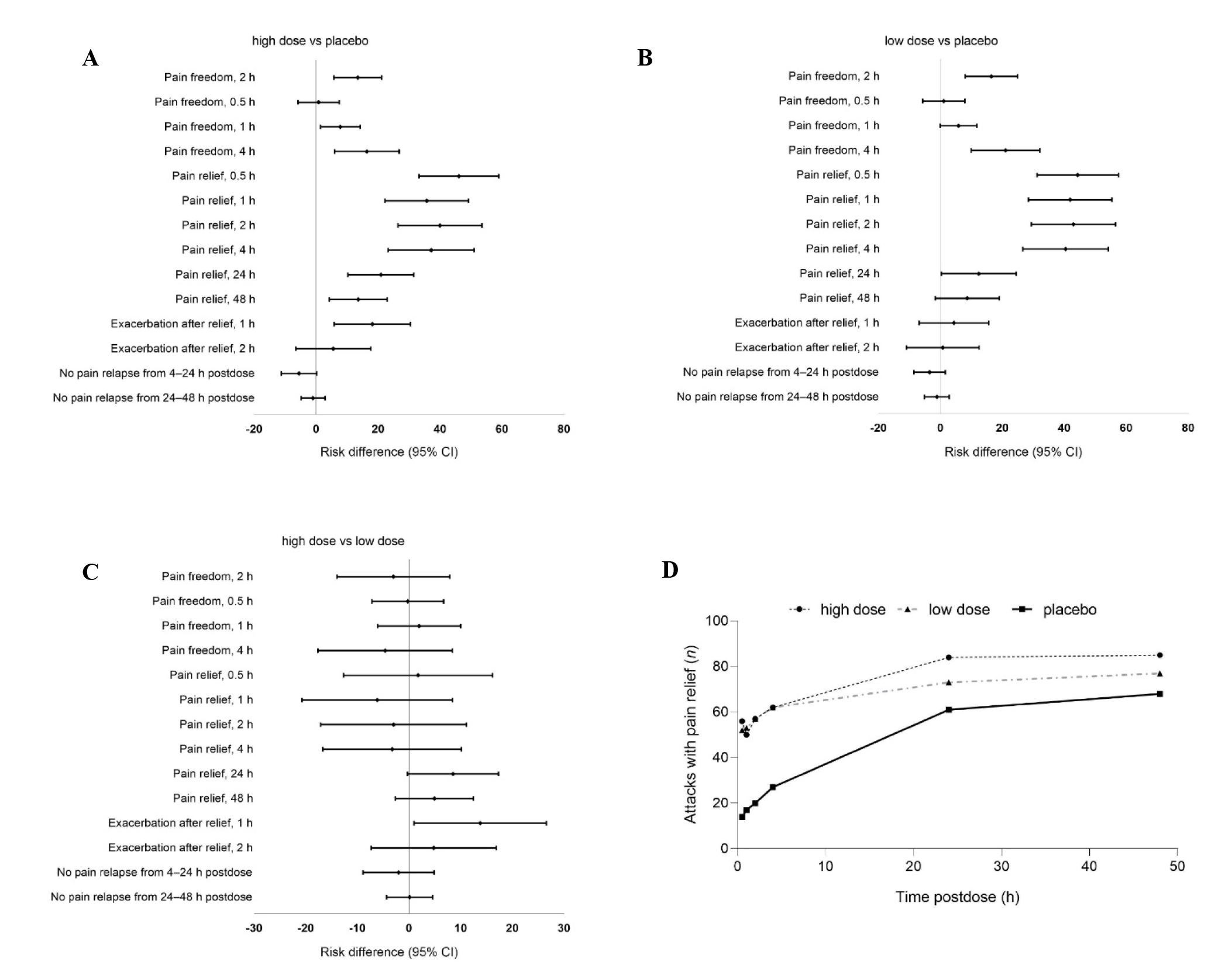
Figure 2 Forest plot of pain freedom, pain relief, exacerbation after relief, no pain relapse, and line chart of pain relief A: forest plot for comparisons between the high-dose group and the placebo group; B: forest plot for comparisons between the low-dose group and the placebo group; C: forest plot for comparisons between the high-dose group and the low-dose group; D: line chart showing the number of migraine attacks with pain relief in subjects receiving dingluo nasal drops or placebo. Subjects in the high-dose and low-dose groups received corresponding doses of dingluo nasal drops, and participants in the placebo group received matching placebo nasal drops; all subjects received the same unified treatment course. Figure 2D illustrates the changing number of pain-relieved migraine attacks within 48 h after dosing across the three groups, with case counts (n) on the vertical axis and continuous post-dose time (h) on the horizontal axis.
Figure 2 Forest plot of pain freedom, pain relief, exacerbation after relief, no pain relapse, and line chart of pain relief A: forest plot for comparisons between the high-dose group and the placebo group; B: forest plot for comparisons between the low-dose group and the placebo group; C: forest plot for comparisons between the high-dose group and the low-dose group; D: line chart showing the number of migraine attacks with pain relief in subjects receiving dingluo nasal drops or placebo. Subjects in the high-dose and low-dose groups received corresponding doses of dingluo nasal drops, and participants in the placebo group received matching placebo nasal drops; all subjects received the same unified treatment course. Figure 2D illustrates the changing number of pain-relieved migraine attacks within 48 h after dosing across the three groups, with case counts (n) on the vertical axis and continuous post-dose time (h) on the horizontal axis.
Table 4 Pain freedom in 2 h of attacks with different TCM patterns and pain areas
| Item | Dingluo | Placebo (n = 83) | Risk difference (95% CI) | |||
|---|---|---|---|---|---|---|
| High dose (n = 89) | Low dose (n = 85) | High dose vs placebo | Low dose vs placebo | High dose vs low dose | ||
| TCM patterns [n (%)]a | ||||||
| Wind pattern | 13 (14.77) | 15 (17.86) | 1 (1.30) | 13.4 (5.70, 21.11) | 16.44 (8.00, 24.88) | -3.04 (-13.97, 7.89) |
| Fire heat pattern | 6 (16.22) | 7 (19.44) | 1 (2.13) | 5.54 (-0.18, 11.25) | 7.03 (0.73, 13.33) | -1.49 (-9.32, 6.34) |
| Damp phlegm pattern | 12 (15.58) | 12 (17.39) | 1 (1.54) | 12.28 (4.80, 19.75) | 12.91 (5.15, 20.68) | -0.63 (-10.89, 9.62) |
| Blood stasis pattern | 7 (12.73) | 13 (31.71) | 1 (2.13) | 6.66 (0.60, 12.73) | 14.09 (6.09, 22.09) | -7.43 (-16.91, 2.05) |
| Emotional stagnation pattern | 10 (13.70) | 13 (20.63) | 1 (1.41) | 10.03 (3.06, 17.00) | 14.09 (6.09, 22.09) | -4.06 (-14.14, 6.02) |
| Qi deficiency pattern [n (%)] | 12 (16.44) | 11 (17.74) | 1 (1.56) | 12.28 (4.8, 19.75) | 11.74 (4.22, 19.25) | 0.54 (-9.52, 10.61) |
| blood deficiency pattern [n (%)] | 8 (15.38) | 12 (21.43) | 0 (0.00) | 8.99 (3.05, 14.93) | 14.12 (6.72, 21.52) | -5.13 (-14.62, 4.36) |
| Yin deficiency pattern [n (%)] | 10 (19.23) | 8 (18.18) | 0 (0.00) | 11.24 (4.67, 17.8) | 9.41 (3.20, 15.62) | 1.82 (-7.21, 10.86) |
| Yang deficiency pattern [n (%)] | 7 (25.93) | 11 (23.40) | 0 (0.00) | 7.87 (2.27, 13.46) | 12.94 (5.81, 20.08) | -5.08 (-14.14, 3.99) |
| Headache area [n (%)] | ||||||
| Unilateral headache | 6 (15.38) | 5 (13.89) | 0 (0.00) | 6.74 (1.53, 11.95) | 5.88 (0.88, 10.88) | 0.86 (-6.36, 8.08) |
| Non-unilateral headacheb | 7 (14.00) | 10 (20.41) | 1 (1.69) | 6.66 (0.60, 12.73) | 10.56 (3.32, 17.8) | -3.9 (-12.74, 4.94) |
| Temple of the headb | 6 (20.00) | 8 (21.62) | 0 (0.00) | 6.74 (1.53, 11.95) | 9.41 (3.20, 15.62) | -2.67 (-10.77, 5.43) |
| Top of the headb | 1 (5.26) | 4 (22.22) | 0 (0.00) | 1.12 (-1.07, 3.31) | 4.71 (0.20, 9.21) | -3.58 (-8.59, 1.42) |
| Occipital of the head | 0 (0.00) | 5 (23.81) | 0 (0.00) | 0 | 5.88 (0.88, 10.88) | -5.88 (-10.88, -0.88) |
| Lateral of the head | 5 (13.89) | 4 (16.67) | 1 (4.76) | 4.41 (-0.92, 9.74) | 3.5 (-1.58, 8.58) | 0.91 (-5.66, 7.48) |
| Whole of the head | 2 (13.33) | 0 (0.00) | 0 (0.00) | 2.25 (-0.83, 5.33) | 0 | 2.25 (-0.83, 5.33) |
| Orbits of the head | 0 (0.00) | 2 (15.38) | 0 (0.00) | 0 | 2.35 (-0.87, 5.58) | -2.35 (-5.58, 0.87) |
| Fore of the headb | 6 (31.58) | 6 (28.57) | 0 (0.00) | 6.74 (1.53, 11.95) | 7.06 (1.61, 12.5) | -0.32 (-7.85, 7.22) |
| Face | 0 (0.00) | 1 (33.33) | 0 (0.00) | 0 | 1.18 (-1.12, 3.47) | -1.18 (-3.47, 1.12) |
Table 4 Pain freedom in 2 h of attacks with different TCM patterns and pain areas
| Item | Dingluo | Placebo (n = 83) | Risk difference (95% CI) | |||
|---|---|---|---|---|---|---|
| High dose (n = 89) | Low dose (n = 85) | High dose vs placebo | Low dose vs placebo | High dose vs low dose | ||
| TCM patterns [n (%)]a | ||||||
| Wind pattern | 13 (14.77) | 15 (17.86) | 1 (1.30) | 13.4 (5.70, 21.11) | 16.44 (8.00, 24.88) | -3.04 (-13.97, 7.89) |
| Fire heat pattern | 6 (16.22) | 7 (19.44) | 1 (2.13) | 5.54 (-0.18, 11.25) | 7.03 (0.73, 13.33) | -1.49 (-9.32, 6.34) |
| Damp phlegm pattern | 12 (15.58) | 12 (17.39) | 1 (1.54) | 12.28 (4.80, 19.75) | 12.91 (5.15, 20.68) | -0.63 (-10.89, 9.62) |
| Blood stasis pattern | 7 (12.73) | 13 (31.71) | 1 (2.13) | 6.66 (0.60, 12.73) | 14.09 (6.09, 22.09) | -7.43 (-16.91, 2.05) |
| Emotional stagnation pattern | 10 (13.70) | 13 (20.63) | 1 (1.41) | 10.03 (3.06, 17.00) | 14.09 (6.09, 22.09) | -4.06 (-14.14, 6.02) |
| Qi deficiency pattern [n (%)] | 12 (16.44) | 11 (17.74) | 1 (1.56) | 12.28 (4.8, 19.75) | 11.74 (4.22, 19.25) | 0.54 (-9.52, 10.61) |
| blood deficiency pattern [n (%)] | 8 (15.38) | 12 (21.43) | 0 (0.00) | 8.99 (3.05, 14.93) | 14.12 (6.72, 21.52) | -5.13 (-14.62, 4.36) |
| Yin deficiency pattern [n (%)] | 10 (19.23) | 8 (18.18) | 0 (0.00) | 11.24 (4.67, 17.8) | 9.41 (3.20, 15.62) | 1.82 (-7.21, 10.86) |
| Yang deficiency pattern [n (%)] | 7 (25.93) | 11 (23.40) | 0 (0.00) | 7.87 (2.27, 13.46) | 12.94 (5.81, 20.08) | -5.08 (-14.14, 3.99) |
| Headache area [n (%)] | ||||||
| Unilateral headache | 6 (15.38) | 5 (13.89) | 0 (0.00) | 6.74 (1.53, 11.95) | 5.88 (0.88, 10.88) | 0.86 (-6.36, 8.08) |
| Non-unilateral headacheb | 7 (14.00) | 10 (20.41) | 1 (1.69) | 6.66 (0.60, 12.73) | 10.56 (3.32, 17.8) | -3.9 (-12.74, 4.94) |
| Temple of the headb | 6 (20.00) | 8 (21.62) | 0 (0.00) | 6.74 (1.53, 11.95) | 9.41 (3.20, 15.62) | -2.67 (-10.77, 5.43) |
| Top of the headb | 1 (5.26) | 4 (22.22) | 0 (0.00) | 1.12 (-1.07, 3.31) | 4.71 (0.20, 9.21) | -3.58 (-8.59, 1.42) |
| Occipital of the head | 0 (0.00) | 5 (23.81) | 0 (0.00) | 0 | 5.88 (0.88, 10.88) | -5.88 (-10.88, -0.88) |
| Lateral of the head | 5 (13.89) | 4 (16.67) | 1 (4.76) | 4.41 (-0.92, 9.74) | 3.5 (-1.58, 8.58) | 0.91 (-5.66, 7.48) |
| Whole of the head | 2 (13.33) | 0 (0.00) | 0 (0.00) | 2.25 (-0.83, 5.33) | 0 | 2.25 (-0.83, 5.33) |
| Orbits of the head | 0 (0.00) | 2 (15.38) | 0 (0.00) | 0 | 2.35 (-0.87, 5.58) | -2.35 (-5.58, 0.87) |
| Fore of the headb | 6 (31.58) | 6 (28.57) | 0 (0.00) | 6.74 (1.53, 11.95) | 7.06 (1.61, 12.5) | -0.32 (-7.85, 7.22) |
| Face | 0 (0.00) | 1 (33.33) | 0 (0.00) | 0 | 1.18 (-1.12, 3.47) | -1.18 (-3.47, 1.12) |
| 1. |
Feigin VL, Nichols E, Alam T, et al. Global, regional, and national burden of neurological disorders, 1990-2016: a systematic analysis for the Global Burden of Disease Study 2016. Lancet Neurol 2019; 18: 459-80.
DOI PMID |
| 2. |
Ashina M, Katsarava Z, Do TP, et al. Migraine: epidemiology and systems of care. Lancet 2021; 397: 1485-95.
DOI PMID |
| 3. |
Steiner TJ, Stovner LJ, Jensen R, et al. Lifting the burden: the Global Campaign against Headache. Migraine remains second among the world's causes of disability, and first among young women: findings from GBD2019. J Headache Pain 2020; 21: 137.
DOI PMID |
| 4. |
Wang YF, Huang XY, Yue SR, et al. Secular trends in the incidence of migraine in China from 1990 to 2019: a joinpoint and age-period-cohort analysis. J Pain Res 2022; 15: 137-46.
DOI PMID |
| 5. |
Liu R, Yu S, He M, et al. Health-care utilization for primary headache disorders in China: a population-based door-to-door survey. J Headache Pain 2013; 14: 47.
DOI PMID |
| 6. |
Takeshima T, Wan Q, Zhang Y, et al. Prevalence, burden, and clinical management of migraine in China, Japan, and South Korea: a comprehensive review of the literature. J Headache Pain 2019; 20: 111.
DOI PMID |
| 7. | Liu JR, Chen YR, Yu Z. A review study on the correlation between migraine and stroke. Zhong Guo Lin Chuang Shen Jing Ke Xue 2020; 28: 100-3. |
| 8. |
GBD 2016 Headache Collaborators. Global, regional, and national burden of migraine and tension-type headache, 1990-2016: a systematic analysis for the Global Burden of Disease Study 2016. Lancet Neurol 2018; 17: 954-76.
DOI PMID |
| 9. | Cao KG, Li HQ, Yu LH. Thinking about establishment of animal models of migraine with phasic characteristics. Zhong Guo Zhong Yi Ji Chu Yi Xue Za Zhi 2009; 15: 266-7. |
| 10. |
Yu S, Liu R, Zhao G, et al. The prevalence and burden of primary headaches in China: a population-based door-to-door survey. Headache 2012; 52: 582-91.
PMID |
| 11. | Neurology Branch of Chinese Medical Doctor Association, Headache and Sensory Disorders Professional Committee of Chinese Research Hospital Society. Chinese guidelines for diagnosis and treatment of migraine (2022 edition). Zhong Guo Teng Tong Yi Xue Za Zhi 2022; 28: 881-98. |
| 12. |
Lipton RB, Munjal S, Buse DC, et al. Unmet acute treatment needs from the 2017 Migraine in America symptoms and treatment study. Headache 2019; 59: 1310-23.
DOI PMID |
| 13. |
Martin V, Hoekman J, Aurora SK, et al. Nasal delivery of acute medications for migraine: the upper versus lower nasal space. J Clin Med 2021; 10: 2468.
DOI URL |
| 14. |
Li G, Duan S, Zhu T, et al. Efficacy and safety of intranasal agents for the acute treatment of migraine: a systematic review and network Meta-analysis. J Headache Pain 2023; 24: 129.
DOI PMID |
| 15. |
Kumar H, Mishra G, Sharma AK, et al. Intranasal drug delivery: a non-invasive approach for the better delivery of neurotherapeutics. Pharm Nanotechnol 2017; 5: 203-14.
DOI PMID |
| 16. |
Li N, Je YJ, Yang M, et al. Pharmacokinetics of baicalin-phospholipid complex in rat plasma and brain tissues after intranasal and intravenous administration. Pharmazie 2011; 66: 374-7.
PMID |
| 17. |
Waqas M, Ansari FUR, Nazir A, et al. Zavegepant nasal spray for the acute treatment of migraine: a Meta-analysis. Medicine (Baltimore) 2023; 102: e35632.
DOI URL |
| 18. | Ge H (Jin dynasty). Zhou Hou Bei Ji Fang. Beijing: People's Medical Publishing House, 2016: 108. |
| 19. | Feng SJ. Radish juice nasal drops for headache. Nanjing Zhong Yi Yao Da Xue Xue Bao 1987; 28: 14. |
| 20. | Wu JH. Radish juice nasal drops treated 20 cases of headache. Sichuan Zhong Yi 1995; 13: 33. |
| 21. | Luo XD, Sun L, Qu YZ. Clinical and experimental study on the treatment of tension headache with Toutongling nasal drops. Shi Yong Zhong Xi Yi Jie He Lin Chuang 2002; 2: 4-5. |
| 22. |
Diener HC, Tassorelli C, Dodick DW, et al. International Headache Society Clinical Trials Standing Committee. Guidelines of the International Headache Society for controlled trials of acute treatment of migraine attacks in adults: fourth edition. Cephalalgia 2019; 39: 687-710.
DOI URL |
| 23. | Headache Classification Committee of the International Headache Society (IHS). The International Classification of Headache Disorders, 3rd edition. Cephalalgia 2018; 38: 1-211. |
| 24. | Brain Therapy Laboratory, Dongzhimen Hospital, Beijing College of Traditional Chinese Medicine, National Encephalopathy Emergency Coordination Group, State Administration of Traditional Chinese Medicine. Cephalic wind diagnosis and evaluation criteria. Shandong Zhong Yi Xue Yuan Xue Bao 1993; 16: 69. |
| 25. | National Encephalopathy Emergency Coordination Group, State Administration of Traditional Chinese Medicine. Criteria for diagnosis of syndrome of head wind disease. Beijing Zhong Yi Yao Da Xue Xue Bao 1997; 38: 48-9. |
| 26. | Scottish Intercollegiate Guidelines Network (SIGN). Pharmacological management of migraine:a national clinical guideline. Edinburgh, Scotland: Scottish Intercollegiate Guidelines Network (SIGN). 2018-02, cited 2024-12-11; 1-51. Available from URL: https://www.sign.ac.uk/media/2077/sign-155-migraine-2023-update-v3.pdf. |
| 27. | Yao YN. Dingluo nasal drops for acute migraine: a clinical trial based on literature mining of Traditional Chinese Medicine. Beijing: Beijing University of Chinese Medicine, 2024: 1-147. |
| 28. | An YQ, Cao KG. Medication Rule of Nasal Therapy for Migraine Attack. Zhong Xi Yi Jie He Xin Nao Xue Guan Bing Za Zhi 2024; 22: 244-9. |
| 29. | Zhang ZJ (Han dynasty). Jin Kui Yao Lue. Beijing: People's Medical Publishing House, 2005: 8. |
| 30. | Wang B (Tang dynasty). Huang Di Nei Jing Su Wen. Beijing: People's Medical Publishing House, 1963: 218. |
| 31. |
Spekker E, Fejes-Szabó A, Nagy-Grócz G. Models of trigeminal activation: is there an animal model of migraine? Brain Sci 2024; 14: 317.
DOI URL |
| 32. |
Biscetti L, Cresta E, Cupini LM, et al. The putative role of neuroinflammation in the complex pathophysiology of migraine: From bench to bedside. Neurobiol Dis 2023; 180: 106072.
DOI URL |
| 33. |
Amtaghri S, Slaoui M, Eddouks M. Mentha pulegium: a plant with several medicinal properties. Endocr Metab Immune Disord Drug Targets 2024; 24: 302-20.
DOI URL |
| [1] | SUN Wu, CHU Liqun, ZHOU Wanyu, SHI Hang, CHEN Shuiling, LIANG Yu, WU Jianguo, WEI Dong, LIU Yushen, ZHANG Qi. Efficacy and safety of Jiawei Simiaoyongan granules (加味四妙勇安颗粒) in the treatment of non-infectious anterior uveitis: a randomized open-label trial [J]. Journal of Traditional Chinese Medicine, 2026, 46(2): 418-426. |
| [2] | LI Jiazheng, ZHOU Bo. Alleviation of nitroglycerin-induced migraine in rats: inhibition of central sensitization by optimizing Qinggan Jieyu decoction (清肝解郁方) via regulation of purinergic receptor P2X ligand-gated ion channel 7 and autophagy [J]. Journal of Traditional Chinese Medicine, 2026, 46(1): 85-94. |
| [3] | WAN Le, JIANG Weiyu, ZHANG Wenchun, Yingsin Peng, LIU Jiancheng. Effects of 4 kinds of Chinese traditional Qigong exercises on cervical spondylosis: a network Meta-analysis [J]. Journal of Traditional Chinese Medicine, 2025, 45(6): 1191-1200. |
| [4] | ZHANG Mingcai, LIN Xun, DU Guoqing, LIU Congying, YUAN Weian, LI Wei, YANG Jiayu, CHEN Bo, YU Xiaoyue, XIONG Yizhe, JIANG Enyu, GAO Ningyang, JIANG Sumin, XU Zhenqiu, WANG Xiang, ZHAN Hongsheng, WU Yufeng. Efficacy and safety of Shi’s cervical manipulation versus diclofenac for patients with acute and subacute neck pain: a multicenter clinical randomized trial [J]. Journal of Traditional Chinese Medicine, 2025, 45(6): 1385-1394. |
| [5] | HAO Shulan, NAN Peng, LIU Likun, LI Xiaoli, ZHONG Qiming, GAO Yu, WANG Xixing, NIE Yingfang. Effectiveness of Yiqi Chupi powder (益气除疲散) for alleviating cancer-related fatigue in patients following colorectal cancer surgery: a randomized controlled trial [J]. Journal of Traditional Chinese Medicine, 2025, 45(5): 1119-1126. |
| [6] | LI Shanyi, GAO Qi, LI Yanjie, ZHANG Yaling, CHEN Xiaoqi. Efficacy and safety of Yangxiao Fukang granule (养消复康颗粒) in the treatment of stage Ⅲ hepatitis B related liver cancer: study protocol for a randomized controlled trial [J]. Journal of Traditional Chinese Medicine, 2025, 45(5): 1127-1134. |
| [7] | LU Zhenkai, TAN Chang, ZHI Yingjie, ZHANG Xuming, XIE Yanming. Efficacy and safety of Compound E’jiao Jiang (复方阿胶浆) for treating leukopenia based: a systematic review and Meta-analysis [J]. Journal of Traditional Chinese Medicine, 2025, 45(5): 941-953. |
| [8] | ZHANG Hongchun, LIU Jian, CHEN Sheng, ZHANG Wei, LU Xuechao, LI Ying, YU Xueqing, HUANG Yan, SU Lianhua, WEI Baolin, LI Zhuyin, PEI Shuai, LEI Xiang, YANG Daowen, GUO Jianning. Efficacy and safety of Suhuang Zhike capsule (苏黄止咳胶囊) for cough variant asthma: a multicenter, single-arm, open-label phase IV real-world clinical trial [J]. Journal of Traditional Chinese Medicine, 2025, 45(4): 817-828. |
| [9] | MIN Yu, ZHENG Meifeng, SUN Ju, PENG Zetong, CAO Zhixian, HUANG Xiaohua. Systematic acupuncture explains acupuncture at Baihui (GV20) and Fengchi (GB20) targeting the inflammatory response to regulate migraine [J]. Journal of Traditional Chinese Medicine, 2025, 45(3): 610-617. |
| [10] | XU Jian, LIU Yuntao, LUO Zhihao, ZHAO Zhen, WANG Dawei, LIU Qing. Chinese patent medicine for atherosclerosis: a systematic review and Meta-analysis of randomized controlled trials [J]. Journal of Traditional Chinese Medicine, 2024, 44(6): 1082-1090. |
| [11] | WU Qiaomin, GUAN Xuanke, LIU Jinfeng, WANG Yanli, CHANG Xing, LIU Zhiming, LIU Ruxiu. Compound Tongyang Fumai decoction (通阳复脉方) improves quality of life in sick sinus syndrome: a randomized controlled study [J]. Journal of Traditional Chinese Medicine, 2024, 44(6): 1247-1253. |
| [12] | ZHANG Meizhen, HAO Xiaohui, TANG Yiting, CHEN Yupeng, HE Puyu, ZHAO Liming, PANG Bing, NI Qing. Efficacy and safety of Buyang Huanwu decoction (补阳还五汤) for diabetic peripheral neuropathy: a systematic review and Meta-analysis [J]. Journal of Traditional Chinese Medicine, 2023, 43(5): 841-850. |
| [13] | SUN Wu, ZHAO Yuwei, LIAO Liang, ZHAO Zhonghui, CHEN Shiqi, YAN Xiaoling, WANG Xueyao, CHAO Guojun, ZHOU Jian. Effectiveness and safety of Xuebijing injection for patients with coronavirus disease 2019: a systematic review and Meta-analysis [J]. Journal of Traditional Chinese Medicine, 2023, 43(4): 631-639. |
| [14] | LUO Xin, XIE Jing, HUANG Li, GAN Wenfan, CHEN Ming. Efficacy and safety of activating blood circulation and removing blood stasis of Traditional Chinese Medicine for managing renal fibrosis in patients with chronic kidney disease: a systematic review and Meta-analysis [J]. Journal of Traditional Chinese Medicine, 2023, 43(3): 429-440. |
| [15] | ZHANG Yuehong, SHAO Xianzhi, ZHAO Qianlong, ZHAN Hualong, ZHANG Jianhua, DU Sisi, CHEN Jing, LIU Yingfang, ZHOU Haiwang, CHEN Xinsheng, HONG Ying, LIAN Fengmei, TONG Xiaolin, BA Yuanming. Effectiveness of Xiangsha Liujun pills (香砂六君丸) on decreased digestive function in convalescent patients of coronavirus disease 2019: a randomized, double blind, placebo controlled clinical trial [J]. Journal of Traditional Chinese Medicine, 2023, 43(3): 552-558. |
| Viewed | ||||||
|
Full text |
|
|||||
|
Abstract |
|
|||||
