
Journal of Traditional Chinese Medicine ›› 2026, Vol. 46 ›› Issue (1): 138-148.DOI: 10.19852/j.cnki.jtcm.2026.01.013
• Original Articles • Previous Articles Next Articles
A network pharmacology-based strategy to discover the molecular mechanism of correlation between the treatment of bronchial asthma with Wenyang Huayin decoction (温阳化饮方) and autophagy
ZHAO Mingzhe1, YAN Peizheng2,3,4, ZHAO Xiaomin5, CHEN Yufan1, LI Mengsitong1, ZHOU Yuping6, ZHANG Lu7, DOU Liwen1, LIU Yan1, ZHENG Hong1( ), LI Jia1()
- 1 School of Pharmacy, Shandong University of Traditional Chinese Medicine, Jinan 250355, China
2 Institute of Traditional Chinese Medicine Literature and Culture, Shandong University of Traditional Chinese Medicine, Jinan 250355, China
3 High Level Key Disciplines of Traditional Chinese Medicine Basic Theory of Traditional Chinese Medicine, National Administration of Traditional Chinese Medicine, Shandong University of Traditional Chinese Medicine, Jinan 250355, China
4 Key Laboratory of Traditional Chinese Medicine Classical Theory, Ministry of Education, Shandong University of Traditional Chinese Medicine, Jinan 250355, China
5 Department of Traditional Chinese Medicine, Shandong College of Traditional Chinese Medicine, Yantai 264199, China
6 Hospital of Shandong Technology and Business University, Yantai 264005, China
7 School of Traditional Chinese Medicine, Shandong University of Traditional Chinese Medicine, Jinan 250355, China
-
Received:2024-05-12Online:2026-02-15Published:2026-01-28 -
Contact:ZHENG Hong, School of Pharmacy, Shandong University of Traditional Chinese Medicine, Jinan 250355, China.zhads@163.com ; Li Jia, School of Pharmacy, Shandong University of Traditional Chinese Medicine, Jinan 250355, China.ljytl7172@163.com ;Telephone: +86-13001700701; +86-15154188997 -
About author:ZHAO Mingzhe andYAN Peizheng are co-first authors and contributed equally to this work -
Supported by:National Natural Science Foundation of China: Study on the Mechanism of Airway Inflammation in Rats with Bronchial Asthma Cold Drink Lung Syndrome Treated with Metastasis Associated Lung Adenocarcinoma Transcript 1 Regulated Autophagy(82004233);Shandong Province Traditional Chinese Medicine Science and Technology Project: Exploring the Mechanism of Xiaoqinglong Tang's Intervention in Bronchial Asthma Cold Drink Lung Syndrome through the "Temperature Sensing Channel Transient Receptor Potential Mitochondrial Autophagy" Pathway based on Transcriptomics Combined with Proteomics(MR20241737);Shandong Province Traditional Chinese Medicine Science and Technology Project: Optimization of Ultrasonic Extraction Process and Study on Structure and Activity of Asarum Polysaccharides(Q-2023042);Shandong Province Traditional Chinese Medicine Science and Technology Project: Study on the Mechanism of Ma Gui Synergistic Intervention on Airway Inflammatory Response in Rats with Asthma Cold Drink and Lung Accumulation Syndrome(Q-2023122);2023 Qilu Biancang Traditional Chinese Medicine Talent Cultivation Project, Shandong Province Medical and Health Science and Technology Development Plan Project: Study on the Mechanism of Airway Epithelial Cell Inflammation Induced by Cellular Autophagy Regulation lncRNA Metastasis Associated Lung Adenocarcinoma Transcript 1 Antagonism Against Ovalbumin Intervention(202203020866)

Cite this article
ZHAO Mingzhe, YAN Peizheng, ZHAO Xiaomin, CHEN Yufan, LI Mengsitong, ZHOU Yuping, ZHANG Lu, DOU Liwen, LIU Yan, ZHENG Hong, LI Jia. A network pharmacology-based strategy to discover the molecular mechanism of correlation between the treatment of bronchial asthma with Wenyang Huayin decoction (温阳化饮方) and autophagy[J]. Journal of Traditional Chinese Medicine, 2026, 46(1): 138-148.
share this article

Figure 1 PPI network analysis and KEGG pathway enrichment analysis A: PPI network of the core targets, the core key targets include TNF, CXCL8, HRAS, MMP9, MAPK14, CASP8, IL1B, SIRT1, PIK3, CCR7, LYN, and PTK2; B: the enrichment pathways obtained using KEGG sequencing mainly included the TGF-β signaling pathway, mTOR signaling pathway, TNF signaling pathway, and PI3K-AKT signaling pathway. mammalian target of rapamycin, transforming growth factor-β. PPI: protein interaction; KEGG: Kyoto encyclopedia of genes and genomes; TNF: tumor necrosis factor; CXCL8: C-X-C motif chemokine ligand 8; HRAS: Harvey rat sarcoma virus oncogene; MMP9: matrix metalloproteinase 9; MAPK14: mitogen-activated protein kinase 14; CASP8: caspase 8; IL1B: interleukin 1 beta; SIRT1: sirtuin 1; PIK3: phosphoinositide 3-kinase; CCR7: C-C motif chemokine receptor type 7; LYN: LYN kinase; PTK2: protein tyrosine kinase 2.
Figure 1 PPI network analysis and KEGG pathway enrichment analysis A: PPI network of the core targets, the core key targets include TNF, CXCL8, HRAS, MMP9, MAPK14, CASP8, IL1B, SIRT1, PIK3, CCR7, LYN, and PTK2; B: the enrichment pathways obtained using KEGG sequencing mainly included the TGF-β signaling pathway, mTOR signaling pathway, TNF signaling pathway, and PI3K-AKT signaling pathway. mammalian target of rapamycin, transforming growth factor-β. PPI: protein interaction; KEGG: Kyoto encyclopedia of genes and genomes; TNF: tumor necrosis factor; CXCL8: C-X-C motif chemokine ligand 8; HRAS: Harvey rat sarcoma virus oncogene; MMP9: matrix metalloproteinase 9; MAPK14: mitogen-activated protein kinase 14; CASP8: caspase 8; IL1B: interleukin 1 beta; SIRT1: sirtuin 1; PIK3: phosphoinositide 3-kinase; CCR7: C-C motif chemokine receptor type 7; LYN: LYN kinase; PTK2: protein tyrosine kinase 2.

Figure 2 Changes in pulmonary function and pathology in experimental rats A: pre-experimental lung function tests in rats: Ri, Re, Cldyn; B: post-experimental lung function parameters Ri, Re, and Cldyn in rats; C: HE-stained histopathology of rat lung tissue, scale bar = 50 μm. A1, B1: Ri; A2, B2: Re; A3, B3: Cldyn; C1: HE-stained lung tissue sections from control rats; C2: HE-stained histological sections of rat lung tissue from the model group; C3: HE-stained lung tissue sections from WYHYD group rats. Control group: no drug, no stress; Model group: OVA group (Model group were sensitized via intraperitoneal injection of 1 mL antigen containing 100 mg of ovalbumin + 100 mg of aluminum hydroxide per mL on the first and eighth days. On the 15th day, asthma was induced in the rats with 1% ovalbumin atomized using an ultrasonic nebulizer once daily for 30 min each time for 8 d); WYHYD: WYHYD group (1.6 mL/100 g each time, Crude drug and body weight: 9.8214 g·kg?1·d?1, the dosing period is from days 2 to 22 of the experiment). WYHYD: Wenyang Huayin decoction; HE: hematoxylin-eosin staining; Ri: inspiratory resistance; Re: expiratory resistance; Cldyn: pulmonary ventilation compliance; OVA: ovalbumin. Differences were evaluated by one-way analysis of variance. Data are presented as mean ± standard deviation (n = 6). aP < 0.01, compared with the control group; bP < 0.01, compared with the model group.
Figure 2 Changes in pulmonary function and pathology in experimental rats A: pre-experimental lung function tests in rats: Ri, Re, Cldyn; B: post-experimental lung function parameters Ri, Re, and Cldyn in rats; C: HE-stained histopathology of rat lung tissue, scale bar = 50 μm. A1, B1: Ri; A2, B2: Re; A3, B3: Cldyn; C1: HE-stained lung tissue sections from control rats; C2: HE-stained histological sections of rat lung tissue from the model group; C3: HE-stained lung tissue sections from WYHYD group rats. Control group: no drug, no stress; Model group: OVA group (Model group were sensitized via intraperitoneal injection of 1 mL antigen containing 100 mg of ovalbumin + 100 mg of aluminum hydroxide per mL on the first and eighth days. On the 15th day, asthma was induced in the rats with 1% ovalbumin atomized using an ultrasonic nebulizer once daily for 30 min each time for 8 d); WYHYD: WYHYD group (1.6 mL/100 g each time, Crude drug and body weight: 9.8214 g·kg?1·d?1, the dosing period is from days 2 to 22 of the experiment). WYHYD: Wenyang Huayin decoction; HE: hematoxylin-eosin staining; Ri: inspiratory resistance; Re: expiratory resistance; Cldyn: pulmonary ventilation compliance; OVA: ovalbumin. Differences were evaluated by one-way analysis of variance. Data are presented as mean ± standard deviation (n = 6). aP < 0.01, compared with the control group; bP < 0.01, compared with the model group.
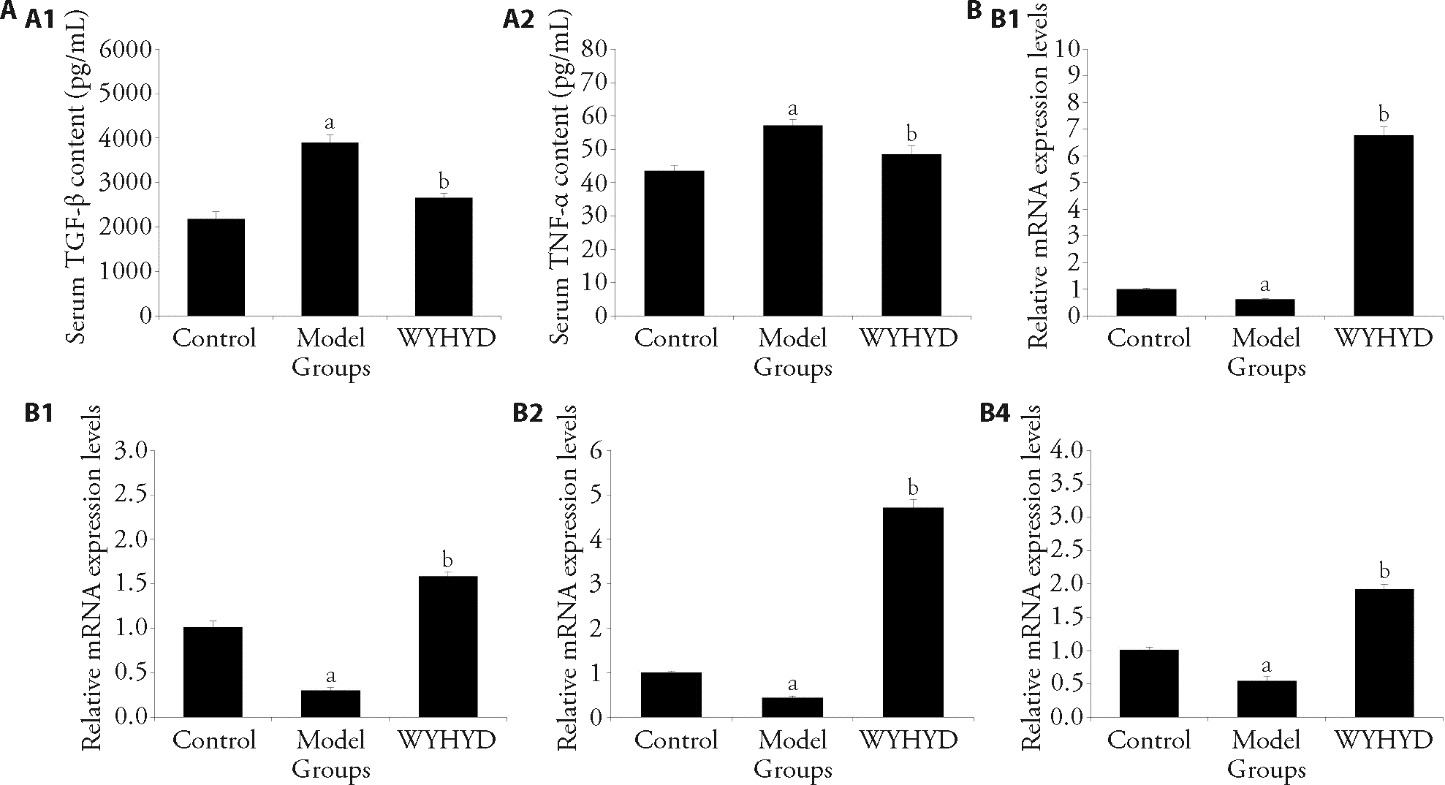
Figure 3 Serum inflammatory cytokine levels and relative expression of Atg gene mRNA in lung tissue A: levels of inflammatory cytokines TNF-α and TGF-β in rat serum; A1: TGF-β; A2: TNF-α; B: relative expression levels of Atg3, 5, 7, and 12 mRNA in rat lungs; B1: Atg3; B2: Atg5; B3: Atg7; B4: Atg12. Control group: no drug, no stress; Model group: OVA group (Model group were sensitized via intraperitoneal injection of 1 mL antigen containing 100 mg of ovalbumin +100 mg of aluminum hydroxide per mL on the first and eighth days. On the 15th day, asthma was induced in the rats with 1% ovalbumin atomized using an ultrasonic nebulizer once daily for 30 min each time for 8 d); WYHYD: WYHYD group (1.6 mL/100 g each time, Crude drug and body weight: 9.8214 g·kg?1·d?1, the dosing period is from days 2 to 22 of the experiment). WYHYD: Wenyang Huayin decoction; TNF-α: tumour necrosis factor-alpha; TGF-β: transforming growth factor-β; Atg 3, 5, 7, 12: autophagy related 3, 5, 7, 12. Differences were evaluated by one-way analysis of variance. Data are presented as mean ± standard deviation (n = 6). aP < 0.01, compared with the control group; bP < 0.01, compared with the model group.
Figure 3 Serum inflammatory cytokine levels and relative expression of Atg gene mRNA in lung tissue A: levels of inflammatory cytokines TNF-α and TGF-β in rat serum; A1: TGF-β; A2: TNF-α; B: relative expression levels of Atg3, 5, 7, and 12 mRNA in rat lungs; B1: Atg3; B2: Atg5; B3: Atg7; B4: Atg12. Control group: no drug, no stress; Model group: OVA group (Model group were sensitized via intraperitoneal injection of 1 mL antigen containing 100 mg of ovalbumin +100 mg of aluminum hydroxide per mL on the first and eighth days. On the 15th day, asthma was induced in the rats with 1% ovalbumin atomized using an ultrasonic nebulizer once daily for 30 min each time for 8 d); WYHYD: WYHYD group (1.6 mL/100 g each time, Crude drug and body weight: 9.8214 g·kg?1·d?1, the dosing period is from days 2 to 22 of the experiment). WYHYD: Wenyang Huayin decoction; TNF-α: tumour necrosis factor-alpha; TGF-β: transforming growth factor-β; Atg 3, 5, 7, 12: autophagy related 3, 5, 7, 12. Differences were evaluated by one-way analysis of variance. Data are presented as mean ± standard deviation (n = 6). aP < 0.01, compared with the control group; bP < 0.01, compared with the model group.

Figure 4 Autophagy-related protein expression was observed using Western blot combined with the measured experimental data A: chemical development image of protein bands; B: analysis of relative expression levels of AKT phosphorylation; C: analysis of relative expression levels of PI3K phosphorylation; D: analysis of relative expression levels of mTOR phosphorylation. Control group: no drug, no stress; Model group: OVA group (Model group were sensitized via intraperitoneal injection of 1 mL antigen containing 100 mg of ovalbumin + 100 mg of aluminum hydroxide per mL on the first and eighth days. On the 15th day, asthma was induced in the rats with 1% ovalbumin atomized using an ultrasonic nebulizer once daily for 30 min each time for 8 d); WYHYD: WYHYD group (1.6 mL/100 g each time, Crude drug and body weight: 9.8214 g·kg?1·d?1, the dosing period is from days 2 to 22 of the experiment). WYHYD: Wenyang Huayin decoction; AKT: protein kinase B; p-AKT: phosphorylated AKT; PI3K: phosphatidylinositol 3-kinase; p-PI3K: phosphorylated PI3K; mTOR: mechanistic target of rapamycin; p-mTOR: phosphorylated mTOR. Differences were evaluated by one-way analysis of variance. Data are presented as mean ± standard deviation (n = 3). aP < 0.01, compared with the control group; bP < 0.01, compared with the model group.
Figure 4 Autophagy-related protein expression was observed using Western blot combined with the measured experimental data A: chemical development image of protein bands; B: analysis of relative expression levels of AKT phosphorylation; C: analysis of relative expression levels of PI3K phosphorylation; D: analysis of relative expression levels of mTOR phosphorylation. Control group: no drug, no stress; Model group: OVA group (Model group were sensitized via intraperitoneal injection of 1 mL antigen containing 100 mg of ovalbumin + 100 mg of aluminum hydroxide per mL on the first and eighth days. On the 15th day, asthma was induced in the rats with 1% ovalbumin atomized using an ultrasonic nebulizer once daily for 30 min each time for 8 d); WYHYD: WYHYD group (1.6 mL/100 g each time, Crude drug and body weight: 9.8214 g·kg?1·d?1, the dosing period is from days 2 to 22 of the experiment). WYHYD: Wenyang Huayin decoction; AKT: protein kinase B; p-AKT: phosphorylated AKT; PI3K: phosphatidylinositol 3-kinase; p-PI3K: phosphorylated PI3K; mTOR: mechanistic target of rapamycin; p-mTOR: phosphorylated mTOR. Differences were evaluated by one-way analysis of variance. Data are presented as mean ± standard deviation (n = 3). aP < 0.01, compared with the control group; bP < 0.01, compared with the model group.
| 1. | Mims JW. Asthma: definitions and pathophysiology. Int Forum Allergy Rhinol 2015; 5: S2-6. |
| 2. |
Mauer Y, Taliercio RM. Managing adult asthma: the 2019 GINA guidelines. Cleve Clin J Med 2020; 87: 569-75.
DOI URL |
| 3. |
King-Biggs MB. Asthma. Ann Intern Med 2019; 171: ITC49-64.
DOI |
| 4. |
Huang K, Yang T, Xu JY, et al. Prevalence, risk factors, and management of asthma in China: a national cross-sectional study. Lancet 2019; 394: 407-18.
DOI PMID |
| 5. |
Papi A, Brightling C, Pedersen SE, et al. Asthma. Lancet 2018; 391: 783-800.
DOI PMID |
| 6. |
Li J, Zhang F, Li JY. The immunoregulatory effects of Traditional Chinese Medicine on treatment of asthma or asthmatic inflammation. Am J Chin Med 2015; 43: 1059-81.
DOI URL |
| 7. | Chang X. Study on the mechanism of autophagy of Wenyang Huayin formula in rat model of asthma with cold retention accumulation in lung syndrome based on theory of lung yang deficiency. Jinan: Shandong University of Traditional Chinese Medicine 2020: 1-125. |
| 8. |
Lü X, Xu Z, Xu G, et al. Investigation of the active components and mechanisms of Schisandra chinensis in the treatment of asthma based on a network pharmacology approach and experimental validation. Food Funct 2020; 11: 3032-42.
DOI PMID |
| 9. |
Li S, Zhang ZQ, Wu LJ, et al. Understanding ZHENG in Traditional Chinese Medicine in the context of neuro-endocrine-immune network. IET Syst Biol 2007; 1: 51-60.
DOI PMID |
| 10. |
Zhou W, Zhang H, Wang X, et al. Network pharmacology to unveil the mechanism of Moluodan in the treatment of chronic atrophic gastritis. Phytomedicine 2022; 95: 153837.
DOI URL |
| 11. | Yang PR, Zhong CH, Huan H, et al. Potential pharmacological mechanisms of four active compounds of Macleaya cordata extract against enteritis based on network pharmacology and molecular docking technology. Front Physiol 2023; 14: 1178492. |
| 12. | Wang X, Wang ZY, Zheng JH, et al. TCM network pharmacology: a new trend towards combining computational, experimental and clinical approaches. Chin J Nat Med 2021; 19: 1-11. |
| 13. | Ru J, Li P, Wang J, et al. TCMSP: a database of systems pharmacology for drug discovery from herbal medicines. J Cheminform 2014; 6: 13. |
| 14. |
UniProt Consortium. UniProt: the universal protein knowledgebase in 2021. Nucleic Acids Res 2021; 49: D480-9.
DOI PMID |
| 15. | Fishilevich S, Nudel R, Rappaport N, et al. GeneHancer: genome-wide integration of enhancers and target genes in GeneCards. Database (Oxford) 2017; 2017: bax028. |
| 16. | Zhou Y, Zhang Y, Lian X, et al. Therapeutic target database update 2012: a resource for facilitating target-oriented drug discovery. Nucleic Acids Res 2012; 40: D1128-36. |
| 17. |
Hamosh A, Scott AF, Amberger JS, et al. Online mendelian inheritance in man (OMIM), a knowledgebase of human genes and genetic disorders. Nucleic Acids Res 2005; 33: D514-7.
DOI PMID |
| 18. | Piñero J, Ramírez-Anguita JM, Saüch-Pitarch J, et al. The DisGeNET knowledge platform for disease genomics: 2019 update. Nucleic Acids Res 2020; 48: D845-55. |
| 19. | Wishart DS, Feunang YD, Guo AC, et al. DrugBank 5.0: a major update to the DrugBank database for 2018. Nucleic Acids Res 2018; 46: D1074-82. |
| 20. | Szklarczyk D, Gable AL, Nastou KC, et al. The STRING database in 2021: customizable protein-protein networks, and functional characterization of user-uploaded gene/measurement sets. Nucleic Acids Res 2021; 49: D605-12. |
| 21. |
Vella D, Marini S, Vitali F, et al. MTGO: PPI network analysis via topological and functional module identification. Sci Rep 2018; 8: 5499.
DOI |
| 22. |
Isali I, McClellan P, Wong TR, et al. A systematic review and in silico study of potential genetic markers implicated in cases of overactive bladder. Am J Obstet Gynecol 2023; 228: 36-47.
DOI URL |
| 23. |
Kanehisa M, Goto S. KEGG: kyoto encyclopedia of genes and genomes. Nucleic Acids Res 2000; 28: 27-30.
DOI PMID |
| 24. |
Martino E, Chiarugi S, Margheriti F, et al. Mapping, structure and modulation of PPI. Front Chem 2021; 9: 718405.
DOI URL |
| 25. | Yin X, Wang P, Yang T, et al. Identification of key modules and genes associated with breast cancer prognosis using WGCNA and ceRNA network analysis. Aging (Albany NY) 2021; 13: 2519-38. |
| 26. |
Lin CY, Lee TL, Chiu YY, et al. Module organization and variance in protein-protein interaction networks. Sci Rep 2015; 5: 9386.
DOI |
| 27. |
Lazareva O, Baumbach J, List M, et al. On the limits of active module identification. Brief Bioinform 2021; 22: bbab066.
DOI URL |
| 28. |
Wu Y, Liu X, Li G. Integrated bioinformatics and network pharmacology to identify the therapeutic target and molecular mechanisms of Huangqin decoction on ulcerative colitis. Sci Rep 2022; 12: 159.
DOI PMID |
| 29. |
Liu Z, Li J, Wang K, et al. Association between TGF-β1 polymorphisms and asthma susceptibility among the Chinese: a meta-analysis. Genet Test Mol Biomarkers 2018; 22: 433-42.
DOI URL |
| 30. |
Racanelli AC, Kikkers SA, Choi AMK, et al. Autophagy and inflammation in chronic respiratory disease. Autophagy 2018; 14: 221-32.
DOI PMID |
| 31. |
Wang S, Wuniqiemu T, Tang W, et al. Luteolin inhibits autophagy in allergic asthma by activating PI3K/Akt/mTOR signaling and inhibiting Beclin-1-PI3KC3 complex. Int Immunopharmacol 2021; 94: 107460.
DOI URL |
| 32. | Liu FC. Study on the effect and mechanism of inhibiting PIK3C3 and PI3K pathway on self-renewal of liver cancer stem cells. Chongqing: Chongqing Medical University 2020: 1-120. |
| 33. | Xi JH, Huang KT, Wang ZW, et al. Research status of PI3K/Akt signal pathway regulating airway mucus hypersecretion in asthma. Zhong Guo Lin Chuang Yao Li Xue Za Zhi 2022; 38: 2779-82. |
| 34. |
Chan HHL, Ng T. Traditional Chinese medicine (TCM) and allergic diseases. Curr Allergy Asthma Rep 2020; 20: 67.
DOI |
| 35. |
Shannon P, Markiel A, Ozier O, et al. Cytoscape: a software environment for integrated models of biomolecular interaction networks. Genome Res 2003; 13: 2498-504.
DOI PMID |
| Viewed | ||||||
|
Full text |
|
|||||
|
Abstract |
|
|||||
