
Journal of Traditional Chinese Medicine ›› 2025, Vol. 45 ›› Issue (6): 1263-1272.DOI: 10.19852/j.cnki.jtcm.2025.06.007
• Original Articles • Previous Articles Next Articles
Effect of Xuanfei Tongqiao acupuncture on nasal inflammation in rats with allergic rhinitis: modulation of long non-coding RNA growth arrest-specific transcript 5 methylation modification
LYU Hequn1,2, ZENG Chunli3,4, ZHANG Hanrui5, YANG Chen6, SHEN Yan6( ), PENG Yongjun7,8()
- 1 Department of Acupuncture and Rehabilitation, Affiliated Hospital of Nanjing University of Chinese Medicine, Nanjing 210029, China
2 Department of Acupuncture, Yancheng TCM Hospital Affiliated to Nanjing University of Chinese Medicine, Yancheng 224000, China
3 Department of Lung Disease, Yancheng TCM Hospital Affiliated to Nanjing University of Chinese Medicine, Yancheng 224000, China
4 Department of Critical Care Medicine, Seventh People’s Hospital of Shanghai University of Traditional Chinese Medicine, Shanghai 200137, China
5 Department of Acupuncture and Rehabilitation, Affiliated Hospital of Nanjing University of Chinese Medicine, Nanjing 210029, China
6 National Clinical Research Center for Chinese Medicine Acupuncture and Moxibustion, First Teaching Hospital of Tianjin University of Traditional Chinese Medicine, Tianjin 300000, China
7 Department of Acupuncture and Rehabilitation, Affiliated Hospital of Nanjing University of Chinese Medicine, Nanjing 210029, China
8 National Clinical Research Center for Chinese Medicine Acupuncture and Moxibustion, First Teaching Hospital of Tianjin University of Traditional Chinese Medicine, Tianjin 300000, China
-
Received:2024-06-12Accepted:2024-12-30Online:2025-12-15Published:2025-11-24 -
Contact:SHEN Yan, National Clinical Research Center for Chinese Medicine Acupuncture and Moxibustion, First Teaching Hospital of Tianjin University of Traditional Chinese Medicine, Tianjin 300000, China. swshtj@163.com, Telephone: + 86-13770671498; + 86-18920396086;
Dr. PENG Yongjun, Department of Acupuncture and Rehabilitation, Affiliated Hospital of Nanjing University of Chinese Medicine, Nanjing 210029, China. pengyongjun2004@126.com -
About author:LYU Hequn and ZENG Chunli are co-first authors and contributed equally to this work -
Supported by:Multi-Center Clinical Study on Xuanfei Tongqiao Acupuncture combined with Sphenopalatine Ganglion Stimulation in the Treatment of Allergic Rhinitis(NCRCOP2023008);Clinical Observation on Preventive Acupuncture for Seasonal Allergic Rhinitis based on the Theory of "Strong Spleen Prevents Pathogenic Invasion"(2020043);Mechanism of Xuanfei Tongqiao Acupuncture in Treating Allergic Rhinitis via m6A Methylation Modification of lncRNA GAS5(YK2023017)

Cite this article
LYU Hequn, ZENG Chunli, ZHANG Hanrui, YANG Chen, SHEN Yan, PENG Yongjun. Effect of Xuanfei Tongqiao acupuncture on nasal inflammation in rats with allergic rhinitis: modulation of long non-coding RNA growth arrest-specific transcript 5 methylation modification[J]. Journal of Traditional Chinese Medicine, 2025, 45(6): 1263-1272.
share this article

Figure 1 Comparison of behavioral scores among different groups of rats before and after intervention Control group: received intraperitoneal and intranasal saline administration; AR group: OVA-sensitized allergic rhinitis model group; AR + Acupuncture group: AR model plus acupuncture treatment; AR + sh-GAS5 group: AR model plus treatment with lentivirus expressing short hairpin RNA targeting lncRNA-GAS5. AR: allergic rhinitis; sh-GAS5: short hairpin RNA-GAS5. Statistical analyse were meansured using one-way analysis of variance followed by post hoc Bonfferroni correction for multiple comparisons. Data were presented as mean ± standard deviation (n = 6). Statistical analysis was performed using one-way analysis of variance followed by post hoc Bonferroni correction for multiple comparisons. Compared with the Control group, aP < 0.05; compared with the AR group, bP < 0.05; compared with the AR + Acupuncture group, cP < 0.05.
Figure 1 Comparison of behavioral scores among different groups of rats before and after intervention Control group: received intraperitoneal and intranasal saline administration; AR group: OVA-sensitized allergic rhinitis model group; AR + Acupuncture group: AR model plus acupuncture treatment; AR + sh-GAS5 group: AR model plus treatment with lentivirus expressing short hairpin RNA targeting lncRNA-GAS5. AR: allergic rhinitis; sh-GAS5: short hairpin RNA-GAS5. Statistical analyse were meansured using one-way analysis of variance followed by post hoc Bonfferroni correction for multiple comparisons. Data were presented as mean ± standard deviation (n = 6). Statistical analysis was performed using one-way analysis of variance followed by post hoc Bonferroni correction for multiple comparisons. Compared with the Control group, aP < 0.05; compared with the AR group, bP < 0.05; compared with the AR + Acupuncture group, cP < 0.05.

Figure 2 Histopathological evaluation of nasal mucosa in rat models of AR and treatment groups by HE staining A: control group exhibits normal nasal mucosal architecture composed of pseudostratified epithelial cells; A1: intact glandular structures; A2: no inflammatory cell infiltration; A3: no goblet cells observed; B: AR group demonstrates characteristic pathological alterations; B1: thickened mucosal layer; B2: increased goblet cell count; B3: inflammatory cell infiltration with eosinophils; C: AR + Acupuncture group shows attenuated inflammation and reduced epithelial hyperplasia; C1: thinner mucosal layer; C2: decreased goblet cell count; C3: reduced inflammatory cell infiltration and eosinophils; D: AR + sh-GAS5 group exhibits therapeutic effects comparable to the Acupuncture group; D1: improved mucosal thickness; D2: reduced goblet cell number; D3: decreased inflammatory cell infiltration. Control group: received intraperitoneal and intranasal saline administration; AR group: OVA-sensitized allergic rhinitis model group; AR + Acupuncture group: AR model plus acupuncture treatment; AR + sh-GAS5 group: AR model plus treatment with lentivirus expressing short hairpin RNA targeting lncRNA-GAS5. AR: allergic rhinitis; HE: hematoxylin/eosin; OVA: ovalbumin; GAS5: growth arrest-specific transcript 5; sh-GAS5: short hairpin RNA-GAS5. Scale bar = 20 μm (applies to all panels).
Figure 2 Histopathological evaluation of nasal mucosa in rat models of AR and treatment groups by HE staining A: control group exhibits normal nasal mucosal architecture composed of pseudostratified epithelial cells; A1: intact glandular structures; A2: no inflammatory cell infiltration; A3: no goblet cells observed; B: AR group demonstrates characteristic pathological alterations; B1: thickened mucosal layer; B2: increased goblet cell count; B3: inflammatory cell infiltration with eosinophils; C: AR + Acupuncture group shows attenuated inflammation and reduced epithelial hyperplasia; C1: thinner mucosal layer; C2: decreased goblet cell count; C3: reduced inflammatory cell infiltration and eosinophils; D: AR + sh-GAS5 group exhibits therapeutic effects comparable to the Acupuncture group; D1: improved mucosal thickness; D2: reduced goblet cell number; D3: decreased inflammatory cell infiltration. Control group: received intraperitoneal and intranasal saline administration; AR group: OVA-sensitized allergic rhinitis model group; AR + Acupuncture group: AR model plus acupuncture treatment; AR + sh-GAS5 group: AR model plus treatment with lentivirus expressing short hairpin RNA targeting lncRNA-GAS5. AR: allergic rhinitis; HE: hematoxylin/eosin; OVA: ovalbumin; GAS5: growth arrest-specific transcript 5; sh-GAS5: short hairpin RNA-GAS5. Scale bar = 20 μm (applies to all panels).

Figure 3 Flow cytometric characterization and quantification of ILC2 populations in AR models A: control group gating strategy; A1: gating of CD45+ leukocytes (PE-A) from live single cells; A2: identification of Lineage? (PB450-A) subsets in CD45+ population; A3: ILC2s defined as CD25+ (APC-A) in CD45+ lineage? cells; B: AR group gating strategy; B1: gating of CD45+ leukocytes (PE-A) from live single cells; B2: lineage? (PB450-A) subsets identified in CD45+ leukocytes; B3: significantly increased ILC2 frequency compared to the control group; C: AR + acupuncture group gating strategy; C1: gating of CD45+ leukocytes (PE-A) from live single cells; C2: lineage? (PB450-A) subsets in CD45+ population; C3: marked reduction in ILC2 frequency compared to the AR group; D: AR + sh-GAS5 group gating strategy; D1: gating of CD45+ leukocytes (PE-A) from live single cells; D2: lineage? (PB450-A) subsets resolved from CD45? leukocytes; D3: significant decrease in ILC2 abundance relative to the AR group; E: ILC2s frequency expressed as percentage of live cells. Control group: received intraperitoneal and intranasal saline administration; AR group: OVA-sensitized allergic rhinitis model group; AR + Acupuncture group: AR model plus acupuncture treatment; AR+sh-GAS5 group: AR model plus treatment with lentivirus expressing short hairpin RNA targeting lncRNA-GAS5. AR: allergic rhinitis; sh-GAS5: short hairpin RNA-GAS5; PE: phycoerythrin; GAS5: growth arrest-specific transcript 5; ILC2: type 2 innate lymphoid cells; OVA: ovalbumin. Data are presented as mean ± standard deviation (n = 3). Statistical analysis was performed using one-way analysis of variance followed by post hoc Bonferroni correction for multiple comparisons. Compared with the Control group, aP < 0.05; compared with the AR group, bP < 0.05; compared with the AR + Acupuncture group, cP < 0.05.
Figure 3 Flow cytometric characterization and quantification of ILC2 populations in AR models A: control group gating strategy; A1: gating of CD45+ leukocytes (PE-A) from live single cells; A2: identification of Lineage? (PB450-A) subsets in CD45+ population; A3: ILC2s defined as CD25+ (APC-A) in CD45+ lineage? cells; B: AR group gating strategy; B1: gating of CD45+ leukocytes (PE-A) from live single cells; B2: lineage? (PB450-A) subsets identified in CD45+ leukocytes; B3: significantly increased ILC2 frequency compared to the control group; C: AR + acupuncture group gating strategy; C1: gating of CD45+ leukocytes (PE-A) from live single cells; C2: lineage? (PB450-A) subsets in CD45+ population; C3: marked reduction in ILC2 frequency compared to the AR group; D: AR + sh-GAS5 group gating strategy; D1: gating of CD45+ leukocytes (PE-A) from live single cells; D2: lineage? (PB450-A) subsets resolved from CD45? leukocytes; D3: significant decrease in ILC2 abundance relative to the AR group; E: ILC2s frequency expressed as percentage of live cells. Control group: received intraperitoneal and intranasal saline administration; AR group: OVA-sensitized allergic rhinitis model group; AR + Acupuncture group: AR model plus acupuncture treatment; AR+sh-GAS5 group: AR model plus treatment with lentivirus expressing short hairpin RNA targeting lncRNA-GAS5. AR: allergic rhinitis; sh-GAS5: short hairpin RNA-GAS5; PE: phycoerythrin; GAS5: growth arrest-specific transcript 5; ILC2: type 2 innate lymphoid cells; OVA: ovalbumin. Data are presented as mean ± standard deviation (n = 3). Statistical analysis was performed using one-way analysis of variance followed by post hoc Bonferroni correction for multiple comparisons. Compared with the Control group, aP < 0.05; compared with the AR group, bP < 0.05; compared with the AR + Acupuncture group, cP < 0.05.
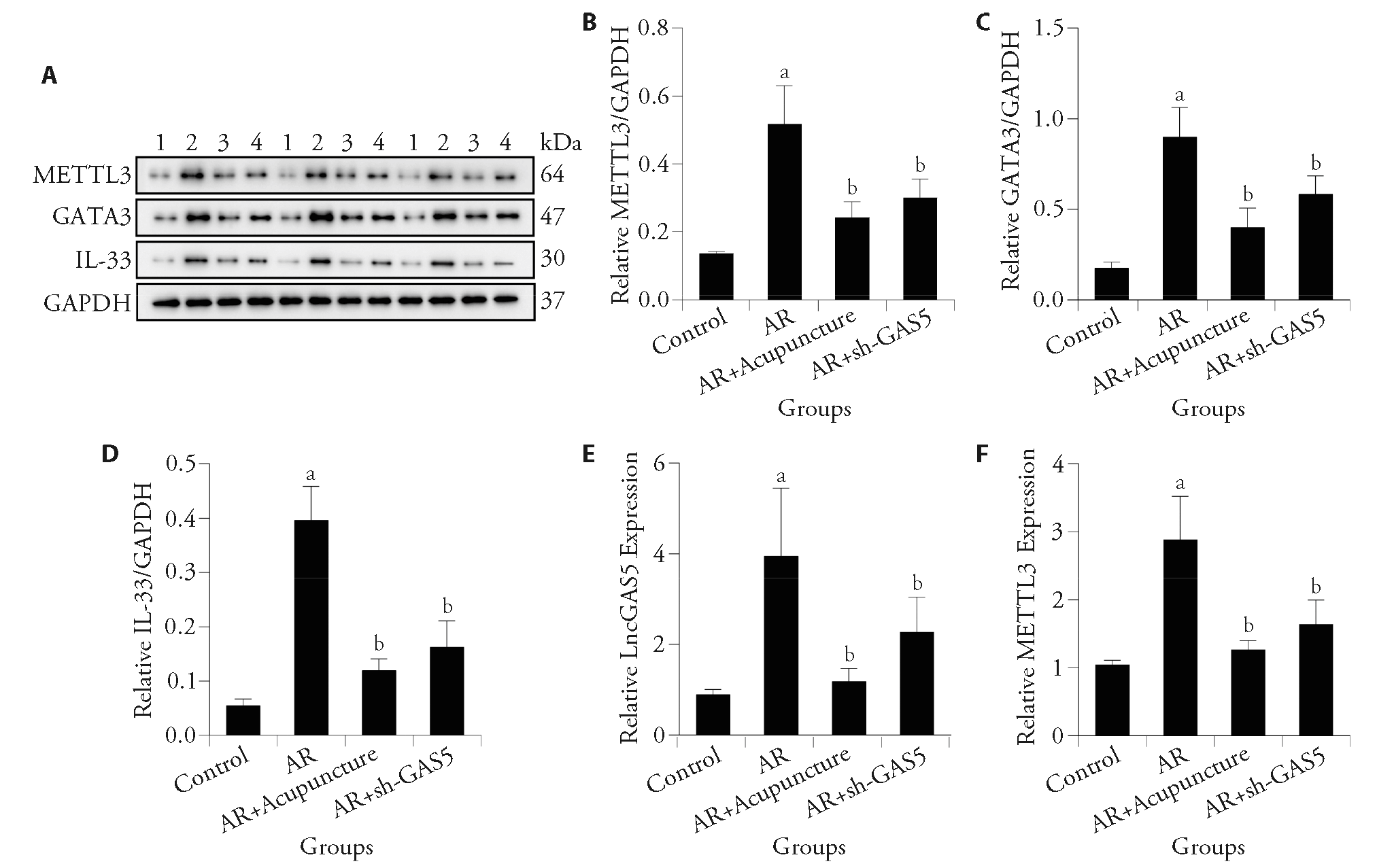
Figure 4 Comparative analysis of m6A-related and type 2 inflammation markers in rat nasal mucosa across experimental groups A: representative Western blot bands showing protein expression of METTL3, GATA3, IL-33, and GAPDH; B: quantitative analysis of METTL3 protein expression normalized to GAPDH; C: quantitative analysis of GATA3 protein expression normalized to GAPDH; D: quantitative analysis of IL-33 protein expression normalized to GAPDH; E: lncRNA-GAS5 expression levels across experimental groups; F: METTL3 mRNA expression levels across experimental groups. Control group: received intraperitoneal and intranasal saline administration; AR group: OVA-sensitized allergic rhinitis model group; AR + Acupuncture group: AR model plus acupuncture treatment; AR + sh-GAS5 group: AR model plus treatment with lentivirus expressing short hairpin RNA targeting lncRNA-GAS5. ILC2s: type 2 innate lymphoid cells; GATA3: GATA binding protein 3; METTL3: methyltransferase-like 3; IL-33: interleukin-33; GAPDH: glyceraldehyde-3-phosphate dehydrogenase. AR: allergic rhinitis; sh-GAS5: short hairpin RNA-GAS5; METTL3: methyltransferase-like 3; GAS5: growth arrest-specific transcript 5; OVA: ovalbumin. Data are presented as mean ± standard deviation (n = 3). Statistical analysis was performed using one-way analysis of variance followed by post hoc Bonferroni correction for multiple comparisons. Compared with the Control group, aP < 0.05; compared with the AR group, bP < 0.05.
Figure 4 Comparative analysis of m6A-related and type 2 inflammation markers in rat nasal mucosa across experimental groups A: representative Western blot bands showing protein expression of METTL3, GATA3, IL-33, and GAPDH; B: quantitative analysis of METTL3 protein expression normalized to GAPDH; C: quantitative analysis of GATA3 protein expression normalized to GAPDH; D: quantitative analysis of IL-33 protein expression normalized to GAPDH; E: lncRNA-GAS5 expression levels across experimental groups; F: METTL3 mRNA expression levels across experimental groups. Control group: received intraperitoneal and intranasal saline administration; AR group: OVA-sensitized allergic rhinitis model group; AR + Acupuncture group: AR model plus acupuncture treatment; AR + sh-GAS5 group: AR model plus treatment with lentivirus expressing short hairpin RNA targeting lncRNA-GAS5. ILC2s: type 2 innate lymphoid cells; GATA3: GATA binding protein 3; METTL3: methyltransferase-like 3; IL-33: interleukin-33; GAPDH: glyceraldehyde-3-phosphate dehydrogenase. AR: allergic rhinitis; sh-GAS5: short hairpin RNA-GAS5; METTL3: methyltransferase-like 3; GAS5: growth arrest-specific transcript 5; OVA: ovalbumin. Data are presented as mean ± standard deviation (n = 3). Statistical analysis was performed using one-way analysis of variance followed by post hoc Bonferroni correction for multiple comparisons. Compared with the Control group, aP < 0.05; compared with the AR group, bP < 0.05.
| 1. |
Brożek JL, Bousquet J, Agache I, et al. Allergic rhinitis and its impact on asthma (ARIA) guidelines-2016 revision. J Allergy Clin Immunol 2017; 140: 950-8.
DOI URL |
| 2. |
Luo P, Ying J, Li J, et al. Air pollution and allergic rhinitis: findings from a prospective cohort study. Environ Sci Technol 2023; 57: 15835-45.
DOI URL |
| 3. |
Pawankar R, Akdis CA. Climate change and the epithelial barrier theory in allergic diseases: a one health approach to a green environment. Allergy 2023; 78: 2829-34.
DOI PMID |
| 4. |
Alkotob SS, Cannedy C, Harter K, et al. Advances and novel developments in environmental influences on the development of atopic diseases. Allergy 2020; 75: 3077-86.
DOI PMID |
| 5. |
Kilanowski A, Thiering E, Wang G, et al. Allergic disease trajectories up to adolescence: characteristics, early-life, and genetic determinants. Allergy 2023; 78: 836-50.
DOI URL |
| 6. | Huang F, Lyu XL, Jiao XF, et al. Progress of researches on acupuncture treatment of allergic rhinitis. Zhen Ci Yan Jiu 2023; 48: 153-7. |
| 7. | Ding LB, Wang HJ, Yao L, et al. Electroacupuncture stimulating Neixiyan (EX-LE5) and Dubi (ST35) alleviates osteoarthritis in rats induced by anterior cruciate ligament transaction affecting DNA methylation regulated transcription of miR-146a and miR-140-5p. J Ttradit Chin Med 2024; 43: 983-90. |
| 8. |
Zhang C, Fu J, Zhou Y. A review in research progress concerning m6A methylation and immunoregulation. Front Immunol 2019; 10: 922.
DOI PMID |
| 9. |
Mjösberg J, Bernink J, Golebski K, et al. The transcription factor GATA3 is essential for the function of human type 2 innate lymphoid cells. Immunity 2012; 37: 649-59.
DOI PMID |
| 10. | Jiang X, Feng LC, Li LP. Expression of MAPK and NF-kappa B signaling pathway in patients with allergic rhinitis. Lab Med Clin 2018; 15: 965-6. |
| 11. | Chen J, Zhang YC, Huang C, et al. m(6)A regulates neurogenesis and neuronal development by modulating histone methyltransferase Ezh2. Genom Proteom Bioinformatics 2019; 17: 154-68. |
| 12. |
Zhou J, Xiong R, Zhou J, et al. Involvement of m6A regulatory factor IGF2BP 1 in malignant transformation of human bronchial epithelial Beas-2B cells induced by tobacco carcinogen NNK. Toxicol Appl Pharmacol 2022; 436: 115849.
DOI URL |
| 13. | Filippova JA, Matveeva AM, Zhuravlev ES, et al. Are small nucleolar RNAs "CRISPRable"? A report on box C/D small nucleolar RNA editing in human cells. Front Pharmacol 2019; 10: 1246. |
| 14. | Shen F. Clinical effect on acupuncture of Xuan-Fei-Tong-Qiao method in allergic rhinitis and its expression on TLR2. Nanjing: Nanjing University of Chinese Medicine; 2017: 34. |
| 15. |
Tonelli LH, Katz M, Kovacsics CE, et al. Allergic rhinitis induces anxiety-like behavior and altered social interaction in rodents. Brain Behav Immun 2009; 23: 784-93.
DOI PMID |
| 16. | Yu SG, Xu B. Experimental acupuncture science. 2nd ed. Beijing: People's Medical Publishing House, 2016: 287-90. |
| 17. | Wang J, Zhou Y, Zhang H, et al. Pathogenesis of allergic diseases and implications for therapeutic interventions. Signal Transduct Target Ther 2023; 8: 138. |
| 18. |
Mersha TB, Afanador Y, Johansson E, et al. Resolving clinical phenotypes into endotypes in allergy: molecular and omics approaches. Clin Rev Allergy Immunol 2021; 60: 200-19.
DOI |
| 19. | Hoyte FCL, Nelson HS. Recent advances in allergic rhinitis. F1000Res 2018; 7: F1000. |
| 20. | Li K. Case studies on the treatment of Biqiu using organ-regulating acupuncture techniques. Zhong Yi Yao Tong Bao 2022; 21: 53-5. |
| 21. | Liu YT, Lyu XD, Pang LJ, Liu C, Liu YM. Discussion of special intrinsic quality of pulmonary diseases from "The Lung Opens into Nose” . Liaoning Da Xue Xue Bao 2016; 18: 72-4. |
| 22. | Yang CY. Clinical interpretation of 70 common and important acupoints. Beijing: China Medical Science and Technology Press, 2017: 217-8. |
| 23. | Luo WJ, Chen CL, Luo BY, Yang CX, Zhang F, Cai LH. Clinical observation of the efficacy of three nasal needles combined with pecking moxibustion at Dazhui in the treatment of Qi deficiency type allergic rhinitis. Quan Qiu Zhong Yi Yao Za Zhi 2021; 14: 1340-3. |
| 24. | Bai J, Li SX, Zhang ZG, Wang JQ. Treating one case of allergic rhinitis by three nasal acupuncture plus wheat grain moxibustion. Zhong Guo Lin Chuang Yi Xue Za Zhi 2022; 14: 68-9. |
| 25. | Ma Y, Shi L, Zhao K, Zheng C. lncRNA FR215775 regulates Th2 differentiation in murine allergic rhinitis. J Immunol Res 2022; 2022: 7783481. |
| 26. |
Wen S, Li F, Tang Y, et al. MIR222HG attenuates macrophage M2 polarization and allergic inflammation in allergic rhinitis by targeting the miR146a-5p/TRAF6/NF-κB axis. Front Immunol 2023; 14: 1168920.
DOI URL |
| 27. |
Zhang H, Zhu X, Liu X, Wang Y, Liu Y. Long non-coding RNA FOXD3-AS1 regulates the expression and secretion of IL-25 in nasal epithelial cells to inhibit Th2 type immunoreaction in allergic rhinitis. Mol Cell Biochem 2020; 473: 239-46.
DOI PMID |
| 28. |
Zhao W, Yu HH, Meng WW, et al. Icariin restrains NLRP3 inflammasome-mediated Th2 immune responses and ameliorates atopic dermatitis through modulating a novel lncRNA MALAT1/miR-124-3p axis. Pharm Biol 2023; 61: 1249-59.
DOI PMID |
| 29. | Li Y, Liu Z, Mou Y, et al. LncRNA FAM239A modulates T helper cell responses via tyrosine phosphatase SHP2 in allergic rhinitis. Allergol Int 2023; 72: 480-3. |
| 30. | Thio CLP, Chang YJ. The modulation of pulmonary group 2 innate lymphoid cell function in asthma: from inflammatory mediators to environmental and metabolic factors. Exp Mol Med 2023; 55: 1872-84. |
| 31. | Wang C, Zhuo JJ, Li WQ, Zhou ML, Cheng KJ. Role of autophagy and mitophagy of group 2 innate lymphoid cells in allergic and local allergic rhinitis. World Allergy Organ J 2024; 17: 100852. |
| 32. | Srivastava RK, Sapra L, Bhardwaj A, Mishra PK, Verma B, Baig Z. Unravelling the immunobiology of innate lymphoid cells (ILCs): implications in health and disease. Cytokine Growth Factor Rev 2023; 74: 56-75. |
| 33. |
Zhong C, Zheng M, Cui K, et al. Differential expression of the transcription factor GATA3 specifies lineage and functions of innate lymphoid cells. Immunity 2020; 52: 83-95. e84.
DOI PMID |
| 34. |
Zhong Z, Huang X, Zhang S, et al. Blocking Notch signalling reverses miR-155-mediated inflammation in allergic rhinitis. Int Immunopharmacol 2023; 116: 109832.
DOI URL |
| 35. |
Cayrol C, Duval A, Schmitt P, et al. Environmental allergens induce allergic inflammation through proteolytic maturation of IL-33. Nat Immunol 2018; 19: 375-85.
DOI PMID |
| 36. |
Hoyler T, Klose CS, Souabni A, et al. The transcription factor GATA-3 controls cell fate and maintenance of type 2 innate lymphoid cells. Immunity 2012; 37: 634-48.
DOI PMID |
| 37. |
Zhu X, Sun Y, Yu Q, Wang X, Wang Y, Zhao Y. Exosomal lncRNA GAS5 promotes M1 macrophage polarization in allergic rhinitis via restraining mTORC1/ULK1/ATG13-mediated autophagy and subsequently activating NF-кB signaling. Int Immunopharmacol 2023; 121: 110450.
DOI URL |
| 38. |
Zhu X, Wang X, Wang Y, Zhao Y. The regulatory network among CircHIPK3, LncGAS5, and miR-495 promotes Th2 differentiation in allergic rhinitis. Cell Death Dis 2020; 11: 216.
DOI PMID |
| 39. | Jia J, Xiang X, Yuan Y, He Y, Li D. METTL 3 in bronchial epithelial cells regulates the immune equilibrium of Th1_Th2 cells. Am J Respir Crit Care 2020; 201: A3055. |
| 40. | Ni X, Li X, Hu B, Wang L. Chronic allergic asthma alters m6A epitranscriptomic tagging of mRNAs and lncRNAs in the lung. Biosci Rep 2022; 42: BSR20221395. |
| 41. |
Grossman J. One airway, one disease. Chest 1997; 111: 11s-6s.
PMID |
| 42. |
Patil DP, Chen CK, Pickering BF, et al. m(6)A RNA methylation promotes XIST-mediated transcriptional repression. Nature 2016; 537: 369-73.
DOI |
| 43. |
Zhang Y, Zhang W, Zhao J, et al. m(6)A RNA modification regulates innate lymphoid cell responses in a lineage-specific manner. Nat Immunol 2023; 24: 1256-64.
DOI |
| 44. | Peng YJ, Sun JH, Wang HS, Chen L, Sheng CR. Clinical observation on the treatment of allergic rhinitis by Xuanfei Tongqiao. Xian Dai Zhong Xi Yi Jie He Za Zhi 2016; 25: 3024-6. |
| 45. | Cui J, Dong M, Yi L, et al. Acupuncture inhibited airway inflammation and group 2 innate lymphoid cells in the lung in an ovalbumin-induced murine asthma model. Acupunct Med 2021; 39: 217-25. |
| 46. | Zeng CL, Lyu HQ, Peng YJ. Clinical efficacy of Xuanfei Tongqiao acupuncture in treatment of allergic rhinitis based on real world. Zhong Guo Zhong Yi Yao Xin Xi Za Zhi 2024; 31: 141-9. |
| 47. | Xie H. Clinical observation of Xuanfei Tongqiao acupuncture therapy combined with self-blood acupoint injection in the treatment of allergic rhinitis and its impact on intestinal microflora. Nanjing: Nanjing University of Chinese Medicine, 2021: 22. |
| 48. |
Zhu X, Wang X, Wang Y, Zhao Y. Exosomal long non-coding RNA GAS5 suppresses Th1 differentiation and promotes Th2 differentiation via downregulating EZH2 and T-bet in allergic rhinitis. Mol Immunol 2020; 118: 30-9.
DOI URL |
| [1] | WANG Ci, CAO Yawen, WANG Jiaying, CHEN Jixin, MA Xue, WANG Xianliang, MAO Jingyuan. Efficacy and safety of acupuncture for arrythmias: an overview of systematic reviews and Meta-analyses [J]. Journal of Traditional Chinese Medicine, 2025, 45(6): 1178-1190. |
| [2] | SHOU Yin, JIANG Juntao, HU Jianlin, JI Wei, CHEN Chunyan, HU Li, MA Yuhang, ZHANG Bimeng. Electroacupuncture alleviates type 2 diabetes mellitus by promoting plasma-derived exosomal circular RNA of enhancer of zeste homolog 1 expression [J]. Journal of Traditional Chinese Medicine, 2025, 45(6): 1228-1237. |
| [3] | LIU Jingxuan, MO Qian, LEI Guowu, JIA Yejuan, LI Aiying, JIA Chunsheng, PAN Lijia. Four-dimensional data independent acquisition proteomics and metabolomics reveal mechanisms of hydrogen-rich water at Zusanli (ST36) point against triple-negative breast cancer in mice [J]. Journal of Traditional Chinese Medicine, 2025, 45(6): 1238-1253. |
| [4] | PENG Shuhong, YANG Lingkun, LIU Xinyi, ZHANG Mengyu, LIN Seqi, ZHANG Changhua, XU Guoliang, ZHU Weifeng, YAO Pengcheng. Hypoglycemic mechanism of modified Gegen Qinlian decoction (加味葛根芩连汤) based on regulating the expression and DNA methylation of cholesterol transporters in the adipose tissue of type 2 diabetes mellitus rats [J]. Journal of Traditional Chinese Medicine, 2025, 45(6): 1254-1262. |
| [5] | ZHANG Qiongshuai, LI Yi, CAO Fang, ZHI Mujun, WANG Le, LIU Ruyao, FENG Juanjuan. Effect of acupuncture on brain microenvironment in rats with post-stroke limb spasticity based on single-cell transcriptome sequencing technology [J]. Journal of Traditional Chinese Medicine, 2025, 45(6): 1273-1282. |
| [6] | XU Yuqin, YUAN Jinjun, ZHU Yanxian, CHEN Chen, MA Xiaoming, JIANG Jiaona, HUANG Xingxian, LUO Wenshu, LIU Fan, YANG Zhuoxin, ZHOU Yumei. Observation of the efficacy and safety of acupuncture for postpartum depression [J]. Journal of Traditional Chinese Medicine, 2025, 45(6): 1405-1413. |
| [7] | WANG Yue, LIU Xingxing, GUO Yi, GUO Yongming, YUAN Gongming, ZHANG Yu, ZHENG Zhiyu, XU Yuan, LI Yuan. Characterization of acupuncture on central amino acid metabolism based on targeted neurotransmitter analysis in mice with inflammatory pain [J]. Journal of Traditional Chinese Medicine, 2025, 45(5): 1019-1027. |
| [8] | GUO Jixing, JI Changchun, XIE Chaoju, RAO Xiang, SUN Zhangyin, XING Yu, ZHANG Rongni, QU Qiangqiang, DONG Youpeng, YANG Jinsheng. Various acupuncture therapies for managing nonspecific low back pain: a network Meta-analysis [J]. Journal of Traditional Chinese Medicine, 2025, 45(5): 954-962. |
| [9] | ZHAO Ping, HE Xingbo, HAN Xudong, CHEN Xinyue, LI Zhanglong, SONG Jike, XING Wenjia, WU Jiangfeng, GUO Bin, BI Hongsheng. Mechanism of electroacupuncture involve in lens-induced myopia guinea pigs by inhibiting wnt/β-catenin signaling pathway [J]. Journal of Traditional Chinese Medicine, 2025, 45(4): 796-805. |
| [10] | ZHENG Ruwen, DONG Xu, WANG Tianyi, FENG Liyuan, ZHANG Hongyan, HUO Hong, ZHANG Ying, ZHANG Qianshi, ZHU Xingyan, WANG Dongyan. Electroacupuncture versus conventional acupuncture of scalp motor area for post-stroke wrist dyskinesia and its effect on muscle function: a randomized, controlled clinical trial [J]. Journal of Traditional Chinese Medicine, 2025, 45(4): 852-859. |
| [11] | SONG Jianfei, QIN Zhengyuan, GU Xinlu, ZHANG Yan, LI Xingrui. Efficacy of acupuncture combined with upper limb rehabilitation robot-assisted training for neuroplasticity and functional recovery of patients with stroke: a prospective cohort study based on functional near-infrared spectroscopy technology [J]. Journal of Traditional Chinese Medicine, 2025, 45(4): 860-866. |
| [12] | Kanae Umemoto, SHAN Xiyao, Takuro Ishikawa, Tadashi Watsuji, Yasuharu Watanabe, Munekazu Naito. Novel insight into the site-specificity of Hegu (LI4): morphological, biomechanical, and histological analyses [J]. Journal of Traditional Chinese Medicine, 2025, 45(4): 867-872. |
| [13] | JIANG Jinglei, YU Tao, QIAN Yulin, WANG Meng. Understanding the role of microglia in Alzheimer's disease: insights into mechanisms, acupuncture, and potential therapeutic targets [J]. Journal of Traditional Chinese Medicine, 2025, 45(4): 922-936. |
| [14] | SUN Jiao, WANG Yueming, LYU Jian, LIU Xin, YUE Bingnan, LI Yinyin, LIU Jipeng, SUN Yize, LIU Qingguo, YAN Liu. Effect of electroacupuncture on hypertensive and sympathetic excitability mechanism mediated by the paraventricular nucleus of the hypothalamus in spontaneous hypertensive rats [J]. Journal of Traditional Chinese Medicine, 2025, 45(3): 586-596. |
| [15] | MIN Yu, ZHENG Meifeng, SUN Ju, PENG Zetong, CAO Zhixian, HUANG Xiaohua. Systematic acupuncture explains acupuncture at Baihui (GV20) and Fengchi (GB20) targeting the inflammatory response to regulate migraine [J]. Journal of Traditional Chinese Medicine, 2025, 45(3): 610-617. |
| Viewed | ||||||
|
Full text |
|
|||||
|
Abstract |
|
|||||
