
Journal of Traditional Chinese Medicine ›› 2025, Vol. 45 ›› Issue (1): 132-139.DOI: 10.19852/j.cnki.jtcm.2025.01.012
Previous Articles Next Articles
Difference of the gut microbiota of premature ovarian insufficiency in two traditional Chinese syndromes
WU Jiaman1, NING Yan1, TAN Liya2, MA Fei1, LIN Yanting1, ZHUO Yuanyuan3( )
)
- 1 Department of Traditional Chinese Medicine, Shenzhen Maternity and Child Healthcare Hospital, Shenzhen 518028, China
2 Guangzhou University of Traditional Chinese Medicine, Guangzhou 510405, China
3 Department of Acupuncture and Moxibustion, Shenzhen Traditional Chinese Medicine Hospital, Shenzhen 518033, China
-
Received:2023-08-22Accepted:2024-04-25Online:2025-02-15Published:2025-01-10 -
Contact:Prof. ZHUO Yuanyuan, Department of Acupuncture and Moxibustion, Shenzhen Traditional Chinese Medicine Hospital, Shenzhen 518033, China;zyy2016@gzucm.edu.cn Telephone: +86-13530969797 -
Supported by:Sanming Project of Medicine in Shenzhen: the First Affiliated Hospital of Guangzhou University of Traditional Chinese Medicine, Luo Songping National Famous Chinese Medicine Practitioner Female Reproductive Disorders Prevention and Treatment Team(SZZYSM202311010);Guangdong Provincial Administration of Traditional Chinese Medicine: Investigation of the Mechanism of Regulating Ren-Tong-Du Acupuncture on Ovarian Granulosa Cells in Polycystic Ovary Syndrome based on Activin A /Smads Signalling Pathway(20181229);Guangdong Provincial Administration of Traditional Chinese Medicine: Evaluation of the Efficacy of Menstrual Regulation and Pregnancy Promotion by Acupuncture in the Treatment of Premature Ovarian Insufficiency(20201294);Shenzhen Science and Innovation Commission: Investigating the Mechanism of Action of Acupuncture in Regulating the Gut Microbiome to Inhibit Apoptosis of Ovarian Granulosa Cells in Premature Ovarian Insufficiency Mice based on the Rictor/Torepamycin Target Protein C2 Pathway(JCYJ20210324130001004)

Cite this article
WU Jiaman, NING Yan, TAN Liya, MA Fei, LIN Yanting, ZHUO Yuanyuan. Difference of the gut microbiota of premature ovarian insufficiency in two traditional Chinese syndromes[J]. Journal of Traditional Chinese Medicine, 2025, 45(1): 132-139.
share this article
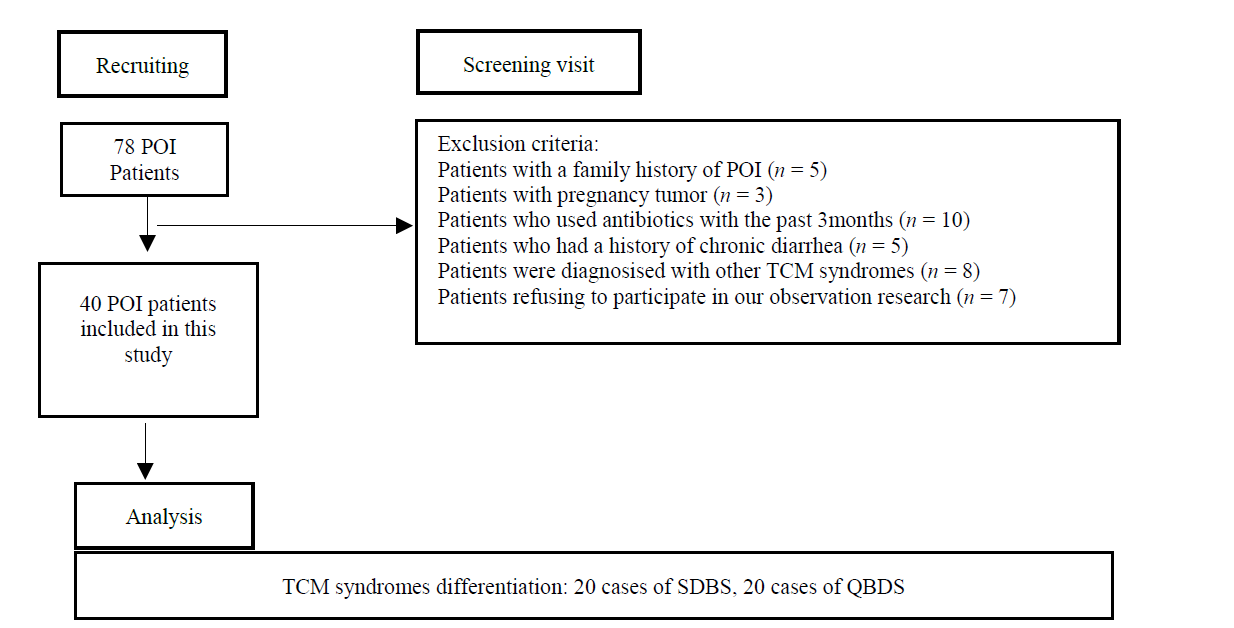
Figure 1 Flowchart for the enrollment of the study population POI: premature ovarian insufficiency; TCM: traditional Chinese medicine; SDBS: kidney deficiency and bloodstasis syndrome; QBDS: Qi and blood deficiency syndrome.
Figure 1 Flowchart for the enrollment of the study population POI: premature ovarian insufficiency; TCM: traditional Chinese medicine; SDBS: kidney deficiency and bloodstasis syndrome; QBDS: Qi and blood deficiency syndrome.
Table 1 Comparison of serum hormone levels
| Characteristic | SDBS group (n = 20) | QBDS group (n = 20) | P value |
|---|---|---|---|
| FSH (IU/L) | 46.35±26.88 | 45.76±19.24 | 0.937 |
| LH (IU/L) | 16.16±9.61 | 14.61±7.84 | 0.580 |
| E2 (pg/L) | 27.35±10.12 | 35.55±7.16 | 0.005a |
| P (nmol/L) | 0.46±0.36 | 0.51±0.23 | 0.625 |
| T (nmol/L) | 0.47±0.25 | 0.42±0.21 | 0.546 |
| PRL (nmol/L) | 16.46±8.82 | 14.42±5.58 | 0.387 |
| AMH (ng/mL) | 0.59±0.29 | 0.38±0.22 | 0.016b |
| FSH/LH (ratio) | 2.96±0.72 | 3.35±0.75 | 0.104 |
Table 1 Comparison of serum hormone levels
| Characteristic | SDBS group (n = 20) | QBDS group (n = 20) | P value |
|---|---|---|---|
| FSH (IU/L) | 46.35±26.88 | 45.76±19.24 | 0.937 |
| LH (IU/L) | 16.16±9.61 | 14.61±7.84 | 0.580 |
| E2 (pg/L) | 27.35±10.12 | 35.55±7.16 | 0.005a |
| P (nmol/L) | 0.46±0.36 | 0.51±0.23 | 0.625 |
| T (nmol/L) | 0.47±0.25 | 0.42±0.21 | 0.546 |
| PRL (nmol/L) | 16.46±8.82 | 14.42±5.58 | 0.387 |
| AMH (ng/mL) | 0.59±0.29 | 0.38±0.22 | 0.016b |
| FSH/LH (ratio) | 2.96±0.72 | 3.35±0.75 | 0.104 |
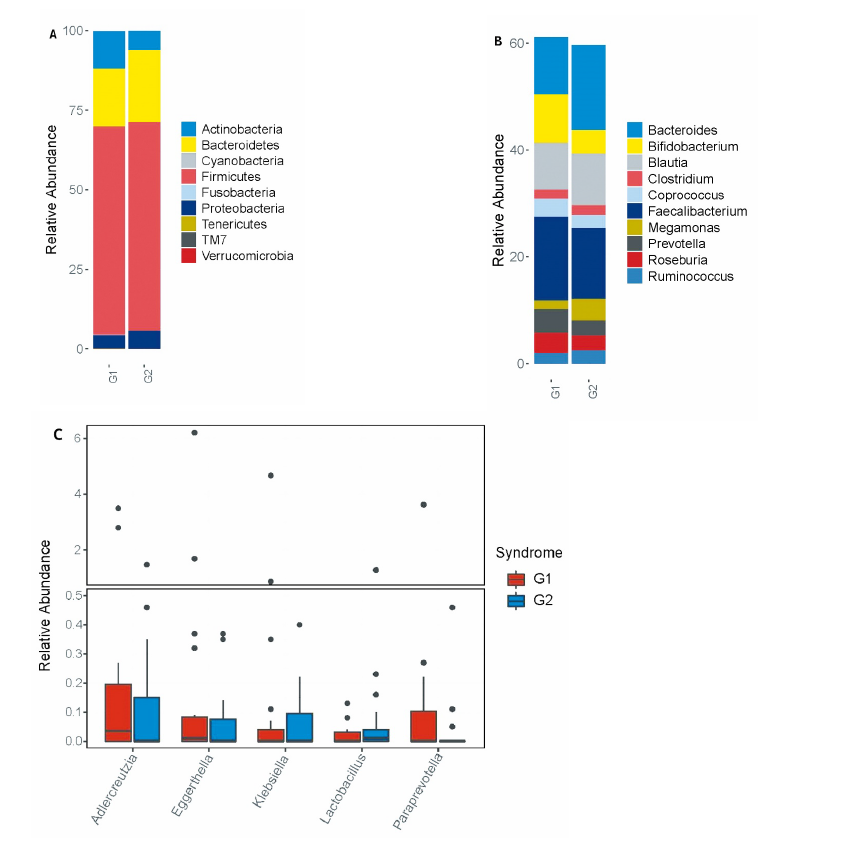
Figure 2 Microbial community profiles of the gut microbiota in the SDBS and QBDS groups A: relative abundance at the phylum level; B: relative abundance at the genus level; C: the genera between the SDBS and QBDS groups differ significantly. G1 represents the SDBS group and G2 represents the QBDS group. SDBS: kidney deficiency and blood stasis pattern; QBDS: Qi and blood deficiency.
Figure 2 Microbial community profiles of the gut microbiota in the SDBS and QBDS groups A: relative abundance at the phylum level; B: relative abundance at the genus level; C: the genera between the SDBS and QBDS groups differ significantly. G1 represents the SDBS group and G2 represents the QBDS group. SDBS: kidney deficiency and blood stasis pattern; QBDS: Qi and blood deficiency.

Figure 3 Metabolic pathways that differed significantly between the SDBS and QBDS groups SDBS: kidney deficiency and blood stasis pattern; QBDS: Qi and blood deficiency; G1 represents the SDBS group and G2 represents the QBDS group.
Figure 3 Metabolic pathways that differed significantly between the SDBS and QBDS groups SDBS: kidney deficiency and blood stasis pattern; QBDS: Qi and blood deficiency; G1 represents the SDBS group and G2 represents the QBDS group.
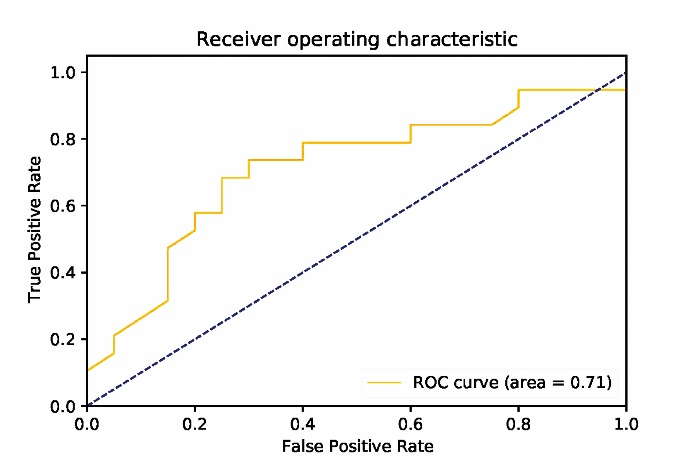
Figure 4 ROC curve for the model based on gut microbiome characteristics ROC: receiver operating characteristic.
Figure 4 ROC curve for the model based on gut microbiome characteristics ROC: receiver operating characteristic.
| 1. | Webber L, Davies M, Anderson R, et al. ESHRE guideline: management of women with premature ovarian insufficiency. Hum Reprod 2016; 31: 926-37. |
| 2. | Anderson RA, Amant F, Braat D, et al. ESHRE guideline: female fertility preservation. Hum Reprod Open 2020; 2020: hoaa052. |
| 3. |
Tsiligiannis S, Panay N, Stevenson JC. Premature ovarian insufficiency and long-term health consequences. Curr Vasc Pharmacol 2019; 17: 604-9.
DOI PMID |
| 4. |
Podfigurna-Stopa A, Czyzyk A, Grymowicz M, et al. Premature ovarian insufficiency: the context of long-term effects. J Endocrinol Invest 2016; 39: 983-90.
DOI PMID |
| 5. | Huang C, Guo T, Qin Y. Meiotic recombination defects and premature ovarian insufficiency. Front Cell Dev Biol 2021; 9: 652407. |
| 6. | Kirshenbaum M, Orvieto R. Premature ovarian insufficiency (POI) and autoimmunity-an update appraisal. J Assist Reprod Genet 2019; 36: 2207-15. |
| 7. | Szeliga A, Calik-Ksepka A, Maciejewska-Jeske M, et al. Autoimmune diseases in patients with premature ovarian insufficiency-our current state of knowledge. Int J Mol Sci 2021; 22: 2594. |
| 8. |
Wang C, Li Q, Ren J. Microbiota-immune interaction in the pathogenesis of gut-derived infection. Front Immunol 2019; 10: 1873.
DOI PMID |
| 9. | Kinashi Y, Hase K. Partners in leaky gut syndrome: intestinal dysbiosis and autoimmunity. Front Immunol 2021; 12: 673708. |
| 10. | Wu J, Zhuo Y, Liu Y, et al. Association between premature ovarian insufficiency and gut microbiota. BMC Pregnancy Childbirth 2021; 21: 418. |
| 11. | Li Z, Xu C. The fundamental theory of Traditional Chinese Medicine and the consideration in its research strategy. Front Med 2011; 5: 208-11. |
| 12. | Chen ZG, Luo H, Xu S, et al. Study on the methodology of developing evidence-based clinical practice guidelines of Chinese medicine. Chin J Integr Med 2015; 21: 874-80. |
| 13. | Liu MY, Yang W, Wang LY, et al. Clinical application evaluation of Guidelines for the diagnosis and treatment of common diseases of pediatrics in Traditional Chinese Medicine. Zhong Guo Zhong Yao Za Zhi 2017; 42: 3238-42. |
| 14. | Li HF, Shen QH, Chen WJ, et al. Efficacy of Traditional Chinese Medicine tonifying kidney (Bushen) and activating blood (Huoxue) prescription for premature ovarian insufficiency: a systematic review and Meta-analysis. Evid Based Complement Alternat Med 2020; 2020: 1789304. |
| 15. | Li F, Zhao C, Xia Z, et al. Computer-assisted lip diagnosis on Traditional Chinese Medicine using multi-class support vector machines. BMC Complement Altern Med 2012; 12: 127. |
| 16. | Chen J, Wang S, Shen J, et al. Analysis of gut microbiota composition in lung adenocarcinoma patients with TCM Qi-Yin deficiency. Am J Chin Med 2021; 49: 1667-82. |
| 17. | Zhang YL, Cai LT, Qi JY, et al. Gut microbiota contributes to the distinction between two Traditional Chinese Medicine syndromes of ulcerative colitis. World J Gastroenterol 2019; 25: 3242-55. |
| 18. |
Lin Z, Ye W, Zu X, et al. Integrative metabolic and microbial profiling on patients with spleen-Yang-deficiency syndrome. Sci Rep 2018; 8: 6619.
DOI PMID |
| 19. | Deng Z, Fu Z, Yan W, et al. The different effects of Chinese herb solid drink and lactulose on gut microbiota in rats with slow transit constipation induced by compound diphenoxylate. Food Res Int 2021; 143: 110273. |
| 20. |
Bolyen E, Rideout JR, Dillon MR, et al. Reproducible, interactive, scalable and extensible microbiome data science using QIIME 2. Nat Biotechnol 2019; 37: 852-7.
DOI PMID |
| 21. | Wu J, Zhuo Y, Liu Y, et al. Association between premature ovarian insufficiency and gut microbiota. BMC Pregnancy Childbirth 2021; 21: 418-25. |
| 22. |
Heintz-Buschart A, Wilmes P. Human gut microbiome: function matters. Trends Microbiol 2018; 26: 563-74.
DOI PMID |
| 23. |
Sharon G, Sampson TR, Geschwind DH, et al. The central nervous system and the gut microbiome. Cell 2016; 167: 915-32.
DOI PMID |
| 24. |
Cryan JF, O'Riordan KJ, Sandhu K, et al. The gut microbiome in neurological disorders. Lancet Neurol 2020; 19: 179-94.
DOI PMID |
| 25. |
Qi X, Yun C, Pang Y, et al. The impact of the gut microbiota on the reproductive and metabolic endocrine system. Gut Microbes 2021; 13: 1-21.
DOI PMID |
| 26. | Thackray VG. Sex, microbes, and polycystic ovary syndrome. Trends Endocrinol Metab 2019; 30: 54-65. |
| 27. |
Miquel S, Martín R, Rossi O, et al. Faecalibacterium prausnitzii and human intestinal health. Curr Opin Microbiol 2013; 16: 255-61.
DOI PMID |
| 28. | Qiu X, Zhang M, Yang X, et al. Faecalibacterium prausnitzii upregulates regulatory T cells and anti-inflammatory cytokines in treating TNBS-induced colitis. J Crohns Colitis 2013; 7: e558-68. |
| 29. |
Zhou L, Zhang M, Wang Y, et al. Faecalibacterium prausnitzii produces butyrate to maintain Th17/Treg balance and to ameliorate colorectal colitis by inhibiting histone deacetylase 1. Inflamm Bowel Dis 2018; 24: 1926-40.
DOI PMID |
| 30. | Zafar H, Saier MH, Jr. Gut bacteroides species in health and disease. Gut Microbes 2021; 13: 1-20. |
| 31. | Jandhyala SM, Talukdar R, Subramanyam C, et al. Role of the normal gut microbiota. World J Gastroenterol 2015; 21: 8787-803. |
| 32. | Distrutti E, Monaldi L, Ricci P, et al. Gut microbiota role in irritable bowel syndrome: new therapeutic strategies. World J Gastroenterol 2016; 22: 2219-41. |
| 33. | Suk KT, Kim DJ. Gut microbiota: novel therapeutic target for nonalcoholic fatty liver disease. Expert Rev Gastroenterol Hepatol 2019; 13: 193-204. |
| 34. |
Wu J, Ning Y, Tan L, et al. Characteristics of the vaginal microbiome in women with premature ovarian insufficiency. J Ovarian Res 2021; 14: 172.
DOI PMID |
| 35. |
Lee S, Koh J, Chang Y, et al. Invariant NKT cells functionally link microbiota-induced butyrate production and joint inflammation. J Immunol 2019; 203: 3199-208.
DOI PMID |
| 36. |
Ríos-Covián D, Ruas-Madiedo P, Margolles A, et al. Intestinal short chain fatty acids and their link with diet and human health. Front Microbiol 2016; 7: 185.
DOI PMID |
| 37. |
Dalile B, Van Oudenhove L, Vervliet B, et al. The role of short-chain fatty acids in microbiota-gut-brain communication. Nat Rev Gastroenterol Hepatol 2019; 16: 461-78.
DOI PMID |
| 38. | Jeong SY, Kang S, Hua CS, et al. Synbiotic effects of β-glucans from cauliflower mushroom and lactobacillus fermentum on metabolic changes and gut microbiome in estrogen-deficient rats. Genes Nutr 2017; 12: 31. |
| 39. | Wu X, Kim MJ, Yang HJ, et al. Chitosan alleviated menopausal symptoms and modulated the gut microbiota in estrogen-deficient rats. Eur J Nutr 2021; 60: 1907-19. |
| 40. | Min Z, Ge Z, Jinao D. Effect of Siwutang on diminished ovarian reserve in rats based on 16S rRNA sequencing of intestinal flora. Zhong Guo Shi Yan Fang Ji Xue Za Zhi 2022; 28: 25-32. |
| [1] | WU Jiaman, TANG Meng, LUO Yu, ZHU Haimin, ZHAO Tianqi, MA Fei, NING Yan. Electroacupuncture enhances the mitophagy of granulosa cells in premature ovarian insufficiency model mice by inactivating the hippo-yes-associated protein/transcriptional co-activator with postsynaptic density protein, drosophila disc large tumor suppressor, and zonula occludens-1 protein binding motif pathway [J]. Journal of Traditional Chinese Medicine, 2025, 45(1): 13-21. |
| [2] | WANG Yiying, LIU Jianjun, XIONG Yongjian, ZHANG Yongli, WEN Yuqi, XUE Mengli, GUO Huishu, QIU Juanjuan. Analysis of composition of gut microbial community in a rat model of functional dyspepsia treated with Simo Tang (四磨汤) [J]. Journal of Traditional Chinese Medicine, 2024, 44(6): 1168-1176. |
| [3] | LIAO Mengting, LI Tao, CHU Fuhao, CHEN Yan, LOU Ni, ZHUANG Yuan, BO Rongqiang, DING Xia. Weichang’ an pill (胃肠安丸) alleviates functional dyspepsia through modulating brain-gut peptides and gut microbiota [J]. Journal of Traditional Chinese Medicine, 2024, 44(6): 1177-1186. |
| [4] | HUANG Xiaona, LI Yuzhen, ZHU Chenyang, ZHU Hengzhou, JIANG Chenyu, ZHU Xiaodan, ZHANG Chencen, JIN Chunhui. Weitiao No. 3 (微调3号方) enhances the efficacy of anti-programmed cell death protein-1 immunotherapy by modulating the intestinal microbiota in an orthotopic model of gastric cancer mice [J]. Journal of Traditional Chinese Medicine, 2024, 44(5): 906-915. |
| [5] | SUN Chuanbo, XU Guangpei, JIANG Ping, HUANG Shipping, CHEN Cunwu, HE Yanfei. Protective effect of Zhizi Huangqi Shanzha formula (栀子黄芪山楂方) on aflatoxin poisoning in mice and its effect on intestinal flora [J]. Journal of Traditional Chinese Medicine, 2024, 44(5): 926-933. |
| [6] | REN Li, HAI Yang, YANG Xue, LUO Xianqin. Yemazhui (Herba Eupatorii Lindleyani) ameliorates lipopolysaccharide-induced acute lung injury via modulation of the toll-like receptor 4/nuclear factor kappa-B/nod-like receptor family pyrin domain-containing 3 protein signaling pathway and intestinal flora in rats [J]. Journal of Traditional Chinese Medicine, 2024, 44(2): 303-314. |
| [7] | WANG Yuezhu, ZHANG Yuyang, QIAO Jiajun, LU Yuyuan, XIA Zhongyuan. Protective effect of thyroid and restores of ovarian function of Buzhong Yiqi granule (补中益气颗粒) on experimental autoimmune thyroiditis in female rats [J]. Journal of Traditional Chinese Medicine, 2024, 44(2): 315-323. |
| [8] | LI Chaoran, YANG Yan, FENG Chuwen, LI Heng, QU Yuanyuan, WANG Yulin, WANG Delong, WANG Qingyong, GUO Jing, SHI Tianyu, SUN Xiaowei, WANG Xue, HOU Yunlong, SUN Zhongren, YANG Tiansong. Integrated 'omics analysis for the gut microbiota response to moxibustion in a rat model of chronic fatigue syndrome [J]. Journal of Traditional Chinese Medicine, 2023, 43(6): 1176-1189. |
| [9] | XU Yani, ZHANG Yutong, HE Weile, DAI Linglin, TANG Ding, WANG Jialing, ZHANG Xufen, CHEN Qin, CHEN Lifang, WANG Zhanglian, ZHAN Mingjie. Efficiency and safety of acupuncture for women with premature ovarian insufficiency: study protocol for a randomized controlled trial [J]. Journal of Traditional Chinese Medicine, 2023, 43(6): 1268-1274. |
| [10] | ZHOU Jun, WANG Junhua, LI Xiaobing, WAN Chenyi, LI Fangjun, Lü Yanni, CHEN Hao, SUN Meiying. Efficacy of Heshouwu (Radix Polygoni Multiflori) on gut mircobiota in mice with autoimmune encephalomyelitis [J]. Journal of Traditional Chinese Medicine, 2023, 43(4): 676-685. |
| [11] | JIANG Yiqian, ZHOU Xibin, PU Wenyuan, ZHOU Chunxiang. Sanwu Baisan decoction (三物白散) inhibits colorectal cancer progression in mice by remodeling gut microbiota and tumorigenesis [J]. Journal of Traditional Chinese Medicine, 2023, 43(3): 466-473. |
| [12] | YANG Yang, YUAN Haining, JIA Hongxiao, NING Yanzhe, WANG Di, ZHANG Lei, YAN Kaijuan, GUO Yumeng, WANG Fei, SUN Weishuang, CHEN Pei. Therapy of replenishing Yin and regulating Yang for manic episode in bipolar disorder: study protocol for a prospective, double-blind, randomized controlled trial [J]. Journal of Traditional Chinese Medicine, 2023, 43(3): 594-601. |
| [13] | LIU Xueling, MA Kun, TAO Wenhua, XU Zhongkun, LIU Gang, HU Chunyan, MAO Weiwei, GU Chang, GUO Qi. Natural products for treatment of premature ovarian failure: a narrative review [J]. Journal of Traditional Chinese Medicine, 2023, 43(3): 606-617. |
| [14] | SUN Mengzhu, ZHANG Yujie, SONG Yafang, GUO Jing, ZHAO Tingting, WANG Yuhang, PEI Lixia, SUN Jianhua. Electroacupuncture at Tianshu (ST25) and Zusanli (ST36) alleviates stress-induced irritable bowel syndrome in mice by modulating gut microbiota and corticotropin-releasing factor [J]. Journal of Traditional Chinese Medicine, 2022, 42(5): 732-740. |
| [15] | YU Zeyue, HAO Liyu, LI Zongyuan, SUN Jianhui, CHEN Hongying, HUO Hairu, LI Xiaoqin, SHAN Zhongchao, LI Hongmei. Correlation between slow transit constipation and spleen Qi deficiency, and gut microbiota: a pilot study [J]. Journal of Traditional Chinese Medicine, 2022, 42(3): 353-363. |
| Viewed | ||||||
|
Full text |
|
|||||
|
Abstract |
|
|||||