
Journal of Traditional Chinese Medicine ›› 2026, Vol. 46 ›› Issue (5): 1149-1159.DOI: 10.19852/j.cnki.jtcm.2026.05.009
• Original Articles • Previous Articles Next Articles
Qige decoction (芪葛汤) ameliorates hyperlipidemia in rats by modulating the intestinal microbiota and liver metabolism
ZHOU Zunming1,2, TAN Meiao2,3, YU Xiaoqing4, KE Xuehong4( ), HUANG Keer2()
- 1
Department of Acupuncture and Moxibustion ,Shenzhen Hospital (Futian) of Guangzhou University of Chinese Medicine Shenzhen 510008, China
2Department of Gastroenterology ,the First Affiliated Hospital of Guangzhou University of Chinese Medicine Guangzhou 510405, China
3Lingnan Medical Research Center ,Guangzhou University of Chinese Medicine Guangzhou 510405, China
4Laboratory Center ,the First Affiliated Hospital of Guangzhou University of Chinese Medicine Guangzhou 510405, China
-
Received:2025-07-04Accepted:2026-01-11Online:2026-10-15Published:2026-10-09 -
Contact:HUANG Keer, Department of Gastroenterology, the First Affiliated Hospital of Guangzhou University of Chinese Medicine, Guangzhou 510405, China. hke1234567@163.com; KE Xuehong, Laboratory Center, the First Affiliated Hospital of Guangzhou University of Chinese Medicine, Guangzhou 510405, China, 2804613799@qq.com -
Supported by:National Natural Science Foundation of China Project: Mechanism of the Huangqi-Gegen Herb Pair with Added Chenpi in Ameliorating Non-alcoholic Fatty Liver Disease via Activation of the Sirtuin 6-Peroxisome proliferator-activated Receptor α Signaling Pathway(82074099);Guangdong Basic and Applied Basic Research Project: Foundation Mechanisms of Qige Decoction in Ameliorating Non-alcoholic Fatty Liver Disease via Peroxisome Proliferator-activated Receptor α Signaling Pathway: A Study on Its Dual-Regulatory Effect on Glucose and Lipid Metabolism(2023A1515011126);Research Special Project of Shenzhen Hospital (Futian) of Guangzhou University of Chinese Medicine, Mechanism of Thread-Embedding Therapy in Preventing and Treating Non-alcoholic Fatty Liver Disease via the Gut Microbiota/Choline/Trimethylamine/Trimethylamine N-oxide Metabolic Pathway(GZYSY2024012);Guangzhou Science and Technology Qige decoction granule Development Project(202102010476)

Cite this article
ZHOU Zunming, TAN Meiao, YU Xiaoqing, KE Xuehong, HUANG Keer. Qige decoction (芪葛汤) ameliorates hyperlipidemia in rats by modulating the intestinal microbiota and liver metabolism[J]. Journal of Traditional Chinese Medicine, 2026, 46(5): 1149-1159.
share this article
Table 1 Effect of QG on serum lipid profile in HLP rats (mmol/L, $\bar{x}±s$)
| Group | n | TC | TG | HDL-C | LDL-C |
|---|---|---|---|---|---|
| CON | 9 | 1.13±0.11a | 0.63±0.12a | 0.85±0.16a | 0.83±0.12a |
| MOD | 9 | 2.64±0.43 | 1.37±0.22 | 0.58±0.15 | 1.37±0.28 |
| ATO | 9 | 1.83±0.51a | 0.75±0.22a | 0.58±0.13 | 0.90±0.30a |
| QG | 9 | 1.868±0.25a | 0.89±0.21a | 0.61±0.14 | 1.01±0.17a |
| HG | 9 | 2.26±0.33b | 1.22±0.19c | 0.64±0.24 | 1.23±0.36 |
| CP | 9 | 2.23±0.35b | 1.22±0.21c | 0.65±0.20 | 1.19±0.19 |

Figure 1 Effect of QG on liver pathology in HLP rats A: liver HE staining at magnification × 200. Black arrows indicate the steatosis of hepatocytes; B: liver oil red O staining at magnification × 400; C: the proportion of liver fat area from oil red O staining Red area indicate the steatosis of hepatocytes; A1, B1: normal control group; A2, B2: model group; A3, B3: atorvastatin group; A4, B4: QG group; A5, B5: HG group; A6, B6: CP group. CON: normal control (fed by normal chow diet); MOD: model group (fed by HFHCD); ATO: atorvastatin group (5 mg/kg atorvastatin+HFHCD); QG: QG group (5 g/kg QG + HFHCD); HG: HG group (4.5 g/kg HG + HFHCD); CP: CP group (0.5 g/kg CP + HFHCD). HLP: hyperlipidemic; CON: control; MOD: model; ATO: atorvastatin; QG: Qige decoction; HG: Huangqi-Gegen decoction; CP: Chenpi decoction; HFHCD: high-fat high-cholesterol diet; ANOVA: analysis of variance. Variables conformed to normal distributions but with different variances, Welch's ANOVA was used to evaluate the statistical significance of the lipid area. All data are expressed as the mean ± standard deviation (n = 6). aP < 0.01, compared to the MOD group; bP < 0.01, compared to the QG group.
Figure 1 Effect of QG on liver pathology in HLP rats A: liver HE staining at magnification × 200. Black arrows indicate the steatosis of hepatocytes; B: liver oil red O staining at magnification × 400; C: the proportion of liver fat area from oil red O staining Red area indicate the steatosis of hepatocytes; A1, B1: normal control group; A2, B2: model group; A3, B3: atorvastatin group; A4, B4: QG group; A5, B5: HG group; A6, B6: CP group. CON: normal control (fed by normal chow diet); MOD: model group (fed by HFHCD); ATO: atorvastatin group (5 mg/kg atorvastatin+HFHCD); QG: QG group (5 g/kg QG + HFHCD); HG: HG group (4.5 g/kg HG + HFHCD); CP: CP group (0.5 g/kg CP + HFHCD). HLP: hyperlipidemic; CON: control; MOD: model; ATO: atorvastatin; QG: Qige decoction; HG: Huangqi-Gegen decoction; CP: Chenpi decoction; HFHCD: high-fat high-cholesterol diet; ANOVA: analysis of variance. Variables conformed to normal distributions but with different variances, Welch's ANOVA was used to evaluate the statistical significance of the lipid area. All data are expressed as the mean ± standard deviation (n = 6). aP < 0.01, compared to the MOD group; bP < 0.01, compared to the QG group.
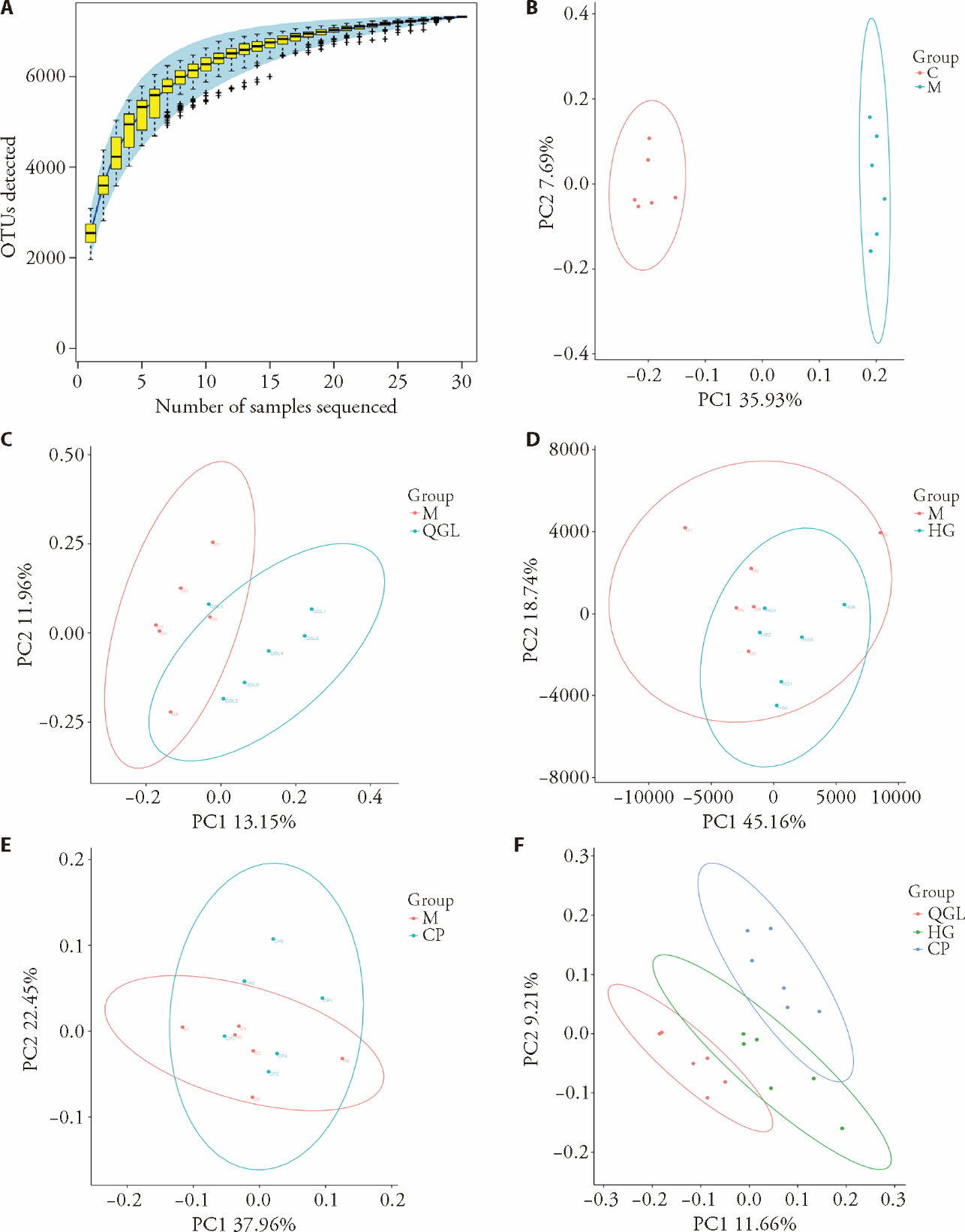
Figure 2 Effect of QG on gut microbiota community in HLP rats A: rarefaction curve; B: C vs M group ( F = 5.5535, R2 = 0.35706, P = 0.005, unweighted_unifrac PcoA plot); C: M vs QG group (F = 1.4852, R2 = 0.12931, P = 0.003, unweighted_unifrac PcoA plot); D: M vs HG group (F = 1.9699, R2 = 0.16457, P = 0.075, euclidean_nolabel PcoA plot); E: M vs CP group (F = 1.1746, R2 = 0.10511, P = 0.278, weighted_unifrac PcoA plot); F: M vs HG vs CP group (F = 1.6581, R2 = 0.18105, P = 0.001, unweighted_unifrac PcoA plot); C: normal control (fed by normal chow diet); M: model group (fed by HFHCD); QGL: QG group (5 g/kg QG + HFHCD); HG: HG group (4.5 g/kg HG + HFHCD); CP: CP group (0.5 g/kg CP + HFHCD). HLP: hyperlipidemic; C: control; M: model; QG: Qige decoction; HG: Huangqi-Gegen decoction; CP: Chenpi decoction; HFHCD: high-fat high-cholesterol diet. Variables did not conform to the normal distributions and variance homogeneity, Kruskal-Wallis was used to evaluate the statistical significance of Chao1, PD, and Shannon index. All data are expressed as the mean ± standard deviation (n = 6).
Figure 2 Effect of QG on gut microbiota community in HLP rats A: rarefaction curve; B: C vs M group ( F = 5.5535, R2 = 0.35706, P = 0.005, unweighted_unifrac PcoA plot); C: M vs QG group (F = 1.4852, R2 = 0.12931, P = 0.003, unweighted_unifrac PcoA plot); D: M vs HG group (F = 1.9699, R2 = 0.16457, P = 0.075, euclidean_nolabel PcoA plot); E: M vs CP group (F = 1.1746, R2 = 0.10511, P = 0.278, weighted_unifrac PcoA plot); F: M vs HG vs CP group (F = 1.6581, R2 = 0.18105, P = 0.001, unweighted_unifrac PcoA plot); C: normal control (fed by normal chow diet); M: model group (fed by HFHCD); QGL: QG group (5 g/kg QG + HFHCD); HG: HG group (4.5 g/kg HG + HFHCD); CP: CP group (0.5 g/kg CP + HFHCD). HLP: hyperlipidemic; C: control; M: model; QG: Qige decoction; HG: Huangqi-Gegen decoction; CP: Chenpi decoction; HFHCD: high-fat high-cholesterol diet. Variables did not conform to the normal distributions and variance homogeneity, Kruskal-Wallis was used to evaluate the statistical significance of Chao1, PD, and Shannon index. All data are expressed as the mean ± standard deviation (n = 6).
Table 2 Effect of QG on relative abundances of microbes at the phylum levels and the F/B ratio in HLP rats ($\bar{x}±s$)
| Bacterium and F/B ratio | CON (n = 6) | MOD (n = 6) | QG (n = 6) | HG (n = 6) | CP (n = 6) |
|---|---|---|---|---|---|
| Firmicutes | 0.3980±0.1134 | 0.3122±0.0851 | 0.2868±0.0956 | 0.2858±0.0852 | 0.3775±0.0809 |
| Bacteroidetes | 0.5255±0.1327 | 0.5314±0.0878 | 0.5844±0.1029 | 0.5861±0.0985 | 0.5101±0.0683 |
| Actinobacteria | 0.0108±0.0007a | 0.0495±0.0183 | 0.0296±0.0057a | 0.0384±0.0111 | 0.0484±0.0132c |
| Gemmatimonadetes | 0.0019±0.0002b | 0.0025±0.0005 | 0.0019±0.0002b | 0.0014±0.0003a | 0.0010±0.0002a |
| F/B ratio | 0.8463±0.4340 | 0.6270±0.2913 | 0.5280±0.2548 | 0.5223±0.2483 | 0.7686±0.2645 |
Table 3 Effect of QG on relative abundances of microbes at the genus levels in HLP rats (%,$\bar{x}±s$)
| Bacterium | CON (n = 6) | MOD (n = 6) | QG (n = 6) | HG (n = 6) | CP (n = 6) |
|---|---|---|---|---|---|
| Collinsella | 0.0356±0.0273a | 3.7961±1.7565 | 1.5633±0.4499c | 2.9817±1.0998d | 3.9656±1.4132f |
| Ruminococcaceae_UCG-005 | 1.4229±1.2446b | 0.1089±0.0546 | 0.2856±0.1867b | 0.2719±0.2306 | 0.3326±0.2971 |
| Turicibacter | 0.2347±0.1542b | 0.0509±0.0902 | 0.2229±0.1962b | 0.1195±0.1223 | 0.0456±0.0794d |
| Escherichia-Shigella | 0.0943±0.0123b | 0.1347±0.0383 | 0.0754±0.0143c | 0.0747±0.0339b | 0.0576±0.0147c |
| Intestinimonas | 0.4558±0.2121c | 0.0826±0.0574 | 0.2052±0.1202c | 0.0765±0.0495c | 0.1233±0.0768c |
| Allisonella | 0.0009±0.0011a | 0.1477±0.0536 | 0.0769±0.0528b | 0.0918±0.0257b | 0.1254±0.0747 |
| [Eubacterium]_hallii_group | 0.0019±0.0023b | 0.2395±0.2461 | 0.0543±0.0303c | 0.1399±0.1337 | 0.2160±0.1104f |
| Phocea | 0.0010±0.0020a | 0.0667±0.0295 | 0.1187±0.0237c | 0.1061±0.0382 | 0.0875±0.0486 |
| Flavobacterium | 0.0036±0.0014b | 0.0019±0.0015 | 0.0173±0.0045a | 0.0025±0.0011e | 0.0016±0.0006e |
| Staphylococcus | 0.0000±0.0000a | 0.0049±0.0031 | 0.0010±0.0012c | 0.0039±0.0019d | 0.0067±0.0068 |
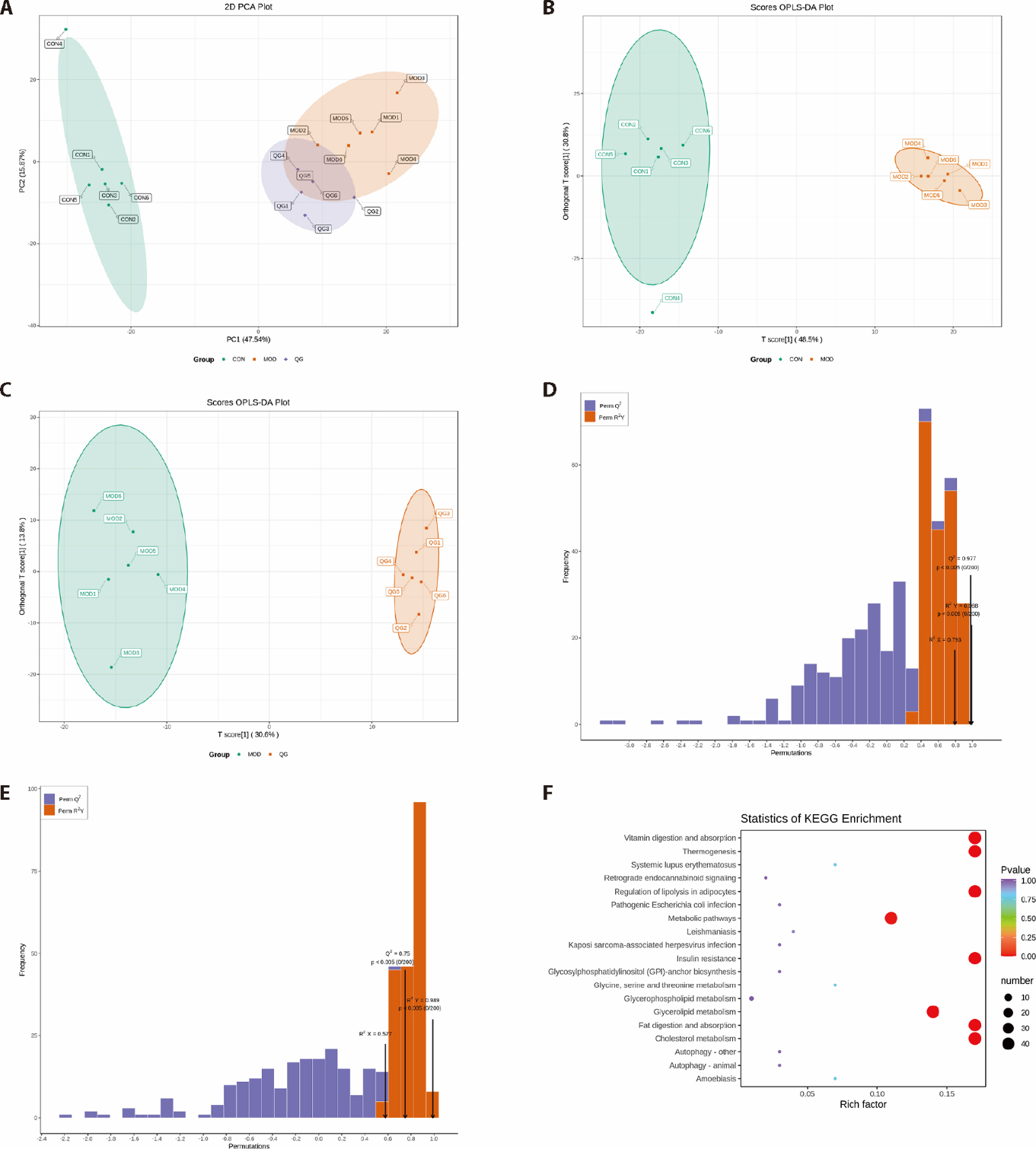
Figure 3 Scores plots of PCOA, OPLS-permutation, and related pathway between CON, MOD, and QG groups (n = 6) A: scores plots of PCA between CON, MOD, and QG groups; B: scores plots of PCOA between CON and MOD groups; C: scores plots of PCOA between MOD and QG groups; D: scores plots of OPLS-permutation between CON and MOD groups; E: scores plots of OPLS-Permutation between MOD and QG groups; F: summary of pathway analysis of liver samples. CON: normal control (fed by normal chow diet); MOD: model group (fed by HFHCD); QG: QG group (5 g/kg QG + HFHCD); CON: control; MOD: model; QG: Qige decoction; HG: Huangqi-Gegen decoction; CP: Chenpi decoction; HFHCD: high-fat high-cholesterol diet; PCOA: principal coordinate analysis; OPLS: orthogonal partial least squares; PCA: principal component analysis.
Figure 3 Scores plots of PCOA, OPLS-permutation, and related pathway between CON, MOD, and QG groups (n = 6) A: scores plots of PCA between CON, MOD, and QG groups; B: scores plots of PCOA between CON and MOD groups; C: scores plots of PCOA between MOD and QG groups; D: scores plots of OPLS-permutation between CON and MOD groups; E: scores plots of OPLS-Permutation between MOD and QG groups; F: summary of pathway analysis of liver samples. CON: normal control (fed by normal chow diet); MOD: model group (fed by HFHCD); QG: QG group (5 g/kg QG + HFHCD); CON: control; MOD: model; QG: Qige decoction; HG: Huangqi-Gegen decoction; CP: Chenpi decoction; HFHCD: high-fat high-cholesterol diet; PCOA: principal coordinate analysis; OPLS: orthogonal partial least squares; PCA: principal component analysis.
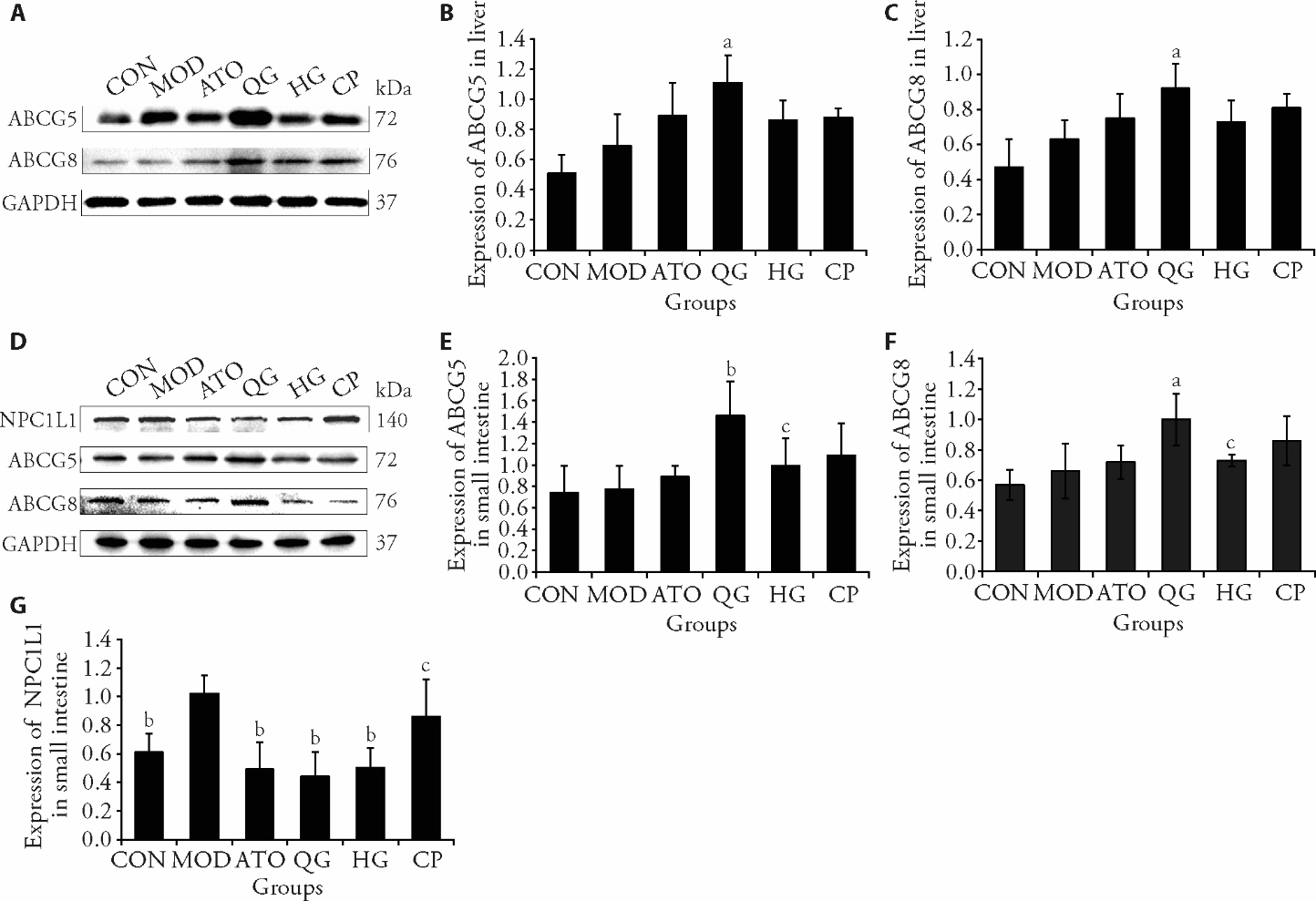
Figure 4 Effect of QG on the expression of NPC1L1, ABCG5, and ABCG8 proteins in HLP rats A: representative Western blot image of liver ABCG5, and ABCG8 proteins; B and C: relative expression level of liver ABCG5 (B) and ABCG8 (C); D: representative Western blot image of small intestine NPC1L1, ABCG5, and ABCG8 proteins; E-G: relative expression level of small intestine ABCG5 (E), ABCG8 (F), and NPC1L1 (G). CON: normal control (fed by normal chow diet); MOD: model group (fed by HFHCD); ATO: atorvastatin group (5 mg/kg atorvastatin+HFHCD); QG: QG group (5 g/kg QG + HFHCD); HG: HG group (4.5 g/kg HG + HFHCD); CP: CP group (0.5 g/kg CP + HFHCD). HLP: hyperlipidemic; CON: control; MOD: model; ATO: atorvastatin; QG: Qige decoction; HG: Huangqi-Gegen decoction; CP: Chenpi decoction; TG: triglycerides; TC: total cholesterol; LDL-C: low-density lipoprotein cholesterol; HDL-C: high-density lipoprotein cholesterol; HFHCD: high-fat high-cholesterol diet. NPC1L1: Niemann-Pick C1-like 1; ABCG5: ATP-binding cassette G5; ABCG8: ATP-binding cassette G8. Variables did not conform to the normal distributions and variance homogeneity, Kruskal-Wallis was used to evaluate the statistical significance of NPC1L1, ABCG5, and ABCG8 proteins. All data are expressed as the mean±standard deviation (n = 3); aP < 0.05 and bP < 0.01, compared to the MOD group; cP < 0.05, compared to the QG group.
Figure 4 Effect of QG on the expression of NPC1L1, ABCG5, and ABCG8 proteins in HLP rats A: representative Western blot image of liver ABCG5, and ABCG8 proteins; B and C: relative expression level of liver ABCG5 (B) and ABCG8 (C); D: representative Western blot image of small intestine NPC1L1, ABCG5, and ABCG8 proteins; E-G: relative expression level of small intestine ABCG5 (E), ABCG8 (F), and NPC1L1 (G). CON: normal control (fed by normal chow diet); MOD: model group (fed by HFHCD); ATO: atorvastatin group (5 mg/kg atorvastatin+HFHCD); QG: QG group (5 g/kg QG + HFHCD); HG: HG group (4.5 g/kg HG + HFHCD); CP: CP group (0.5 g/kg CP + HFHCD). HLP: hyperlipidemic; CON: control; MOD: model; ATO: atorvastatin; QG: Qige decoction; HG: Huangqi-Gegen decoction; CP: Chenpi decoction; TG: triglycerides; TC: total cholesterol; LDL-C: low-density lipoprotein cholesterol; HDL-C: high-density lipoprotein cholesterol; HFHCD: high-fat high-cholesterol diet. NPC1L1: Niemann-Pick C1-like 1; ABCG5: ATP-binding cassette G5; ABCG8: ATP-binding cassette G8. Variables did not conform to the normal distributions and variance homogeneity, Kruskal-Wallis was used to evaluate the statistical significance of NPC1L1, ABCG5, and ABCG8 proteins. All data are expressed as the mean±standard deviation (n = 3); aP < 0.05 and bP < 0.01, compared to the MOD group; cP < 0.05, compared to the QG group.
| [1] | Global, regional, and national incidence, prevalence, and years lived with disability for 354 diseases and injuries for 195 countries and territories, 1990-2017: a systematic analysis for the Global Burden of Disease Study 2017. Lancet 2018; 392: 1789-858. |
| [2] | Liu M, Marinacci LX, Joynt Maddox KE, Wadhera RK. Cardiovascular health among rural and urban us adults-healthcare, lifestyle, and social factors. JAMA Cardiol 2025; 10: 585-94. |
| [3] | You M, Zhou L, Wu F, Zhang L, Zhu SX, Zhang HX. Probiotics for the treatment of hyperlipidemia: Focus on gut-liver axis and lipid metabolism. Pharmacol Res 2025; 214: 107694. |
| [4] | Li J, Chen Y, Li S, et al. NAFPD exacerbation by hyperlipidemia combined with hyperuricemia: a pilot rat experiment in lipidomics. Front Nutr 2024; 11: 1437373. |
| [5] | Parham JS, Goldberg AC. Review of recent clinical trials and their impact on the treatment of hypercholesterolemia. Prog Cardiovasc Dis 2022; 75: 90-6. |
| [6] | Fan Q, Xu F, Liang B, Zou X. The anti-obesity effect of Traditional Chinese Medicine on lipid metabolism. Frontiers in pharmacology 2021; 12: 696603. |
| [7] | Li YC (Qing dynasty). Zheng Zhi Hui Bu. Beijing: People's medical publishing house, 2006: 71. |
| [8] | Zhou ZM, Tan MA, Peng C, et al. Impact of Huangqi Gegen formula on lipid metabolism and oxidative stress in hyperlipidemia rats. Zhong Guo Zhong Xi Yi Jie He Za Zhi 2022; 42: 195-201. |
| [9] | Choi DJ, Kim SC, Park GE, et al. Protective effect of a mixture of astragalus membranaceus and lithospermum erythrorhizon extract against hepatic steatosis in high fat diet-induced nonalcoholic fatty liver disease mice. Evid Based Complement Alternat Med 2020; 2020: 8370698. |
| [10] | Lei Y, Zhang R, Li Y, et al. Pueraria radix and its major constituents against metabolic diseases: pharmacological mechanisms and potential applications. Phytother Res 2025; 39: 5521-50. |
| [11] | Carvalho BMR, Nascimento LC, Nascimento JC, et al. Citrus extract as a perspective for the control of dyslipidemia: a systematic review with Meta-analysis from animal models to human studies. Front Pharmacol 2022; 13: 822678. |
| [12] | Peng C, Zhou ZM, Li J, et al. CCl(4)-induced liver injury was ameliorated by qige decoction through the antioxidant pathway. Evid Based Complement Alternat Med 2019; 2019: 5941263. |
| [13] | Fan S, Yu X, Li Y, et al. Combining lipidomics and efficacy-oriented compatibility revealed that Qige decoction compatibility improved lipid metabolism in hyperlipidemic rats. Biomed Chromatogr 2023; 37: e5595. |
| [14] | Zhai YJ, Wang XX, Wang X, Dou YJ, Xu YY, Li YB. Research progress on indirect action and mechanism of Traditional Chinese Medicine based on gut-gut microbiota-target organ talks. Zhong Guo Zhong Yao Za Zhi 2024; 49: 5977-87. |
| [15] | Lin T, Lu C, Lai W, et al. Role of gut microbiota in identification of novel TCM-derived active metabolites. Protein Cell 2021; 12: 394-410. |
| [16] | Chen ZY, Wei XY, Qiu ZD, et al. Compatibility of Fuzi and Ginseng significantly increase the exposure of aconitines. Front Pharmacol 2022; 13: 883898. |
| [17] | He L, Yao D, Wang L, Zhang L, Bai X. Gut microbiome-mediated alteration of immunity, inflammation, and metabolism involved in the regulation of non-alcoholic fatty liver disease. Front Microbiol 2021; 12: 761836. |
| [18] | Lensu S, Pekkala S. Gut microbiota, microbial metabolites and human physical performance. Metabolites 2021; 11: 716. |
| [19] | Carter J, Bhattacharya D, Borgerding J, Fiel M, Faith J, Friedman S. Modeling dysbiosis of human NASH in mice: loss of gut microbiome diversity and overgrowth of erysipelotrichales. PLoS One 2021; 16: e0244763. |
| [20] | Crovesy L, Masterson D, Rosado EL. Profile of the gut microbiota of adults with obesity: a systematic review. Eur J Clin Nutr 2020; 74: 1251-62. |
| [21] | Wu L, Park SH, Kim H. Direct and indirect evidence of effects of Bacteroides spp. on obesity and inflammation. Int J Mol Sci 2023; 25: 438. |
| [22] | Stojanov S, Berlec A, Štrukelj B. The influence of probiotics on the Firmicutes/Bacteroidetes ratio in the treatment of obesity and inflammatory bowel disease. Microorganisms 2020; 8: 1715. |
| [23] | Ley R, Bäckhed F, Turnbaugh P, Lozupone C, Knight R, Gordon J. Obesity alters gut microbial ecology. Proc Natl Acad Sci USA 2005; 102: 11070-5. |
| [24] | Thingholm L, Rühlemann M, Koch M, et al. Obese individuals with and without type 2 diabetes show different gut microbial functional capacity and composition. Cell Host Microbe 2019; 26: 252-64.e10. |
| [25] | Sun M, Wu T, Zhang G, et al. Lactobacillus rhamnosus LRa05 improves lipid accumulation in mice fed with a high fat diet regulating the intestinal microbiota, reducing glucose content and promoting liver carbohydrate metabolism. Food Funct 2020; 11: 9514-25. |
| [26] | Rodriguez-Diaz C, Taminiau B, García-García A, et al. Microbiota diversity in nonalcoholic fatty liver disease and in drug-induced liver injury. Pharmacol Res 2022; 182: 106348. |
| [27] | Cheung GYC, Bae J S, Otto M. Pathogenicity and virulence of Staphylococcus aureus. Virulence 2021; 12: 547-69. |
| [28] | Astbury S, Atallah E, Vijay A, Aithal GP, Grove JI, Valdes AM. Lower gut microbiome diversity and higher abundance of proinflammatory genus Collinsella are associated with biopsy-proven nonalcoholic steatohepatitis. Gut Microbes 2020; 11: 569-80. |
| [29] | Geng X, Tian W, Zhuang M, Shang H, Gong Z, Li J. Green radish polysaccharides ameliorate hyperlipidemia in high-fat-diet-induced mice via short-chain fatty acids production and gut microbiota regulation. Foods 2024; 13: 4113. |
| [30] | Chen H, Mo P, Xu G. Potential function of hepatic Niemann-Pick C1-like 1: cholesterol homeostasis regulation of the canalicular lipid bilayer membrane. Gastroenterol Rep (Oxf) 2025; 13: goaf010. |
| [31] | Xiao J, Dong LW, Liu S, et al. Bile acids-mediated intracellular cholesterol transport promotes intestinal cholesterol absorption and NPC1L 1 recycling. Nat Commun 2023; 14: 6469. |
| [32] | Bydlowski SP, Levy D. Association of ABCG5 and ABCG8 transporters with sitosterolemia. Adv Exp Med Biol 2024; 1440: 31-42. |
| [33] | Zhang S, Xu L, Zhu C, et al. Lactobacillus fermentum 166, derived from yak yogurt from tibetan areas of sichuan, improves high-fat- diet-induced hyperlipidemia by modulating gut microbiota and liver- and gut-related pathways. Foods 2025; 14: 867. |
| [34] | Haghikia A, Zimmermann F, Schumann P, et al. Propionate attenuates atherosclerosis by immune-dependent regulation of intestinal cholesterol metabolism. Eur Heart J 2022; 43: 518-33. |
| [35] | Hu H, Shao W, Liu Q, et al. Gut microbiota promotes cholesterol gallstone formation by modulating bile acid composition and biliary cholesterol secretion. Nat Commun 2022; 13: 252. |
| [1] | WANG Xiumin, LÜ Lixia, LI Jianghua, CHEN Jilan, TAN Cailin, DING Weijun. Therapeutic efficacy of Jichuan decoction (济川煎) in slow-transit constipation: focus on gut microbiota modulation [J]. Journal of Traditional Chinese Medicine, 2026, 46(3): 544-551. |
| [2] | REN Zonghao, YUE Rensong. Validating the potential mechanism and therapeutic effect of Qinlian Jiangxia decoction (芩连姜夏汤) in the treatment of type 2 diabetes mellitus complicated with hyperlipidemia through network pharmacology, molecular docking, molecular dynamics simulation, and in vivo experiments [J]. Journal of Traditional Chinese Medicine, 2026, 46(1): 127-137. |
| [3] | SONG Tianli, LI Haixia, LIU Li'an. Clinical observation of white eye distribution in patients with hyperlipidemia: an artificial intelligence digital visual examination technique [J]. Journal of Traditional Chinese Medicine, 2025, 45(5): 1135-1143. |
| [4] | HU Huiming, WENG Jiajun, TANG Fangrui, WANG Yaqi, FAN Shengxian, WANG Xuecheng, CUI Can, SHAO Feng, ZHU Yanchen. Hypolipidemic effect and mechanism of Hedan tablet (荷丹片) based on network pharmacology [J]. Journal of Traditional Chinese Medicine, 2025, 45(2): 408-421. |
| [5] | ZHANG Jiri Mutu, LIANG Shilong, NIE Peng, LIAO Yong’an, AI Qinying, YAN Xiaojun, LIU Hongning, JI Yanhua, ZENG Zhijun. Efficacy of Kushen decoction (苦参汤) on high-fat-diet-induced hyperlipidemia in rats [J]. Journal of Traditional Chinese Medicine, 2022, 42(3): 364-371. |
| [6] | CHEN Benjian, HUANG Xiaodan, PENG Huiting, LI Yishi, CAO Yongtao, WU Huanlin, XU Danping. Effectiveness and safety of red yeast rice predominated by monacolin K β-hydroxy acid form for hyperlipidemia treatment and management [J]. Journal of Traditional Chinese Medicine, 2022, 42(2): 264-271. |
| [7] | Sun Chen, Wang Li, Sun Jing, Wang Zheng, Tang Zhishu. Hypoglycemic and hypolipidemic effects of rutin on hyperglycemic rats [J]. Journal of Traditional Chinese Medicine, 2020, 40(4): 640-645. |
| [8] | Se-Eun Lee, Hyungwoo Kim, Chang-Hyun Kim, Chiyeon Lim, Suin Cho. Effect of methanol extract of Schisandrae Fructus on high fat diet induced hyperlipidemic mice [J]. Journal of Traditional Chinese Medicine, 2019, 39(06): 818-825. |
| [9] | Wonseok Chung, Jimi Ryu, Seokhee Chung, Sungsoo Kim. Effect of Qingxue Dan on obesity and metabolic biomarker: a double-blind randomized-controlled pilot study [J]. Journal of Traditional Chinese Medicine, 2016, 36(03): 291-298. |
| [10] | Yao Haiqiang, Zhang Zengliang, Wang Ji, Zuo Jiacheng, Chen Yu, Zhu Libing, Li Xiaoke, Yang Zheng, Wang Zisong, Sun Ranran, Xu Xuanxuan, Li Changming, Wu Yanling, Li Lingru, Wang Qi. Efficacy and safety of Yinchenwuling powder for hyperlipidemia: a systematic review and Meta-analysis [J]. Journal of Traditional Chinese Medicine, 2016, 36(02): 135-143. |
| [11] | Wang Yuanyuan, Jin Minghua, Zhang Lina, Li Suhua, Zhai Jiayu, Shen Yongzhi, Chen Chunyu, Qin Jian. Effect of a combination of calorie-restriction therapy and Lingguizhugan decoction on levels of fasting blood lipid and inflammatory cytokines in a high-fat diet induced hyperlipidemia rat model [J]. Journal of Traditional Chinese Medicine, 2015, 35(02): 218-221. |
| [12] | Jiangquan Liao, Jiaxing Tian, Tengfei Li, Weijiang Song, Weihan Zhao, Jinhang Du. Xuefuzhuyu decoction for hyperlipidemia: a systematic review and Meta-analysis of randomized clinical trails [J]. Journal of Traditional Chinese Medicine, 2014, 34(04): 411-418. |
| [13] | Xianfeng Ye, Huifang Zhang. Influence of moxibustion temperatures on blood lipids, endothelin-1, and nitric oxide in hyperlipidemia patients [J]. Journal of Traditional Chinese Medicine, 2013, 33(05): 592-596. |
| [14] | Xichao Xia, Yuhong Ma, Xiankun Xing, Chuanfeng Huang, Ling Li, Gaixia Gui, Qingchun Liu, Shipeng Xue. Antioxidant and hepatoprotective effect of different extracts of Guizhencao (Herba Bidentis Bipinnatae) against liver injury in hyperlipidemia rats [J]. Journal of Traditional Chinese Medicine, 2013, 33(04): 518-523. |
| [15] | Yubin Yang, Jian Qin, Bin Ke, Junjie Zhang, Lanying Shi, Qiong Li. Effect of Linguizhugan decoction on hyperlipidemia rats with intermittent fasting [J]. Journal of Traditional Chinese Medicine, 2013, 33(02): 250-252. |
| Viewed | ||||||
|
Full text |
|
|||||
|
Abstract |
|
|||||