
Journal of Traditional Chinese Medicine ›› 2026, Vol. 46 ›› Issue (5): 1072-1081.DOI: 10.19852/j.cnki.jtcm.2026.05.002
• Original Articles • Previous Articles Next Articles
Hongqu (Ultivarietas Oryzae Sativae et Monasci) attenuates non-alcoholic fatty liver disease progression by inhibiting lipogenesis and promoting fatty acid oxidation through regulating the adenosine 5'-monophosphate-activated protein kinase/sterol regulatory element-binding protein 1c signaling pathway
YAO Xingqin, WANG Haixia, WU Min, ZHANG Haibin, ZHANG Yili, WU Yuanfen, YANG Xiaojia( ), JIANG Meng()
Department of Pharmacy ,Hangzhou Hospital of Traditional Chinese Medicine Hangzhou 310007, China
-
Received:2025-05-13Accepted:2025-11-19Online:2026-10-15Published:2026-10-09 -
Contact:JIANG Meng, Department of Pharmacy, Hangzhou Hospital of Traditional Chinese Medicine, Hangzhou 310007, China. anna_sewell@163.com,Telephone: + 86-13989880942; YANG Xiaojia, Department of Pharmacy, Hangzhou Hospital of Traditional Chinese Medicine, Hangzhou 310007, China. yang86272388@163.com,Telephone: + 86-13989880942 -
Supported by:Zhejiang Province Traditional Chinese Medicine Science and Technology Project under Grant: Investigation of the Mechanism of Hongqu (Ultivarietas Oryzae Sativae et Monasci) in regulating Lipid Metabolic Disorders to Treat Nonalcoholic Fatty Liver Disease via the Adenosine 5'-Monophosphate-activated Protein Kinase/Sterol Regulatory Element-Binding Protein 1c Pathway(2024ZL657)

Cite this article
YAO Xingqin, WANG Haixia, WU Min, ZHANG Haibin, ZHANG Yili, WU Yuanfen, YANG Xiaojia, JIANG Meng. Hongqu (Ultivarietas Oryzae Sativae et Monasci) attenuates non-alcoholic fatty liver disease progression by inhibiting lipogenesis and promoting fatty acid oxidation through regulating the adenosine 5'-monophosphate-activated protein kinase/sterol regulatory element-binding protein 1c signaling pathway[J]. Journal of Traditional Chinese Medicine, 2026, 46(5): 1072-1081.
share this article

Figure 1 RYR treatment ameliorated pathological damage and lipid accumulation in NAFLD mice A: observation of liver histomorphology, n = 6; B: assessment of liver weight, n = 6; C: detection of liver index, n = 6; D: representative photomicrographs of HE staining in liver tissues of mice, n = 3; E: representative photomicrographs of oil red O staining in mouse liver tissues, n = 3; F: lipid deposition in mouse liver tissues was assessed using oil red O staining, n = 3; D1-D5, E1-E5: × 200, scale bar: 100 μm; D6-D10, E6-E10: × 400, scale bar: 50 μm; A1, D1, D6, E1, E6: sham group; A2, D2, D7, E2, E7: NAFLD group; A3, D3, D8, E3, E8: NAFLD + RYR-L group; A4, D4, D9, E4, E9: NAFLD + RYR-H group; A5, D5, D10, E5, E10: NAFLD + Silymarin group. Sham group: mice were fed with control diet for 12 weeks and 0.2 mL of 0.5% CMC-Na was gavaged once daily; NAFLD group: mice were fed with HFD (60% fat, 20% carbohydrate, 20% protein) for 12 weeks and 0.2 mL of 0.5% CMC-Na was gavaged once daily; NAFLD + RYR-L group: mice were fed with HFD for 12 weeks and low dose of RYR (150 mg/kg, which was dissolved in 0.2 mL of 0.5% CMC-Na) was gavaged once daily; NAFLD + RYR-H group: mice were fed with HFD for 12 weeks and high dose of RYR (300 mg/kg) was gavaged once daily; NAFLD + Silymarin group: mice were fed with HFD for 12 weeks and silymarin (200 mg/kg, which was dissolved in 0.2 mL of 0.5% CMC-Na) was gavaged once daily. RYR: red yeast rice; NAFLD: non-alcoholic fatty liver disease; HFD: high-fat diet; HE: hematoxylin and eosin. Results were presented as the mean ± standard deviation. Statistical analyses were measured by using one-way analysis of variance. aP < 0.01 vs Sham group; bP < 0.05 and cP < 0.01 vs NAFLD group.
Figure 1 RYR treatment ameliorated pathological damage and lipid accumulation in NAFLD mice A: observation of liver histomorphology, n = 6; B: assessment of liver weight, n = 6; C: detection of liver index, n = 6; D: representative photomicrographs of HE staining in liver tissues of mice, n = 3; E: representative photomicrographs of oil red O staining in mouse liver tissues, n = 3; F: lipid deposition in mouse liver tissues was assessed using oil red O staining, n = 3; D1-D5, E1-E5: × 200, scale bar: 100 μm; D6-D10, E6-E10: × 400, scale bar: 50 μm; A1, D1, D6, E1, E6: sham group; A2, D2, D7, E2, E7: NAFLD group; A3, D3, D8, E3, E8: NAFLD + RYR-L group; A4, D4, D9, E4, E9: NAFLD + RYR-H group; A5, D5, D10, E5, E10: NAFLD + Silymarin group. Sham group: mice were fed with control diet for 12 weeks and 0.2 mL of 0.5% CMC-Na was gavaged once daily; NAFLD group: mice were fed with HFD (60% fat, 20% carbohydrate, 20% protein) for 12 weeks and 0.2 mL of 0.5% CMC-Na was gavaged once daily; NAFLD + RYR-L group: mice were fed with HFD for 12 weeks and low dose of RYR (150 mg/kg, which was dissolved in 0.2 mL of 0.5% CMC-Na) was gavaged once daily; NAFLD + RYR-H group: mice were fed with HFD for 12 weeks and high dose of RYR (300 mg/kg) was gavaged once daily; NAFLD + Silymarin group: mice were fed with HFD for 12 weeks and silymarin (200 mg/kg, which was dissolved in 0.2 mL of 0.5% CMC-Na) was gavaged once daily. RYR: red yeast rice; NAFLD: non-alcoholic fatty liver disease; HFD: high-fat diet; HE: hematoxylin and eosin. Results were presented as the mean ± standard deviation. Statistical analyses were measured by using one-way analysis of variance. aP < 0.01 vs Sham group; bP < 0.05 and cP < 0.01 vs NAFLD group.
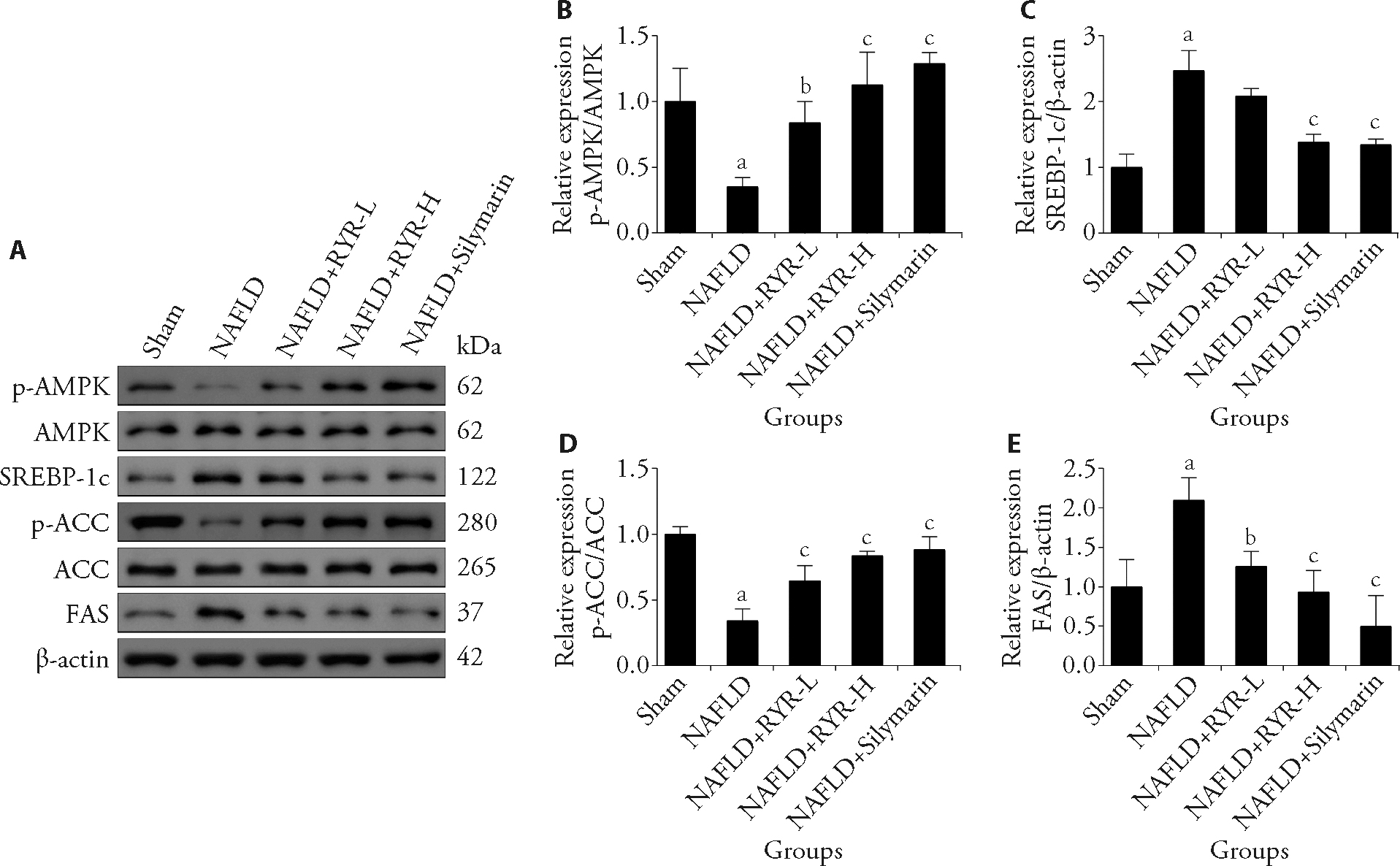
Figure 2 RYR treatment alleviated lipid metabolism disorder by modulating the AMPK/SREBP-1c pathway in NAFLD mice A: representative Western blot of p-AMPK/AMPK, SREBP-1c, p-ACC/ACC, and FAS protein expression; B: changes in p-AMPK/AMPK expression; C: changes in SREBP-1c expression; D: changes in p-ACC/ACC expression; E: changes in FAS expression. Sham group: mice were fed with control diet for 12 weeks and 0.2 mL of 0.5% CMC-Na was gavaged once daily; NAFLD group: mice were fed with HFD (60% fat, 20% carbohydrate, 20% protein) for 12 weeks and 0.2 mL of 0.5% CMC-Na was gavaged once daily; NAFLD + RYR-L group: mice were fed with HFD for 12 weeks and low dose of RYR (150 mg/kg, which was dissolved in 0.2 mL of 0.5% CMC-Na) was gavaged once daily; NAFLD + RYR-H group: mice were fed with HFD for 12 weeks and high dose of RYR (300 mg/kg) was gavaged once daily; NAFLD + Silymarin group: mice were fed with HFD for 12 weeks and silymarin (200 mg/kg, which was dissolved in 0.2 mL of 0.5% CMC-Na) was gavaged once daily. RYR: red yeast rice; NAFLD: non-alcoholic fatty liver disease; HFD: high-fat diet; AMPK: adenosine 5'-monophosphate-activated protein kinase; SREBP-1c: sterol regulatory element-binding protein 1c; FAS: fatty acid synthase; ACC: acetyl-CoA carboxylase. Results were presented as the mean ± standard deviation (n = 3). Statistical analyses were measured by using one-way analysis of variance. aP < 0.01 vs Sham group; bP < 0.05 and cP < 0.01 vs NAFLD group.
Figure 2 RYR treatment alleviated lipid metabolism disorder by modulating the AMPK/SREBP-1c pathway in NAFLD mice A: representative Western blot of p-AMPK/AMPK, SREBP-1c, p-ACC/ACC, and FAS protein expression; B: changes in p-AMPK/AMPK expression; C: changes in SREBP-1c expression; D: changes in p-ACC/ACC expression; E: changes in FAS expression. Sham group: mice were fed with control diet for 12 weeks and 0.2 mL of 0.5% CMC-Na was gavaged once daily; NAFLD group: mice were fed with HFD (60% fat, 20% carbohydrate, 20% protein) for 12 weeks and 0.2 mL of 0.5% CMC-Na was gavaged once daily; NAFLD + RYR-L group: mice were fed with HFD for 12 weeks and low dose of RYR (150 mg/kg, which was dissolved in 0.2 mL of 0.5% CMC-Na) was gavaged once daily; NAFLD + RYR-H group: mice were fed with HFD for 12 weeks and high dose of RYR (300 mg/kg) was gavaged once daily; NAFLD + Silymarin group: mice were fed with HFD for 12 weeks and silymarin (200 mg/kg, which was dissolved in 0.2 mL of 0.5% CMC-Na) was gavaged once daily. RYR: red yeast rice; NAFLD: non-alcoholic fatty liver disease; HFD: high-fat diet; AMPK: adenosine 5'-monophosphate-activated protein kinase; SREBP-1c: sterol regulatory element-binding protein 1c; FAS: fatty acid synthase; ACC: acetyl-CoA carboxylase. Results were presented as the mean ± standard deviation (n = 3). Statistical analyses were measured by using one-way analysis of variance. aP < 0.01 vs Sham group; bP < 0.05 and cP < 0.01 vs NAFLD group.

Figure 3 RYR treatment inhibited lipid accumulation and apoptosis in THLE-2 cells A: determination of TC content, n = 6; B: determination of TG content, n = 6; C: representative photomicrographs of oil red O staining in THLE-2 cells, n = 3; D: lipid deposition in THLE-2 cells was assessed using oil red O staining, n = 3; E: detection of apoptosis was performed by flow cytometry assay, n = 3; F: changes of apoptosis rates, n = 3; C1-C4: magnification × 200, scale bar: 100 μm; C5-C7: magnification × 400, scale bar: 50 μm; C1, C5, E1: Control group; C2, C6, E2: OA group; C3, C7, E3: OA+RYR group; C4, C8, E4: OA + RYR + Compound C group. Control group: basal medium; OA group: THLE-2 cells were treated with 0.2 mM OA for 24 h; OA+RYR group: THLE-2 cells were treated with 0.2 mM OA for 24 h and subsequent 674 µg/mL of RYR for 24 h; OA + RYR + Compound C group: THLE-2 cells were cultured with 1 mM of Compound C for 0.5 h, 0.2 mM OA for 24 h and subsequent 674 µg/mL of RYR for 24 h. RYR: red yeast rice; THLE-2: normal human liver epithelial cell line; OA: oleic acid; TC: total cholesterol; TG: triglyceride. Results were presented as the mean ± standard deviation. Statistical analyses were measured by using one-way analysis of variance. aP < 0.01 vs Control group; bP < 0.01 vs OA group; cP < 0.01 vs OA+RYR group; dP < 0.05 vs OA group.
Figure 3 RYR treatment inhibited lipid accumulation and apoptosis in THLE-2 cells A: determination of TC content, n = 6; B: determination of TG content, n = 6; C: representative photomicrographs of oil red O staining in THLE-2 cells, n = 3; D: lipid deposition in THLE-2 cells was assessed using oil red O staining, n = 3; E: detection of apoptosis was performed by flow cytometry assay, n = 3; F: changes of apoptosis rates, n = 3; C1-C4: magnification × 200, scale bar: 100 μm; C5-C7: magnification × 400, scale bar: 50 μm; C1, C5, E1: Control group; C2, C6, E2: OA group; C3, C7, E3: OA+RYR group; C4, C8, E4: OA + RYR + Compound C group. Control group: basal medium; OA group: THLE-2 cells were treated with 0.2 mM OA for 24 h; OA+RYR group: THLE-2 cells were treated with 0.2 mM OA for 24 h and subsequent 674 µg/mL of RYR for 24 h; OA + RYR + Compound C group: THLE-2 cells were cultured with 1 mM of Compound C for 0.5 h, 0.2 mM OA for 24 h and subsequent 674 µg/mL of RYR for 24 h. RYR: red yeast rice; THLE-2: normal human liver epithelial cell line; OA: oleic acid; TC: total cholesterol; TG: triglyceride. Results were presented as the mean ± standard deviation. Statistical analyses were measured by using one-way analysis of variance. aP < 0.01 vs Control group; bP < 0.01 vs OA group; cP < 0.01 vs OA+RYR group; dP < 0.05 vs OA group.
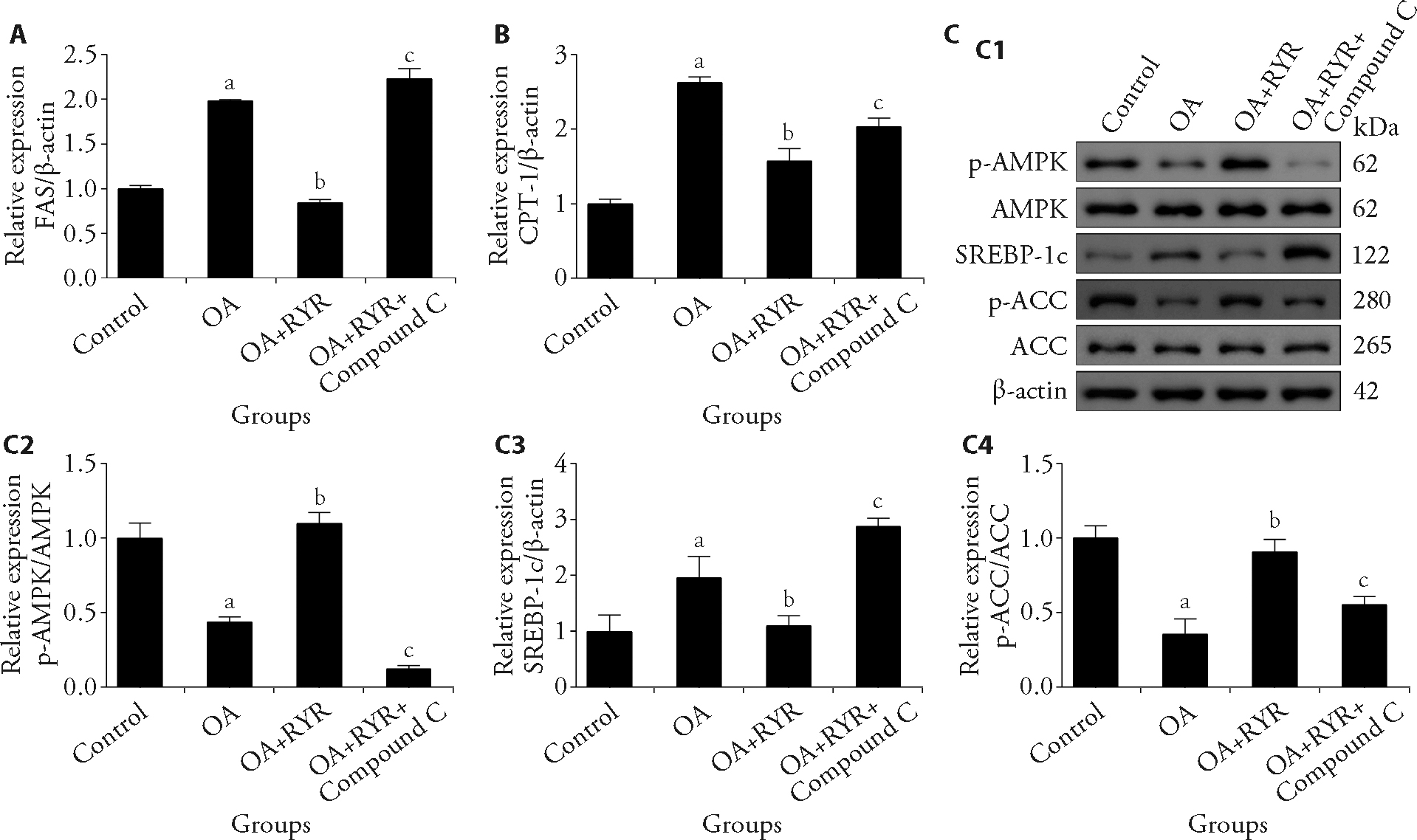
Figure 4 RYR treatment ameliorated lipid metabolism disorder by modulating the AMPK/SREBP-1c pathway in OA-treated THLE-2 cells A: assessment of FAS expression using qRT-PCR assay; B: assessment of CPT-1 mRNA expression using qRT-PCR assay; C: determination of p-AMPK/AMPK, SREBP-1c, and p-ACC/ACC protein expression in THLE-2 cells was conducted by Western blot assay; C1: representative Western blot of p-AMPK/AMPK, SREBP-1c, and p-ACC/ACC protein expression; C2: changes in p-AMPK/AMPK expression; C3: changes in SREBP-1c expression; C4: changes in p-ACC/ACC expression. Control group: basal medium; OA group: THLE-2 cells were treated with 0.2 mM OA for 24 h; OA+RYR group: THLE-2 cells were treated with 0.2 mM OA for 24 h and subsequent 674 µg/mL of RYR for 24 h; OA + RYR + Compound C group: THLE-2 cells were cultured with 1 mM of Compound C for 0.5 h, 0.2 mM OA for 24 h and subsequent 674 µg/mL of RYR for 24 h. RYR: red yeast rice; OA: oleic acid; AMPK: adenosine 5'-monophosphate-activated protein kinase; SREBP-1c: sterol regulatory element-binding protein 1c; THLE-2: normal human liver epithelial cell line; FAS: fatty acid synthase; qRT-PCR: quantitative real-time polymerase chain reaction; CPT-1: carnitine palmitoyl transferase 1; ACC: acetyl-CoA carboxylase. Results were presented as the mean ± standard deviation (n = 3). Statistical analyses were measured by using one-way analysis of variance. aP < 0.01 vs Control group; bP < 0.01 vs OA group; cP < 0.01 vs OA + RYR group.
Figure 4 RYR treatment ameliorated lipid metabolism disorder by modulating the AMPK/SREBP-1c pathway in OA-treated THLE-2 cells A: assessment of FAS expression using qRT-PCR assay; B: assessment of CPT-1 mRNA expression using qRT-PCR assay; C: determination of p-AMPK/AMPK, SREBP-1c, and p-ACC/ACC protein expression in THLE-2 cells was conducted by Western blot assay; C1: representative Western blot of p-AMPK/AMPK, SREBP-1c, and p-ACC/ACC protein expression; C2: changes in p-AMPK/AMPK expression; C3: changes in SREBP-1c expression; C4: changes in p-ACC/ACC expression. Control group: basal medium; OA group: THLE-2 cells were treated with 0.2 mM OA for 24 h; OA+RYR group: THLE-2 cells were treated with 0.2 mM OA for 24 h and subsequent 674 µg/mL of RYR for 24 h; OA + RYR + Compound C group: THLE-2 cells were cultured with 1 mM of Compound C for 0.5 h, 0.2 mM OA for 24 h and subsequent 674 µg/mL of RYR for 24 h. RYR: red yeast rice; OA: oleic acid; AMPK: adenosine 5'-monophosphate-activated protein kinase; SREBP-1c: sterol regulatory element-binding protein 1c; THLE-2: normal human liver epithelial cell line; FAS: fatty acid synthase; qRT-PCR: quantitative real-time polymerase chain reaction; CPT-1: carnitine palmitoyl transferase 1; ACC: acetyl-CoA carboxylase. Results were presented as the mean ± standard deviation (n = 3). Statistical analyses were measured by using one-way analysis of variance. aP < 0.01 vs Control group; bP < 0.01 vs OA group; cP < 0.01 vs OA + RYR group.
| [1] | Leow WQ, Chan AW, Mendoza PGL, Lo R, Yap K, Kim H. Non-alcoholic fatty liver disease: the pathologist's perspective. Clin Mol Hepatol 2023; 29: S302-18. |
| [2] | Guo X, Yin X, Liu Z, Wang J. Non-alcoholic fatty liver disease (NAFLD) pathogenesis and natural products for prevention and treatment. Int J Mol Sci 2022; 23: 15489 |
| [3] | Zhou F, Zhou J, Wang W, et al. Unexpected rapid increase in the burden of NAFLD in China from 2008 to 2018: a systematic review and meta-analysis. Hepatology 2019; 70: 1119-33. |
| [4] | Paternostro R, Trauner M. Current treatment of non-alcoholic fatty liver disease. J Intern Med 2022; 292: 190-204. |
| [5] | Geng Y, Faber KN, de Meijer VE, Blokzijl H, Moshage H. How does hepatic lipid accumulation lead to lipotoxicity in non-alcoholic fatty liver disease? Hepatol Int 2021; 15: 21-35. |
| [6] | Yang SJ, Ma YH, Bai ZX, et al. Intervention effect of Cigu Xiaozhi prescription (慈菇消脂方) on ceramide lipoapoptosis in non-alcoholic fatty liver disease. J Tradit Chin Med 2024; 44: 63-9. |
| [7] | Werlinger P, Nguyen HT, Gu M, Cho JH, Cheng J, Suh JW. Lactobacillus reuteri MJM60668 prevent progression of non-alcoholic fatty liver disease through anti-adipogenesis and anti-inflammatory pathway. Microorganisms 2022; 10: 2203. |
| [8] | Sun J, Chen C, Wang J. Artesunate inhibits lipid accumulation and inflammation by regulating the NLRP3 inflammasome in nonalcoholic fatty liver disease. Discov Med 2024; 36: 385-92. |
| [9] | Yin X, Liu Z, Wang J. Tetrahydropalmatine ameliorates hepatic steatosis in nonalcoholic fatty liver disease by switching lipid metabolism via AMPK-SREBP-1c-Sirt1 signaling axis. Phytomedicine 2023; 119: 155005. |
| [10] | Liu X, Hu M, Ye C, et al. Isosilybin regulates lipogenesis and fatty acid oxidation via the AMPK/SREBP-1c/PPARα pathway. Chem Biol Interact 2022; 368: 110250. |
| [11] | Feng RB, Fan CL, Liu Q, et al. Crude triterpenoid saponins from Llex latifolia (Da Ye Dong Qing) ameliorate lipid accumulation by inhibiting srebp expression via activation of AMPK in a non-alcoholic fatty liver disease model. Chin Med 2015; 10: 23. |
| [12] | Ji L, Li Q, He Y, et al. Therapeutic potential of Traditional Chinese Medicine for the treatment of NAFLD: A promising drug Potentilla discolor bunge. Acta Pharm Sin B 2022; 12: 3529-47. |
| [13] | Cicero AFG, Fogacci F, Stoian AP, Toth PP. Red yeast rice for the improvement of lipid profiles in mild-to-moderate hypercholesterolemia: a narrative review. Nutrients 2023; 15: 2288. |
| [14] | Zhu B, Qi F, Wu J, et al. Red yeast rice: a systematic review of the traditional uses, chemistry, pharmacology, and quality control of an important Chinese folk medicine. Front Pharmacol 2019; 10: 1449. |
| [15] | Hu J, Wang J, Gan QX, et al. Impact of red yeast rice on metabolic diseases: a review of possible mechanisms of action. J Agric Food Chem 2020; 68: 10441-55. |
| [16] | Zhang W, Yang J, Liu J, et al. Red yeast rice prevents chronic alcohol-induced liver disease by attenuating oxidative stress and inflammatory response in mice. J Food Biochem 2021; 45: e13672. |
| [17] | Zou J, Yan C, Wan JB. Red yeast rice ameliorates non-alcoholic fatty liver disease through inhibiting lipid synthesis and nf-κb/ nlrp3 inflammasome-mediated hepatic inflammation in mice. Chin Med 2022; 17: 17. |
| [18] | Lai JR, Hsu YW, Pan TM, Lee CL. Monascin and ankaflavin of monascus purpureus prevent alcoholic liver disease through regulating AMPK-mediated lipid metabolism and enhancing both anti-inflammatory and anti-oxidative systems. Molecules 2021; 26: 6301. |
| [19] | Hao S, Ming L, Li Y, et al. Modulatory effect of camel milk on intestinal microbiota of mice with non-alcoholic fatty liver disease. Front Nutr 2022; 9: 1072133. |
| [20] | Ahn SH, Yang ES, Cho HR, Lee SO, Ha KT, Kim K. Herbal formulation MIT ameliorates high-fat diet-induced non-alcoholic fatty liver disease. Integr Med Res 2020; 9: 100422. |
| [21] | Wang L, Zhi Y, Ye Y, et al. Identify molecular mechanisms of Jiangzhi decoction on nonalcoholic fatty liver disease by network pharmacology analysis and experimental validation. Biomed Res Int 2020; 2020: 8829346. |
| [22] | Zhang X, Wu X, Hu H, Liu X, Kang Z, Deng X. Dt-010 exerts cardioprotective effects by regulating the crosstalk between the AMPK/PGC-1α pathway and ERp57. Cardiovasc Ther 2023; 2023: 8047752. |
| [23] | Liu Y, Fan Y, Liu J, Liu X, Li X, Hu J. Application and mechanism of Chinese herb medicine in the treatment of non-alcoholic fatty liver disease. Front Pharmacol 2024; 15: 1499602. |
| [24] | Khan TJ, Xu X, Xie X, et al. Tremella fuciformis crude polysaccharides attenuates steatosis and suppresses inflammation in diet-induced NAFLD mice. Curr Issues Mol Biol 2022; 44: 1224-34. |
| [25] | Gong Z, Han S, Li C, et al. Rhinacanthin C ameliorates insulin resistance and lipid accumulation in NAFLD mice via the AMPK/SIRT1 and SREBP-1c/FAS/ACC signaling pathways. Evid Based Complement Alternat Med 2023; 2023: 6603522. |
| [26] | Xie J, Chen X, Zheng M, Zhu J, Mao H. The metabolism of Coenzyme A and its derivatives plays a crucial role in diseases. Front Biosci (Landmark Ed) 2024; 29: 143. |
| [27] | Abo-Zaid OA, Moawed FS, Ismail ES, Farrag MA. Β-sitosterol attenuates high-fat diet-induced hepatic steatosis in rats by modulating lipid metabolism, inflammation and ER stress pathway. BMC Pharmacol Toxicol 2023; 24: 31. |
| [28] | Fan Y, Yan LT, Yao Z, Xiong GY. Biochanin A regulates cholesterol metabolism further delays the progression of nonalcoholic fatty liver disease. Diabetes Metab Syndr Obes 2021; 14: 3161-72. |
| [29] | Gou SH, Huang HF, Chen XY, et al. Lipid-lowering, hepatoprotective, and atheroprotective effects of the mixture Hong-qu and gypenosides in hyperlipidemia with NAFLD rats. J Chin Med Assoc 2016; 79: 111-21. |
| [30] | Chyau CC, Wang HF, Zhang WJ, et al. Antrodan alleviates high-fat and high-fructose diet-induced fatty liver disease in C57BL1/6 mice model via AMPK/Sirt1/SREBP-1c/PPARγ pathway. Int J Mol Sci 2020; 21. |
| [31] | Parlati L, Régnier M, Guillou H, Postic C. New targets for NAFLD. JHEP Rep 2021; 3: 100346. |
| [32] | Kim MH, Seong JB, Huh JW, Bae YC, Lee HS, Lee DS. Peroxiredoxin 5 ameliorates obesity-induced non-alcoholic fatty liver disease through the regulation of oxidative stress and AMP-activated protein kinase signaling. Redox Biol 2020; 28: 101315. |
| [33] | Fang C, Pan J, Qu N, et al. The AMPK pathway in fatty liver disease. Front Physiol 2022; 13: 970292. |
| [34] | Ge X, Wang C, Chen H, et al. Luteolin cooperated with metformin hydrochloride alleviates lipid metabolism disorders and optimizes intestinal flora compositions of high-fat diet mice. Food Funct 2020; 11: 10033-46. |
| [35] | Chang B, Bae J, Yun S, Kim Y, Park S, Kim S. Wheat sprouts (Triticum aestivum Linn.) cultured by a smart farm system ameliorate NAFLD through the AMPK-mediated SREBP signaling pathway. Food Sci Biotechnol 2023; 32: 1585-94. |
| [36] | Huang CH, Shiu SM, Wu MT, Chen WL, Wang SG, Lee HM. Monacolin K affects lipid metabolism through SIRT1/AMPK pathway in HepG2 cells. Arch Pharm Res 2013; 36: 1541-51. |
| [37] | Zhang X, Zhang J, Zhou Z, et al. Integrated network pharmacology, metabolomics, and transcriptomics of Huanglian-Hongqu herb pair in non-alcoholic fatty liver disease. J Ethnopharmacol 2024; 325: 117828. |
| [1] | LI Bingbing, DING Meiqi, CHEN Xiangying, LI Wenzhe, WEI Chao, YU Bin, MA Xiaona, SUN Xinhui. Shaofu Zhuyu decoction (少腹逐瘀汤) can inhibit the progression of endometriosis fibrosis through the transforming growth factor-β1/ smads signaling pathway mediated by 5’ adenosine monophosphate-activated protein kinase [J]. Journal of Traditional Chinese Medicine, 2026, 46(4): 809-820. |
| [2] | XU Mengjun, YAN Zixing, CHEN Xi, CAI Juanjuan, ZHANG Haiou, LIN Zhenwen. Hepatoprotection of Jianpi Qingre Lishi prescription (健脾清热利湿法) on non-alcoholic steatohepatitis via miRNA-27/peroxisome proliferator-activated receptor gamma axis [J]. Journal of Traditional Chinese Medicine, 2026, 46(3): 561-570. |
| [3] | JIANG Mingqian, WANG Tong, HUANG Bowei, QIU Chen, LIANG Yanbin, YE Binhua. Exploring the mechanism of the Lianshi Jianpi formula (莲实健脾方) in treating impaired glucose tolerance: a network pharmacology, molecular docking, and experimental validation study [J]. Journal of Traditional Chinese Medicine, 2026, 46(1): 160-171. |
| [4] | SHI Jinyu, GE Haiya, YANG Zongrui, ZHAN Hongsheng. Qigu capsule (芪骨胶囊) alleviates dexamethasone-induced muscle dysfunction through mitochondrial biogenesis [J]. Journal of Traditional Chinese Medicine, 2025, 45(4): 739-746. |
| [5] | LIU Qian, XIAO Liuchen, YUAN Yue, DANG Xiaopeng, WEN Jie, TAN Moye, LIU Yuxin, GU Hongfeng, XIE Xuejiao. Xiong's Shiwei Wendan decoction (熊氏十味温胆汤) attenuates plaque lesions and balances gut microbiota dysbiosis in ApoE-/- mice with high-fat diet [J]. Journal of Traditional Chinese Medicine, 2025, 45(3): 508-517. |
| [6] | LI Yue, PAN Jiaxiang, YANG Guanlin, YU Jiajia, WU Xize, MIN Dongyu, CHENG Meijia, YU Dongdong, NAN Minghua, GAO Xiaoyu, PANG Linlin, GONG Lihong, JIA Lianqun. Mechanism of Huayu Qutan recipe (化瘀祛痰方) anti-atherosclerosis mediates lipophagy via mammalian target of rapamycin complex 1/ transcription factor EB signaling pathway in ApoE-/-mice [J]. Journal of Traditional Chinese Medicine, 2025, 45(2): 291-302. |
| [7] | HENG Xianpei, WANG Zhita, LI Liang, YANG Liuqing, HUANG Suping, JIN Lang, HE Weidong. Mechanisms of Dangua Fang (丹瓜方) in multi-target and multi-method regulation of glycolipid metabolism based on phosphoproteomics [J]. Journal of Traditional Chinese Medicine, 2024, 44(2): 334-344. |
| [8] | YANG Shaojun, MA Yanhua, BAI Zhouxia, YU Ye, FANG Buwu, ZHANG Li, WANG Li. Intervention effect of Cigu Xiaozhi prescription (慈菇消脂方) on ceramide lipoapoptosis in non-alcoholic fatty liver disease [J]. Journal of Traditional Chinese Medicine, 2024, 44(1): 63-69. |
| [9] | YIN Yixiao, TANG Hao, FANG Yi, LIU Wei, WANG Jun, HU Yiyang, PENG Jinghua. Hepatic transcriptome delineates the therapeutic effects of Sanren Tang (三仁汤) on high-fat diet-induced non-alcoholic fatty liver disease [J]. Journal of Traditional Chinese Medicine, 2023, 43(6): 1092-1102. |
| [10] | LIU Bingbing, LI Jieru, SI Jianchao, CHEN Qi, YANG Shengchang, JI Ensheng. Ginsenoside Rb1 alleviates chronic intermittent hypoxia-induced diabetic cardiomyopathy in db/db mice by regulating the adenosine monophosphate-activated protein kinase/Nrf2/heme oxygenase-1 signaling pathway [J]. Journal of Traditional Chinese Medicine, 2023, 43(5): 906-914. |
| [11] | YANG Jiayao, TAO Dongqing, MA Wei, LIU Song, LIAO Yan, SHU Lei, ZHANG Shu, LI Chenyu, DU Nianlong. Protective effects and mechanisms of Lizhong decoction (理中汤) against non-alcoholic fatty liver disease in a rat model [J]. Journal of Traditional Chinese Medicine, 2022, 42(5): 773-780. |
| [12] | CHEN Benjian, HUANG Xiaodan, PENG Huiting, LI Yishi, CAO Yongtao, WU Huanlin, XU Danping. Effectiveness and safety of red yeast rice predominated by monacolin K β-hydroxy acid form for hyperlipidemia treatment and management [J]. Journal of Traditional Chinese Medicine, 2022, 42(2): 264-271. |
| [13] | ZHANG Chengfei, QIN Lingling, WANG Haiyan, SUN Boju, ZHAO Dan, ZHANG Qiue, ZHONG Fengying, WU Lili, LIU Tonghua. Efficacy of aqueous extract of flower of Edgeworthia gardneri (Wall.) Meisn on glucose and lipid metabolism in KK/Upj-Ay/J mice [J]. Journal of Traditional Chinese Medicine, 2022, 42(2): 187-193. |
| [14] | ZHAO Zhiyue, SHI Zhenyu, ZHANG Zhenzhen, LI Yinghong, ZENG Xiaohui, CHEN Yuxing, YAO Nan, ZHOU Min, SU Hui, WANG Qinghai, JIN LiLi. Anti-hypertensive and endothelia protective effects of Fufang Qima capsule(复方芪麻胶囊) on primary hypertension via adiponectin/adenosine monophosphate activated protein kinase pathway [J]. Journal of Traditional Chinese Medicine, 2021, 41(6): 919-926. |
| [15] | LIU Wenjun, XU Xinzhu, DUAN Zhiyuan, LIANG Xicai, MA Dan, LI Gege, XIE Xin, CHAI Jiyan, CHEN Jing, SHAN Dehong. Efficacy of Sijunzi decoction (四君子汤) on limb weakness in spleen Qi deficiency model rats through adenosine monophosphate-activated protein kinase/unc-51 like autophagy activating kinase 1 signaling [J]. Journal of Traditional Chinese Medicine, 2021, 41(4): 617-623. |
| Viewed | ||||||
|
Full text |
|
|||||
|
Abstract |
|
|||||