
Journal of Traditional Chinese Medicine ›› 2026, Vol. 46 ›› Issue (5): 1082-1095.DOI: 10.19852/j.cnki.jtcm.2026.05.003
• Original Articles • Previous Articles Next Articles
Regulatory effect of baicalein on intestinal ribosome biogenesis in mice with asthma
LU Yao1, WEI Lini1,2, WANG Ruiqi1, YANG Jingwen1, ZHANG Kaiqi1, ZHAO Ning1, LI Li1( )
- 1
Institute of Clinical Basic Medicine of Traditional Chinese Medicine ,Chinese Academy of Traditional Chinese Medicine Beijing 100010, China
2Medical Work Department ,Maoming Hospital of Guangzhou University of Chinese Medicine Maoming 525000, China
-
Received:2025-05-28Accepted:2025-12-25Online:2026-10-15Published:2026-10-09 -
Contact:Researcher LI Li, Institute of Clinical Basic Medicine of Traditional Chinese Medicine, Chinese Academy of Traditional Chinese Medicine, Beijing 100010, China, lilylove1116@126.com,Telephone: +86-15810212686 -
Supported by:National Key Research and Development Program of China: the Fundamental Research Funds for the Central public welfare research institutes: Mechanism and Verification of Baicalein Improving Gut Microbiota Metabolism and Epithelial Barrier in Asthmatic Mice(ZB2025013);Key Technologies for Integrated Prevention and Treatment of Major Emerging Infectious Diseases with Traditional Chinese Medicine(2023YFC3503400);Infectious Disease Prevention and Control with Traditional Chinese Medicine and Integrated Biobank Operation and Maintenance(102160222020040009016)

Cite this article
LU Yao, WEI Lini, WANG Ruiqi, YANG Jingwen, ZHANG Kaiqi, ZHAO Ning, LI Li. Regulatory effect of baicalein on intestinal ribosome biogenesis in mice with asthma[J]. Journal of Traditional Chinese Medicine, 2026, 46(5): 1082-1095.
share this article

Figure 1 Effect of BAI on airway inflammation, as determined by HE staining, mucus secretion, as determined by PAS, and inflammatory cytokine levels A: HE staining is used to detect pulmonary inflammatory infiltration (× 100); B: PAS staining is used to identify mucus secretion in lung tissue (× 100); C: HE staining is used to examine inflammatory infiltration in colon tissue (× 100); D: PAS staining is used to check the secretion of colonic mucus (× 100). A1, B1, C1, D1: Control group; A2, B2, C2, D2: Model group; A3, B3, C3, D3: BAI (L) group; A4, B4, C4, D4: BAI (M) group; A5, B5, C5, D5: BAI (H) group; A6, B6, C6, D6: Montelukast group. Control: treated only with physiological saline solution; model: treated with OVA and physiological saline; BAI (L): treated with OVA and 10 mg/kg BAI; BAI (M): treated with OVA and 20 mg/kg BAI. BAI (H): treated with OVA and 40 mg/kg BAI. BAI (L): Baicalein (low-dose); BAI (M): Baicalein (Medium-dose); BAI (H): Baicalein (high-dose). The data were analyzed with one-way analysis of variance, and the statistically significant effects were compared with Tukey’s multiple range test. HE: hematoxylin and eosin; PAS: periodic acid-schiff; OVA: ovalbumin. All the data are presented as the mean ± standard deviations ($\bar{x}$ ± s) (n = 3).
Figure 1 Effect of BAI on airway inflammation, as determined by HE staining, mucus secretion, as determined by PAS, and inflammatory cytokine levels A: HE staining is used to detect pulmonary inflammatory infiltration (× 100); B: PAS staining is used to identify mucus secretion in lung tissue (× 100); C: HE staining is used to examine inflammatory infiltration in colon tissue (× 100); D: PAS staining is used to check the secretion of colonic mucus (× 100). A1, B1, C1, D1: Control group; A2, B2, C2, D2: Model group; A3, B3, C3, D3: BAI (L) group; A4, B4, C4, D4: BAI (M) group; A5, B5, C5, D5: BAI (H) group; A6, B6, C6, D6: Montelukast group. Control: treated only with physiological saline solution; model: treated with OVA and physiological saline; BAI (L): treated with OVA and 10 mg/kg BAI; BAI (M): treated with OVA and 20 mg/kg BAI. BAI (H): treated with OVA and 40 mg/kg BAI. BAI (L): Baicalein (low-dose); BAI (M): Baicalein (Medium-dose); BAI (H): Baicalein (high-dose). The data were analyzed with one-way analysis of variance, and the statistically significant effects were compared with Tukey’s multiple range test. HE: hematoxylin and eosin; PAS: periodic acid-schiff; OVA: ovalbumin. All the data are presented as the mean ± standard deviations ($\bar{x}$ ± s) (n = 3).
Table 1 Comparison of pathological scores of lung tissue in different groups of mice ($\bar{x}$ ± s)
| Group | n | Dose (mg·kg-1·d-1) | HE staining score | PAS staining score |
|---|---|---|---|---|
| Control | 3 | - | 0.83±0.41 | 2.14±0.22 |
| Model | 3 | - | 10.83±1.83a | 4.36±0.42a |
| BAI (L) | 3 | 10 | 8.83±1.94 | 3.21±0.13b |
| BAI (M) | 3 | 20 | 6.67±1.37 | 3.10±0.20b |
| BAI (H) | 3 | 40 | 3.83±0.75b | 2.76±0.32b |
| Montelukast | 3 | 10 | 3.83±0.75b | 2.79±0.43b |
Table 2 Special airway resistance of mice in different groups under different concentrations of Mch ($\bar{x}$± s)
| Group | n | sRaw (cm H2O.s) | |||
|---|---|---|---|---|---|
| Mch (0 mg/mL) | Mch (3.125 mg/mL) | Mch (6.25 mg/mL) | Mch (12.5 mg/mL) | ||
| Control | 4 | 2.98±0.90 | 3.04±0.86 | 3.63±0.63 | 4.46±0.76 |
| Model | 4 | 6.16±1.56a | 6.09±0.73a | 7.44±1.52a | 9.24±0.12a |
| BAI (L) | 4 | 5.24±0.55 | 5.45±0.29 | 6.13±0.17 | 7.49±0.84b |
| BAI (M) | 4 | 4.21±0.39b | 4.94±0.48 | 5.52±0.47b | 6.33±0.54b |
| BAI (H) | 4 | 3.68±0.72b | 4.68±0.75 | 5.25±0.68b | 5.48±0.46b |
| Montelukast | 4 | 3.56±0.68b | 4.07±1.40b | 4.56±0.93b | 5.21±1.04b |
Table 3 Effect of baicalein on the levels of IL-4, IL-5, and IL-13 in mouse lung tissue ((pg/mL, $\bar{x}$ ± s)
| Group | n | IL-4 | IL-5 | IL-13 | TSLP | IL-25 | IL-33 |
|---|---|---|---|---|---|---|---|
| Control | 6 | 71.5±20.5 | 83.2±2.9 | 39.6±3.1 | 82.0±2.6 | 42.9±4.2 | 49.4±3.6 |
| Model | 6 | 629.3±66.6a | 596.7±76.4a | 141.8±14.8a | 390.4±28.2a | 232.1±15.2a | 318.3±6.0a |
| BAI (L) | 6 | 220.1±67.1b | 428.6±12.3b | 185.3±7.9 | 285.0±4.9b | 159.1±7.4b | 220.7±8.5b |
| BAI (M) | 6 | 174.9±46.2b | 339.5±11.4b | 101.3±8.2b | 184.9±3.8b | 132.3±5.9b | 145.2±1.7b |
| BAI (H) | 6 | 70.4±17.0b | 203.1±49.5b | 87.6±11.8b | 109.9±8.8b | 76.6±3.7b | 108.9±11.7b |
| Montelukast | 6 | 124.7±72.7b | 246.8±32.7b | 126.1±2.4b | 162.7±10.0b | 98.7±2.5b | 110.1±8.6b |
Table 4 Comparison of pathological scores of lung tissue in different groups of mice ($\bar{x}$ ± s)
| Group | n | Dose (mg·kg-1·d-1) | HE staining score | PAS staining score |
|---|---|---|---|---|
| Control | 3 | - | 0.0±0.0 | 7.9±1.6 |
| Model | 3 | - | 10.6±2.1a | 17.2±0.8a |
| BAI (L) | 3 | 10 | 10.6±1.1 | 16.2±1.9 |
| BAI (M) | 3 | 20 | 5.0±0.7 | 13.1±1.3 |
| BAI (H) | 3 | 40 | 1.2±0.8b | 11.2±1.2b |
| Montelukast | 3 | 10 | 1.4±0.6b | 10.5±0.7b |
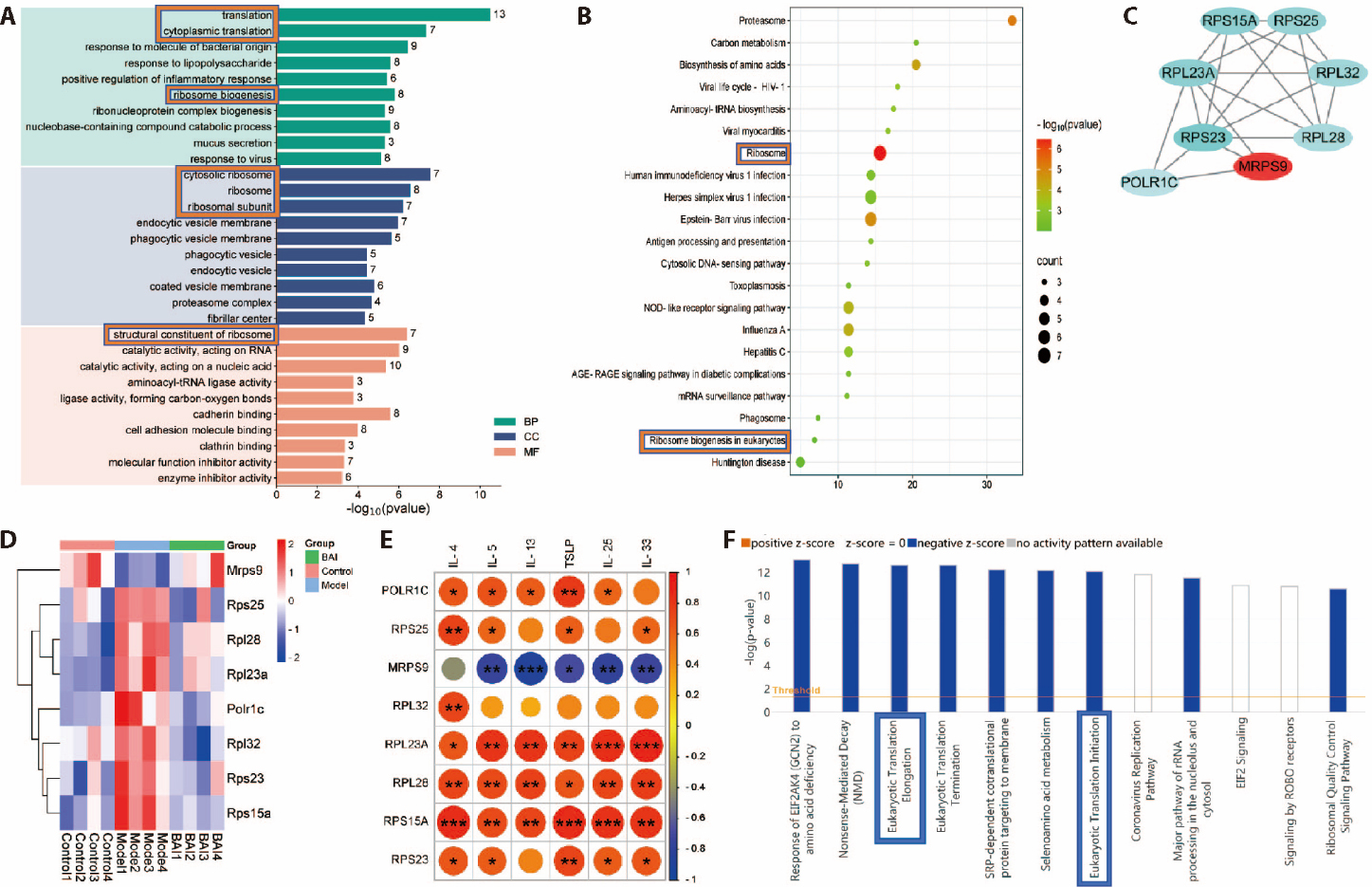
Figure 2 Data quality monitoring and bioinformatics analysis of DEPs by category A: the ten most significantly enriched terms of the GO hierarchy and the number of involved proteins in a term; B: enriched KEGG pathways of the DEPs. The number of proteins involved and corresponding P values are shown on the right side of the column; C: PPI analysis and key node protein screening were performed with STRING and Cytoscape; D: expression heatmap of proteins involved in ribosomal biological processes; E: correlation analysis of 8 ribosome-related proteins and inflammatory factors; F: IPA to predict biological effects based on differential expression profiles in the data. The red boxes in Figures A and B, as well as the blue boxes in Figure F, refer to the content related to "ribosome biogenesis". DEPs: differentially expressed proteins; GO: gene ontology; KEGG: kyoto encyclopedia of genes and genomes; PPI: protein-protein interaction; STRING: Search Tool for the Retrieval of Interacting Genes/Proteins; IPA: ingenuity pathway analysis; BP: biological process; CC: cellular component; MF: molecular function; MRPS9: small ribosomal subunit protein uS9m; RPL28: ribosomal protein L28; RPL32: ribosomal protein L32; RPS15A: ribosomal protein S15A; RPS23: ribosomal protein S23; POLR1C: RNA polymerase I and III subunit C; RPL23A: ribosomal protein L23A; RPS25: ribosomal protein S25; IL: interleukin; TSLP: thymic stromal lymphopoietin.
Figure 2 Data quality monitoring and bioinformatics analysis of DEPs by category A: the ten most significantly enriched terms of the GO hierarchy and the number of involved proteins in a term; B: enriched KEGG pathways of the DEPs. The number of proteins involved and corresponding P values are shown on the right side of the column; C: PPI analysis and key node protein screening were performed with STRING and Cytoscape; D: expression heatmap of proteins involved in ribosomal biological processes; E: correlation analysis of 8 ribosome-related proteins and inflammatory factors; F: IPA to predict biological effects based on differential expression profiles in the data. The red boxes in Figures A and B, as well as the blue boxes in Figure F, refer to the content related to "ribosome biogenesis". DEPs: differentially expressed proteins; GO: gene ontology; KEGG: kyoto encyclopedia of genes and genomes; PPI: protein-protein interaction; STRING: Search Tool for the Retrieval of Interacting Genes/Proteins; IPA: ingenuity pathway analysis; BP: biological process; CC: cellular component; MF: molecular function; MRPS9: small ribosomal subunit protein uS9m; RPL28: ribosomal protein L28; RPL32: ribosomal protein L32; RPS15A: ribosomal protein S15A; RPS23: ribosomal protein S23; POLR1C: RNA polymerase I and III subunit C; RPL23A: ribosomal protein L23A; RPS25: ribosomal protein S25; IL: interleukin; TSLP: thymic stromal lymphopoietin.
Table 5 Molecular docking of 8 proteins related to the biological functions of ribosomes to baicalein
| Drug | Targets | PDB ID | Binding affinity (kcal/mol) |
|---|---|---|---|
| Baicalein | RPL28 | 6IP8 | -7.9 |
| Baicalein | POLR1C | 7OB9 | -8.6 |
| Baicalein | RPS15A | 5K0Y | -6.8 |
| Baicalein | RPS23 | 3MGU | -8.8 |
| Baicalein | RPL23A | 1G62 | -10.5 |
| Baicalein | RPS25 | 6ZOL | -9 |
| Baicalein | RPL32 | 1T0K | -7.2 |
| Baicalein | MRPS9 | 5AJ3 | -7.5 |

Figure 3 MD simulation analysis of the RPS25-Baicalein, RPL23A-Baicalein, and POLR1C-Baicalein complexes for more than 100 ns. A: RMSD image; B: Rg image; C: SASA image; D: image showing the number of Hbonds; E: RMSF image (RPL23A-Baicalein); F: RMSF image (RPS25-Baicalein); G: RMSF image (POLR1C-Baicalein). E1: RPL23A-Baicalein-Chain-A; E2: RPL23A-Baicalein-Chain-B; F1: RPS25-Baicalein-Chain-A; F2: RPS25-Baicalein-Chain-B; F3: RPS25-Baicalein-Chain-C; F4: RPS25-Baicalein-Chain-D. RMSD: the root mean square deviation; Rg: the radius of gyration; SASA: solvent accessible surface area; RMSF: the root mean square fluctuation; POLR1C: RNA polymerase I and III subunit C; RPL23A: ribosomal protein L23A; RPS25: ribosomal protein S25.
Figure 3 MD simulation analysis of the RPS25-Baicalein, RPL23A-Baicalein, and POLR1C-Baicalein complexes for more than 100 ns. A: RMSD image; B: Rg image; C: SASA image; D: image showing the number of Hbonds; E: RMSF image (RPL23A-Baicalein); F: RMSF image (RPS25-Baicalein); G: RMSF image (POLR1C-Baicalein). E1: RPL23A-Baicalein-Chain-A; E2: RPL23A-Baicalein-Chain-B; F1: RPS25-Baicalein-Chain-A; F2: RPS25-Baicalein-Chain-B; F3: RPS25-Baicalein-Chain-C; F4: RPS25-Baicalein-Chain-D. RMSD: the root mean square deviation; Rg: the radius of gyration; SASA: solvent accessible surface area; RMSF: the root mean square fluctuation; POLR1C: RNA polymerase I and III subunit C; RPL23A: ribosomal protein L23A; RPS25: ribosomal protein S25.

Figure 4 Baicalein decreased ribosome biogenesis in the colon tissues of mice with allergic asthma A: identification of POLR1C expression in colon tissue by immunohistochemical staining (× 200), scale bar: 100 μm; B: identification of RPS25 expression in colon tissue by immunohistochemical staining (× 200), scale bar: 100 μm; C: identification of RPL23A expression in colon tissue by immunohistochemical staining (× 200), scale bar: 100 μm. A1, B1, C1: Control group; A2, B2, C2: Model group; A3, B3, C3: BAI (H) group; A4, B4, C4: Montelukast group. Control: treated only with physiological saline solution; model: treated with OVA and physiological saline; BAI (H): treated with OVA and 40 mg/kg BAI. BAI (H): Baicalein (high-dose); OVA: ovalbumin; POLR1C: RNA polymerase I and III subunit C; RPL23A: ribosomal protein L23A; RPS25: ribosomal protein S25.
Figure 4 Baicalein decreased ribosome biogenesis in the colon tissues of mice with allergic asthma A: identification of POLR1C expression in colon tissue by immunohistochemical staining (× 200), scale bar: 100 μm; B: identification of RPS25 expression in colon tissue by immunohistochemical staining (× 200), scale bar: 100 μm; C: identification of RPL23A expression in colon tissue by immunohistochemical staining (× 200), scale bar: 100 μm. A1, B1, C1: Control group; A2, B2, C2: Model group; A3, B3, C3: BAI (H) group; A4, B4, C4: Montelukast group. Control: treated only with physiological saline solution; model: treated with OVA and physiological saline; BAI (H): treated with OVA and 40 mg/kg BAI. BAI (H): Baicalein (high-dose); OVA: ovalbumin; POLR1C: RNA polymerase I and III subunit C; RPL23A: ribosomal protein L23A; RPS25: ribosomal protein S25.
Table 6 Staining intensity of POLR1C, RPS25, and RPL23A proteins in colon tissue of mice in each group (scores, $\bar{x}$ ± s)
| Group | n | POLR1C/AOD | RPS25/AOD | RPL23A/AOD |
|---|---|---|---|---|
| Control | 3 | 0.006±0.000 | 0.018±0.000 | 0.020±0.000 |
| Model | 3 | 0.024±0.000a | 0.061±0.020a | 0.073±0.020a |
| BAI (H) | 3 | 0.008±0.000b | 0.020±0.000b | 0.031±0.010b |
| Montelukast | 3 | 0.008±0.000b | 0.032±0.010 | 0.039±0.010 |
| [1] | Palaniyandi S, Rajendrakumar AM, Periasamy S, et al. TRPV4 is dispensable for the development of airway allergic asthma. Lab Invest 2020; 100: 265-73. |
| [2] | Rajvanshi N, Kumar P, Goyal JP. Global initiative for asthma guidelines 2024: an update. Indian Pediatr 2024; 61: 781-6. |
| [3] | Kulkarni NS, Hollins F, Sutcliffe A, et al. Eosinophil protein in airway macrophages: a novel biomarker of eosinophilic inflammation in patients with asthma. J Allergy Clin Immunol 2010; 126: 61-9. |
| [4] | Song XL, Liang J, Lin SZ, et al. Gut-lung axis and asthma: a historical review on mechanism and future perspective. Clin Transl Allergy 2024; 14: e12356. |
| [5] | Zhang D, Li S, Wang N, et al. The cross-talk between gut microbiota and lungs in common lung diseases. Front Microbiol 2020; 11: 301. |
| [6] | Tan TG, Sefik E, Gevazatorsky N, et al. Identifying species of symbiont bacteria from the human gut that, alone, can induce intestinal Th17 cells in mice. Proc Natl Acad Sci U S A 2016; 113: E8141-50. |
| [7] | Henrick BM, Rodriguez L, Lakshmikanth T, et al. Bifidobacteria-mediated immune system imprinting early in life. Cell 2021; 184: 3884-98. |
| [8] | Huang Y, Mao K, Chen X, et al. S1P-dependent interorgan trafficking of group 2 innate lymphoid cells supports host defense. Science 2018; 359: 114-9. |
| [9] | Budden KF, Gellatly SL, Wood DLA, et al. Emerging pathogenic links between microbiota and the gut-lung axis. Nat Rev Microbiol 2017; 15: 55-63. |
| [10] | Ruan Y, Yuan PP, Li PY, et al. Tingli Dazao Xiefei decoction ameliorates asthma in vivo and in vitro from lung to intestine by modifying NO-CO metabolic disorder mediated inflammation, immune imbalance, cellular barrier damage, oxidative stress and intestinal bacterial disorders. J Ethnopharmacol 2023; 313: 116503. |
| [11] | Ousingsawat J, Centeio R, Reyne N, et al. Inhibition of mucus secretion by niclosamide and benzbromarone in airways and intestine. Sci Rep 2024; 14: 1464. |
| [12] | Bao K, Gu X, Song Y, et al. TCF-1 and TOX regulate the memory formation of intestinal group 2 innate lymphoid cells in asthma. Nat Commun 2024; 15: 7850. |
| [13] | Zhang Y, Li T, Yuan H, Pan W, Dai Q. Correlations of inflammatory factors with intestinal flora and gastrointestinal incommensurate symptoms in children with asthma. Med Sci Monit 2018; 24: 7975-9. |
| [14] | Gensollen T, Iyer SS, Kasper DL, Blumberg RS. How colonization by microbiota in early life shapes the immune system. Science 2016; 352: 539-44. |
| [15] | Maslowski KM, Vieira AT, Ng A, et al. Regulation of inflammatory responses by gut microbiota and chemoattractant receptor GPR43. Nature 2009; 461: 1282-6. |
| [16] | Arpaia N, Campbell C, Fan X, et al. Metabolites produced by commensal bacteria promote peripheral regulatory T-cell generation. Nature 2013; 504: 451-5. |
| [17] | Shi CY, Yu CH, Yu WY, Ying HZ. Gut-lung microbiota in chronic pulmonary diseases: evolution, pathogenesis, and therapeutics. Can J Infect Dis Med Microbiol 2021; 2021: 9278441. |
| [18] | Lai HC, Lin TL, Chen TW, et al. Gut microbiota modulates COPD pathogenesis: role of anti-inflammatory Parabacteroides goldsteinii lipopolysaccharide. Gut 2022; 71: 309-21. |
| [19] | Adam L, Stanifer M, Springer F, et al. Transcriptomics-inferred dynamics of SARS-CoV-2 interactions with host epithelial cells. Sci Signal 2023; 16: eabl8266. |
| [20] | Shen X, Liang M, Chen X, et al. Cutting edge: core binding factor β is required for group 2 innate lymphoid cell activation. J Immunol 2019; 202: 1669-73. |
| [21] | Murooka TT, Rahbar R, Platanias LC, Fish EN. CCL5-mediated T-cell chemotaxis involves the initiation of mRNA translation through mTOR/4E-BP1. Blood 2008; 111: 4892-901. |
| [22] | Wei L, Zhang L, Zhang Y, et al. Intestinal Escherichia coli and related dysfunction as potential targets of Traditional Chinese Medicine for respiratory infectious diseases. J Ethnopharmacol 2023; 313: 116381. |
| [23] | Tuli HS, Aggarwal V, Kaur J, et al. Baicalein: a metabolite with promising antineoplastic activity. Life Sci 2020; 259: 118183. |
| [24] | Xu T, Ge X, Lu C, et al. Baicalein attenuates OVA-induced allergic airway inflammation through the inhibition of the NF-κB signaling pathway. Aging-Us 2019; 11: 9310-27. |
| [25] | Wang D, Nasab EM, Athari SS. Study effect of Baicalein encapsulated/loaded Chitosan-nanoparticle on allergic Asthma pathology in mouse model. Saudi J Biol Sci 2021; 28: 4311-7. |
| [26] | Peng W, Xia Q, Zhang Y, Cao D, Zheng X. VEGF and EGFR signaling pathways are involved in the baicalein attenuation of OVA-induced airway inflammation and airway remodeling in mice. Respir Res 2024; 25: 10. |
| [27] | Bui TT, Piao CH, Song CH, et al. Baicalein, wogonin, and Scutellaria baicalensis ethanol extract alleviate ovalbumin-induced allergic airway inflammation and mast cell-mediated anaphylactic shock by regulation of Th1/Th2 imbalance and histamine release. Anat Cell Biol 2017; 50: 124-34. |
| [28] | Li YY, Wang XJ, Su YL, et al. Baicalein ameliorates ulcerative colitis by improving intestinal epithelial barrier via AhR/IL-22 pathway in ILC3s. Acta Pharmacol Sin 2022; 43: 1495-507. |
| [29] | Zhou S, Yin X, Liang Z, et al. Antifibrotic activities of Scutellariae Radix extracts and flavonoids: Comparative proteomics reveals distinct and shared mechanisms. Phytomedicine 2022; 100: 154049. |
| [30] | Kilkenny C, Browne W, Cuthill IC, Emerson M, Altman DG. Animal research: reporting in vivo experiments: the ARRIVE guidelines. Br J Pharmacol 2010; 160: 1577-9. |
| [31] | Mcgrath JC, Drummond GB, Mclachlan EM, Kilkenny C, Wainwright CL. Guidelines for reporting experiments involving animals: the ARRIVE guidelines. Br J Pharmacol 2010; 160: 1573-6. |
| [32] | Lazarinis N, Bood J, Gomez C, et al. Leukotriene E4 induces airflow obstruction and mast cell activation through the cysteinyl leukotriene type 1 receptor. J Allergy Clin Immunol 2018; 142: 1080-9. |
| [33] | Temelkovski J, Hogan SP, Shepherd DP, Foster PS, Kumar RK. An improved murine model of asthma: selective airway inflammation, epithelial lesions and increased methacholine responsiveness following chronic exposure to aerosolised allergen. Thorax 1998; 53: 849-56. |
| [34] | Jia K, Wang Y, Tong X, Wang R. KGF is delivered to inflammatory and induces the epithelial hyperplasia in trinitrobenzene sulfonic acid-induced ulcerative colitis rats. Drug Des Devel Ther 2020; 14: 217-31. |
| [35] | Guo S, Shi Y, Xu A, Wang Y, Xu P. Liubao tea extract ameliorates ovalbumin-induced allergic asthma by regulating gut microbiota in mice. Food Funct 2023; 14: 10605-16. |
| [36] | Rakhshani H, Dehghanian E, Rahati A. Enhanced GROMACS: toward a better numerical simulation framework. J Mol Model 2019; 25: 355. |
| [37] | Wang X, Kaiser H, Kvist-Hansen A, et al. IL-17 pathway members as potential biomarkers of effective systemic treatment and cardiovascular disease in patients with moderate-to-severe psoriasis. Int J Mol Sci 2022; 23: 555. |
| [38] | Shen L, Yang A, Chen X, et al. Proteomic profiling of cerebrum mitochondria, myelin sheath, and synaptosome revealed mito-chondrial damage and synaptic impairments in association with 3 x Tg-AD mice model. Cell Mol Neurobiol 2022; 42: 1745-63. |
| [39] | Nair PM, Starkey MR, Haw TJ, et al. Targeting PP2A and proteasome activity ameliorates features of allergic airway disease in mice. Allergy 2017; 72: 1891-903. |
| [40] | Sharma S, Litonjua A. Asthma, allergy, and responses to methyl donor supplements and nutrients. J Allergy Clin Immunol 2014; 133: 1246-54. |
| [41] | Chinnapaiyan S, Dutta RK, Nair M, et al. TGF-β1 increases viral burden and promotes HIV-1 latency in primary differentiated human bronchial epithelial cells. Sci Rep 2019; 9: 12552. |
| [42] | Hong H-J, Kim E, Jung MY, Kim S, Kim TS. AIMP 1 deficiency enhances airway hyperreactivity in mice via increased TH2 immune responses. Clin Immunol 2012; 143: 256-65. |
| [43] | Esnault S, Kelly EAB, Shen ZJ, et al. IL-3 maintains activation of the p90S6K/RPS6 pathway and increases translation in human eosinophils. J Immunol 2015; 195: 2529-39. |
| [44] | Zhao J, Zhang Q, Yao D, et al. Prenatal LPS exposure promotes allergic airway inflammation via long coding RNA NONMMUT033452.2, and protein binding partner, Eef1D. Am J Respir Cell Mol Biol 2023; 68: 610-24. |
| [45] | Zhou LM, Goldsmith AM, Bentley JK, et al. 4E-binding protein phosphorylation and eukaryotic initiation factor-4E release are required for airway smooth muscle hypertrophy. Am J Respir Cell Mol Biol 2005; 33: 195-202. |
| [46] | Li C, Wen R, Liu D, et al. Assessment of the potential of sarcandra glabra (thunb.) Nakai. in treating ethanol-induced gastric ulcer in rats based on metabolomics and network analysis. Front Pharmacol 2022; 13: 810344. |
| [47] | Mims JW. Asthma: definitions and pathophysiology. Int Forum Allergy Rhinol 2015; 5: S2-6. |
| [48] | Demirci M, Tokman HB, Uysal HK, et al. Reduced Akkermansia muciniphila and Faecalibacterium prausnitzii levels in the gut microbiota of children with allergic asthma. Allergol Immunopathol (Madr) 2019; 47: 365-71. |
| [49] | Mabalirajan U, Ahmad T, Rehman R, et al. Baicalein reduces airway injury in allergen and IL-13 induced airway inflammation. PloS ONE 2013; 8: e62916. |
| [50] | Hu T, Zhu Y, Zhou X, et al. Baicalein ameliorates SEB-induced acute respiratory distress syndrome in a microbiota-dependent manner. Phytomedicine 2024; 135: 156049. |
| [51] | Shankar A, Mcalees JW, Lewkowich IP. Modulation of IL-4/IL-13 cytokine signaling in the context of allergic disease. J Allergy Clin Immunol 2022; 150: 266-76. |
| [52] | Kianmehr M, Haghmorad D, Nosratabadi R, et al. The effect of zataria multiflora on Th1/Th2 and Th17/T regulatory in a mouse model of allergic asthma. Front Pharmacol 2017; 8: 458. |
| [53] | Hammad H, Lambrecht BN. The basic immunology of asthma. Cell 2021; 184: 2521-2. |
| [54] | Moro K, Yamada T, Tanabe M, et al. Innate production of T(H)2 cytokines by adipose tissue-associated c-kit(+)Sca-1(+) lymphoid cells. Nature 2010; 463: 540-4. |
| [55] | Wallrapp A, Riesenfeld SJ, Burkett PR, Kuchroo VK. Type 2 innate lymphoid cells in the induction and resolution of tissue inflammation. Immunol Rev 2018; 286: 53-73. |
| [56] | Salmond RJ, Mirchandani AS, Besnard AG, et al. IL-33 induces innate lymphoid cell-mediated airway inflammation by activating mammalian target of rapamycin. J Allergy Clin Immunol 2012; 130: 1159-1166.e6. |
| [57] | Chua HH, Chou HC, Tung YL, et al. Intestinal dysbiosis featuring abundance of ruminococcus gnavus associates with allergic diseases in infants. Gastroenterology 2018; 154: 154-67. |
| [58] | Wen Y, Emontzpohl C, Xu L, et al. Interleukin-33 facilitates liver regeneration through serotonin-involved gut-liver axis. Hepatology 2023; 77: 1580-92. |
| [59] | Ma PJ, Wang MM, Wang Y. Gut microbiota: a new insight into lung diseases. Biomed Pharmacother 2022; 155: 113810. |
| [60] | Zakeri A, Russo M. Dual role of toll-like receptors in human and experimental asthma models. Front Immunol 2018; 9: 1027. |
| [61] | Wypych TP, Wickramasinghe LC, Marsland BJ. The influence of the microbiome on respiratory health. Nat Immunol 2019; 20: 1279-90. |
| [62] | Barcik W, Pugin B, Westermann P, et al. Histamine-secreting microbes are increased in the gut of adult asthma patients. J Allergy Clin Immunol 2016; 138: 1491-4. |
| [63] | He Q, Liu C, Shen L, et al. Theory of the exterior-interior relationship between the lungs and the large intestine to explore the mechanism of Eriobotrya japonica leaf water extract in the treatment of cough variant asthma. J Ethnopharmacol 2021; 281: 114482. |
| [64] | Pelletier J, Thomas G, Volarevic S. Ribosome biogenesis in cancer: new players and therapeutic avenues. Nat Rev Cancer 2018; 18: 51-63. |
| [65] | Zhang D, Pu X, Zheng M, Li G, Chen J. Employing a synergistic bioinformatics and machine learning framework to elucidate biomarkers associating asthma with pyrimidine metabolism genes. Respir Res 2024; 25: 327. |
| [66] | Watt KEN, Macintosh J, Bernard G, Trainor PA. RNA Polymerases I and III in development and disease. Semin Cell Dev Biol 2023; 136: 49-63. |
| [67] | Mersakova S, Marcinek J, Brany D, et al. Establishment of coala: a novel 3D and 2D cancer cell line derived from colorectal cancer liver metastasis. Hum Cell 2025; 38: 137. |
| [68] | Jiang J, Qi T, Li L, et al. MRPS9-mediated regulation of the PI3K/Akt/mTOR pathway inhibits neuron apoptosis and protects ischemic stroke. J Mol Neurosci 2024; 74: 23. |
| [69] | Flaquer A, Heinzmann A, Rospleszcz S, et al. Association study of mitochondrial genetic polymorphisms in asthmatic children. Mitochondrion 2014; 14: 49-53. |
| [70] | Xie J, Zhang W, Liang X, et al. RPL 32 promotes lung cancer progression by facilitating p53 degradation. Mol Ther Nucleic Acids 2020; 21: 75-85. |
| [71] | Li L-S, Tong Y, Yuan C, Zhang W. Evaluation of diagnostic value and Mendelian randomization study of appendicitis hub genes obtained by WGCNA analysis. Medicine 2024; 103: e39307. |
| [72] | Zheng K, Cai Y, Lei Y, et al. Proteomic characteristics of beryllium sulfate-induced differentially expressed proteins in rats. Toxicol Res 2021; 10: 962-74. |
| [73] | Chen J, Wei Y, Feng Q, et al. Ribosomal protein S15A promotes malignant transformation and predicts poor outcome in colorectal cancer through misregulation of p53 signaling pathway. Int J Oncol 2016; 48: 1628-38. |
| [74] | Farre-Garros R, Lee JY, Natanek SA, et al. Quadriceps miR-542-3p and-5p are elevated in COPD and reduce function by inhibiting ribosomal and protein synthesis. J Appl Physiol 2019; 126: 1514-24. |
| [75] | Maeda Y, Kurakawa T, Umemoto E, et al. Dysbiosis contributes to arthritis development via activation of autoreactive T cells in the intestine. Arthritis Rheumatol 2016; 68: 2646-61. |
| [76] | Hsu CH, Hsu CW, Hsueh C, et al. Identification and characterization of potential biomarkers by quantitative tissue proteomics of primary lung adenocarcinoma. Mol Cell Proteomics 2016; 15: 2396-410. |
| [77] | Kim CW, Cha JM, Kwak MS. Identification of potential biomarkers and biological pathways for poor clinical outcome in mucinous colorectal adenocarcinoma. Cancers (Basel) 2021; 13: 3280. |
| [78] | You A, Tian W, Yuan H, et al. TTC22 promotes m6A-mediated WTAP expression and colon cancer metastasis in an RPL4 binding-dependent pattern. Oncogene 2022; 41: 3925-38. |
| [79] | Burrows K, Ngai L, Chiaranunt P, et al. A gut commensal protozoan determines respiratory disease outcomes by shaping pulmonary immunity. Cell abbreviation 2025; 188: 316-30. |
| [80] | Liao G, Yan Q, Zhang M, et al. Integrative analysis of network pharmacology and proteomics reveal the protective effect of Xiaoqinglong decotion on neutrophilic asthma. J Ethnopharmacol. 2024; 330: 118102. |
| [1] | WANG Bingyu, JIN Fangfang, GAO Jiawei, YANG Liuxin, ZHANG Yali, YUAN Xingxing, ZHANG Yang. Acupuncture reduces sedative and anaesthetic consumption and improves pain tolerance in patients undergoing colonoscopy: a Meta-analysis [J]. Journal of Traditional Chinese Medicine, 2024, 44(6): 1091-1103. |
| [2] | LI Miao, ZHENG Jialu, WANG Shuangshuang, CHEN Lei, PENG Xiao, CHEN Jinfang, AN Hongmei, HU Bing. Tenglong Buzhong granules (藤龙补中颗粒) inhibits the growth of SW620 human colon cancer in vivo [J]. Journal of Traditional Chinese Medicine, 2022, 42(5): 701-706. |
| [3] | You WU, Yuli HU, Wei LIU, Boju SUN, Chengfei ZHANG, Lili WU, Tonghua LIU. Flavonoids from traditional Chinese herbs for diabetes in rats: a network Meta-analysis [J]. Journal of Traditional Chinese Medicine, 2022, 42(1): 1-8. |
| [4] | Halimeh Amiri, Farhad Ramezani-Badr, Naseh Sigari, Karim Nasseri. Comparative efficacy of honey 12.5% and chlorhexidine 0.2% mouthwashes on the oropharyngeal bacterial colonization in mechanically-ventilated patients: a randomized controlled trial [J]. Journal of Traditional Chinese Medicine, 2020, 40(3): 440-446. |
| [5] | Li Kai, Liu Rui, Xu Guangzhong, Zhang Weihua, Liu Chen, Zhu Bin, Hua Baojin, Feng Xingzhong. Effect of a modified Banxia Xiexin decoction plus chemotherapy on stage Ⅲ colon cancer [J]. Journal of Traditional Chinese Medicine, 2019, 39(02): 251-257. |
| [6] | Song Junmin, Liu Hongxiang, Li Zhen, Yang Chao, Wang Chaojie. Ginsenoside Rg3 inhibits colon cancer cell migration by suppressing nuclear factor kappa B activity [J]. Journal of Traditional Chinese Medicine, 2015, 35(04): 440-444. |
| Viewed | ||||||
|
Full text |
|
|||||
|
Abstract |
|
|||||