
Journal of Traditional Chinese Medicine ›› 2026, Vol. 46 ›› Issue (4): 809-820.DOI: 10.19852/j.cnki.jtcm.2026.04.004
• Original Articles • Previous Articles Next Articles
Shaofu Zhuyu decoction (少腹逐瘀汤) can inhibit the progression of endometriosis fibrosis through the transforming growth factor-β1/ smads signaling pathway mediated by 5’ adenosine monophosphate-activated protein kinase
LI Bingbing1, DING Meiqi1, CHEN Xiangying1, LI Wenzhe1, WEI Chao1, YU Bin1, MA Xiaona2( ), SUN Xinhui3()
- 1
College of Integrated Traditional Chinese and Western Medicine ,Jining Medical University Jining 272000, China
2Gynecology department ,Beijing University of Chinese Medicine Third Affiliated Hospital Beijing 100029, China
3Gynecology department ,First Teaching Hospital of Tianjin University of Traditional Chinese Medicine; National Clinical Research Center for Chinese Medicine Tianjin 300000, China
-
Received:2025-09-28Accepted:2026-04-13Online:2026-08-15Published:2026-08-08 -
Contact:MA Xiaona, Gynecology department, Beijing University of Chinese Medicine Third Affiliated Hospital, Beijing 100029, China. fightandfight@yeah.net;
SUN Xinhui, Gynecology department, First Teaching Hospital of Tianjin University of Traditional Chinese Medicine; National Clinical Research Center for Chinese Medicine, Tianjin 300000, China. weimo0827@163.com,Telephone: +86-19801226182 -
Supported by:National Natural Science Foundation of China: To Explore the Mechanism of Shaofu Zhuyu Decoction in the Treatment of Endometriosis Based on Adiponectin/AdipoR/5' Adenosine Monophosphate-activated Protein Kinase Pathway-Mediated Fibrosis(82104920);Natural Science Foundation of Shandong Province: Adipose-Derived Stem Cell Exosomes Regulate the Transforming Growth Factor β1/Smads Pathway-mediated Fibrosis in Endometriosis and the Intervention Effect of Shaofu Zhuyu Decoction(ZR2021QH129);Shandong Provincial Key Laboratory of Traditional Chinese Medicine: Laboratory for Integrated Traditional Chinese Medicine-Western Medicine Clinical Research([2022]4)

Cite this article
LI Bingbing, DING Meiqi, CHEN Xiangying, LI Wenzhe, WEI Chao, YU Bin, MA Xiaona, SUN Xinhui. Shaofu Zhuyu decoction (少腹逐瘀汤) can inhibit the progression of endometriosis fibrosis through the transforming growth factor-β1/ smads signaling pathway mediated by 5’ adenosine monophosphate-activated protein kinase[J]. Journal of Traditional Chinese Medicine, 2026, 46(4): 809-820.
share this article

Figure 1 Effect of SFZYD on the formation of ectopic lesions A: images of ectopic lesions or uterine tissues in the five groups of mice; B: volume of the ectopic lesions in each group; C: weight of the ectopic lesions in each group; D: HE staining of the uterus of mice in the Control group and of the ectopic lesions in the other groups (scale bars: 50 μm). A1-A5: in vivo images; A6-A10: ex vivo images; A1, A6, D1: Control group; A2, A7, D2: Model group; A3, A8, D3: SFZYD-L group; A4, A9, D4: SFZYD-H group; A5, A10, D5: Dinorgestrel group. Black arrow: uterin and ectopic lesions; red arrow: giand; blue arrow: epithelium. Control group: the mice received 0.9% NaCl once every day for 3 weeks; Model group: the mice received 0.9% NaCl once every day for 3 weeks; SFZYD-L group: the mice received SFZYD at a dose of 8.645 g/kg once every day for 3 weeks; SFZYD-H group: the mice received SFZYD at a dose of 17.290 g/kg once every day for 3 weeks; Dinorgestrel group: the mice received Dinorgestrel at a dose of 0.3 mg/kg once every day for 3 weeks. SFZYD: Shaofu Zhuyu decoction; SFZYD-L: low-dose Shaofu Zhuyu decoction; SFZYD-H: high-dose Shaofu Zhuyu decoction; SD: standard deviation; HE: hematoxylin and eosin. The data passed tests for normality and homogeneity of variance. Statistical significance was assessed using one-way analysis of variance. Data are expressed as the mean ± standard deviation (n = 6/group) and these represent independent biological replicates. aP < 0.05 versus Model group; bP < 0.01 versus Model group.
Figure 1 Effect of SFZYD on the formation of ectopic lesions A: images of ectopic lesions or uterine tissues in the five groups of mice; B: volume of the ectopic lesions in each group; C: weight of the ectopic lesions in each group; D: HE staining of the uterus of mice in the Control group and of the ectopic lesions in the other groups (scale bars: 50 μm). A1-A5: in vivo images; A6-A10: ex vivo images; A1, A6, D1: Control group; A2, A7, D2: Model group; A3, A8, D3: SFZYD-L group; A4, A9, D4: SFZYD-H group; A5, A10, D5: Dinorgestrel group. Black arrow: uterin and ectopic lesions; red arrow: giand; blue arrow: epithelium. Control group: the mice received 0.9% NaCl once every day for 3 weeks; Model group: the mice received 0.9% NaCl once every day for 3 weeks; SFZYD-L group: the mice received SFZYD at a dose of 8.645 g/kg once every day for 3 weeks; SFZYD-H group: the mice received SFZYD at a dose of 17.290 g/kg once every day for 3 weeks; Dinorgestrel group: the mice received Dinorgestrel at a dose of 0.3 mg/kg once every day for 3 weeks. SFZYD: Shaofu Zhuyu decoction; SFZYD-L: low-dose Shaofu Zhuyu decoction; SFZYD-H: high-dose Shaofu Zhuyu decoction; SD: standard deviation; HE: hematoxylin and eosin. The data passed tests for normality and homogeneity of variance. Statistical significance was assessed using one-way analysis of variance. Data are expressed as the mean ± standard deviation (n = 6/group) and these represent independent biological replicates. aP < 0.05 versus Model group; bP < 0.01 versus Model group.

Figure 2 Effect of SFZYD on fibrotic staining of ectopic lesions A: images of Masson’s trichrome of the uterine tissue of the mice in the control group and of the ectopic lesions of the mice in the other groups (scale bars: 50 μm); B: images of Sirius red staining of the uterine tissue of the mice in the control group and of the ectopic lesions of the mice in the other groups (scale bars: 50 μm); C: intergroup comparisons of Masson’s trichrome results in each group; D: intergroup comparisons of Sirius red staining results in each group; A1, B1: Control group; A2, B2: Model group; A3, B3: SFZYD-L group; A4, B4: SFZYD-H group; A5, B5: Dinorgestrel group. Control group: the mice received 0.9% NaCl once every day for 3 weeks; Model group: the mice received 0.9% NaCl once every day for 3 weeks; SFZYD-L group: the mice received SFZYD at a dose of 8.645 g/kg once every day for 3 weeks; SFZYD-H group: the mice received SFZYD at a dose of 17.290g/kg once every day for 3 weeks; Dinorgestrel group: the mice received Dinorgestrel at a dose of 0.3 mg/kg once every day for 3 weeks. SFZYD: Shaofu Zhuyu decoction; SFZYD-L: low-dose Shaofu Zhuyu decoction; SFZYD-H: high-dose Shaofu Zhuyu decoction; SD: standard deviation. The data passed tests for normality and homogeneity of variance. Statistical significance was assessed using one-way analysis of variance. Data are expressed as the mean ± standard deviation (n = 3/group) and these represent independent biological replicates. aP < 0.01 versus Control group; bP < 0.05 versus Model group; cP < 0.01 versus Model group.
Figure 2 Effect of SFZYD on fibrotic staining of ectopic lesions A: images of Masson’s trichrome of the uterine tissue of the mice in the control group and of the ectopic lesions of the mice in the other groups (scale bars: 50 μm); B: images of Sirius red staining of the uterine tissue of the mice in the control group and of the ectopic lesions of the mice in the other groups (scale bars: 50 μm); C: intergroup comparisons of Masson’s trichrome results in each group; D: intergroup comparisons of Sirius red staining results in each group; A1, B1: Control group; A2, B2: Model group; A3, B3: SFZYD-L group; A4, B4: SFZYD-H group; A5, B5: Dinorgestrel group. Control group: the mice received 0.9% NaCl once every day for 3 weeks; Model group: the mice received 0.9% NaCl once every day for 3 weeks; SFZYD-L group: the mice received SFZYD at a dose of 8.645 g/kg once every day for 3 weeks; SFZYD-H group: the mice received SFZYD at a dose of 17.290g/kg once every day for 3 weeks; Dinorgestrel group: the mice received Dinorgestrel at a dose of 0.3 mg/kg once every day for 3 weeks. SFZYD: Shaofu Zhuyu decoction; SFZYD-L: low-dose Shaofu Zhuyu decoction; SFZYD-H: high-dose Shaofu Zhuyu decoction; SD: standard deviation. The data passed tests for normality and homogeneity of variance. Statistical significance was assessed using one-way analysis of variance. Data are expressed as the mean ± standard deviation (n = 3/group) and these represent independent biological replicates. aP < 0.01 versus Control group; bP < 0.05 versus Model group; cP < 0.01 versus Model group.
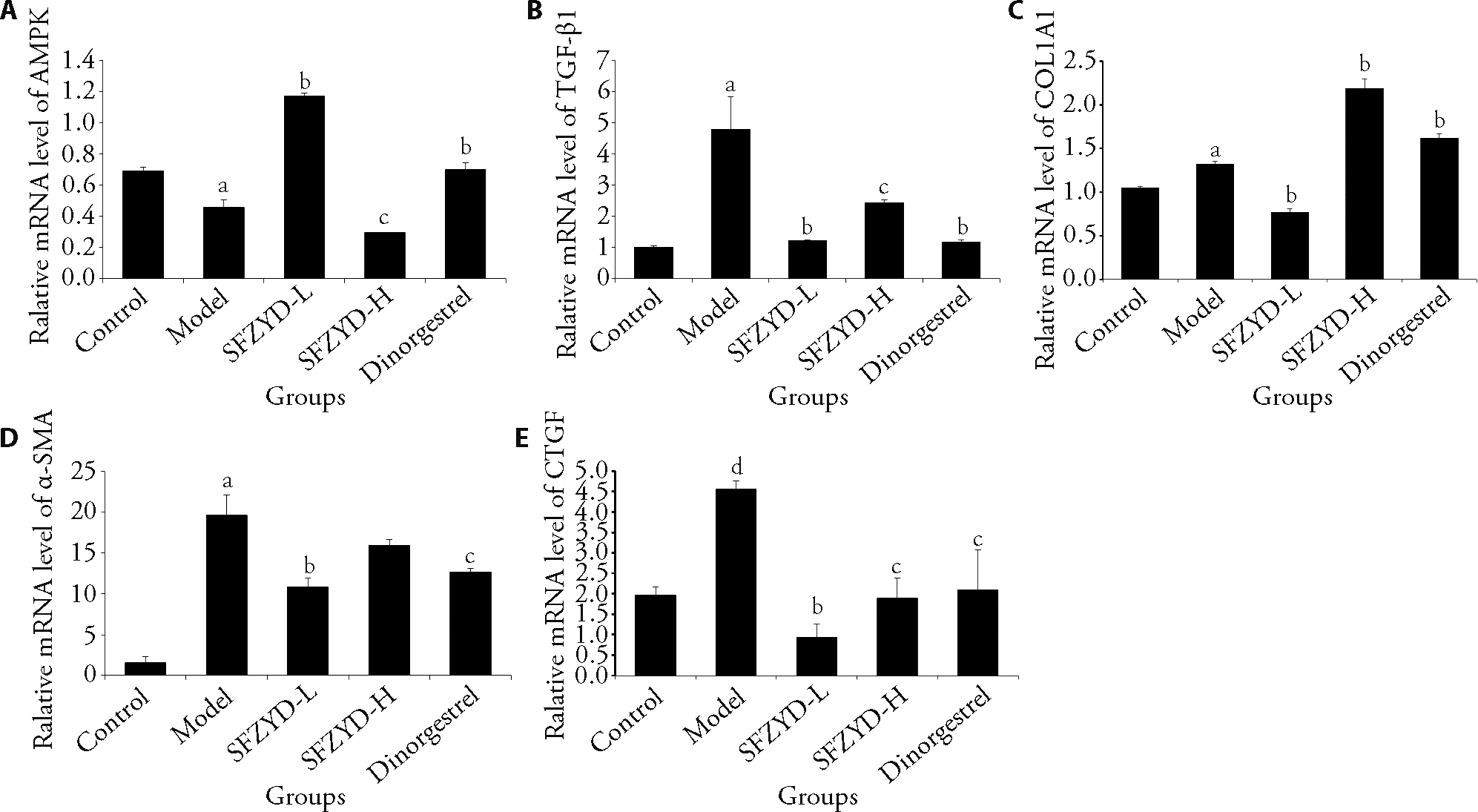
Figure 3 Analysis of the mRNA levels of fibrosis-related factors A: mRNA levels of AMPK; B: mRNA levels of TGF-β1; C: mRNA levels of COL1A1; D: mRNA levels of α-SMA; E: mRNA levels of CTGF; Control group: the mice received 0.9% NaCl once every day for 3 weeks; Model group: the mice received 0.9% NaCl once every day for 3 weeks; SFZYD-L group: the mice received SFZYD at a dose of 8.645 g/kg once every day for 3 weeks; SFZYD-H group: the mice received SFZYD at a dose of 17.290 g/kg once every day for 3 weeks; Dinorgestrel group: the mice received Dinorgestrel at a dose of 0.3 mg/kg once every day for 3 weeks; SFZYD: Shaofu Zhuyu decoction; SFZYD-L: low-dose Shaofu Zhuyu decoction; SFZYD-H: high-dose Shaofu Zhuyu decoction; AMPK: 5′ adenosine monophosphate-activated protein kinase; TGF-β1: transforming growth factor beta 1; COL1A1: collagen type I alpha 1 chain; α-SMA: alpha smooth muscle actin; SD: standard deviation. The data passed tests for normality and homogeneity of variance. Statistical significance was assessed using one-way analysis of variance. Data are presented as the mean ± standard deviation (n = 3/group). aP < 0.01, dP < 0.05 versus Control group; bP < 0.01, cP < 0.05 versus Model group.
Figure 3 Analysis of the mRNA levels of fibrosis-related factors A: mRNA levels of AMPK; B: mRNA levels of TGF-β1; C: mRNA levels of COL1A1; D: mRNA levels of α-SMA; E: mRNA levels of CTGF; Control group: the mice received 0.9% NaCl once every day for 3 weeks; Model group: the mice received 0.9% NaCl once every day for 3 weeks; SFZYD-L group: the mice received SFZYD at a dose of 8.645 g/kg once every day for 3 weeks; SFZYD-H group: the mice received SFZYD at a dose of 17.290 g/kg once every day for 3 weeks; Dinorgestrel group: the mice received Dinorgestrel at a dose of 0.3 mg/kg once every day for 3 weeks; SFZYD: Shaofu Zhuyu decoction; SFZYD-L: low-dose Shaofu Zhuyu decoction; SFZYD-H: high-dose Shaofu Zhuyu decoction; AMPK: 5′ adenosine monophosphate-activated protein kinase; TGF-β1: transforming growth factor beta 1; COL1A1: collagen type I alpha 1 chain; α-SMA: alpha smooth muscle actin; SD: standard deviation. The data passed tests for normality and homogeneity of variance. Statistical significance was assessed using one-way analysis of variance. Data are presented as the mean ± standard deviation (n = 3/group). aP < 0.01, dP < 0.05 versus Control group; bP < 0.01, cP < 0.05 versus Model group.

Figure 4 Regulation of the AMPK/TGF-β1/Smads pathway by SFZYD in mice with ectopic lesions A: immunohistochemical labeling of TGF-β1 in the different groups (scale bars: 50 μm); B: changes of TGF-β1; C: immune ohistochemical labeling of COL1A1 in the different groups (scale bars: 50 μm); D: changes of COL1A1; E: immunohistochemical labeling of α-SMA in the different groups (scale bars: 50 μm); F: changes of α-SMA; G: Western blot analysis of the protein expression levels of AMPK, p-AMPK, TGF-β1, Smad2/3, p-Smad2/3, COL1A1, α-SMA, CTGF, and β-actin protein levels in uterine tissue and ectopic lesions; H1: changes of p-AMPK/AMPK; H2: changes of TGF-β1; H3: changes of p-Smad2/3/Smad2/3; H4: changes of COL1A1;H5: changes of α-SMA; H6: changes of CTGF; A1, C1, E1: Control group; A2, C2, E2: Model group; A3, C3, E3: SFZYD-L group; A4, C4, E4: SFZYD-H group; A5, C5, E5: Dinorgestrel group. Control group: the mice received 0.9% NaCl once every day for 3 weeks; Model group: the mice received 0.9% NaCl once every day for 3 weeks; SFZYD-L group: the mice received SFZYD at a dose of 8.645 g/kg once every day for 3 weeks; SFZYD-H group: the mice received SFZYD at a dose of 17.290 g/kg once every day for 3 weeks; Dinorgestrel group: the mice received Dinorgestrel at a dose of 0.3 mg/kg once every day for 3 weeks. SFZYD: Shaofu Zhuyu decoction; SFZYD-L: low-dose Shaofu Zhuyu decoction; SFZYD-H: high-dose Shaofu Zhuyu decoction; AMPK: 5′ adenosine monophosphate-activated protein kinase; TGF-β1: transforming growth factor beta 1; COL1A1: collagen type I alpha 1 chain; α-SMA: alpha smooth muscle actin; SD: standard deviation. The data passed tests for normality and homogeneity of variance. Statistical significance was assessed using one-way analysis of variance. Data are expressed as the mean ± standard deviation (n = 3/group) and these represent independent biological replicates. aP < 0.01, dP < 0.05 versus Control group; bP < 0.05, cP < 0.01 versus Model group.
Figure 4 Regulation of the AMPK/TGF-β1/Smads pathway by SFZYD in mice with ectopic lesions A: immunohistochemical labeling of TGF-β1 in the different groups (scale bars: 50 μm); B: changes of TGF-β1; C: immune ohistochemical labeling of COL1A1 in the different groups (scale bars: 50 μm); D: changes of COL1A1; E: immunohistochemical labeling of α-SMA in the different groups (scale bars: 50 μm); F: changes of α-SMA; G: Western blot analysis of the protein expression levels of AMPK, p-AMPK, TGF-β1, Smad2/3, p-Smad2/3, COL1A1, α-SMA, CTGF, and β-actin protein levels in uterine tissue and ectopic lesions; H1: changes of p-AMPK/AMPK; H2: changes of TGF-β1; H3: changes of p-Smad2/3/Smad2/3; H4: changes of COL1A1;H5: changes of α-SMA; H6: changes of CTGF; A1, C1, E1: Control group; A2, C2, E2: Model group; A3, C3, E3: SFZYD-L group; A4, C4, E4: SFZYD-H group; A5, C5, E5: Dinorgestrel group. Control group: the mice received 0.9% NaCl once every day for 3 weeks; Model group: the mice received 0.9% NaCl once every day for 3 weeks; SFZYD-L group: the mice received SFZYD at a dose of 8.645 g/kg once every day for 3 weeks; SFZYD-H group: the mice received SFZYD at a dose of 17.290 g/kg once every day for 3 weeks; Dinorgestrel group: the mice received Dinorgestrel at a dose of 0.3 mg/kg once every day for 3 weeks. SFZYD: Shaofu Zhuyu decoction; SFZYD-L: low-dose Shaofu Zhuyu decoction; SFZYD-H: high-dose Shaofu Zhuyu decoction; AMPK: 5′ adenosine monophosphate-activated protein kinase; TGF-β1: transforming growth factor beta 1; COL1A1: collagen type I alpha 1 chain; α-SMA: alpha smooth muscle actin; SD: standard deviation. The data passed tests for normality and homogeneity of variance. Statistical significance was assessed using one-way analysis of variance. Data are expressed as the mean ± standard deviation (n = 3/group) and these represent independent biological replicates. aP < 0.01, dP < 0.05 versus Control group; bP < 0.05, cP < 0.01 versus Model group.
| 1. |
Yu SY, Zhang SW, Xia Y, Liu XQ, Liu YJ, Fu JR. Network-based pharmacology and experimental validation to explore the mechanism of action of the Jiawei Pentongling formula (加味盆痛灵方) for the treatment of endometriosis-related pain. J Tradit Chin Med 2024; 44: 991-9.
DOI |
| 2. |
Taylor HS, Kotlyar AM, Flores VA. Endometriosis is a chronic systemic disease: clinical challenges and novel innovations. Lancet 2021; 397: 839-52.
DOI PMID |
| 3. |
Matsuzaki S, Darcha C. Antifibrotic properties of epigallocatechin-3-gallate in endometriosis. Hum Reprod 2014; 29: 1677-87.
DOI URL |
| 4. |
Matsuzaki S, Pouly JL, Canis M. Persistent activation of signal transducer and activator of transcription 3 via interleukin-6 trans-signaling is involved in fibrosis of endometriosis. Hum Reprod 2022; 37: 1489-504.
DOI URL |
| 5. |
Vissers G, Giacomozzi M, Verdurmen W, Peek R, Nap A. The role of fibrosis in endometriosis: a systematic review. Hum Reprod Update 2024; 30: 706-50.
DOI URL |
| 6. |
Yang GM, Deng YP, Cao GM, Liu C. Galectin-3 promotes fibrosis in ovarian endometriosis. PeerJ 2024; 12: e16922.
DOI URL |
| 7. |
Vercellini P, Crosignani PG, Abbiati A, Somigliana E, Viganò P, Fedele L. The effect of surgery for symptomatic endometriosis: the other side of the story. Hum Reprod Update 2009; 15: 177-88.
DOI PMID |
| 8. |
Zhang ZZ, Zhou X, Xia L, et al. Wenshen Xiaozheng Tang alleviates fibrosis in endometriosis by regulating differentiation and paracrine signaling of endometrium-derived mesenchymal stem cells. J Ethnopharmacol 2025; 336: 118724.
DOI URL |
| 9. |
Guo SW. Recurrence of endometriosis and its control. Hum Reprod Update 2009; 15: 441-61.
DOI URL |
| 10. |
Zhang M, Barroso E, Peña L, et al. PPARβ/δ attenuates hepatic fibrosis by reducing SMAD 3 phosphorylation and p300 levels via AMPK in hepatic stellate cells. Biomed Pharmacother 2024; 179: 117303.
DOI URL |
| 11. |
Wang AH, Ma HY, Yi YL, et al. Oleanolic acid derivative alleviates cardiac fibrosis through inhibiting PTP1B activity and regulating AMPK/TGF-β/Smads pathway. Eur J Pharmacol 2023; 960: 176116.
DOI URL |
| 12. |
Wang L, Zhong NN, Wang X, et al. Metformin attenuates TGF-β1-induced fibrosis in salivary gland: a preliminary study. Int J Mol Sci 2023; 24: 16260.
DOI URL |
| 13. |
Assaf L, Eid AA, Nassif J. Role of AMPK/mTOR, mitochondria, and ROS in the pathogenesis of endometriosis. Life Sci 2022; 306: 120805.
DOI URL |
| 14. |
Wu LZ, Lan DT, Sun BW, et al. Luoshi Neiyi prescription inhibits estradiol synthesis and inflammation in endometriosis through the HIF1A/EZH2/SF-1 pathway. J Ethnopharmacol 2024; 335: 118659.
DOI URL |
| 15. |
Mück F, Scotti F, Mauvisseau Q, et al. Complementary authentication of Chinese herbal products to treat endometriosis using DNA metabarcoding and HPTLC shows a high level of variability. Front Pharmacol 2023; 14: 1305410.
DOI URL |
| 16. | Flower A, Liu JP, Lewith G, et al. Chinese herbal medicine for endometriosis. Cochrane Database Syst Rev 2012; 5: CD006568. |
| 17. | Huang HY, Lin YS, Ye HY. A Meta-analysis of the efficacy and safety of Traditional Chinese Medicine in treating endometriosis. Altern Ther Health Med 2024; 30: 456-64. |
| 18. |
Dong PP, Ling L, Hu LYW. Systematic review and Meta-analysis of Traditional Chinese Medicine compound in treating infertility caused by endometriosis. Ann Palliat Med 2021; 10: 12631-42.
DOI PMID |
| 19. | Wang QR (Qing dynasty). Yi Lin Gai Cuo. Beijing: People's Medical Publishing House, 2005: 68. |
| 20. | Zhang TF, Mao F, Zhao JL. The effect of Shao Abdominal Zhuyu decoction on the endometrial receptivity and serum RBP4, HMGB1, MCP-1 and RANTES in the treatment of endometriosis in patients. J Chin Med Mater 2021; 44: 210-14. |
| 21. |
Ding D, Liu XS, Duan J, Guo SW. Platelets are an unindicted culprit in the development of endometriosis: clinical and experimental evidence. Hum Reprod 2015; 30: 812-32.
DOI URL |
| 22. |
Li BB, Xun QQ, Wei C, et al. Effects of Shaofu Zhuyu decoction on intestinal flora and fibrosis in a mouse model of endometriosis. Heliyon 2024; 10: e38701.
DOI URL |
| 23. | Du GH. Experimental pharmacology. 2nd ed. Beijing: Higher Education Press, 2021: 88-92. |
| 24. | Huo C, Li F, Guo L, et al. Mechanism of action of HuPoSan on EMs rats as revealed by multi-omics combined with network pharmacology. Phytomedicine 2025; 148: 157480. |
| 25. |
Ding J, Mei SS, Cheng W, Ni Z, Yu C. Curcumin treats endometriosis in mice by the HIF signaling pathway. Am J Transl Res 2022; 14: 2184-98.
PMID |
| 26. |
Yang MJ, Jiang H, Ding XY, et al. Multi-omics integration highlights the role of ubiquitination in endometriosis fibrosis. J Transl Med 2024; 22: 445.
DOI PMID |
| 27. |
Kula H, Ilgen O, Kurt S, Yılmaz F. Patterns of proliferation and fibrosis in a rat model of endometriosis following administration of Allium cepa. Clin Exp Reprod Med 2024; 51: 112-9.
DOI URL |
| 28. |
Liu J, Yang DX, Sun XL, et al. Mass spectrum oriented metabolomics for evaluating the efficacy and discovering the mechanism of Shaofuzhuyu decoction for endometriosis of cold coagulation and blood stasis. Heliyon 2024; 10: e33806.
DOI URL |
| 29. | Ji XJ, Zhang XH, Huang CC, et al. Shaofu Zhuyu decoction attenuates fibrosis in endometriosis through regulating PTEN/Akt/mTOR signaling pathway. Zhong Guo Zhong Yao Za Zhi 2023; 48: 3207-14. |
| 30. |
He Y, Liang B, Hung SW, et al. Re-evaluation of mouse models of endometriosis for pathological and immunological research. Front Immunol 2022; 13: 986202.
DOI URL |
| 31. |
Kiani K, Movahedin M, Malekafzali H, et al. Effect of the estrus cycle stage on the establishment of murine endometriosis lesions. Int J Reprod Biomed 2018; 16: 305-14.
PMID |
| 32. |
Kim HJ, Kim SH, Oh YS, Lee SR, Chae HD. Dienogest may reduce estradiol- and inflammatory cytokine-induced cell viability and proliferation and inhibit the pathogenesis of endometriosis: a cell culture and mouse model-based study. Biomedicines 2022; 10: 2992.
DOI URL |
| 33. |
Su Q, Peng M, Zhang Y, et al. Quercetin induces bladder cancer cells apoptosis by activation of AMPK signaling pathway. Am J Cancer Res 2016; 6: 498-508.
PMID |
| 34. |
Jung JH, Lee JO, Kim JH, et al. Quercetin suppresses HeLa cell viability via AMPK-induced HSP70 and EGFR down-regulation. J Cell Physiol 2010; 223: 408-14.
DOI PMID |
| 35. |
Wu L, Zhang Q, Mo W, et al. Quercetin prevents hepatic fibrosis by inhibiting hepatic stellate cell activation and reducing autophagy via the TGF-β1/Smads and PI3K/Akt pathways. Sci Rep 2017; 7: 9289.
DOI |
| 36. |
Ji Y, Dou YN, Zhao QW, et al. Paeoniflorin suppresses TGF-β mediated epithelial-mesenchymal transition in pulmonary fibrosis through a Smad-dependent pathway. Acta Pharmacol Sin 2016; 37: 794-804.
DOI PMID |
| 37. | Li R, Xia J, Shi C, et al. Direct pharmacological targeting of Piezo1 by Paeoniflorin: a novel therapeutic approach for renal fibrosis. J Adv Res 2025: S2090-1232(25)00540-5. |
| 38. | Hu Z, Qin F, Gao S, Zhen Y, Huang D, Dong L. Paeoniflorin exerts protective effect on radiation-induced hepatic fibrosis in rats via TGF-β1/Smads signaling pathway. Am J Transl Res 2018; 10: 1012-21. |
| 39. |
Feng Y, Dong H, Tan BZ. Endometriotic mesenchymal stem cells promote the fibrosis process of endometriosis through paracrine TGF-β1 mediated RASAL1 inhibition. J Obstet Gynaecol Res 2024; 50: 467-77.
DOI URL |
| 40. |
Zubrzycka A, Migdalska-Sęk M, Jędrzejczyk S, Brzeziańska-Lasota E. The expression of TGF-β1, SMAD3, ILK and miRNA-21 in the ectopic and eutopic endometrium of women with endometriosis. Int J Mol Sci 2023; 24: 2453.
DOI URL |
| 41. | Effendi KY, Nasrul E, Zulqarnain I, et al. Diagnostic test of transforming growth factor-beta 1 (TGF-β1) in menstrual blood with endometriosis. Obstet Gynecol Int 2023; 2023: 9970818. |
| 42. |
Xia Y, Guo Y, Zhou JH, et al. Neferine mediated TGF-β/ERK signaling to inhibit fibrosis in endometriosis. Am J Transl Res 2023; 15: 3240-53.
PMID |
| 43. |
Mwaura AN, Riaz MA, Maoga JB, et al. Role of betaglycan in TGF-β signaling and wound healing in human endometriotic epithelial cells and in endometriosis. Biology 2022; 11: 513.
DOI URL |
| 44. |
Gong Y, Liu M, Zhang QQ, et al. Lysine acetyltransferase 14 mediates TGF-β-induced fibrosis in ovarian endometrioma via co-operation with serum response factor. J Transl Med 2024; 22: 561.
DOI PMID |
| 45. |
Zhang M, Sun XM, Zhao FS, et al. Tinglu Yixin granule inhibited fibroblast-myofibroblast transdifferentiation to ameliorate myocardial fibrosis in diabetic mice. J Ethnopharmacol 2025; 337: 118980.
DOI URL |
| 46. |
Zhang RQ, Liang H, Liu GL, et al. Nesfatin-1, a novel energy-regulating peptide, alleviates pulmonary fibrosis by blocking TGF-β1/Smad pathway in an AMPKα-dependent manner. Int Immunopharmacol 2023; 120: 110369.
DOI URL |
| 47. |
Zhong W, Jia HN, Zhu HY, Tian Y, Huang W, Yang Q. Sarcopenia is attenuated by mairin in SAMP8 mice via the inhibition of FAPs fibrosis through the AMPK-TGF-β-SMAD axis. Gene 2024; 931: 148873.
DOI URL |
| 48. |
Zheng Y, Khan Z, Zanfagnin V, Correa LF, Delaney AA, Daftary GS. Epigenetic modulation of collagen 1A1: therapeutic implications in fibrosis and endometriosis. Biol Reprod 2016; 94: 87.
DOI PMID |
| 49. |
Lu CT, Ko JL, Ou CC, Hsu CT, Hsiao YP, Tang SC. Genistein inhibited endocytosis and fibrogenesis in keloid via CTGF signaling pathways. Genes Nutr 2024; 19: 23.
DOI |
| 50. |
Zhang ZZ, Wang J, Chen YB, et al. Activin a promotes myofibroblast differentiation of endometrial mesenchymal stem cells via STAT3-dependent Smad/CTGF pathway. Cell Commun Signal 2019; 17: 45.
DOI |
| 51. |
Chen L, Chen RJ, Kemper S, Charrier A, Brigstock DR. Suppression of fibrogenic signaling in hepatic stellate cells by Twist1-dependent microRNA-214 expression: role of exosomes in horizontal transfer of Twist1. Am J Physiol Gastrointest Liver Physiol 2015; 309: G491-9.
DOI URL |
| 52. |
Yang YT, Jiang XY, Xu HL, et al. Autoimmune disease-related hub genes are potential biomarkers and associated with immune microenvironment in endometriosis. Int J Gen Med 2023; 16: 2897-921.
DOI URL |
| 53. |
Casper RF. Progestin-only pills may be a better first-line treatment for endometriosis than combined estrogen-progestin contraceptive pills. Fertil Steril 2017; 107: 533-6.
DOI PMID |
| 54. |
Vercellini P, Pietropaolo G, De Giorgi O, Pasin R, Chiodini A, Crosignani PG. Treatment of symptomatic rectovaginal endometriosis with an estrogen-progestogen combination versus low-dose norethindrone acetate. Fertil Steril 2005; 84: 1375-87.
PMID |
| 55. |
Harada T, Momoeda M, Taketani Y, et al. Dienogest is as effective as intranasal buserelin acetate for the relief of pain symptoms associated with endometriosis--a randomized, double-blind, multicenter, controlled trial. Fertil Steril 2009; 91: 675-81.
DOI PMID |
| Viewed | ||||||
|
Full text |
|
|||||
|
Abstract |
|
|||||
