
Journal of Traditional Chinese Medicine ›› 2026, Vol. 46 ›› Issue (2): 371-381.DOI: 10.19852/j.cnki.jtcm.20250929.001
• Original Articles • Previous Articles Next Articles
Mechanic evaluation of Jisheng Shenqi Wan (济生肾气丸) on calcium oxalate kidney stones: an integrated network pharmacology and metabolomics
SHI Bing1,2, LI Yang3, JIANG Zhuocheng4, QIN Guozheng2,5, ZHAO Fan4
- 1
Department of Urology ,Nantong Hospital Affiliated to Nanjing University of Chinese Medicine Nantong 226000, China
2the First Clinical College ,Nanjing University of Chinese Medicine Nanjing 210000, China
3Department of Gynaecology ,Nantong Hospital Affiliated to Nanjing University of Chinese Medicine Nantong 226000, China
4Department of Urology ,Affiliated Hospital of Nantong University Nantong 226000, China
5Department of Urology and Andrology ,the First Affifiliated Hospital of Yunnan University of Chinese Medicine Kunming 650000, China
-
Received:2025-02-26Accepted:2025-06-09Online:2026-04-15Published:2025-09-29 -
Contact:Dr. ZHAO Fan, Department of Urology, Affiliated Hospital of Nantong University, Nantong 226000, China; Prof. QIN Guozheng, the First Clinical College, Nanjing University of Chinese Medicine, Nanjing 210000, China; Department of Urology and Andrology, the First Affifiliated Hospital of Yunnan University of Chinese Medicine, Kunming 650000, China. Telephone: + 86-18752867039 -
Supported by:Grant from Jiangsu Provincial Research Hospital(YJXYY202204-YSA05);Young Elite Scientists Sponsorship Program by China Association of Chinese Medicine(2023-QNRC2-B21);Nantong University Special Research Fund for Clinical Medicine: Exploring the Mechanism of Jisheng Shenqi Wan in Preventing and Treating Calcium Oxalate Kidney Stones Based on Oxidative Stress and Ferroptosis(2024JQ049);Nantong Social Livelihood Science and Technology Plan Project: Exploring the Mechanism of Jisheng Shenqi Wan in Preventing and Treating Calcium Oxalate Kidney Stones Based on the Concept of “Shen-Kidney Theory”(MS2024013)

Cite this article
SHI Bing, LI Yang, JIANG Zhuocheng, QIN Guozheng, ZHAO Fan. Mechanic evaluation of Jisheng Shenqi Wan (济生肾气丸) on calcium oxalate kidney stones: an integrated network pharmacology and metabolomics[J]. Journal of Traditional Chinese Medicine, 2026, 46(2): 371-381.
share this article
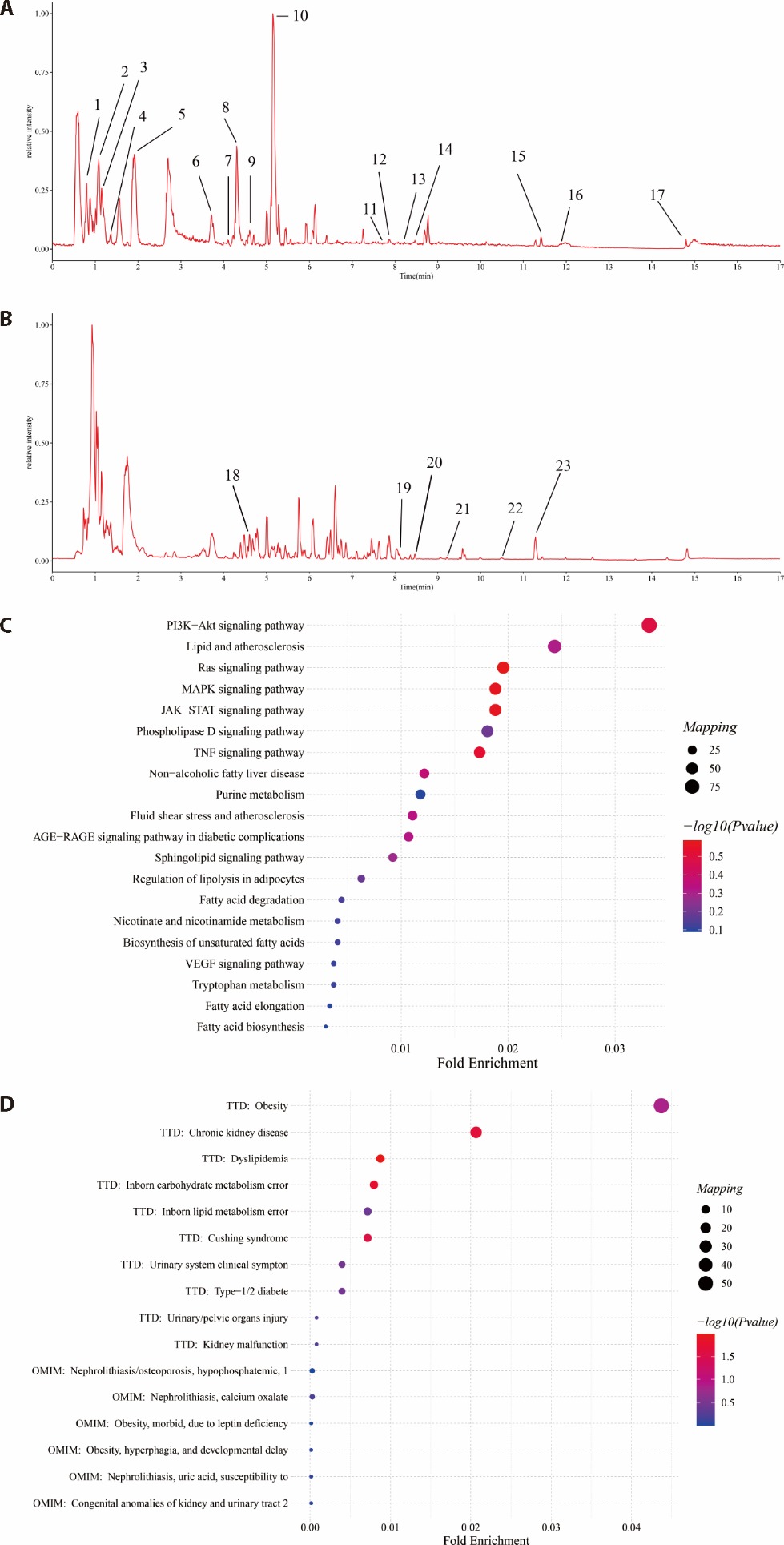
Figure 1 UHPLC-Q/Orbitrap HRMS identification of JSSQW chemical components and network pharmacology analysis A: base peak chromatogram of the JSSQW serum group in positive mode; B: base peak chromatogram of the JSSQW Serum group in negative mode; C: KEGG pathway analysis; D: TTD and OMIM disease enrichment analysis. UHPLC-Q/Orbitrap HRMS: ultra-high performance liquid chromatography combined with tandem electrostatic field orbital trap high-resolution mass spectrometry; JSSQW: Jisheng Shenqi Wan; KEGG: kyoto encyclopedia of genes and genomes; TTD: Therapeutic Target Database; OMIM: Online Mendelian Inheritance in Man.
Figure 1 UHPLC-Q/Orbitrap HRMS identification of JSSQW chemical components and network pharmacology analysis A: base peak chromatogram of the JSSQW serum group in positive mode; B: base peak chromatogram of the JSSQW Serum group in negative mode; C: KEGG pathway analysis; D: TTD and OMIM disease enrichment analysis. UHPLC-Q/Orbitrap HRMS: ultra-high performance liquid chromatography combined with tandem electrostatic field orbital trap high-resolution mass spectrometry; JSSQW: Jisheng Shenqi Wan; KEGG: kyoto encyclopedia of genes and genomes; TTD: Therapeutic Target Database; OMIM: Online Mendelian Inheritance in Man.
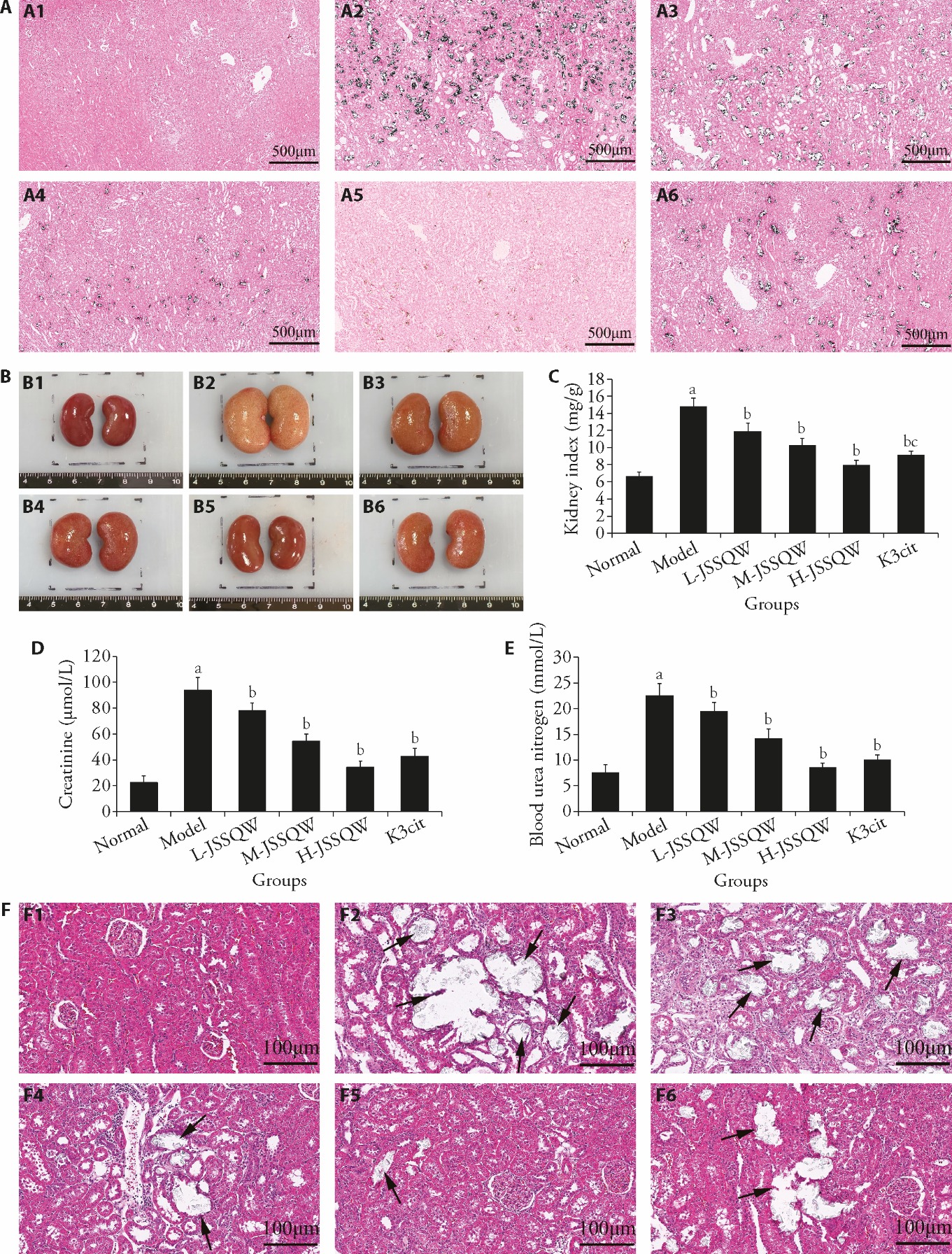
Figure 2 JSSQW inhibits calcium oxalate crystal deposition and renal tubular structural damage in KS rat kidneys and improves renal function A: Von Kossa staining of kidney sections from the different groups; B: appearance of kidneys in the different groups; C: kidney index in rats of different groups; D: serum creatinine levels in rats of different groups; E: blood urea nitrogen levels in rats of different groups; F: HE staining of kidney sections from the different groups. Black arrows indicate damaged renal tubules containing transparent deposits of calcium oxalate crystals; A1, B1, F1: Normal group; A2, B2, F2: Model group; A3, B3, F3: low-dose JSSQW group; A4, B4, F4: middle-dose JSSQW group; A5, B5, F5: high-dose JSSQW group; A6, B6, F6: K3cit group. Normal group: without calcium oxalate kidney stone modeling drug; Model group: without any treatment; low-dose JSSQW group: treated with 1.2 g/kg JSSQW for 4 weeks; middle-dose JSSQW group: treated with 2.4 g/kg JSSQW for 4 weeks; high-dose JSSQW group: treated with 4.8 g/kg JSSQW for 4 weeks; K3cit group: treated with 8 mL/kg K3cit for 4 weeks; JSSQW: Jisheng Shenqi Wan; KS: kidney stones; HE: hematoxylin and eosin staining. One-way analysis of variance was used to compare more than two groups, followed by the least significant difference test to detect differences between groups. The data are presented as the mean ± standard deviation (n = 8). Compared with Normal group, a P < 0.05; compared with Model group, b P < 0.05; compared with high-dose JSSQW group, c P < 0.05.
Figure 2 JSSQW inhibits calcium oxalate crystal deposition and renal tubular structural damage in KS rat kidneys and improves renal function A: Von Kossa staining of kidney sections from the different groups; B: appearance of kidneys in the different groups; C: kidney index in rats of different groups; D: serum creatinine levels in rats of different groups; E: blood urea nitrogen levels in rats of different groups; F: HE staining of kidney sections from the different groups. Black arrows indicate damaged renal tubules containing transparent deposits of calcium oxalate crystals; A1, B1, F1: Normal group; A2, B2, F2: Model group; A3, B3, F3: low-dose JSSQW group; A4, B4, F4: middle-dose JSSQW group; A5, B5, F5: high-dose JSSQW group; A6, B6, F6: K3cit group. Normal group: without calcium oxalate kidney stone modeling drug; Model group: without any treatment; low-dose JSSQW group: treated with 1.2 g/kg JSSQW for 4 weeks; middle-dose JSSQW group: treated with 2.4 g/kg JSSQW for 4 weeks; high-dose JSSQW group: treated with 4.8 g/kg JSSQW for 4 weeks; K3cit group: treated with 8 mL/kg K3cit for 4 weeks; JSSQW: Jisheng Shenqi Wan; KS: kidney stones; HE: hematoxylin and eosin staining. One-way analysis of variance was used to compare more than two groups, followed by the least significant difference test to detect differences between groups. The data are presented as the mean ± standard deviation (n = 8). Compared with Normal group, a P < 0.05; compared with Model group, b P < 0.05; compared with high-dose JSSQW group, c P < 0.05.
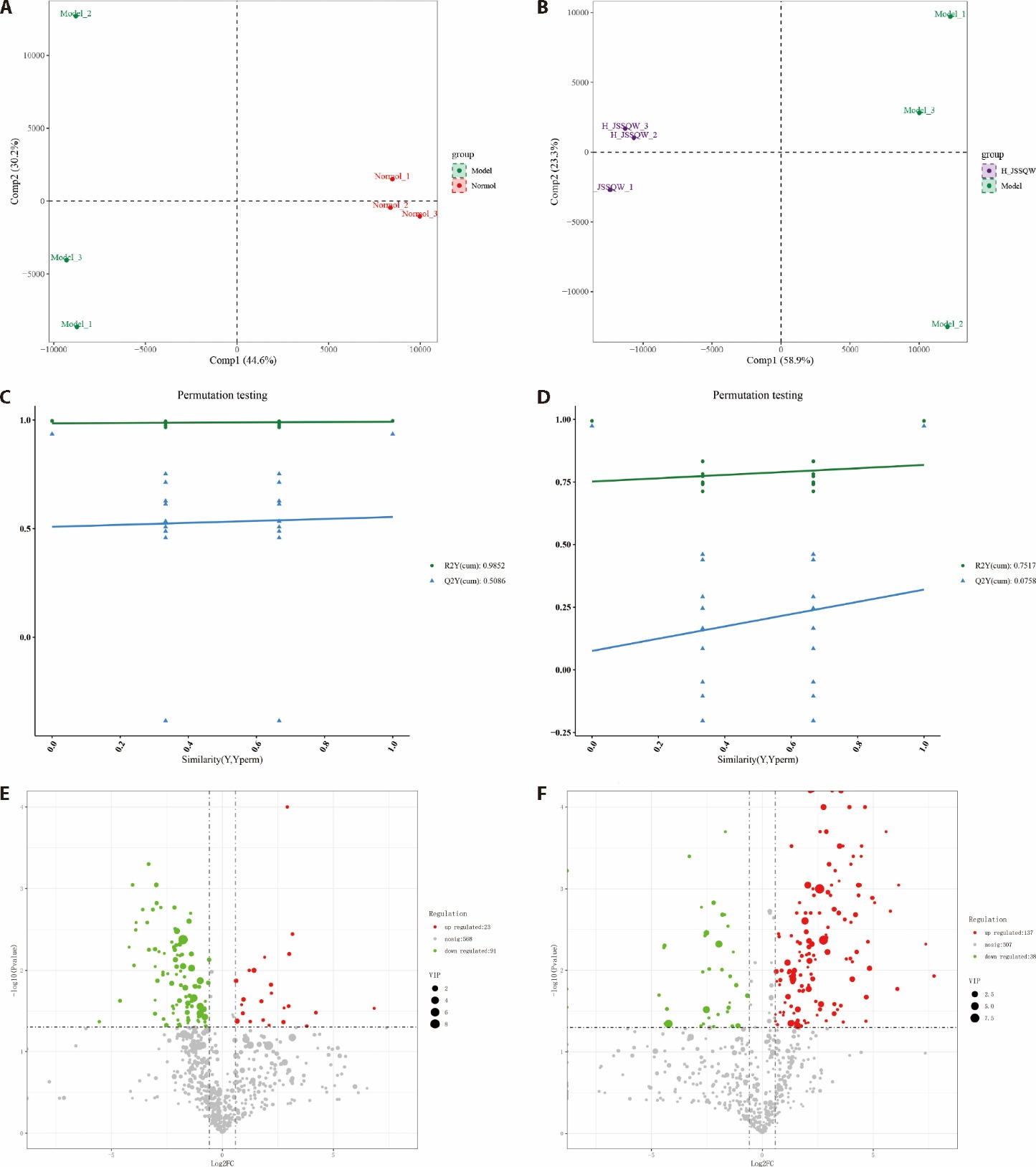
Figure 3 OPLS-DA and volcano plot of serum metabolomics analysis A: OPLS-DA scores of Model vs Normal group; B: OPLS-DA scores of H-JSSQW vs Model group; C: OPLS-DA permutation test analysis of Model vs Normal group; D: OPLS-DA permutation test analysis of H-JSSQW vs Model group; E: volcano plot of Model vs Normal group; F: volcano plot of H-JSSQW vs Model group. H-JSSQW: high-dose JSSQW group; Normal group: without calcium oxalate kidney stone modeling drug; Model group: without any treatment; high-dose JSSQW group: treated with 4.8 g/kg JSSQW for 4 weeks. JSSQW: Jisheng Shenqi Wan; KS: kidney stones; OPLS-DA: orthogonal partial least-squares discriminant analysis.
Figure 3 OPLS-DA and volcano plot of serum metabolomics analysis A: OPLS-DA scores of Model vs Normal group; B: OPLS-DA scores of H-JSSQW vs Model group; C: OPLS-DA permutation test analysis of Model vs Normal group; D: OPLS-DA permutation test analysis of H-JSSQW vs Model group; E: volcano plot of Model vs Normal group; F: volcano plot of H-JSSQW vs Model group. H-JSSQW: high-dose JSSQW group; Normal group: without calcium oxalate kidney stone modeling drug; Model group: without any treatment; high-dose JSSQW group: treated with 4.8 g/kg JSSQW for 4 weeks. JSSQW: Jisheng Shenqi Wan; KS: kidney stones; OPLS-DA: orthogonal partial least-squares discriminant analysis.
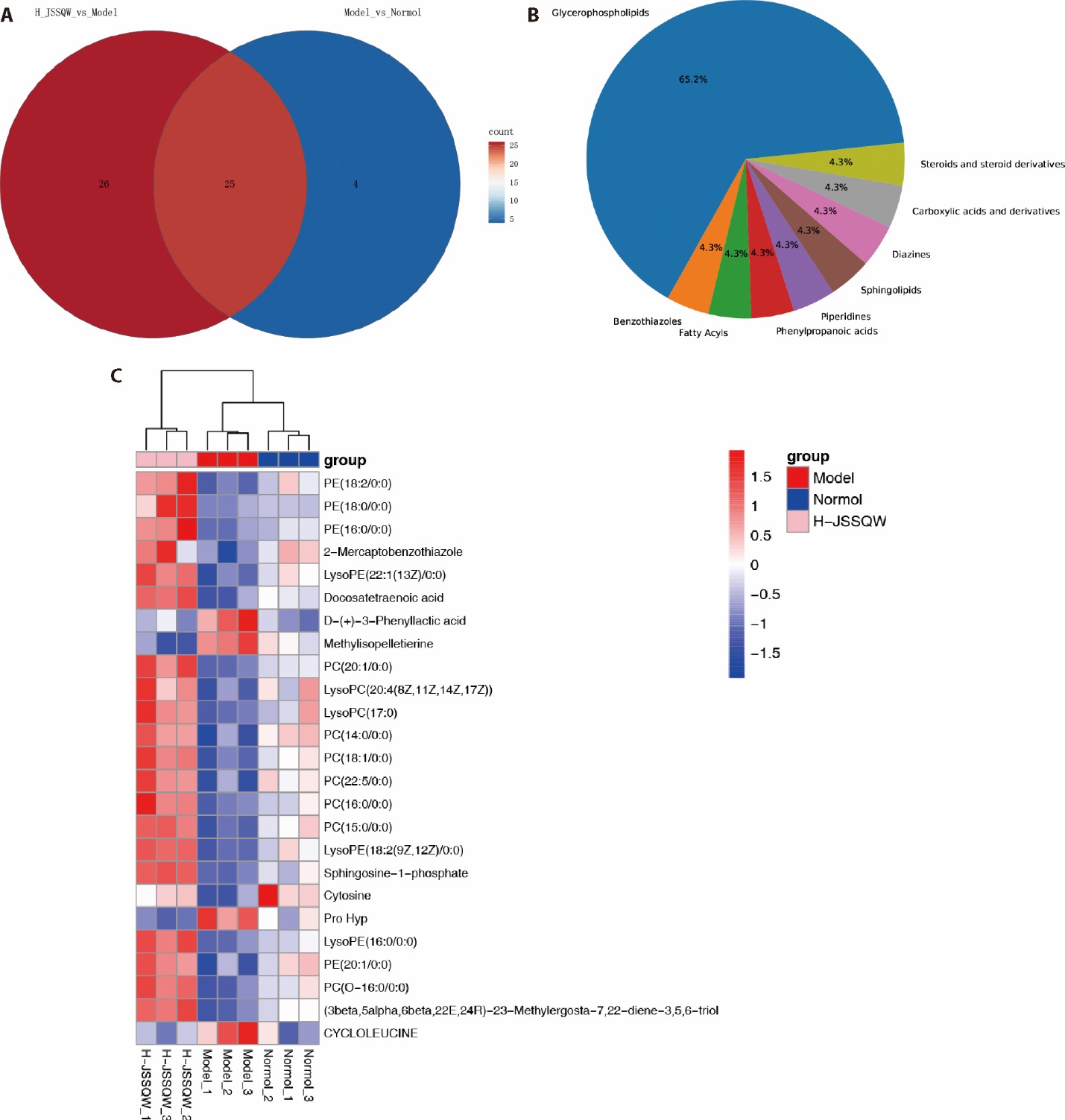
Figure 4 Classification and cluster analysis of differential metabolites A: venn diagrams of Model vs Normal group and H-JSSQW vs Model group; B: pie chart of classification of 25 differential metabolites; C: cluster analysis heatmap of 25 differential metabolites. JSSQW: Jisheng Shenqi Wan; H-JSSQW: high-dose JSSQW group; Normal group: without calcium oxalate kidney stone modeling drug; Model group: without any treatment; high-dose JSSQW group: treated with 4.8 g/kg JSSQW for 4 weeks.
Figure 4 Classification and cluster analysis of differential metabolites A: venn diagrams of Model vs Normal group and H-JSSQW vs Model group; B: pie chart of classification of 25 differential metabolites; C: cluster analysis heatmap of 25 differential metabolites. JSSQW: Jisheng Shenqi Wan; H-JSSQW: high-dose JSSQW group; Normal group: without calcium oxalate kidney stone modeling drug; Model group: without any treatment; high-dose JSSQW group: treated with 4.8 g/kg JSSQW for 4 weeks.
| 1. |
Bishop K, Momah T, Ricks J. Nephrolithiasis. Prim Care 2020; 47: 661-71.
DOI PMID |
| 2. |
Rodgers A, Trinchieri A. Fifty years of basic and clinical renal stone research: have we achieved major breakthroughs? A debate. Curr Opin Nephrol Hypertens 2023; 32: 177-82.
DOI URL |
| 3. |
Zeng G, Mai Z, Xia S, et al. Prevalence of kidney stones in China: an ultrasonography based cross-sectional study. BJU Int 2017; 120: 109-16.
DOI PMID |
| 4. | Dong CT, Song C, He ZQ, et al. An overview of global research landscape in etiology of urolithiasis based on bibliometric analysis. Urolithiasis 2023; 51: 71. |
| 5. |
Ye Z, Zeng G, Yang H, et al. The status and characteristics of urinary stone composition in China. BJU Int 2020; 125: 801-9.
DOI PMID |
| 6. | Liu H, Zhang Y. Characteristics of Traditional Chinese Medicine syndromes in 296 patients with urolithiasis. Zhong Guo Shi Yan Fang Ji Xue Za Zhi 2023; 29: 209-15. |
| 7. | Wan S, Xu K, Ren LM, et al. Analysis of Traditional Chinese Medicine constitution types among adult urolithiasis patients in Wuhu, China. Altern Ther Health Med 2023; 29: 435-9. |
| 8. |
Jiang QH, Dong CT, He ZQ, Jiang R, Liao WB, Yang SX. Research landscape and pharmacological mechanisms of Traditional Chinese Medicines in treating and preventing urolithiasis: unearthing an anti-urolithic treasure trove. J Ethnopharmacol 2024; 334: 118502.
DOI URL |
| 9. | Shi B, Zhao F, Xie L, et al. Discussion on the prevention and treatment of urolithiasis by integrated Traditional Chinese and Western Medicine based on Shen-kidney theory. Zhong Yi Za Zhi 2024; 65: 572-6, 99. |
| 10. |
Lin PH, Lin SK, Hsu RJ, Cheng KC, Liu JM. The use and the prescription pattern of Traditional Chinese Medicine among urolithiasis patients in Taiwan: a population-based study. J Altern Complement Med 2016; 22: 88-95.
DOI URL |
| 11. | Dong CT, Zhou JW, Su XZ, et al. Understanding formation processes of calcareous nephrolithiasis in renal interstitium and tubule lumen. J Cell Mol Med 2024; 28: e18235. |
| 12. |
Bao D, Zhang HM, Wang JW, Wang Y, Wang SX, Zhao MH. Determinants on urinary excretion of oxalate and other key factors related to urolithiasis among patients with chronic kidney disease: a single center study. Urolithiasis 2023; 51: 88.
DOI PMID |
| 13. |
Khan A. In vitro and in vivo models for the study of urolithiasis. Urologia 2018; 85: 145-9.
DOI URL |
| 14. | Li C. Thoughts on in vitro pharmacological research methods of Chinese herbal compound. Zhong Hua Zhong Yi Yao Za Zhi 2023; 38: 1441-4. |
| 15. |
Wu JS, Zhang FQ, Li ZZ, Jin WY, Shi Y. Integration strategy of network pharmacology in Traditional Chinese Medicine: a narrative review. J Tradit Chin Med 2022; 42: 479-86.
DOI |
| 16. |
Duan X, Wang N, Peng D. Application of network pharmacology in synergistic action of Chinese herbal compounds. Theor Biosci 2024; 143: 195-203.
DOI PMID |
| 17. |
Mosley JD, Dunn WB, Kuligowski J, et al. Metabolomics 2023 workshop report: moving toward consensus on best QA/QC practices in LC-MS-based untargeted metabolomics. Metabolomics 2024; 20: 73.
DOI |
| 18. |
Skogvold HB, Sand ES, Elgstoen KBP. Global metabolomics using LC-MS for clinical applications. Methods Mol Biol 2025; 2855: 23-39.
DOI PMID |
| 19. | Thongprayoon C, Lieske JC, Rule AD, Denic A.Authors' reply: urine metabolomic versus standard chemistry analysis: what can metabolomic analysis bring to the treatment and prevention of urolithiasis? J Am Soc Nephrol 2023; 34: 1124-5. |
| 20. |
Zhu W, Li H, Zhang M, Ji B, Liu Z. Plasma metabolites as potential markers and targets to prevent and treat urolithiasis: a Mendelian randomization study. Front Mol Biosci 2024; 11: 1426575.
DOI URL |
| 21. |
Wang R, Qi S, Zhang J, Ren H, Xie L, Liu C. Nontargeted urine metabolomics with electrospray ionization-mass spectrometry reveals the major metabolic characterization between adult males and females involved in calcium oxalate urolithiasis. Anal Lett 2024; 57: 1369-80.
DOI URL |
| 22. |
Tran TVM, Li X, Adams-Huet B, Maalouf NM. Impact of age and renal function on urine chemistry in patients with calcium oxalate kidney stones. Urolithiasis 2021; 49: 495-504.
DOI PMID |
| 23. |
Tan ZL, Hong J, Sun AC, Ding MD, Shen JW. Causal effects of circulating lipids and lipid-lowering drugs on the risk of urinary stones: a Mendelian randomization study. Front Endocrinol 2023; 14: 1301163.
DOI URL |
| 24. | Wang D, Zhang D, Zhang L, Shi F, Zhu Y. Association between triglyceride-glucose index and risk of kidney stone: a Chinese population-based case-control study. BMJ Open 2024; 14: e086641. |
| 25. |
Kuo A, Hla T. Regulation of cellular and systemic sphingolipid homeostasis. Nat Rev Mol Cell Biol 2024; 25: 802-21.
DOI |
| 26. |
Lee M, Lee SY, Bae Y-S. Functional roles of sphingolipids in immunity and their implication in disease. Exp Mol Med 2023; 55: 1110-30.
DOI PMID |
| 27. |
McCluskey G, Donaghy C, Morrison KE, McConville J, Duddy W, Duguez S. The role of sphingomyelin and ceramide in motor neuron diseases. J Pers Med 2022; 12: 1418.
DOI URL |
| 28. |
Mallela SK, Merscher S, Fornoni A. Implications of sphingolipid metabolites in kidney diseases. Int J Mol Sci 2022; 23: 4244.
DOI URL |
| 29. | Chao YF, Li N, Xiong SL, Zhang GB, Gao SY, Dong X.Lipidomics based on liquid chromatography-high resolution mass spectrometry reveals the protective role of peroxisome proliferator-activated receptor alpha on kidney stone formation in mice treated with glyoxylate. J Sep Sci 2023; 46: e2300452. |
| 30. | Chen W, Liu WR, Hou JB, et al. Metabolomic analysis reveals a protective effect of Fu-Fang-Jin-Qian-Chao herbal granules on oxalate-induced kidney injury. Biosci Rep 2019; 39: BSR20181833. |
| Viewed | ||||||
|
Full text |
|
|||||
|
Abstract |
|
|||||
