
Journal of Traditional Chinese Medicine ›› 2026, Vol. 46 ›› Issue (1): 14-21.DOI: 10.19852/j.cnki.jtcm.2026.01.002
• Systematic Reviews • Previous Articles Next Articles
Efficacy of Tongxie Yaofang (痛泻要方) compared with pinaverium bromide on irritable bowel syndrome with liver depression and spleen deficiency: a systematic review and Meta-analysis
ZHOU Mi1, BU Huaien1, WANG Dongjun2, ZHANG Naijin1, SUN Xuan1, TIAN Zhikui1, WANG Hongwu1( )
)
- 1 School of Health Science and Engineering, Tianjin University of Traditional Chinese Medicine, Tianjin 301617, China
2 College of Traditional Chinese Medicine, North China University of Science and Technology, Tangshan 063000, China
-
Received:2023-08-22Accepted:2024-03-12Online:2026-02-15Published:2026-01-28 -
Contact:WANG Hongwu, Tianjin University of Traditional Chinese Medicine, Tianjin 301617, China.tjwanghw55@163.com ; Telephone: +86-18621191736 -
Supported by:National Key Basic Research and Development Plan(973 Plan);Research on Traditional Chinese Medicine Original Thinking and Health State Identification Method System(2011CB505406)

Cite this article
ZHOU Mi, BU Huaien, WANG Dongjun, ZHANG Naijin, SUN Xuan, TIAN Zhikui, WANG Hongwu. Efficacy of Tongxie Yaofang (痛泻要方) compared with pinaverium bromide on irritable bowel syndrome with liver depression and spleen deficiency: a systematic review and Meta-analysis[J]. Journal of Traditional Chinese Medicine, 2026, 46(1): 14-21.
share this article
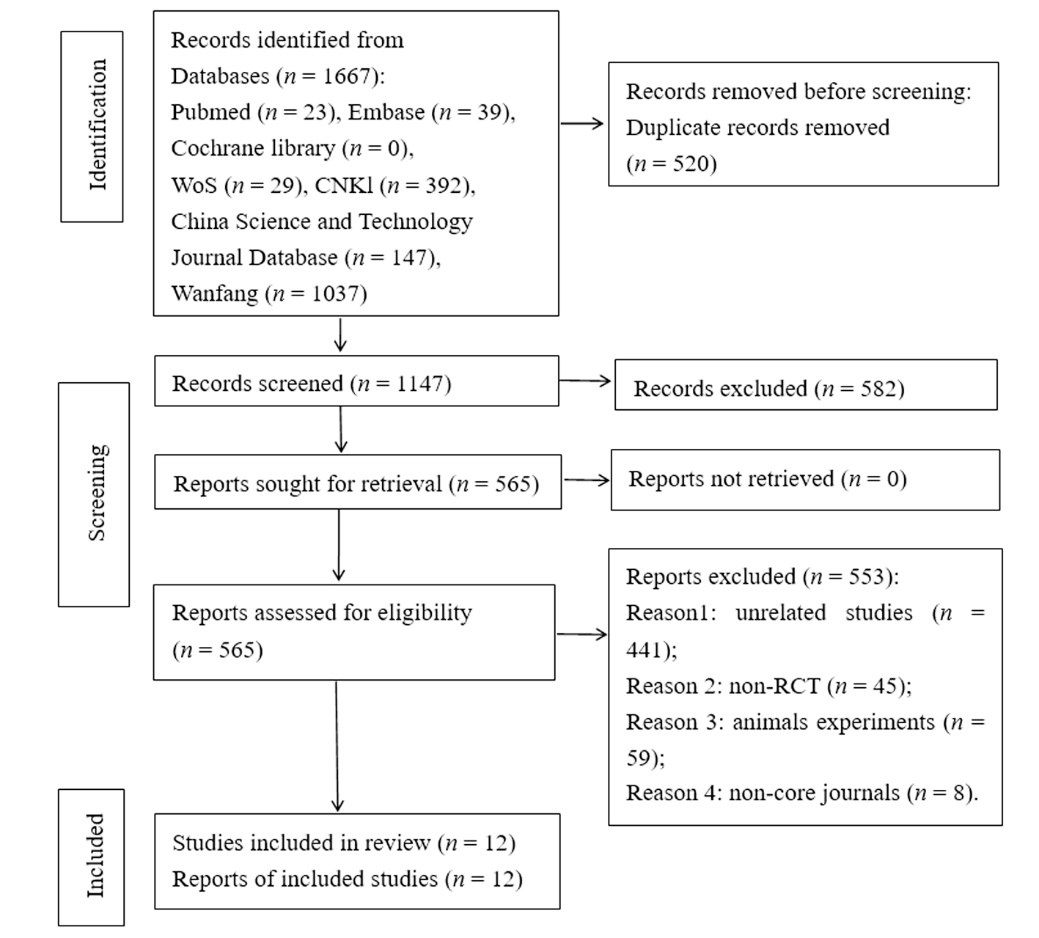
Figure 1 Literature search flowchart CNKI: China National Knowledge Infrastructure Database; WOS:Web of Science; RCT: randomized controlled trial.
Figure 1 Literature search flowchart CNKI: China National Knowledge Infrastructure Database; WOS:Web of Science; RCT: randomized controlled trial.
Table 1 Basic information on patients with IBS-D
| Study | Sample size (T/C) | Age (mean or range) (T/C) | Course of the disease (mean or range) (T/C) | Intervention | Duration of use (days) | Outcome | Randomization method | Blinding method | Baseline differences | |
|---|---|---|---|---|---|---|---|---|---|---|
| T | C | |||||||||
| Chen JL et al 2016 12 | 30/30 | 43.2±18.3, 42.1±17.5 | 2.87±12.6, 2.63±1.19a | TXYF+- | PB | 30 | 2 | 2 | No | No |
| Fu R et al 2018 | 58/57 | 36.72±10.9, 37.10±10.32 | 5.79±4.94, 5.88±4.26a | TXYF+- | PB | 30 | 1, 2 | 2 | No | No |
| Ge F et al 2016 | 62/62 | 36.8±7.2, 37.4±6.7 | 3.8±2.9, 4.1±3.1a | TXYF+- | PB | 30 | 1, 4 | 1 | No | No |
| Huang S et al 2015 | 30/30 | 46.23±14.30, 49.73±12.77 | 1.51±0.74, 1.39±0.63a | TXYF | PB | 28 | 1, 2 | 2 | No | No |
| Li L et al 2020 | 28/28 | 38.32±12.35, 39.83±14,76 | 10.20±2.32, 9.37±3.21b | TXYF+- | PB | 30 | 1, 2, 3 | 4 | No | No |
| Liu Let al 2011 | 24/22 | 43.55±13.79, 38.70±10.76 | 6.30±5.52, 5.61±5.51a | TXYF+- | PB | 28 | 1, 2, 4 | 1 | No | No |
| Ma J et al 2007 | 45/40 | 40.3 | 4.5a | TXYF+- | PB | 60 | 1, 5 | 1 | No | Not refer |
| Peng MZ et al 2014 | 27/23 | Not refer | Not refer | TXYF+- | PB | 28 | 1, 2 | 3 | Yes | No |
| Wang SS et al 2020 | 41/41 | 29±6,26±5 | 3.5±1.4,3.6±1.3a | TXYF | PB | 28 | 1, 2, 3, 5, 6 | 3 | No | No |
| Wang XR et al 2022 | 84/84 | 36.5±8.7, 37.9±7.3 | 3.7±1.2, 3.1±1.1a | TXYF | PB | 28 | 1, 2, 3 | 3 | No | No |
| Yao SJ et al 2020 | 58/58 | 34.5±6.7, 33.9±5.3 | 2.3±1.2, 2.5±1.3a | TXYF | PB | 28 | 1, 2, 3, 5, 6 | 2 | No | No |
| Ye B et al 2013 | 48/48 | 20-65, 20-65 | Not refer | TXYF+- | PB | 28 | 1 | 1 | No | No |
Table 1 Basic information on patients with IBS-D
| Study | Sample size (T/C) | Age (mean or range) (T/C) | Course of the disease (mean or range) (T/C) | Intervention | Duration of use (days) | Outcome | Randomization method | Blinding method | Baseline differences | |
|---|---|---|---|---|---|---|---|---|---|---|
| T | C | |||||||||
| Chen JL et al 2016 12 | 30/30 | 43.2±18.3, 42.1±17.5 | 2.87±12.6, 2.63±1.19a | TXYF+- | PB | 30 | 2 | 2 | No | No |
| Fu R et al 2018 | 58/57 | 36.72±10.9, 37.10±10.32 | 5.79±4.94, 5.88±4.26a | TXYF+- | PB | 30 | 1, 2 | 2 | No | No |
| Ge F et al 2016 | 62/62 | 36.8±7.2, 37.4±6.7 | 3.8±2.9, 4.1±3.1a | TXYF+- | PB | 30 | 1, 4 | 1 | No | No |
| Huang S et al 2015 | 30/30 | 46.23±14.30, 49.73±12.77 | 1.51±0.74, 1.39±0.63a | TXYF | PB | 28 | 1, 2 | 2 | No | No |
| Li L et al 2020 | 28/28 | 38.32±12.35, 39.83±14,76 | 10.20±2.32, 9.37±3.21b | TXYF+- | PB | 30 | 1, 2, 3 | 4 | No | No |
| Liu Let al 2011 | 24/22 | 43.55±13.79, 38.70±10.76 | 6.30±5.52, 5.61±5.51a | TXYF+- | PB | 28 | 1, 2, 4 | 1 | No | No |
| Ma J et al 2007 | 45/40 | 40.3 | 4.5a | TXYF+- | PB | 60 | 1, 5 | 1 | No | Not refer |
| Peng MZ et al 2014 | 27/23 | Not refer | Not refer | TXYF+- | PB | 28 | 1, 2 | 3 | Yes | No |
| Wang SS et al 2020 | 41/41 | 29±6,26±5 | 3.5±1.4,3.6±1.3a | TXYF | PB | 28 | 1, 2, 3, 5, 6 | 3 | No | No |
| Wang XR et al 2022 | 84/84 | 36.5±8.7, 37.9±7.3 | 3.7±1.2, 3.1±1.1a | TXYF | PB | 28 | 1, 2, 3 | 3 | No | No |
| Yao SJ et al 2020 | 58/58 | 34.5±6.7, 33.9±5.3 | 2.3±1.2, 2.5±1.3a | TXYF | PB | 28 | 1, 2, 3, 5, 6 | 2 | No | No |
| Ye B et al 2013 | 48/48 | 20-65, 20-65 | Not refer | TXYF+- | PB | 28 | 1 | 1 | No | No |
| 1. |
Mearin F, Lacy BE, Chang L, et al. Bowel disorders. Gastroenterology 2016; 150: 1393-407.
DOI |
| 2. | Wen YD, Li BS, Wang Y G, et al. Guidelines for the treatment of irritable bowel syndrome in Chinese medicine, a common disease of the digestive system (primary care physician version). Zhong Hua Zhong Yi Yao Za Zhi 2020; 35: 3518-23. |
| 3. | Zhang KB, Li X, Zhang L, Li Y, Li C. Current status of Chinese and Western Medicine research on diarrheal irritable bowel syndrome. Zhong Guo Zhong Xi Yi Jie He Xiao Hua Za Zhi 2021; 29: 298-302. |
| 4. | Long Y. Prevalence and risk factors for functional bowel disorders in South China: apopulation based study using the Rome III criteria. Neurogastroenterol Mot 2017; 29: e12897. |
| 5. | Zhao Q, Zhang M, Zhao W, et al. Research progress on the material basis and pharmacological effects of painful diarrhea essential formula. Zhong Guo Shi Yan Fang Ji Xue Za Zhi 2022; 12: 1-9. |
| 6. | Man S, Liu H, Wang L, Bian Y. Analysis of the mechanism of heterogeneous treatment of irritable bowel syndrome and depression based on the network pharmacology of pain and diarrhea formula. Tianjin Yao Xue 2022; 34: 13-9. |
| 7. | Lu L, Zhu R, Zhu L. Clinical observation on the treatment of irritable bowel syndrome caused by liver-depression and spleen-deficiency with the addition and subtraction of Shuhelian drink. Zhong Guo Zhong Xi Yi Jie He Xiao Hua Za Zhi 2020; 28: 901-5. |
| 8. | Lai JM, Chen ZY, He SY, et al. Observation on the effect of adding the formula for painful diarrhea in the treatment of patients with D-IBS with anxiety state. Zhong Wai Yi Xue Yan Jiu 2019; 17: 161-3. |
| 9. | Li Xi, Xu P, Ge B, et al. Effects of paeoniflorin on irritable bowel syndrome and the barrier function of intestinal epithelial cells. Guo Ji Yao Xue Yan Jiu Za Zhi 2017; 44: 958-64. |
| 10. |
Tian DD, Wang M, Liu A, et al. Antidepressant effect of paeoniflorin is through inhibiting pyroptosis CASP-11/GSDMD pathway. Mol Neurobiol 2020, 58: 761-76.
DOI |
| 11. | Li JX, Chen XX, Tang XD, Bian LQ. Consensus opinion on the combined diagnosis and treatment of irritable bowel syndrome in Chinese and Western Medicine (2017). Zhong Guo Zhong Xi Yi Jie He Xiao Hua Za Zhi 2018; 26: 227-32. |
| 12. | Chen JL, Chen JF, Deng JM, et al. Effects of adding the formula for painful diarrhea on the content of 5-hydroxytryptamine and its receptor mRNA expression in the small intestinal mucosa of patients with irritable bowel syndrome with liver depression and spleen deficiency. Zhong Guo Zhong Xi Yi Jie He Xiao Hua Za Zhi 2016; 24: 442-5. |
| 13. | Fu R, Chen QG, Liu SY, et al. Clinical study on the treatment of diarrhea-type irritable bowel syndrome with Xinjia painful diarrhea essentials formula. Zhong Hua Zhong Yi Yao Za Zhi 2018; 33: 2681-6. |
| 14. | Ge F, Ji Y, Sun ZG, et al. Treatment of diarrhea-type irritable bowel syndrome with Jiangyou I formula and its mechanism. Nanjing Zhong Yi Yao Da Xue Xue Bao 2016; 32: 213-6. |
| 15. | Huang S, Liang J, Deng TH, et al. Clinical observation on the treatment of diarrhea-type irritable bowel syndrome with liver-depression and spleen-deficiency evidence by An Yin Tang. Hunan Zhong Yi Za Zhi 2015; 31: 11-3. |
| 16. | Li L, Jiang DF, Zhang PF, Wang L. Clinical observation of 28 cases of irritable bowel syndrome with liver-depression and spleen-deficiency diarrhea treated with Wu Yin therapy combined with painful diarrhea essentials plus. Hunan Zhong Yi Za Zhi 2020; 36: 48-50. |
| 17. | Liu L, Liu JF, Gao F. A randomized controlled observation on the treatment of diarrhea-type irritable bowel syndrome with the addition of painful diarrhea essentials formula. Zhong Yi Yao Xin Xi 2011; 28: 106-7. |
| 18. | Ma J, Pan JY. Effect of adding the formula for painful diarrhea on gastrointestinal hormones in patients with diarrhea-type irritable bowel syndrome. Xian Dai Zhong Yi Xi Jie He Za Zhi 2007; 21: 2969-70. |
| 19. | Peng MZ, Wang SY, Li X, et al. Clinical study on the treatment of diarrhea-type irritable bowel syndrome with the method of dredging the liver and strengthening the spleen. Shi Jie Zhong Yi Yao 2014; 12: 1595-8. |
| 20. | Wang SS, Wang XR, Yang RY, Xu Y, Li MY. Study on the efficacy and mechanism of acupuncture combined with painful diarrhea formula in treating diarrhea-type irritable bowel syndrome with liver-depression and spleen-deficiency evidence. Zhong Guo Zhen Jiu 2020; 40: 605-9. |
| 21. | Wang XR, Fu WB, Sun YQ, et al. Clinical efficacy of pain and drainage essentials formula in relieving visceral hypersensitivity in patients with diarrhea-type irritable bowel syndrome with liver-depression and spleen-deficiency evidence. Zhong Guo Shi Yan Fang Ji Xue Za Zhi 2022; 28: 97-102. |
| 22. | Yao SJ, Wang XR, Zhang MM. Clinical efficacy and mechanism of painful diarrhea essentials formula in patients with liver-depression and spleen-deficiency type IBS-D. Zhong Guo Shi Yan Fang Ji Xue Za Zhi 2020; 26: 107-13. |
| 23. | Ye B, Chen J, Ning LQ, et al. Clinical study on the treatment of diarrhea-type irritable bowel syndrome with the formula for regulating the liver and transporting the spleen. Nanjing Zhong Yi Yao Da Xue Xue Bao 2013; 29: 314-6. |
| 24. | State Administration of Traditional Chinese Medicine. Guiding principles for clinical research on new Chinese medicines. Beijing: China Medical Science Press, 2002: 139-43. |
| 25. | Huang F, Xie L, Xu Z. Effect of cognitive intervention on psychological well-being and compliance with nursing measures in patients undergoing surgery for chronic rhinosinusitis. Chongqing Yi Xue 2017; 46: 2303-4. |
| 26. | Liu HH, Liu XD, Wang YJ, et al. Effects of acupuncture on VIP and AQP8 expression in colon tissue of rats with D-IBS model. Zhong Guo Zhen Jiu 2012; 32: 919-24. |
| 27. | Chen Y, Cui Y, Jiang LS, et al. Correlation between Chinese medical evidence and brain and intestinal peptides in diarrheal irritable bowel syndrome with overlapping gastroesophageal reflux disease. Shi Zhen Guo Yi Guo Yao 2018; 29: 3039-41. |
| 28. |
Cryan JF, Dinan TG. Mind-altering microorganisms: the impact of the gut microbiota on brain and behaviour. Nat Rev Neurosci 2012; 13: 701-12.
DOI PMID |
| 29. | Chu GW. Research and explanation of TXYF. Zhong Hua Zhong Yi Yao Xue Kan 2006; 11: 2036-7. |
| 30. |
Liang SB, Cao HJ, Kong LY, et al. Systematic review and analysis of Chinese herbal formula Tongxie Yaofang for diarrhea-predominant irritable bowel syndrome: evidence for clinical practice and future trials. Front Pharmacol 2022; 13: 904657
DOI URL |
| 31. |
Bouchoucha M, Faye A, Devroede G, et al. Effects of oral pinaverium bromide on collonic response to food in irritable bowel syndrome patients. Biomed Pharmacother 2000; 54: 381-7.
PMID |
| 32. |
Lembo A, Sultan S, Chang L, Heidelbaugh JJ, Smalley W, Verne GN. AGA clinical practice guideline on the pharmacological management of irritable bowel syndrome with diarrhea. Gastroenterology 2022; 163: 137-51.
DOI PMID |
| 33. | Ruepert L, Quartero AO, de Wit NJ, et al. Bulking agents,antispasmodics and antidepressants for the treatment of irritable bowel syndrome. Cochrane Database Syst Rev 2011; CD003460. |
| 34. | Chen JP, Chen K. Clinical observation on the treatment of diarrhea-type irritable bowel syndrome with prolotherapy combined with pivetonium bromide tablets. Hebei Zhong Yi Yao 2016; 38: 239-42. |
| [1] | YUAN Jianan, CHENG Kunming, LI Chao, ZHANG Xiang, DING Zeyu, LI Bing, ZHENG Yongqiu. Atractylenolide I ameliorates post-infectious irritable bowel syndrome by inhibiting the polymerase I and transcript release factor and c-Jun N-terminal kinase/inducible nitric oxide synthase pathway [J]. Journal of Traditional Chinese Medicine, 2025, 45(1): 57-65. |
| [2] | ZHANG Fang, YAN Cuina, WENG Zhijun, WU Luyi, QI Li, ZHAO Min, XIN Yuhu, WU Huangan, LIU Huirong. Regulatory role of electroacupuncture on satellite glial cell activity in the colon and dorsal root ganglion of rats with irritable bowel syndrome [J]. Journal of Traditional Chinese Medicine, 2024, 44(5): 981-990. |
| [3] | SUN Mengzhu, ZHANG Yujie, SONG Yafang, GUO Jing, WANG Yuhang, XIN Chen, GU Dongmei, SUN Jianhua, PEI Lixia. Electroacupuncture alleviates water avoidance stress-induced irritable bowel syndrome in mice by improving intestinal barrier functions and suppressing the expression of inflammatory cytokines [J]. Journal of Traditional Chinese Medicine, 2023, 43(3): 494-500. |
| [4] | FENG Min, JIA Ziming, WAN Ming, FAN Bolin, TANG Xiaoqiao, CHENG Wenhua, SUN Fanzhong. Effectiveness of Fuling (Poria) and its extracts against spleen deficiency in rats via tonifying spleen [J]. Journal of Traditional Chinese Medicine, 2023, 43(3): 501-506. |
| [5] | SUN Mengzhu, ZHANG Yujie, SONG Yafang, GUO Jing, ZHAO Tingting, WANG Yuhang, PEI Lixia, SUN Jianhua. Electroacupuncture at Tianshu (ST25) and Zusanli (ST36) alleviates stress-induced irritable bowel syndrome in mice by modulating gut microbiota and corticotropin-releasing factor [J]. Journal of Traditional Chinese Medicine, 2022, 42(5): 732-740. |
| [6] | Wang Yuxian, Zhang Shengsheng, Zhou Qiang, Meng Meng, Chen Wenwen. Efficacy of Shenlingbaizhu formula on irritable bowel syndrome: a systematic review [J]. Journal of Traditional Chinese Medicine, 2020, 40(6): 897-907. |
| [7] | Song Yafang, Geng Hao, Chen Lu, Wu Xiaoliang, Yuan Mengqian, Xu Wanli, Guo Jing, Sun Jianhua, Pei Lixia. Electroacupuncture relieves irritable bowel syndrome by increasing expression of nucleotide-binding oligomerization domain protein-like receptor family pyrin domain containing 6 in water-avoidance stress mice [J]. Journal of Traditional Chinese Medicine, 2020, 40(3): 407-413. |
| [8] | Lin Yongjun, Ding Ying, Lü Bin, Liu Nan. Effect of Tongxieyaofang decoction on colonic mucosal protein expression profiles in rats with visceral hypersensitivity [J]. Journal of Traditional Chinese Medicine, 2020, 40(2): 245-252. |
| [9] | Xiong Ying, Song Zhixiu, Gu Yun, Qin Yuhang, Wei Jiangfei, Lu Jinlu, Zhu Yan. Effect of chiropractic manipulation on disrupted epithelium barrier and its mechanism of specialized pro-resolving mediators in a spleen-deficiency murine model [J]. Journal of Traditional Chinese Medicine, 2019, 39(05): 678-684. |
| [10] | Yang Ling, Lu Yuan, Zhang Haifeng, Ma Xiaopeng, Bao Chunhui, Wu Huangan, Zhao Chen, Ding Guanghong, Qi Li, Zhou Shuang. Effect of warming moxibustion Tianshu(ST 25, bilateral) and Qihai(CV 6) for the treatment of diarrhea-dominant irritable bowel syndrome: a patient-blinded pilot trial with orthogonal design [J]. Journal of Traditional Chinese Medicine, 2017, 37(04): 538-545. |
| [11] | Lu Zhenzhong, Yin Xiaojun, Teng Weijun, Chen Yuehua, Sun Jie, Zhao Jimeng, Wang Anqi, Bao Chunhui, Shi Yin. Comparative effect of electroacupuncture and moxibustion on the expression of substance P and vasoactive intestinal peptide in patients with irritable bowel syndrome [J]. Journal of Traditional Chinese Medicine, 2015, 35(04): 402-410. |
| [12] | Yang Zemin, Lin Jing, Chen Longhui, Zhang Min, Yang Xiaorong, Chen Weiwen. Influences of AMY1 gene copy number and protein expression on salivary alpha-amylase activity before and after citric acid stimulation in splenic asthenia children [J]. Journal of Traditional Chinese Medicine, 2015, 35(03): 266-272. |
| [13] | Jie Wu, Qing Li, Lin Chen, Dehua Tian. Clinical research on using acupuncture to treat female adult abdominal obesity with spleen deficiency and exuberant dampness [J]. Journal of Traditional Chinese Medicine, 2014, 34(03): 274-278. |
| [14] | Qianwen Li, Fengbin Liu, Zhengkun Hou, Di Luo. Treatment of constipation-predominant irritable bowel syndrome by focusing on the liver in terms of Traditional Chinese Medicine:a meta-analysis [J]. Journal of Traditional Chinese Medicine, 2013, 33(05): 562-571. |
| [15] | Xiaolan Su, Yanping Tang, Jing Zhang, Yuebin Dong, Wei Wei, Yibing Bai, Yong Liu. Curative effect of warming kidney and fortifying spleen recipe on diarrhea-predominant irritable bowel syndrome [J]. Journal of Traditional Chinese Medicine, 2013, 33(05): 615-619. |
| Viewed | ||||||
|
Full text |
|
|||||
|
Abstract |
|
|||||
