
Journal of Traditional Chinese Medicine ›› 2026, Vol. 46 ›› Issue (1): 110-118.DOI: 10.19852/j.cnki.jtcm.2026.01.010
• Original Articles • Previous Articles Next Articles
Network pharmacological and experimental validation of the mechanism of Chaihu Guizhi Ganjiang decoction (柴胡桂枝干姜汤) regulating T helper cell 17/regulatory T cell balance to improve autoimmune hepatitis
LIANG Zihao1,2, GAO Jie1,2, SONG Jinyun1,2, ZHENG Qin2( ), ZHAO Hongyu1,2()
- 1 Clinical Research Center, the Second Hospital of Nanjing, Nanjing University of Chinese Medicine, Nanjing 210023, China
2 Department of Oncology, the Second Hospital of Nanjing, Nanjing University of Chinese Medicine, Nanjing 210023, China
-
Received:2024-10-14Accepted:2025-05-29Online:2026-02-15Published:2026-01-28 -
Contact:ZHAO Hongyu, Clinical Research Center, the Second Hospital of Nanjing, Nanjing University of Chinese Medicine, Nanjing 210023, China; Department of Oncology, the Second Hospital of Nanjing, Nanjing University of Chinese Medicine, Nanjing 210023, China.njdie001@njucm.edu.cn ; ZHENG Qin, Department of Oncology, the Second Hospital of Nanjing, Nanjing University of Chinese Medicine, Nanjing 210023, China.njyy040@njucm.edu.cn ;Telephone: +86-13814065775 -
Supported by:Nanjing Health Science and Technology Key Medical Science and Technology Development Program: Mechanism of Action of the Modified Si-Miao Powder with Sanguisorba Carbonisata in Regulating Microbiota and Microecology for the Treatment of Recurrent Vulvovaginal Candidiasis(ZKX22039)

Cite this article
LIANG Zihao, GAO Jie, SONG Jinyun, ZHENG Qin, ZHAO Hongyu. Network pharmacological and experimental validation of the mechanism of Chaihu Guizhi Ganjiang decoction (柴胡桂枝干姜汤) regulating T helper cell 17/regulatory T cell balance to improve autoimmune hepatitis[J]. Journal of Traditional Chinese Medicine, 2026, 46(1): 110-118.
share this article
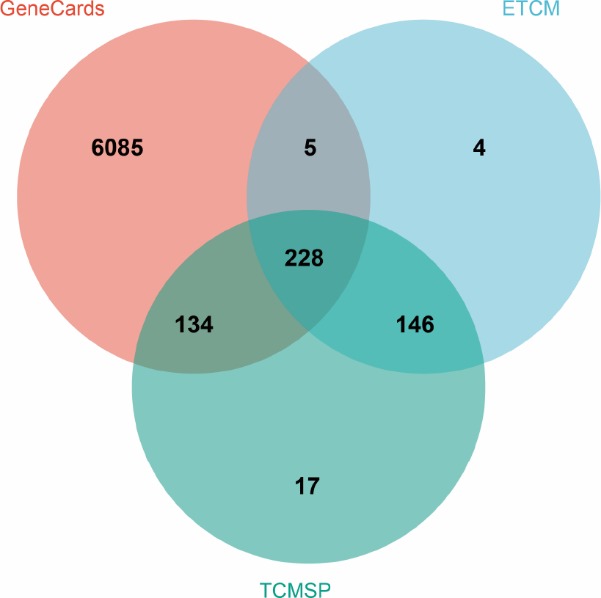
Figure 1 Venn diagram of the AIH and CGGD target genes ETCM: Encyclopedia of Traditional Chinese Medicine; TCMSP: Traditional Chinese Medicine Systems Pharmacology Database and Analysis Platform; AIH: autoimmune hepatitis; CGGD: Chaihu Guizhi Ganjiang decoction.
Figure 1 Venn diagram of the AIH and CGGD target genes ETCM: Encyclopedia of Traditional Chinese Medicine; TCMSP: Traditional Chinese Medicine Systems Pharmacology Database and Analysis Platform; AIH: autoimmune hepatitis; CGGD: Chaihu Guizhi Ganjiang decoction.

Figure 2 Enrichment analysis of common target genes of AIH and CGGD A: top five significantly enriched terms (P < 0.05) in the biological process (red), cellular component (green), and molecular function (purple) categories according to GO analysis; B: the top 15 significantly enriched KEGG pathways (P < 0.05). GO: Gene Ontology; NMDA: N-methyl-D-aspartic acid; PI3K: phosphoinositide 3-kinase; AKT: protein kinase B; cAMP: cyclic adenosine monophosphate; Rap 1: ras-proximate-1; NOD: nucleotide-binding Oligomerization; MAPK: mitogen-activated protein kinase; NF-kapper B: nuclear factor kappa-B; Th17: T helper cell 17; AIH: autoimmune hepatitis; CGGD: Chaihu Guizhi Ganjiang decoction; KEGG: kyoto encyclopedia of genes and genomes.
Figure 2 Enrichment analysis of common target genes of AIH and CGGD A: top five significantly enriched terms (P < 0.05) in the biological process (red), cellular component (green), and molecular function (purple) categories according to GO analysis; B: the top 15 significantly enriched KEGG pathways (P < 0.05). GO: Gene Ontology; NMDA: N-methyl-D-aspartic acid; PI3K: phosphoinositide 3-kinase; AKT: protein kinase B; cAMP: cyclic adenosine monophosphate; Rap 1: ras-proximate-1; NOD: nucleotide-binding Oligomerization; MAPK: mitogen-activated protein kinase; NF-kapper B: nuclear factor kappa-B; Th17: T helper cell 17; AIH: autoimmune hepatitis; CGGD: Chaihu Guizhi Ganjiang decoction; KEGG: kyoto encyclopedia of genes and genomes.

Figure 3 CGGD alleviates ConA-induced liver injury A: histological changes in the liver were assessed using HE staining. Scale bars = 100 μm; A1: Ctrl group; A2: ConA group; A3: CGGD-L group; A4: CGGD-M group; A5: CGGD-H group; B: activities of and AST; C: activities of ALT. Ctrl Group: 200 μL of normal saline was administered daily for one week, followed by an intravenous injection of 10 μL of normal saline via the tail vein on the eighth day; ConA Group: 200 μL of normal saline was administered daily for one week, followed by an intravenous injection of ConA at a dose of 20 mg/kg according to body weight on the eighth day; CGGD-L Group: received ConA by gavage at doses of 2000, mg/kg once daily for one week prior to model induction; CGGD-M Group: received ConA by gavage at doses of 4000 mg/kg once daily for one week prior to model induction; CGGD-H Group: received ConA by gavage at doses of 8000 mg/kg once daily for one week prior to model induction. AST: aspartate aminotransferase; ALT: alanine aminotransferase; CGGD: Chaihu Guizhi Ganjiang decoction. Statistical differences between groups were analyzed using a one-way analysis of variance. Data were presented as mean ± standard error of the mean (n = 6). Compared with the Ctrl group, aP < 0.01; compared with the ConA group, bP < 0.01; compared with the CGGD-L group, cP < 0.01; compared with the CGGD-M group, dP < 0.01.
Figure 3 CGGD alleviates ConA-induced liver injury A: histological changes in the liver were assessed using HE staining. Scale bars = 100 μm; A1: Ctrl group; A2: ConA group; A3: CGGD-L group; A4: CGGD-M group; A5: CGGD-H group; B: activities of and AST; C: activities of ALT. Ctrl Group: 200 μL of normal saline was administered daily for one week, followed by an intravenous injection of 10 μL of normal saline via the tail vein on the eighth day; ConA Group: 200 μL of normal saline was administered daily for one week, followed by an intravenous injection of ConA at a dose of 20 mg/kg according to body weight on the eighth day; CGGD-L Group: received ConA by gavage at doses of 2000, mg/kg once daily for one week prior to model induction; CGGD-M Group: received ConA by gavage at doses of 4000 mg/kg once daily for one week prior to model induction; CGGD-H Group: received ConA by gavage at doses of 8000 mg/kg once daily for one week prior to model induction. AST: aspartate aminotransferase; ALT: alanine aminotransferase; CGGD: Chaihu Guizhi Ganjiang decoction. Statistical differences between groups were analyzed using a one-way analysis of variance. Data were presented as mean ± standard error of the mean (n = 6). Compared with the Ctrl group, aP < 0.01; compared with the ConA group, bP < 0.01; compared with the CGGD-L group, cP < 0.01; compared with the CGGD-M group, dP < 0.01.
Table 1 mRNA expression levels of cytokine levels
| Group | n | IL-1β | IL-6 | TNF-α | IL-10 |
|---|---|---|---|---|---|
| Ctrl | 6 | 1.00±0.46a | 1.00±0.30a | 1.00±0.22a | 1.00±0.32c |
| ConA | 6 | 27.22±5.50 | 32.98±4.95 | 17.56±3.34 | 2.08±0.39 |
| GCCD-L | 6 | 16.67±4.21a | 25.44±2.26b | 8.82±1.93a | 2.23±0.51 |
| GCCD-M | 6 | 13.16±3.05a | 19.32±2.82a | 6.57±1.01a | 2.41±0.55 |
| GCCD-H | 6 | 5.43±2.06a | 13.99±2.95a | 2.83±0.90a | 4.13±0.91a |
Table 1 mRNA expression levels of cytokine levels
| Group | n | IL-1β | IL-6 | TNF-α | IL-10 |
|---|---|---|---|---|---|
| Ctrl | 6 | 1.00±0.46a | 1.00±0.30a | 1.00±0.22a | 1.00±0.32c |
| ConA | 6 | 27.22±5.50 | 32.98±4.95 | 17.56±3.34 | 2.08±0.39 |
| GCCD-L | 6 | 16.67±4.21a | 25.44±2.26b | 8.82±1.93a | 2.23±0.51 |
| GCCD-M | 6 | 13.16±3.05a | 19.32±2.82a | 6.57±1.01a | 2.41±0.55 |
| GCCD-H | 6 | 5.43±2.06a | 13.99±2.95a | 2.83±0.90a | 4.13±0.91a |

Figure 4 CGGD regulates Th17/Treg homeostasis in ConA-induced AIH in mice A: flow cytometry analysis of CD4+IL-17+ (Th17) in mouse spleen; A1: Ctrl group; A2: ConA group; A3: CGGD-L group; A4: CGGD-M group; A5: CGGD-H group; A6: the quantitative frequency analysis of Th17 cells; B: flow cytometry analysis of CD4+Foxp3+ (Treg) cells in mouse spleen; B1: Ctrl group; B2: ConA group; B3: CGGD-L group; B4: CGGD-M group; B5: CGGD-H group; B6: the quantitative frequency analysis of Treg cells. Control Group: 200 μL of normal saline was administered daily for one week, followed by an intravenous injection of 10 μL of normal saline via the tail vein on the eighth day; ConA Group: 200 μL of normal saline was administered daily for one week, followed by an intravenous injection of ConA at a dose of 20 mg/kg according to body weight on the eighth day; CGGD-L, CGGD-M & CGGD-H Group: received ConA by gavage at doses of 2000, 4000, and 8000 mg/kg once daily for one week prior to model induction. Th17: T helper cell 17; Treg: regulatory T cell. CGGD: Chaihu Guizhi Ganjiang decoction. Statistical differences between groups were analyzed using a one-way analysis of variance. Data were presented as mean ± standard error of the mean (n = 6). Compared with the Ctrl group, aP < 0.01; compared with the ConA group, bP < 0.01; compared with the CGGD-L group, cP < 0.01; compared with the CGGD-M group, d P < 0.01.
Figure 4 CGGD regulates Th17/Treg homeostasis in ConA-induced AIH in mice A: flow cytometry analysis of CD4+IL-17+ (Th17) in mouse spleen; A1: Ctrl group; A2: ConA group; A3: CGGD-L group; A4: CGGD-M group; A5: CGGD-H group; A6: the quantitative frequency analysis of Th17 cells; B: flow cytometry analysis of CD4+Foxp3+ (Treg) cells in mouse spleen; B1: Ctrl group; B2: ConA group; B3: CGGD-L group; B4: CGGD-M group; B5: CGGD-H group; B6: the quantitative frequency analysis of Treg cells. Control Group: 200 μL of normal saline was administered daily for one week, followed by an intravenous injection of 10 μL of normal saline via the tail vein on the eighth day; ConA Group: 200 μL of normal saline was administered daily for one week, followed by an intravenous injection of ConA at a dose of 20 mg/kg according to body weight on the eighth day; CGGD-L, CGGD-M & CGGD-H Group: received ConA by gavage at doses of 2000, 4000, and 8000 mg/kg once daily for one week prior to model induction. Th17: T helper cell 17; Treg: regulatory T cell. CGGD: Chaihu Guizhi Ganjiang decoction. Statistical differences between groups were analyzed using a one-way analysis of variance. Data were presented as mean ± standard error of the mean (n = 6). Compared with the Ctrl group, aP < 0.01; compared with the ConA group, bP < 0.01; compared with the CGGD-L group, cP < 0.01; compared with the CGGD-M group, d P < 0.01.
| 1. |
Wu H, Lou T, Pan M, et al. Chaihu Guizhi Ganjiang decoction attenuates nonalcoholic steatohepatitis by enhancing intestinal barrier integrity and ameliorating PPAR alpha-mediated lipotoxicity. J Ethnopharmacol 2024; 326: 117841.
DOI URL |
| 2. | Sucher E, Sucher R, Gradistanac T, Brandacher G, Schneeberger S, Berg T. Autoimmune hepatitis-immunologically triggered liver pathogenesis-diagnostic and therapeutic strategies. J Immunol Res 2019; 2019: 9437043. |
| 3. |
Komori A. Recent updates on the management of autoimmune hepatitis. Clin Mol Hepatol 2021; 27: 58-69.
DOI PMID |
| 4. |
Zhang Y, Tan R, Gershwin ME, Xiong M. Autoimmune hepatitis: pathophysiology. Clin Liver Dis 2024; 28: 15-35.
DOI PMID |
| 5. |
Feng TT, Zou T, Wang X, Zhao WF, Qin AL. Clinical significance of changes in the Th17/Treg ratio in autoimmune liver disease. World J Gastroenterol 2017; 23: 3832-38.
DOI URL |
| 6. |
Behfarjam F, Nasseri-Moghaddam S, Jadali Z. Enhanced Th17 responses in patients with autoimmune hepatitis. Middle East J Dig Dis 2019; 11: 98-103.
DOI URL |
| 7. | Chen H, Han Z, Fan Y, et al. CD4+ T-cell subsets in autoimmune hepatitis: a review. Hepatol Commun 2023; 7: e0269. |
| 8. | Cerbulo-Vazquez A, Hernandez-Pelaez G, Arriaga-Pizano LA, et al. Characterization of CD127(-) CD25(++) Treg from human colostrum. Am J Reprod Immunol 2018; 79: 2. |
| 9. |
Zhang R, Zhao Y, Chen X, Zhuang Z, Li X, Shen E. Low-dose IL-2 therapy in autoimmune diseases: an update review. Int Rev Immunol 2024; 43: 113-7.
DOI URL |
| 10. | Sun SM (Tang dynasty). Qian Jin Yi Fang. Shanxi: Shanxi Science and Technology Publishing House, 2010: 806. |
| 11. |
Chen GR, Xie XF, Peng C. Treatment of irritable bowel syndrome by Chinese medicine: a review. Chin J Integr Med 2023; 29: 377-84.
DOI |
| 12. |
Cui L, Li C, Shang Y, et al. Chaihu Guizhi Ganjiang decoction ameliorates pancreatic fibrosis via JNK/mTOR signaling pathway. Front Pharmacol 2021; 12: 679557.
DOI URL |
| 13. |
Li M, Zhu J, Liu X, et al. Chaihu-Guizhi-Ganjiang decoction is more efficacious in treating irritable bowel syndrome than Dicetel according to metabolomics analysis. Chin Med 2022; 17: 139.
DOI |
| 14. | Zhang P, Zhang D, Zhou W, et al. Network pharmacology: Towards the artificial intelligence-based precision Traditional Chinese Medicine. Brief Bioinform 2023; 25: 518. |
| 15. |
Lai X, Wang X, Hu Y, Su S, Li W, Li S. Editorial: network pharmacology and traditional medicine. Front Pharmacol 2020; 11: 1194.
DOI PMID |
| 16. |
Li S, Zhang B. Traditional Chinese Medicine network pharmacology: theory, methodology and application. Chin J Nat Med 2013; 11: 110-20.
DOI URL |
| 17. | Ru J, Li P, Wang J, et al. TCMSP: a database of systems pharmacology for drug discovery from herbal medicines. J Cheminform 2014; 6: 13. |
| 18. |
Xu HY, Zhang YQ, Liu ZM, et al. ETCM: An encyclopaedia of Traditional Chinese Medicine. Nucleic Acids Res 2019; 47: D976-82.
DOI URL |
| 19. | Pinero J, Sauch J, Sanz F, Furlong LI. The DisGeNET cytoscape app: exploring and visualizing disease genomics data. Comput Struct Biotechnol J 2021; 19: 2960-7. |
| 20. |
Yang X, Peng WB, Yue XQ. Syndrome differentiation and treatment of Taiyang disease in Shang Han Lun. Zhong Xi Yi Jie He Xue Bao 2009; 7: 171-4.
DOI URL |
| 21. |
Trivedi PJ, Hirschfield GM. Recent advances in clinical practice: epidemiology of autoimmune liver diseases. Gut 2021; 70: 1989-2003.
DOI PMID |
| 22. |
Eskandari-Nasab E, Tahmasebi A, Hashemi M. Meta-analysis: the relationship between CTLA-4 +49 A/G polymorphism and primary biliary cirrhosis and type I autoimmune hepatitis. Immunol Invest 2015; 44: 331-48.
DOI PMID |
| 23. |
Couture A, Garnier A, Docagne F, et al. HLA-class Ⅱ artificialantigen presenting cells in CD4(+) T cell-based immunotherapy. Front Immunol 2019; 10: 1081.
DOI URL |
| 24. |
Muscate F, Woestemeier A, Gagliani N. Functional heterogeneity of CD4(+) T cells in liver inflammation. Semin Immunopathol 2021; 43: 549-61.
DOI |
| 25. |
Lubbering D, Preti M, Schlott L, et al. Autoantigen-selected B cells are bystanders in spontaneous T cell-driven experimental autoimmune hepatitis. Immunology 2023; 170: 214-29.
DOI URL |
| 26. |
Schultheiss C, Simnica D, Willscher E, et al. Next-generation immunosequencing reveals pathological T-cell architecture in autoimmune hepatitis. Hepatology 2021; 73: 1436-48.
DOI URL |
| 27. |
Liu X, Jiang X, Liu R, et al. B cells expressing CD11b effectively inhibit CD4+ T-cell responses and ameliorate experimental autoimmune hepatitis in mice. Hepatology 2015; 62: 1563-75.
DOI PMID |
| 28. |
Christen U. Animal models of autoimmune hepatitis. Biochim Biophys Acta Mol Basis Dis 2019; 1865: 970-81.
DOI URL |
| 29. |
Liu Y, Hao H, Hou T. Concanavalin A-induced autoimmune hepatitis model in mice: mechanisms and future outlook. Open Life Sci 2022; 17: 91-101.
DOI PMID |
| 30. |
Longhi MS, Zhang L, Mieli-Vergani G, Vergani D. B and T cells: (Still) the dominant orchestrators in autoimmune hepatitis. Autoimmun Rev 2024; 23: 103591.
DOI URL |
| 31. |
Sirbe C, Simu G, Szabo I, Grama A, Pop TL. Pathogenesis of autoimmune hepatitis-cellular and molecular mechanisms. Int J Mol Sci 2021; 22: 13578.
DOI URL |
| 32. |
Gao L, Zhang W, Zhang L, et al. Silencing of aryl hydrocarbon receptor repressor restrains Th 17 cell immunity in autoimmune hepatitis. J Autoimmun 2024; 143: 103162.
DOI URL |
| 33. |
Roy T, Banang-Mbeumi S, Boateng ST, et al. Dual targeting of mTOR/IL-17A and autophagy by fisetin alleviates psoriasis-like skin inflammation. Front Immunol 2022; 13: 1075804.
DOI URL |
| 34. |
Nagai S, Kurebayashi Y, Koyasu S. Role of PI3K/Akt and mTOR complexes in Th17 cell differentiation. Ann N Y Acad Sci 2013; 1280: 30-4.
DOI URL |
| 35. |
He C, Li Y, Gan L, et al. Notch signaling regulates Th17 cells differentiation through PI3K/AKT/mTORC1 pathway and involves in the thyroid injury of autoimmune thyroiditis. J Endocrinol Invest 2024; 47: 1971-86.
DOI PMID |
| 36. |
He X, Liu L, Luo X, et al. Astragalus polysaccharide relieves inflammatory responses in guinea pigs with allergic rhinitis via ameliorating NF-kB-mediated Treg/Th17 imbalance. Am J Rhinol Allergy 2022; 36: 638-48.
DOI URL |
| 37. |
Hua Q, Zhang Y, Li H, et al. Human umbilical cord blood-derived MSCs trans-differentiate into endometrial cells and regulate Th17/Treg balance through NF-kappa B signaling in rabbit intrauterine adhesions endometrium. Stem Cell Res Ther 2022; 13: 301.
DOI |
| 38. |
Noh K, Kang Y, Nepal MR, et al. Role of intestinal microbiota in baicalin-induced drug interaction and its pharmacokinetics. Molecules 2016; 21: 337.
DOI PMID |
| 39. |
Liu Z, Xiang H, Deng Q, et al. Baicalin and baicalein attenuate hyperuricemic nephropathy via inhibiting PI3K/AKT/NF-κB signalling pathway. Nephrology 2023; 28: 315-27.
DOI URL |
| 40. |
Liu B, Piao X, Niu W, et al. Kuijieyuan decoction improved intestinal barrier injury of ulcerative colitis by affecting TLR4-dependent PI3K/AKT/NF-κB oxidative and inflammatory signaling and gut microbiota. Front Pharmacol 2020; 11: 1036.
DOI PMID |
| 41. |
Gao T, Zhang M, Li M, et al. Nuezhenoside G13 from Osmanthus fragrans fruit ameliorates Concanavalin A-induced autoimmune hepatitis by regulating the NF-κB/MAPK pathway. J Ethnopharmacol 2024; 319: 117257.
DOI URL |
| 42. |
Zhang M, Li Q, Zhou C, Zhao Y, Li R, Zhang Y. Demethyleneberberine attenuates concanavalin A-induced autoimmune hepatitis in mice through inhibition of NF-κB and MAPK signaling. Int Immunopharmacol 2020; 80: 106137.
DOI URL |
| Viewed | ||||||
|
Full text |
|
|||||
|
Abstract |
|
|||||
