
Journal of Traditional Chinese Medicine ›› 2026, Vol. 46 ›› Issue (5): 1127-1138.DOI: 10.19852/j.cnki.jtcm.2026.05.007
• Original Articles • Previous Articles Next Articles
Bushen Huoxue decoction (补肾活血汤) attenuates osteoporosis in ovariectomized rats through suppressing osteoclast differentiation by targeting sirtuin 1 to deactivate nuclear factor-κB
CHEN Shuai1, JIN Jie1, HU Yuwen2, TIAN Ningsheng1, HAN Huawei1, XU Ziqing1, WU Lan3( ), LI Zhiwei1()
- 1
Department of Orthopaedics ,The Second Affiliated Hospital of Nanjing University of Chinese Medicine Nanjing 210017, China
2School of Chinese Medicine ,School of Integrated Chinese and Western Medicine, Nanjing University of Chinese Medicine Nanjing 210023, China
3Department of Obstetrics and Gynecology ,Women’s Hospital of Nanjing Medical University, Nanjing Women and Children’s Healthcare Hospital Nanjing 210004, China
-
Received:2025-05-16Accepted:2026-01-12Online:2026-10-15Published:2026-10-09 -
Contact:LI Zhiwei, Department of Orthopaedics, the Second Affiliated Hospital of Nanjing University of Chinese Medicine, Nanjing 210017, China. fsyy00797@njucm.edu.cn; Telephone: +86-13512540810; WU Lan, Department of Obstetrics and Gynecology, Women’s Hospital of Nanjing Medical University, Nanjing Women and Children’s Healthcare Hospital, Nanjing 210004, China. 920919625@qq.com,Telephone: +86-15952589935 -
About author:CHEN Shuai and JIN Jie are co-first authors and contributed equally to this work
-
Supported by:Foundation of Jiangsu Provincial Science and Technology Plan Special Fund Key R&D Plan Social Development Project: Multicenter Study on Traditional Chinese Medicine Preventive Intervention for High-risk Populations of Osteoporosis(BE2023787);Foundation of the Second Affiliated Hospital of Nanjing University of Chinese Medicine: the Role and Mechanism of Bushen Huoxue Decoction in Treating Osteoporosis by Regulating the Ras Homolog Family Member A/Rho-associated Coiled-coil Containing Protein Kinase Pathway to Promote Osteogenic Differentiation of Bone Marrow Mesenchymal Stem Cells(SEZ202107)

Cite this article
CHEN Shuai, JIN Jie, HU Yuwen, TIAN Ningsheng, HAN Huawei, XU Ziqing, WU Lan, LI Zhiwei. Bushen Huoxue decoction (补肾活血汤) attenuates osteoporosis in ovariectomized rats through suppressing osteoclast differentiation by targeting sirtuin 1 to deactivate nuclear factor-κB[J]. Journal of Traditional Chinese Medicine, 2026, 46(5): 1127-1138.
share this article

Figure 1 Effect of BSHXD on bone loss in osteoporosis model rats A: micro-CT with 3D reconstruction was performed, and representative images from each group are displayed; B: quantitative analysis of BMD of femurs; C: quantitative analysis of Tb.N of femurs; D: quantitative analysis of Tb.Th of femurs; E: quantitative analysis of BV/TV of femurs; F: D: quantitative analysis of Tb.Sp of femurs; G: representative HE staining images of femurs from rats (scale bars: 250 μm); A1, A7, G1: sham group; A2, A8, G2: OVX group; A3, A9, G3: BSHXD-L; A4, A10, G4: BSHXD-M; A5, A11, G5: BSHXD-H; A6, A12, G6: Alendronate group. Sham group: the rats received distilled water once every day for 12 weeks; Model group: the rats received distilled water once every day for 12 weeks; BSHXD-L group: the rats received BSHXD at a dose of 5 g/kg once every day for 12 weeks; BSHXD-M group: the rats received BSHXD at a dose of 10 g/kg once every day for 12 weeks; BSHXD-H group: the rats received BSHXD at a dose of 20 g/kg once every day for 12 weeks; Alendronate group: the rats received Alendronate at a dose of 2.5 mg/kg once every day for 12 weeks. BSHXD: Bushen Huoxue decoction; HE: hematoxylin and eosin; OVX: ovariectomized; BMD: bone mineral density; Tb.N: trabecular number, Tb.Th: trabecular thickness; BV/TV: bone volume fraction index; Tb.Sp: trabecular separation. The results are presented as the mean ± standard deviation (n = 6). Statistical analyses were measured using one-way analysis of variance with Tukey’s multiple comparison tests. aP < 0.05, compared to the sham group; bP < 0.05, compared to the OVX group.
Figure 1 Effect of BSHXD on bone loss in osteoporosis model rats A: micro-CT with 3D reconstruction was performed, and representative images from each group are displayed; B: quantitative analysis of BMD of femurs; C: quantitative analysis of Tb.N of femurs; D: quantitative analysis of Tb.Th of femurs; E: quantitative analysis of BV/TV of femurs; F: D: quantitative analysis of Tb.Sp of femurs; G: representative HE staining images of femurs from rats (scale bars: 250 μm); A1, A7, G1: sham group; A2, A8, G2: OVX group; A3, A9, G3: BSHXD-L; A4, A10, G4: BSHXD-M; A5, A11, G5: BSHXD-H; A6, A12, G6: Alendronate group. Sham group: the rats received distilled water once every day for 12 weeks; Model group: the rats received distilled water once every day for 12 weeks; BSHXD-L group: the rats received BSHXD at a dose of 5 g/kg once every day for 12 weeks; BSHXD-M group: the rats received BSHXD at a dose of 10 g/kg once every day for 12 weeks; BSHXD-H group: the rats received BSHXD at a dose of 20 g/kg once every day for 12 weeks; Alendronate group: the rats received Alendronate at a dose of 2.5 mg/kg once every day for 12 weeks. BSHXD: Bushen Huoxue decoction; HE: hematoxylin and eosin; OVX: ovariectomized; BMD: bone mineral density; Tb.N: trabecular number, Tb.Th: trabecular thickness; BV/TV: bone volume fraction index; Tb.Sp: trabecular separation. The results are presented as the mean ± standard deviation (n = 6). Statistical analyses were measured using one-way analysis of variance with Tukey’s multiple comparison tests. aP < 0.05, compared to the sham group; bP < 0.05, compared to the OVX group.

Figure 2 BSHXD inhibited osteoclastogenesis in OVX-induced osteoporosis model rats A: representative TRAP staining images of femurs from rats (scale bars: 100 μm); B: quantitative analysis of TRAP staining images of femurs from rats; C: representative immunohistochemistry staining images of MMP9 and NFATc1 in the femur (scale bars: 100 μm); D: quantitative analysis of MMP9 in the femur; E: quantitative analysis of NFATc1 in the femur; A1, C1, C7: sham group; A2, C2, C8: OVX group; A3, C3, C9: BSHXD-L; A4, C4, C10: BSHXD-M; A5, C5, C11: BSHXD-H; A6, C6, C12: Alendronate group. Sham group: the rats received distilled water once every day for 12 weeks; Model group: the rats received distilled water once every day for 12 weeks; BSHXD-L group: the rats received BSHXD at a dose of 5 g/kg once every day for 12 weeks; BSHXD-M group: the rats received BSHXD at a dose of 10 g/kg once every day for 12 weeks; BSHXD-H group: the rats received BSHXD at a dose of 20 g/kg once every day for 12 weeks; Alendronate group: the rats received Alendronate at a dose of 2.5 mg/kg once every day for 12 weeks. BSHXD: Bushen Huoxue decoction; OVX: ovariectomized; Trap: tartrate-resistant acid phosphatase; MMP9: matrix metalloproteinase 9; NFATc1: nuclear factor of activated T cells cytoplasmic 1. The results are presented as the mean ± standard deviation (n = 3). Statistical analyses were measured using one-way analysis of variance with Tukey’s multiple comparison tests. aP < 0.05, compared to the sham group; bP < 0.05, compared to the OVX group.
Figure 2 BSHXD inhibited osteoclastogenesis in OVX-induced osteoporosis model rats A: representative TRAP staining images of femurs from rats (scale bars: 100 μm); B: quantitative analysis of TRAP staining images of femurs from rats; C: representative immunohistochemistry staining images of MMP9 and NFATc1 in the femur (scale bars: 100 μm); D: quantitative analysis of MMP9 in the femur; E: quantitative analysis of NFATc1 in the femur; A1, C1, C7: sham group; A2, C2, C8: OVX group; A3, C3, C9: BSHXD-L; A4, C4, C10: BSHXD-M; A5, C5, C11: BSHXD-H; A6, C6, C12: Alendronate group. Sham group: the rats received distilled water once every day for 12 weeks; Model group: the rats received distilled water once every day for 12 weeks; BSHXD-L group: the rats received BSHXD at a dose of 5 g/kg once every day for 12 weeks; BSHXD-M group: the rats received BSHXD at a dose of 10 g/kg once every day for 12 weeks; BSHXD-H group: the rats received BSHXD at a dose of 20 g/kg once every day for 12 weeks; Alendronate group: the rats received Alendronate at a dose of 2.5 mg/kg once every day for 12 weeks. BSHXD: Bushen Huoxue decoction; OVX: ovariectomized; Trap: tartrate-resistant acid phosphatase; MMP9: matrix metalloproteinase 9; NFATc1: nuclear factor of activated T cells cytoplasmic 1. The results are presented as the mean ± standard deviation (n = 3). Statistical analyses were measured using one-way analysis of variance with Tukey’s multiple comparison tests. aP < 0.05, compared to the sham group; bP < 0.05, compared to the OVX group.

Figure 3 BSHXD inhibited the activation of NF-κB by targeting SIRT1 A: quantification of gene expression of NFATc1; B: the expression of p65-Acetyl310 was detected via Western blot; C: relative protein expression levels of p65-Acetyl310; D: representative immunohistochemistry staining images of SIRT1 in the femur (scale bars: 100 μm); E: quantitative analysis of SIRT1 in the femur; F: the expression of SIRT1 was detected via Western blot; G: relative protein expression levels of SIRT1; D1: sham group; D2: OVX group; D3: BSHXD-L; D4: BSHXD-M; D5: BSHXD-H. Sham group: the rats received distilled water once every day for 12 weeks; Model group: the rats received distilled water once every day for 12 weeks; BSHXD-L group: the rats received BSHXD at a dose of 5 g/kg once every day for 12 weeks; BSHXD-M group: the rats received BSHXD at a dose of 10 g/kg once every day for 12 weeks; BSHXD-H group: the rats received BSHXD at a dose of 20 g/kg once every day for 12 weeks. BSHXD: Bushen Huoxue decoction; OVX: ovariectomized; SIRT1: Sirtuin 1; p65: nuclear factor NF-kappa-B p65 subunit. The results are presented as the mean ± standard deviation (n = 3). Statistical analyses were measured using one-way analysis of variance with Tukey’s multiple comparison tests. aP < 0.05, compared to the sham group; bP < 0.05, compared to the OVX group.
Figure 3 BSHXD inhibited the activation of NF-κB by targeting SIRT1 A: quantification of gene expression of NFATc1; B: the expression of p65-Acetyl310 was detected via Western blot; C: relative protein expression levels of p65-Acetyl310; D: representative immunohistochemistry staining images of SIRT1 in the femur (scale bars: 100 μm); E: quantitative analysis of SIRT1 in the femur; F: the expression of SIRT1 was detected via Western blot; G: relative protein expression levels of SIRT1; D1: sham group; D2: OVX group; D3: BSHXD-L; D4: BSHXD-M; D5: BSHXD-H. Sham group: the rats received distilled water once every day for 12 weeks; Model group: the rats received distilled water once every day for 12 weeks; BSHXD-L group: the rats received BSHXD at a dose of 5 g/kg once every day for 12 weeks; BSHXD-M group: the rats received BSHXD at a dose of 10 g/kg once every day for 12 weeks; BSHXD-H group: the rats received BSHXD at a dose of 20 g/kg once every day for 12 weeks. BSHXD: Bushen Huoxue decoction; OVX: ovariectomized; SIRT1: Sirtuin 1; p65: nuclear factor NF-kappa-B p65 subunit. The results are presented as the mean ± standard deviation (n = 3). Statistical analyses were measured using one-way analysis of variance with Tukey’s multiple comparison tests. aP < 0.05, compared to the sham group; bP < 0.05, compared to the OVX group.
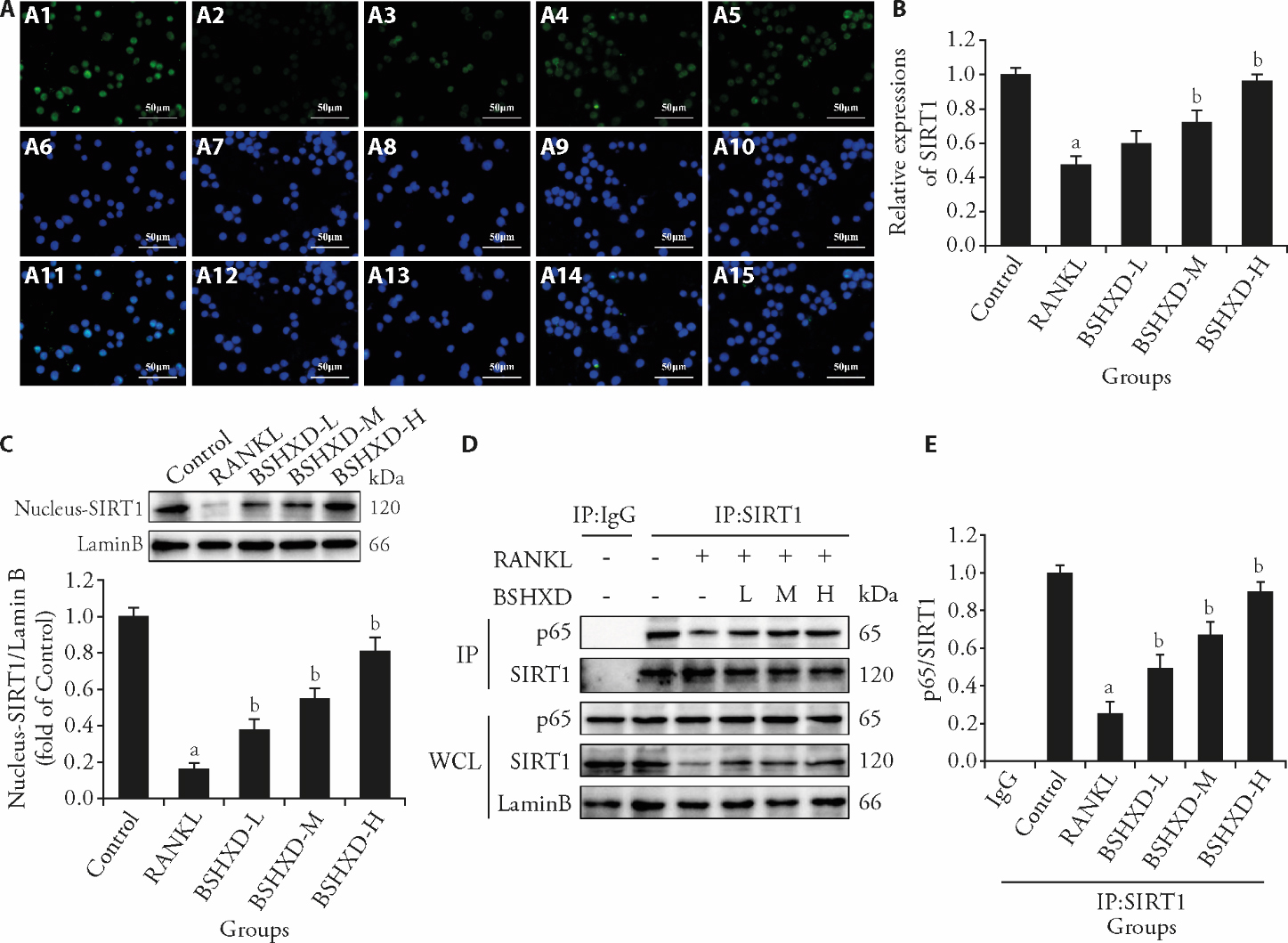
Figure 4 BSHXD inhibits osteoclast differentiation by activating SIRT1 A: representative immunofluorescence staining images of SIRT1 (scale bars: 50 μm; green: SIRT1; blue: DAPI); B: quantitative analysis of immunofluorescence staining images of SIRT1; C: the protein expression level of SIRT1 was detected via Western blot; D: the protein expression level of p65 and SIRT1 were detected via Western blot; E: relative protein expression levels of p65/SIRT1; A1, A6, A11: Control group; A2, A7, A12: RANKL group; A3, A8, A13: BSHXD-L group; A4, A9, A14: BSHXD-M group; A5, A10, A15: BSHXD-H group. Control group: RAW 264.7 cells cultured with 30 ng/mL M-CSF; RANKL group: RAW 264.7 cells cultured with 50 ng/mL RANKL and 30 ng/mL M-CSF; BSHXD-L group: RAW 264.7 cells cultured with 50 ng/mL RANKL, 30 ng/mL M-CSF, and 5% BSHXD-containing serum; BSHXD-M group: RAW 264.7 cells cultured with 50 ng/mL RANKL, 30 ng/mL M-CSF, and 10% BSHXD-containing serum; BSHXD-H group: RAW 264.7 cells cultured with 50 ng/mL RANKL, 30 ng/mL M-CSF, and 15% BSHXD-containing serum. BSHXD: Bushen Huoxue decoction; SIRT1: Sirtuin 1; p65: nuclear factor NF-kappa-B p65 subunit. The results are presented as the mean ± standard deviation (n = 3). Statistical analyses were measured using one-way analysis of variance with Tukey’s multiple comparison tests. aP < 0.05, compared to the control group; bP < 0.05, compared to the RANKL group.
Figure 4 BSHXD inhibits osteoclast differentiation by activating SIRT1 A: representative immunofluorescence staining images of SIRT1 (scale bars: 50 μm; green: SIRT1; blue: DAPI); B: quantitative analysis of immunofluorescence staining images of SIRT1; C: the protein expression level of SIRT1 was detected via Western blot; D: the protein expression level of p65 and SIRT1 were detected via Western blot; E: relative protein expression levels of p65/SIRT1; A1, A6, A11: Control group; A2, A7, A12: RANKL group; A3, A8, A13: BSHXD-L group; A4, A9, A14: BSHXD-M group; A5, A10, A15: BSHXD-H group. Control group: RAW 264.7 cells cultured with 30 ng/mL M-CSF; RANKL group: RAW 264.7 cells cultured with 50 ng/mL RANKL and 30 ng/mL M-CSF; BSHXD-L group: RAW 264.7 cells cultured with 50 ng/mL RANKL, 30 ng/mL M-CSF, and 5% BSHXD-containing serum; BSHXD-M group: RAW 264.7 cells cultured with 50 ng/mL RANKL, 30 ng/mL M-CSF, and 10% BSHXD-containing serum; BSHXD-H group: RAW 264.7 cells cultured with 50 ng/mL RANKL, 30 ng/mL M-CSF, and 15% BSHXD-containing serum. BSHXD: Bushen Huoxue decoction; SIRT1: Sirtuin 1; p65: nuclear factor NF-kappa-B p65 subunit. The results are presented as the mean ± standard deviation (n = 3). Statistical analyses were measured using one-way analysis of variance with Tukey’s multiple comparison tests. aP < 0.05, compared to the control group; bP < 0.05, compared to the RANKL group.
| [1] | Hatano M, Sasabuchi Y, Okada A, et al. Osteoarthritis risk associated with romosozumab compared with teriparatide in individuals with osteoporosis: a target trial emulation study. Ann Rheum Dis 2025; 84: 1938-47. |
| [2] | Crandall CJ, Larson JC, Schousboe JT, et al. Race and ethnicity and fracture prediction among younger postmenopausal women in the women's health initiative study. JAMA Intern Med 2023; 183: 696-704. |
| [3] | Zheng HW, Bui AAT, Ensrud KE, et al. Identifying younger postmenopausal women with osteoporosis using USPSTF-recommended osteoporosis risk assessment tools. JAMA Netw Open 2025; 8: e250626. |
| [4] | Aga R, Søgaard AJ, Holvik K, et al. Effectiveness of a fall and fracture prevention pathway on hip fracture risk, need of permanent care and mortality: a controlled before-and-after study. Age Ageing 2025; 54: afaf161. |
| [5] | Cotts KG, Cifu AS. Treatment of osteoporosis. JAMA 2018; 319: 1040-1. |
| [6] | Qaseem A, Forciea MA, McLean RM, et al. Treatment of low bone density or dsteoporosis to prevent fractures in men and women: a clinical practice guideline update from the american college of physicians. Ann Intern Med 2017; 166: 818-39. |
| [7] | Crandall CJ, Newberry SJ, Diamant A, et al. Comparative effectiveness of pharmacologic treatments to prevent fractures: an updated systematic review. Ann Intern Med 2014; 161: 711-23. |
| [8] | Eriksen EF. Cellular mechanisms of bone remodeling. Rev Endocr Metab Disord 2010; 11: 219-27. |
| [9] | Zhi X, Wang L, Chen H, et al. l-tetrahydropalmatine suppresses osteoclastogenesis in vivo and in vitro via blocking RANK-TRAF6 interactions and inhibiting NF-κB and MAPK pathways. J Cell Mol Med 2020; 24: 785-98. |
| [10] | Zainabadi K. Drugs targeting SIRT1, a new generation of therapeutics for osteoporosis and other bone related disorders? Pharmacol Res 2019; 143: 97-105. |
| [11] | Boyle WJ, Simonet WS, Lacey DL. Osteoclast differentiation and activation. Nature 2003; 423: 337-42. |
| [12] | Zeng J, Guo J, Sun Z, Deng F, Ning C, Xie Y. Osteoblastic and anti-osteoclastic activities of strontium-substituted silicocarnotite ceramics: In vitro and in vivo studies. Bioact Mater 2020; 5: 435-46. |
| [13] | Idris AI, Krishnan M, Simic P, et al. Small molecule inhibitors of IkappaB kinase signaling inhibit osteoclast formation in vitro and prevent ovariectomy-induced bone loss in vivo. Faseb J 2010; 24: 4545-55. |
| [14] | Sun P, Huang T, Huang C, Wang Y, Tang D. Role of histone modification in the occurrence and development of osteoporosis. Front Endocrinol (Lausanne) 2022; 13: 964103. |
| [15] | Shakibaei M, Buhrmann C, Mobasheri A. Resveratrol-mediated SIRT-1 interactions with p300 modulate receptor activator of NF-kappaB ligand (RANKL) activation of NF-kappa B signaling and inhibit osteoclastogenesis in bone-derived cells. J Biol Chem 2011; 286: 11492-505. |
| [16] | Edwards JR, Perrien DS, Fleming N, et al. Silent information regulator (Sir)T1 inhibits NF-κB signaling to maintain normal skeletal remodeling. J Bone Miner Res 2013; 28: 960-9. |
| [17] | Zhao L (Qing dynasty). Shang Ke Da Cheng. Shanghai: Shanghai Classics Publishing House, 1995: 45-50. |
| [18] | Zhang ND, Han T, Huang BK, et al. Traditional Chinese medicine formulas for the treatment of osteoporosis: implication for antiosteoporotic drug discovery. J Ethnopharmacol 2016; 189: 61-80. |
| [19] | Zhan JW, Li KM, Zhu LG, et al. Efficacy and safety of Bushen Huoxue Formula in patients with discogenic low-back pain: a double-blind, randomized, placebo-controlled trial. Chin J Integr Med 2022; 28: 963-70. |
| [20] | Zhang XJ, Zhang XL, Wu ZP, Nie J, Xiong JF. Effect of Busheng Huoxue capsule on the quality of life of primary osteoporosis senile males. Zhong Guo Zhong Xi Yi Jie He Za Zhi 2014; 34: 292-6. |
| [21] | Hu S, Ge Q, Xia C, et al. Bushenhuoxue formula accelerates fracture healing via upregulation of TGF-β/Smad2 signaling in mesenchymal progenitor cells. Phytomedicine 2020; 76: 153256. |
| [22] | Chen S, Tao L, Zhu F, et al. BushenHuoxue decoction suppresses M1 macrophage polarization and prevents LPS induced inflammatory bone loss by activating AMPK pathway. Heliyon 2023; 9: e15583. |
| [23] | Reagan-Shaw S, Nihal M, Ahmad N. Dose translation from animal to human studies revisited. Faseb j 2008; 22: 659-61. |
| [24] | Yi H, Zhang N, Sundquist J, Sundquist K, Zheng X, Ji J. Long-term outcomes after unilateral salpingo-oophorectomy: a registry-based retrospective cohort study. PLoS Med 2025; 22: e1004639. |
| [25] | Feng YC, Liu YL, Dang X, et al. Exploring the multicomponent synergy mechanism of Zuogui Wan on postmenopausal osteoporosis by a systems pharmacology strategy. J Tradit Chin Med 2024; 44: 489-95. |
| [26] | Kanis JA, Cooper C, Rizzoli R, Reginster JY. European guidance for the diagnosis and management of osteoporosis in postmenopausal women. Osteoporos Int 2019; 30: 3-44. |
| [27] | Wang P, Wang M, Zhuo T, et al. Hydroxysafflor yellow A promotes osteogenesis and bone development via epigenetically regulating β-catenin and prevents ovariectomy-induced bone loss. Int J Biochem Cell Biol 2021; 137: 106033. |
| [28] | Chen Y, Dai F, He Y, et al. Beneficial effects of hyperoside on bone metabolism in ovariectomized mice. Biomed Pharmacother 2018; 107: 1175-82. |
| [29] | Ren Y, Song X, Tan L, et al. A review of the pharmacological properties of psoralen. Front Pharmacol 2020; 11: 571535. |
| [30] | Lu Y, Zhang M, Zhang J, Jiang M, Bai G. Psoralen prevents the inactivation of estradiol and treats osteoporosis via covalently targeting HSD17B2. J Ethnopharmacol 2023; 311: 116426. |
| [31] | Ren P, Wang QW, Bai W, et al. Identifying the effective combination of acupuncture and traditional Chinese medicinal herbs for postmenopausal osteoporosis therapy through studies of their molecular regulation of bone homeostasis. J Tradit Chin Med 2024; 44: 212-9. |
| [32] | Li F, Li Q, Huang X, et al. Psoralen stimulates osteoblast proliferation through the activation of nuclear factor-κB-mitogen-activated protein kinase signaling. Exp Ther Med 2017; 14: 2385-91. |
| [33] | Mudri D, Kizivat T, Mihaljević I, Bilić Ćurčić I. Wnt inhibitors and bone mineral density in patients with graves' disease treated with antithyroid drugs: a preliminary prospective study. Metabolites 2022; 12: 711. |
| [34] | Matsoukas MT, Aranguren-Ibáñez Á, Lozano T, et al. Identification of small-molecule inhibitors of calcineurin-NFATc signaling that mimic the PxIxIT motif of calcineurin binding partners. Sci Signal 2015; 8: ra63. |
| [35] | Huang XL, Huang LY, Cheng YT, et al. Zoledronic acid inhibits osteoclast differentiation and function through the regulation of NF-κB and JNK signalling pathways. Int J Mol Med 2019; 44: 582-92. |
| [36] | Yasuda H, Shima N, Nakagawa N, et al. Osteoclast differentiation factor is a ligand for osteoprotegerin/osteoclastogenesis-inhibitory factor and is identical to TRANCE/RANKL. Proc Natl Acad Sci USA 1998; 95: 3597-602. |
| [37] | Liu Y, Liu W, Yu Z, et al. A novel BRD4 inhibitor suppresses osteoclastogenesis and ovariectomized osteoporosis by blocking RANKL-mediated MAPK and NF-κB pathways. Cell Death Dis 2021; 12: 654. |
| [38] | Wang Z, Li Z, Wang G, Sun Y, Yuan Y, Nie H. Salubrinal alleviates collagen-induced arthritis through promoting P65 degradation in osteoclastogenesis. Int J Mol Sci 2021; 22: 3501. |
| [39] | Wu Z, Li C, Chen Y, et al. Chrysin protects against titanium particle-induced osteolysis by attenuating osteoclast formation and function by inhibiting NF-κB and MAPK signaling. Front Pharmacol 2022; 13: 793087. |
| [40] | Wu J, Li XY, Fang X, Teng FY, Xu Y. Decreased serum maresin 1 concentration is associated with postmenopausal osteoporosis: a cross-sectional study. Front Med (Lausanne) 2021; 8: 759825. |
| [41] | Deqiang D, Yan X, Dan MA, et al. Role of toll-like receptor 4/mutant myeloid differentiation primary response 88/nuclear factor kappa-B mediated inflammation in diabetes mellitus with Northwest dryness syndrome. J Tradit Chin Med 2024; 44: 963-73. |
| [42] | Astleford K, Campbell E, Norton A, Mansky KC. Epigenetic regulators involved in osteoclast differentiation. IJMS 2020; 21: 7080. |
| [43] | Kurotaki D, Yoshida H, Tamura T. Epigenetic and transcriptional regulation of osteoclast differentiation. Bone 2020; 138: 115471. |
| [44] | Finkel T, Deng CX, Mostoslavsky R. Recent progress in the biology and physiology of sirtuins. Nature 2009; 460: 587-91. |
| [45] | Chen Y, Zhou F, Liu H, et al. SIRT1, a promising regulator of bone homeostasis. Life Sci 2021; 269: 119041. |
| [46] | Cohen-Kfir E, Artsi H, Levin A, et al. Sirt1 is a regulator of bone mass and a repressor of Sost encoding for sclerostin, a bone formation inhibitor. Endocrinology 2011; 152: 4514-24. |
| [47] | Chen H, Hu X, Yang R, et al. SIRT1/FOXO3a axis plays an important role in the prevention of mandibular bone loss induced by 1,25(OH)(2)D deficiency. Int J Biol Sci 2020; 16: 2712-26. |
| [48] | Feng J, Liu S, Ma S, et al. Protective effects of resveratrol on postmenopausal osteoporosis: regulation of SIRT1-NF-κB signaling pathway. Acta Biochim Biophys Sin (Shanghai) 2014; 46: 1024-33. |
| Viewed | ||||||
|
Full text |
|
|||||
|
Abstract |
|
|||||