
Journal of Traditional Chinese Medicine ›› 2022, Vol. 42 ›› Issue (6): 972-979.DOI: 10.19852/j.cnki.jtcm.2022.06.008
• Research Articles • Previous Articles Next Articles
Efficacy of stimulating Mingmen (GV4) and Guanyuan (CV4) on kidney Yang deficiency in rat model: laser irradiation vs traditional moxibustion
FANG Jing1, PAN Wen1, WANG Xiangyun1, LI Fengxing1, ZHAO Ling1( ), HUANG Zouqin3(), SHEN Xueyong2
- 1 Acupuncture and Tuina School, Shanghai University of Traditional Chinese Medicine, Shanghai 201203, China
2 Acupuncture and Tuina School, Shanghai University of Traditional Chinese Medicine, Shanghai 201203, China; Shanghai Research Center of Acupuncture & Meridian, Shanghai 201203, China
3 Department of Acupuncture,Shanghai Pudong New District Hospital of Traditional Chinese Medicine, Shanghai 201203, China
-
Received:2021-09-12Accepted:2021-12-02Online:2022-12-15Published:2022-11-01 -
Contact:ZHAO Ling,HUANG Zouqin -
About author:HUANG Zouqin, Department of Acupuncture, Shanghai Pudong New District Hospital of Traditional Chinese Medicine, Shanghai 201203, China. hzqmusic@yeah.net,Telephone: +86-13917674196; +86-13564599607
ZHAO Ling, Acupuncture and Tuina School, Shanghai University of Traditional Chinese Medicine, Shanghai 201203, China. zl2@shutcm.edu.cn;

Cite this article
FANG Jing, PAN Wen, WANG Xiangyun, LI Fengxing, ZHAO Ling, HUANG Zouqin, SHEN Xueyong. Efficacy of stimulating Mingmen (GV4) and Guanyuan (CV4) on kidney Yang deficiency in rat model: laser irradiation vs traditional moxibustion[J]. Journal of Traditional Chinese Medicine, 2022, 42(6): 972-979.
share this article
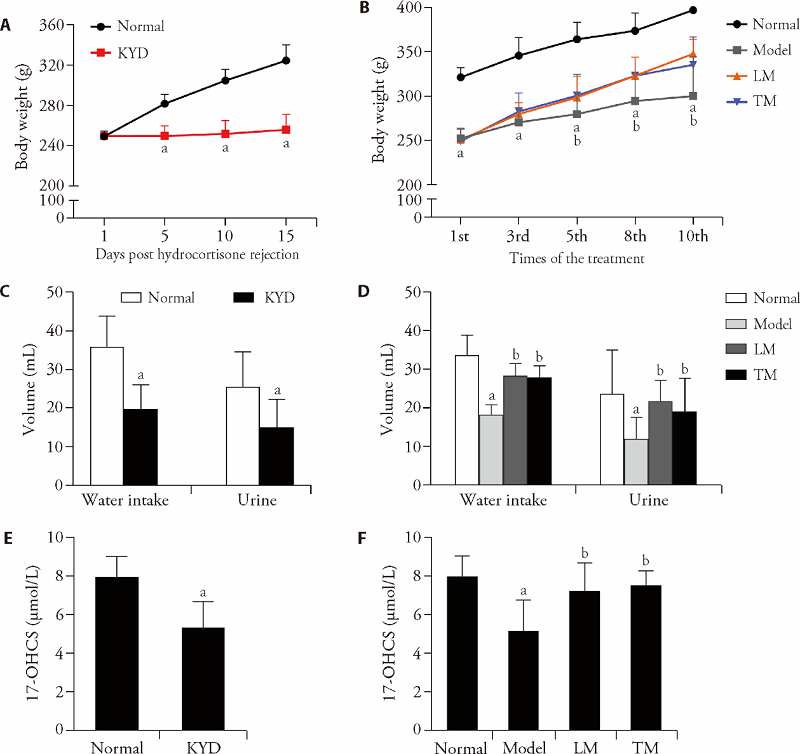
Figure 1 Changes in body weight, 24-h water intake, urine volume, and 17-OHCS levels in the different groups A: the body weights of rats after hydrocortisone injection; B: the body weights of rats after treatment; C: 24-h water intake and 24-h urine after hydrocortisone injection; D: post-treatment 24-h water intake and 24-h urine levels; E: urine 17-OHCS levels after hydrocortisone injection; F: urine 17-OHCS levels after treatment. The normal group: normal rats without modeling; the KYD group received intramuscular hydrocortisone injections (25 mg/kg) (n = 30); the model group: KYD rats without treatment (n = 10); the LM-group: KYD rats were immobilized and received laser irradiation on Mingmen (GV4) and Guanyuan (CV4) for 10 min once every other day for 10 sessions (n = 10); the TM group: KYD rats received moxibustion on Mingmen (GV4) and Guanyuan (CV4) for 10 min once every other day for 10 sessions (n = 10). KYD: kidney Yang deficiency; LM: laser moxibustion; TM: traditional moxibustion. Significant differences compared with the normal group were designated as aP < 0.05 and the model group as bP < 0.05.
Figure 1 Changes in body weight, 24-h water intake, urine volume, and 17-OHCS levels in the different groups A: the body weights of rats after hydrocortisone injection; B: the body weights of rats after treatment; C: 24-h water intake and 24-h urine after hydrocortisone injection; D: post-treatment 24-h water intake and 24-h urine levels; E: urine 17-OHCS levels after hydrocortisone injection; F: urine 17-OHCS levels after treatment. The normal group: normal rats without modeling; the KYD group received intramuscular hydrocortisone injections (25 mg/kg) (n = 30); the model group: KYD rats without treatment (n = 10); the LM-group: KYD rats were immobilized and received laser irradiation on Mingmen (GV4) and Guanyuan (CV4) for 10 min once every other day for 10 sessions (n = 10); the TM group: KYD rats received moxibustion on Mingmen (GV4) and Guanyuan (CV4) for 10 min once every other day for 10 sessions (n = 10). KYD: kidney Yang deficiency; LM: laser moxibustion; TM: traditional moxibustion. Significant differences compared with the normal group were designated as aP < 0.05 and the model group as bP < 0.05.
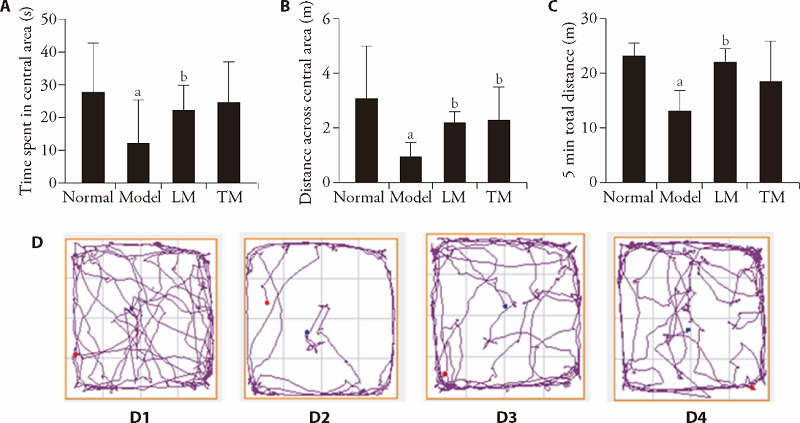
Figure 2 Open field test in the different groups A: distance across the central area after treatment; B: time spent in the central area after treatment; C: the total 5-min distance after treatment; D: the course map of each group within the open field area. D1: Normal group; D2: Model group; D3: LM group; D4: TM group. The red dot indicates that the mouse begins to move, and the blue point indicates that the mouse stops. The normal group: normal rats without modeling; the KYD group received intramuscular hydrocortisone injections (25 mg/kg) (n = 30); the model group: KYD rats without treatment (n = 10); the LM-group: KYD rats were immobilized and received laser irradiation on Mingmen (GV4) and Guanyuan (CV4) for 10 min once every other day for 10 sessions (n = 10); the TM group: KYD rats received moxibustion on Mingmen (GV4) and Guanyuan (CV4) for 10 min once every other day for 10 sessions (n = 10). KYD: kidney Yang deficiency; LM: laser moxibustion; TM: traditional moxibustion. Significant differences compared with the normal group were designated as aP < 0.05and the model group as bP < 0.05.
Figure 2 Open field test in the different groups A: distance across the central area after treatment; B: time spent in the central area after treatment; C: the total 5-min distance after treatment; D: the course map of each group within the open field area. D1: Normal group; D2: Model group; D3: LM group; D4: TM group. The red dot indicates that the mouse begins to move, and the blue point indicates that the mouse stops. The normal group: normal rats without modeling; the KYD group received intramuscular hydrocortisone injections (25 mg/kg) (n = 30); the model group: KYD rats without treatment (n = 10); the LM-group: KYD rats were immobilized and received laser irradiation on Mingmen (GV4) and Guanyuan (CV4) for 10 min once every other day for 10 sessions (n = 10); the TM group: KYD rats received moxibustion on Mingmen (GV4) and Guanyuan (CV4) for 10 min once every other day for 10 sessions (n = 10). KYD: kidney Yang deficiency; LM: laser moxibustion; TM: traditional moxibustion. Significant differences compared with the normal group were designated as aP < 0.05and the model group as bP < 0.05.
Table 1 Anal temperature during modeling time (℃, $\bar{x} \pm s$)
| Group | n | Day 1 | Day 5 | Day 10 | Day15 |
|---|---|---|---|---|---|
| Normal | 10 | 37.5±0.4 | 37.1±0.4 | 37.1±0.4 | 37.0±0.3 |
| KYD | 30 | 37.5±0.5 | 36.8±0.6 | 36.5±0.7a | 36.3±0.6a |
Table 1 Anal temperature during modeling time (℃, $\bar{x} \pm s$)
| Group | n | Day 1 | Day 5 | Day 10 | Day15 |
|---|---|---|---|---|---|
| Normal | 10 | 37.5±0.4 | 37.1±0.4 | 37.1±0.4 | 37.0±0.3 |
| KYD | 30 | 37.5±0.5 | 36.8±0.6 | 36.5±0.7a | 36.3±0.6a |
Table 2 Anal temperature during treatment time (℃, $\bar{x} \pm s$)
| Group | n | 1st | 3rd | 5th | 8th | 10th |
|---|---|---|---|---|---|---|
| Normal | 10 | 37.01±0.21 | 37.00±0.18 | 37.11±0.47 | 37.21±0.50 | 37.28±0.32 |
| Model | 10 | 36.33±0.49a | 36.41±0.87 | 36.40±0.78 | 36.30±0.53a | 36.15±0.34a |
| LM | 10 | 36.35±0.30a | 36.49±0.63 | 36.80±0.64 | 36.82±0.32 | 37.02±0.36b |
| TM | 10 | 36.32±0.23a | 36.90±0.34 | 37.34±0.43b | 37.00±0.23b | 37.13±0.09b |
Table 2 Anal temperature during treatment time (℃, $\bar{x} \pm s$)
| Group | n | 1st | 3rd | 5th | 8th | 10th |
|---|---|---|---|---|---|---|
| Normal | 10 | 37.01±0.21 | 37.00±0.18 | 37.11±0.47 | 37.21±0.50 | 37.28±0.32 |
| Model | 10 | 36.33±0.49a | 36.41±0.87 | 36.40±0.78 | 36.30±0.53a | 36.15±0.34a |
| LM | 10 | 36.35±0.30a | 36.49±0.63 | 36.80±0.64 | 36.82±0.32 | 37.02±0.36b |
| TM | 10 | 36.32±0.23a | 36.90±0.34 | 37.34±0.43b | 37.00±0.23b | 37.13±0.09b |
Table 3 Surface temperature after treatment (℃, $\bar{x} \pm s$)
| Group | n | Head and neck | Back | Tail root |
|---|---|---|---|---|
| Normal | 10 | 32.73±0.56 | 33.67±0.80 | 28.44±0.05 |
| Model | 10 | 27.72±0.69a | 27.93±0.53a | 23.02±0.65a |
| LM | 10 | 31.01±0.91b | 31.33±1.71a,b | 27.84±0.92a,b |
| TM | 10 | 31.08±0.53b | 32.37±1.00a,b | 28.99±0.46a,b |
Table 3 Surface temperature after treatment (℃, $\bar{x} \pm s$)
| Group | n | Head and neck | Back | Tail root |
|---|---|---|---|---|
| Normal | 10 | 32.73±0.56 | 33.67±0.80 | 28.44±0.05 |
| Model | 10 | 27.72±0.69a | 27.93±0.53a | 23.02±0.65a |
| LM | 10 | 31.01±0.91b | 31.33±1.71a,b | 27.84±0.92a,b |
| TM | 10 | 31.08±0.53b | 32.37±1.00a,b | 28.99±0.46a,b |

Figure 3 Mingmen (GV4) and Guanyuan (CV4) temperatures in the different groups and Pearson’s correlation analysis results A: Mingmen (GV4) temperature in the different groups; B: Guanyuan (CV4) temperature in the different groups. aP < 0.05, compared with the normal group. bP < 0.05, compared with the model group. C: correlation of 17-OHCS levels with the Mingmen (GV4) and Guanyuan (CV4) temperatures after modeling; D: correlation of 17-OHCS levels with Mingmen (GV4) and Guanyuan (CV4) temperatures after treatment. The normal group: normal rats without modeling; the KYD group received intramuscular hydrocortisone injections (25 mg/kg) (n = 30); the model group: KYD rats without treatment (n = 10); the LM-group: KYD rats were immobilized and received laser irradiation on Mingmen (GV4) and Guanyuan (CV4) for 10 min once every other day for 10 sessions (n = 10); the TM group: KYD rats received moxibustion on Mingmen (GV4) and Guanyuan (CV4) for 10 min once every other day for 10 sessions (n = 10). KYD: kidney Yang deficiency; LM: laser moxibustion; TM: traditional moxibustion. Significant differences compared with the normal group were designated as aP < 0.05 and the model group as bP < 0.05.
Figure 3 Mingmen (GV4) and Guanyuan (CV4) temperatures in the different groups and Pearson’s correlation analysis results A: Mingmen (GV4) temperature in the different groups; B: Guanyuan (CV4) temperature in the different groups. aP < 0.05, compared with the normal group. bP < 0.05, compared with the model group. C: correlation of 17-OHCS levels with the Mingmen (GV4) and Guanyuan (CV4) temperatures after modeling; D: correlation of 17-OHCS levels with Mingmen (GV4) and Guanyuan (CV4) temperatures after treatment. The normal group: normal rats without modeling; the KYD group received intramuscular hydrocortisone injections (25 mg/kg) (n = 30); the model group: KYD rats without treatment (n = 10); the LM-group: KYD rats were immobilized and received laser irradiation on Mingmen (GV4) and Guanyuan (CV4) for 10 min once every other day for 10 sessions (n = 10); the TM group: KYD rats received moxibustion on Mingmen (GV4) and Guanyuan (CV4) for 10 min once every other day for 10 sessions (n = 10). KYD: kidney Yang deficiency; LM: laser moxibustion; TM: traditional moxibustion. Significant differences compared with the normal group were designated as aP < 0.05 and the model group as bP < 0.05.
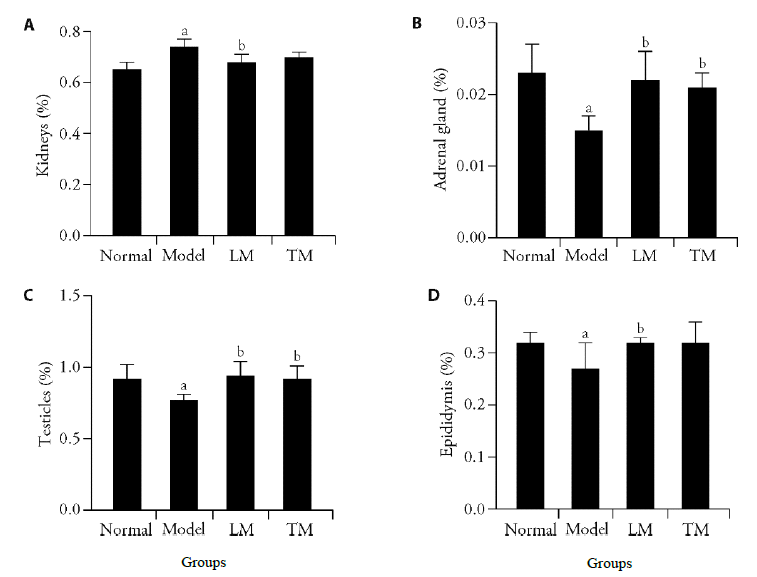
Figure 4 Organ coefficients in the different groups A: kidneys in the different groups; B: Adrenal glands in the different groups; C: testicles in the different groups; D: epididymis in the different groups. aP < 0.05, compared with the normal group; bP < 0.05, compared with the model group. The normal group: normal rats without modeling; the KYD group received intramuscular hydrocortisone injections (25 mg/kg) (n = 30); the model group: KYD rats without treatment (n = 10); the LM-group: KYD rats were immobilized and received laser irradiation on Mingmen (GV4) and Guanyuan (CV4) for 10 min once every other day for 10 sessions (n = 10); the TM group: KYD rats received moxibustion on Mingmen (GV4) and Guanyuan (CV4) for 10 min once every other day for 10 sessions (n = 10). KYD: kidney Yang deficiency; LM: laser moxibustion; TM: traditional moxibustion. Significant differences compared with the normal group were designated as aP < 0.05 and the model group as bP < 0.05.
Figure 4 Organ coefficients in the different groups A: kidneys in the different groups; B: Adrenal glands in the different groups; C: testicles in the different groups; D: epididymis in the different groups. aP < 0.05, compared with the normal group; bP < 0.05, compared with the model group. The normal group: normal rats without modeling; the KYD group received intramuscular hydrocortisone injections (25 mg/kg) (n = 30); the model group: KYD rats without treatment (n = 10); the LM-group: KYD rats were immobilized and received laser irradiation on Mingmen (GV4) and Guanyuan (CV4) for 10 min once every other day for 10 sessions (n = 10); the TM group: KYD rats received moxibustion on Mingmen (GV4) and Guanyuan (CV4) for 10 min once every other day for 10 sessions (n = 10). KYD: kidney Yang deficiency; LM: laser moxibustion; TM: traditional moxibustion. Significant differences compared with the normal group were designated as aP < 0.05 and the model group as bP < 0.05.
| [1] |
Guo Y, Wang L, Li Q, Zhao C, He P, Ma X. Enhancement of kidney invigorating function in mouse model by cistanches herba dried rapidly at a medium high temperature. J Med Food 2019; 22: 1246-53.
DOI PMID |
| [2] |
Lu X, Xiong Z, Li J, Zheng S, Huo T, Li F. Metabonomic study on 'kidney-Yang deficiency syndrome' and intervention effects of rhizoma drynariae extracts in rats using ultra performance liquid chromatography coupled with mass spectrometry. Talanta 2011; 83: 700-8.
DOI URL |
| [3] |
Tan Y, Liu X, Lu C, et al. Metabolic profiling reveals therapeutic biomarkers of processed Aconitum carmichaeli Debx in treating hydrocortisone induced kidney-Yang deficiency syndrome rats. J Ethnopharmacol 2014; 152: 585-93.
DOI URL |
| [4] |
Zhang JY, Hong CL, Chen HS, et al. Target identification of active constituents of shen qi wan to treat kidney Yang deficiency using computational target fishing and network pharmacology. Front Pharmacol 2019; 10: 650.
DOI PMID |
| [5] |
Rong R, Li RR, Hou YB, et al. Mahuang-xixin-fuzi decoction reduces the infection of influenza a virus in kidney-yang deficiency syndrome mice. J Ethnopharmacol 2016; 192: 217-24.
DOI PMID |
| [6] | Huang C, Liang J, Han L, Liu J, Yu M, Zhao B. Moxibustion in early chinese medicine and its relation to the origin of meridians: a study on the unearthed literatures. Evid Based Complement Alternat Med 2017; 2017: 8242136. |
| [7] |
Zhao B, Wang X, Lin Z, Liu R, Lao L. A novel sham moxibustion device: a randomized, placebo-controlled trial. Complement Ther Med 2006; 14: 53-60.
PMID |
| [8] |
Park JE, Lee SS, Lee MS, Choi SM, Ernst E. Adverse events of moxibustion: a systematic review. Complement Ther Med 2010; 18: 215-23.
DOI URL |
| [9] |
Lu CY, Kang SY, Liu SH, Mai CW, Tseng CH. Controlling indoor air pollution from moxibustion. Int J Environ Res Public Health 2016; 13: 612.
DOI URL |
| [10] |
Whittaker P. Laser acupuncture: past, present, and future. Lasers Med Sci 2004; 19: 69-80.
DOI URL |
| [11] |
Mao H, Mao JJ, Guo M, et al. Effects of infrared laser moxibustion on cancer-related fatigue: A randomized, double-blind, placebo-controlled trial. Cancer 2016; 122: 3667-72.
DOI PMID |
| [12] |
Makihara E, Makihara M, Masumi S, Sakamoto E. Evaluation of facial thermographic changes before and after low-level laser irradiation. Photomed Laser Surg 2005; 23: 191-195.
PMID |
| [13] |
Lin L, Cheng K, Tan MT, et al. Comparison of the effects of 10.6-μm infrared laser and traditional moxibustion in the treatment of knee osteoarthritis. Lasers Med Sci 2020; 35: 823-32.
DOI URL |
| [14] | Zhu J, Liu S, Guo Y, et al. A new model of diarrhea with spleen-kidney yang deficiency syndrome. Evid based complement alternat med 2018; 2018: 4280343. |
| [15] | Shen ZY. Study on localization of kidney-Yang deficiency. Zhong Guo Zhong Xi Yi Jie He Za Zhi 1997; 17: 50-2. |
| [16] | Shen ZY. Basic theory of Traditional Chinese Medicine. Zhong Guo Zhong Xi Yi Jie He Za Zhi 1997; 17: 643. |
| [17] | Leong PK, Wong HS, Chen J, Ko KM. Yang/Qi invigoration: an herbal therapy for chronic fatigue syndrome with yang deficiency. Evid Based Complement Alternat Med 2015; 2015: 945901. |
| [18] |
Gu C, Yang X, Huang L. Cistanches herba: a neuropharmacology review. Cistanches herba: a neuropharmacology review. Front Pharmacol 2016; 7: 289.
PMID |
| [19] | Tang N, Liu L, Qiu H, et al. Analysis of gene expression and functional changes of adrenal gland in a rat model of kidney yang deficiency syndrome treated with Sini decoction. Exp Ther Med 2018; 16: 3107-15. |
| [20] |
Zhang JY, Hong CL, Chen HS, et al. Target identification of active constituents of shen Qi wan to treat kidney Yang deficiency using computational target fishing and network pharmacology. Front Pharmacol 2019; 10: 650.
DOI PMID |
| [21] |
Chen M, Zhao L, Jia W. Metabonomic study on the biochemical profiles of a hydrocortisone-induced animal model. J Proteome Res 2005; 4: 2391-96.
PMID |
| [22] | Zhang L, Lang J, Jin L, et al. Effect of hirsutella sinensis fungus on the hypothalamic-pituitary-adrenal axis in lewis rats with kidney-Yang deficiency syndrome. Evid Based Complement Alternat Med 2020; 2020: 5952612. |
| [23] | Zhao L, Wu H, Qiu M, et al. Metabolic signatures of Kidney Yang deficiency syndrome and protective effects of two herbal extracts in rats using GC/TOF MS. Evid Based Complement Alternat Med 2013; 2013:540957. |
| [24] |
Nan Y, Zhou X, Liu Q, et al. Serum metabolomics strategy for understanding pharmacological effects of shen Qi pill acting on kidney Yang deficiency syndrome. J Chromatogr B Analyt Technol Biomed Life Sci 2016; 1026: 217-26.
DOI PMID |
| [25] | Chiu JH. How does moxibustion possibly work. Evid Based Complement Alternat Med 2013; 2013: 198584. |
| [26] | Deng H, Shen X. The mechanism of moxibustion: ancient theory and modern research. Evid Based Complement Alternat Med 2013; 2013: 379291. |
| [27] |
Xiong J, Liu Z, Chen R, Xie D, Chi Z, Zhang B. Effectiveness and safety of heat-sensitive moxibustion on bronchial asthma: a meta-analysis of randomized control trials. J Tradit Chin Med 2014; 34: 392-400.
PMID |
| [28] |
Han Y, Ma TM, Lu ML, Ren L, Ma XD, Bai ZH. Role of moxibustion in inflammatory responses during treatment of rat ulcerative colitis. World J Gastroenterol 2014; 20: 11297-304.
DOI URL |
| [29] |
Wu Z, Xu G, Xiong J, Zuo Z, Yu X, Xie Q. Moxibustion therapy on myofascial pain syndrome: an evidence-based clinical practice guideline. Medicine (Baltimore) 2020; 99: e22342.
DOI URL |
| [30] | Song XJ, Wang SY, Li YL, Zhang D. Analysis of the spectral characteristics of pure moxa stick burning by hyperspectral imaging and fourier transform infrared spectroscopy. Evid Based Complement Alternat Med 2016; 2016: 1057878. |
| [31] |
Karu TI, Pyatibrat LV, Kalendo GS. Photobiological modulation of cell attachment via cytochrome c oxidase. Photochem Photobiol Sci 2004; 3: 211-16.
DOI URL |
| [32] |
Muili KA, Gopalakrishnan S, Meyer SL, Eells JT, Lyons JA. Amelioration of experimental autoimmune encephalomyelitis in C57BL/6 mice by photobiomodulation induced by 670 nm light. PLoS One 2012; 7: e30655.
DOI URL |
| [33] |
Melancon MP, Elliott AM, Shetty A, Huang Q, Stafford RJ, Li C. Near-infrared light modulated photothermal effect increases vascular perfusion and enhances polymeric drug delivery. J Control Release 2011; 156: 265-72.
DOI URL |
| [34] |
Shen X, Ding G, Wei J, et al. An infrared radiation study of the biophysical characteristics of traditional moxibustion. Complement Ther Med 2006; 14: 213-19.
PMID |
| [35] |
Shen D, Wei J, Chen L, Shen X, Wang L. Besides photothermal effects, low-level co(2) laser irradiation can potentiate skin microcirculation through photobiomodulation mechanisms. Photobiomodul Photomed Laser Surg 2019; 37: 151-8.
DOI PMID |
| [36] |
Gutterman DD, Chabowski DS, Kadlec AO, et al. The human microcirculation: regulation of flow and beyond. Circ Res 2016; 118: 157-72.
DOI PMID |
| [37] |
Min S, Lee H, Kim SY, et al. Local changes in microcirculation and the analgesic effects of acupuncture: a laser doppler perfusion imaging study. J Altern Complement Med 2015; 21: 46-52.
DOI URL |
| [38] | Ding N, Liu X, Chen N, et al. Lack of association between acupoint sensitization and microcirculatory structural changes in a mouse model of knee osteoarthritis: a pilot study. J Biophotonics 2019; 12: e201800458. |
| [39] | Zheng J, Zhao Y, Wang Y, Hu S, Lu P, Shen X. The infrared radiation temperature characteristic of acupoints of mammary gland hyperplasia patients. Evid Based Complement Alternat Med 2013; 2013: 567987. |
| [40] | Ding N, Jiang J, Liu X, Xu Y, Hu J, Li Z. Laser speckle imaging of sensitized acupoints. Evid Based Complement Alternat Med 2018; 2018: 7308767. |
| [41] |
Kogure M, Mimura N, Ikemoto H, et al. Moxibustion at mingmen reduces inflammation and decreases IL-6 in a collagen-induced arthritis mouse model. J Acupunct Meridian Stud 2012; 5: 29-33.
DOI PMID |
| [42] |
Wang X, Shi SH, Yao HJ, et al. Electroacupuncture at Dazhui (GV14) and Mingmen (GV4) protects against spinal cord injury: the role of the Wnt/β-catenin signaling pathway. Neural Regen Res 2016; 11: 2004-11.
DOI URL |
| [43] | Xu JS, Pan XH, Hu XL, et al. Comparison between governor meridian and its bilateral control points in microcirculatory blood perfusion in 53 volunteer subjects. Zhen Ci Yan Jiu 2008; 33: 321-5. |
| [44] | Lan CL, Pan XH, Sa ZY, et al. Changes of skin temperature of acupoint regions of the governor meridian after moxibustion stimulation. Zhen Ci Yan Jiu 2016; 41: 70-3. |
| [1] | QIAO Lina, SHI Yinan, TAN Lianhong, JIANG Yanshu, YANG Yongsheng. Efficacy of electroacupuncture stimulating Shenmen (HT7), Baihui (GV20), Sanyinjiao (SP6) on spatial learning and memory deficits in rats with insomnia induced by para-chlorophenylalanine: a single acupoint vs combined acupoints [J]. Journal of Traditional Chinese Medicine, 2023, 43(4): 704-714. |
| [2] | ZHANG Xinghe, LI Qifu, YI Rong, XING Chonghui, JIN Yuhao, MENG Jiangqiong, FENG Jialei, ZHAO Siwen, LIANG Fanrong, GUO Taipin. Effect of catgut embedding at acupoints versus non-acupoints in abdominal obesity: a randomized clinical trial [J]. Journal of Traditional Chinese Medicine, 2023, 43(4): 780-786. |
| [3] | MIN Youjiang, YAO Haihua, WANG Zhiqin, LUO Kaitao, SUN Jie, YUAN Zheng, WU Huiqi, CHENG Lihong. Efficacy of suspended moxibustion stimulating Shenshu (BL23) and Guanyuan (CV4) on the amygdala-HPA axis in rats with kidney-Yang deficiency symptom pattern induced by hydrocortisone [J]. Journal of Traditional Chinese Medicine, 2023, 43(1): 113-123. |
| [4] | FAN Xisheng, DU Xiaoyi, PAN Lijia, SONG Xiaodan, LIU Jun, ZHANG Juncha, CHEN Hao, GAO Yayu, ZHANG Mingjian, SHI Xuliang, SHE Yanfen. An infrared thermographic analysis of the sensitization acupoints of women with primary dysmenorrhea [J]. Journal of Traditional Chinese Medicine, 2022, 42(5): 825-832. |
| [5] | Saghachian Mahasti, Barry Caroline, Asselain Bernard, LI Yunfen, NIE Jianyun, LIU Dequan, CHEN Dedian, CHEN Chunxin, Laura Estevez, LI Wenhui, Jean-Pierre Armand, ZHU Miansheng, JU Liya. An international multicentric phase Ⅲ randomized controlled trial of time-acupoints-space acupuncture for the prevention of chemotherapy-induced fatigue in patients with early stage breast cancer: a study protocol [J]. Journal of Traditional Chinese Medicine, 2022, 42(2): 289-295. |
| [6] | Jin Yutong, Chen Shan, Xuan Lihua. Effect and safety of stimulating acupoints in children with cough variant asthma:A Meta-analysis [J]. Journal of Traditional Chinese Medicine, 2018, 38(04): 480-489. |
| [7] | Yang Jiamin, Wu Jihui, Shen Xiaoyu, Zhang Mei, Liu Zhenzhen, Qi Dandan, Zhou Jin, Cui Xiao, Zhang Lufen, Li Yuhang. Efficacy of moxibustion by stimulating acupoints of Danzhong(CV 17) and Ganshu(BL 18) on hyperplasia of mammary gland in rats [J]. Journal of Traditional Chinese Medicine, 2018, 38(01): 76-82. |
| [8] | Wang Dan, Ji Bo, Zhao Guozhen, Yan Mingna, Bai Hongxin, Sun Xiaomin, Dai Jian, Lu Yawen, Liu Yitian, You Min, Wu Jiaojuan, Ge Yunpeng, Su Hang, Cheng Kai. Effect of electroacpuncture of Neiguan(PC 6) and Tianquan(PC 2)on skin temperature, blood perfusion, and adrenoceptor response in rats with acute myocardial ischemia [J]. Journal of Traditional Chinese Medicine, 2017, 37(06): 794-803. |
| [9] | Zhang Guoliang, He Liyun, Tang Liuping, Yang Tong, Zou Xinying, Zhu Qingxiong, Yan Shiyan, Hou Yong, Huang Baoju, Zhao Jindong, Li Yan, Huang Jihan. Xiyanping injection therapy for children with mild hand foot and mouth disease: a randomized controlled trial [J]. Journal of Traditional Chinese Medicine, 2017, 37(03): 397-403. |
| [10] | She Yanfen, Ma Liangxiao, Zhu Jiang, Qi Conghui, Wang Yanxia, Tang Ling, Li Chunhua, Yuan Hongwen, Liu Yuqi, Song Jiashan. Comparative study on skin temperature response to menstruation at acupuncture points in healthy volunteers and primary dysmenorrhea patients [J]. Journal of Traditional Chinese Medicine, 2017, 37(02): 220-228. |
| [11] | Ho-Yeon Go, Ju Ah Lee, Sunyoung Park, Sunju Park, Jeong-Su Park, Chunhoo Cheon, Seong-Gyu Ko, Kyung-Hwan Kong, Chan-yong Jun, Jong-hyeong Park, Mi-Ran Shin, Se-Hoon Lee. Comparative effects of artemisia vulgaris and charcoal moxa stimulating Zhongwan(CV 12) on body temperature in healthy participants:a cross-over single-blind randomized study [J]. Journal of Traditional Chinese Medicine, 2015, 35(05): 551-557. |
| [12] | Qingyan Xu, Jinsheng Yang, Liang Wang, Zi Deng, Yingying Wang, Li Yang, Peng Wu, Liang Li. Use of laser speckle contrast imaging to reveal changes in temperature and blood perfusion in the skin of healthy subjects after administration of heated moxa sticks and Daiwenjiu ointment [J]. Journal of Traditional Chinese Medicine, 2014, 34(04): 455-459. |
| [13] | Xianfeng Ye, Huifang Zhang. Influence of moxibustion temperatures on blood lipids, endothelin-1, and nitric oxide in hyperlipidemia patients [J]. Journal of Traditional Chinese Medicine, 2013, 33(05): 592-596. |
| [14] | Limin Wang, Xin Zhao, Jiaxu Chen, Xiaoling Guo, Xin Liang, Danhui Yi, Huating Cui, Yueyun Liu. Biological indicators of sub-optimal health status [J]. Journal of Traditional Chinese Medicine, 2013, 33(05): 647-650. |
| [15] | Jaehui Kang, Namhun Lee, Yochan Ahn, Hyun Lee. Study on improving blood flow with korean red ginseng substances using digital infrared thermal imaging and doppler sonography:randomized,double blind,placebo-controlled clinical trial with parallel design [J]. Journal of Traditional Chinese Medicine, 2013, 33(01): 39-45. |
| Viewed | ||||||
|
Full text |
|
|||||
|
Abstract |
|
|||||