
Journal of Traditional Chinese Medicine ›› 2026, Vol. 46 ›› Issue (3): 684-694.DOI: 10.19852/j.cnki.jtcm.20251030.001
• Original Articles • Previous Articles Next Articles
Clinical characteristics of acupoint sensitization in patients with essential hypertension: a cross-sectional matched case-control study
GONG Yu1, HAO Xiaomin2, LIU Qingguo1, TIAN Junjian1, LIU Yu3( )
)
- 1
School of Acupuncture-Moxibustion and Tuina ,Beijing University of Chinese Medicine Beijing 102400, China
2Department of Acupuncture and Moxibustion ,Dongzhimen Hospital, Beijing University of Chinese Medicine Beijing 100000, China
3Department of Medicine ,School of Special Education, Beijing Union University Beijing 100071, China
-
Received:2025-04-12Accepted:2025-08-29Online:2026-06-15Published:2025-10-30 -
Contact:LIU Yu, Department of Medicine, School of Special Education, Beijing Union University, Beijing 100071, China, 2270031106@qq.com, Telephone: +86-15210359531 -
About author:First author contact:GONG Yu and HAO Xiaomin are co-first authors and contributed equally to this work
-
Supported by:Open Project of National Clinical Research Center for Chinese Medicine Acupuncture and Moxibustion: a Study on The Evidence-Based Evaluation of the Acupuncture Therapy of Promoting Blood Circulation and Dispelling Wind in the Treatment of Primary Hypertension(NCRCOP2023004);Young Faculty and High-Level Project Incubation Program of Beijing Union University: a Study on the Mechanism of Pingchong Jiangni Acupuncture in Regulating the Adenosine 5‘-monophosphate-activated Protein Kinase/ Perilipin 2 Lipophagy Signaling Pathway in the Paraventricular Nucleus of Spontaneously Hypertensive Rats(ZK30202508)

Cite this article
GONG Yu, HAO Xiaomin, LIU Qingguo, TIAN Junjian, LIU Yu. Clinical characteristics of acupoint sensitization in patients with essential hypertension: a cross-sectional matched case-control study[J]. Journal of Traditional Chinese Medicine, 2026, 46(3): 684-694.
share this article
Table 1 Basic situation of hypertensive patients and healthy subjects
| Item | Hypertension patients (n = 224) | Healthy controls (n = 224) | Statistical magnitude (t/F value) | P value |
|---|---|---|---|---|
| Age (years) | 56±11 | 56±10 | 0.239 | 0.811 |
| Gender (male/female, n) | 116/108 | 110/114 | 0.321 | 0.570 |
| BMI | 25±4 | 24±4 | 2.352 | 0.051 |
| Duration of disease (years) | 12±6 | 0.00 | < 0.001a |
Table 1 Basic situation of hypertensive patients and healthy subjects
| Item | Hypertension patients (n = 224) | Healthy controls (n = 224) | Statistical magnitude (t/F value) | P value |
|---|---|---|---|---|
| Age (years) | 56±11 | 56±10 | 0.239 | 0.811 |
| Gender (male/female, n) | 116/108 | 110/114 | 0.321 | 0.570 |
| BMI | 25±4 | 24±4 | 2.352 | 0.051 |
| Duration of disease (years) | 12±6 | 0.00 | < 0.001a |
Table 2 Comparison of acupoint mechanical pain threshold between hypertensive patients and healthy subjects
| Acupoint | Hypertension patients (g) | Healthy controls (g) | P value | Diagnostic threshold (g) | Sensitivity | Specificity | Youden index | Patient sensitization rate (%) | Sensitization rate of healthy controls (%) |
|---|---|---|---|---|---|---|---|---|---|
| Quchi (LI11) | 53.7±16.7 | 97.7±38.7 | <0.001a | 80.95 | 0.679 | 0.04 | 0.638 | 95.98 | 32.14 |
| Neiguan (PC6) | 46.3±14.8 | 79.8±39.8 | <0.001a | 67.51 | 0.589 | 0.071 | 0.518 | 87.5 | 41.07 |
| Hegu (LI4) | 51.3±15.7 | 82.1±31.9 | <0.001a | 70.125 | 0.625 | 0.107 | 0.518 | 89.29 | 37.5 |
| Taichong (LR3) | 40.3±13.7 | 74.8±32.4 | <0.001a | 55.845 | 0.719 | 0.125 | 0.594 | 92.86 | 28.13 |
| Sanyinjiao (SP6) | 60.2±18.9 | 99.8±43.9 | <0.001a | 82.225 | 0.625 | 0.103 | 0.522 | 89.73 | 37.5 |
| Zusanli (ST36) | 61.7±18.5 | 101.3±40.4 | <0.001a | 82.795 | 0.656 | 0.094 | 0.563 | 90.63 | 34.38 |
| Fenglong (ST40) | 62.4±17.5 | 102.3±40.3 | <0.001a | 85.52 | 0.629 | 0.08 | 0.549 | 91.96 | 37.05 |
| Xingjian (LR2) | 38.3±11.5 | 70.3±33.8 | <0.001a | 56.49 | 0.661 | 0.054 | 0.607 | 94.64 | 33.93 |
| Taixi (KI3) | 50.9±17.8 | 94.6±39.7 | <0.001a | 72.345 | 0.679 | 0.054 | 0.625 | 94.64 | 32.14 |
| Yongquan (KI1) | 36.8±11.9 | 68.7±30.9 | <0.001a | 56.185 | 0.652 | 0.063 | 0.589 | 93.75 | 34.82 |
| Baihui (GV20) | 59.6±18.9 | 99.6±44.4 | <0.001a | 82.795 | 0.598 | 0.112 | 0.487 | 88.84 | 40.18 |
| Fengchi (GB20) | 58.19±18.9 | 98.6±44.2 | <0.001a | 77.605 | 0.656 | 0.125 | 0.531 | 87.5 | 34.38 |
| Renying (ST9) | 54.2±17.7 | 94.1±37.6 | <0.001a | 55.485 | 0.853 | 0.089 | 0.763 | 89.07 | 14.73 |
| Xinshu (BL15) | 63.9±20.8 | 103.4±37.8 | <0.001a | 86.31 | 0.656 | 0.121 | 0.536 | 87.95 | 34.38 |
| Ganshu (BL18) | 64.0±17.5 | 105.05±43.8 | <0.001a | 89.58 | 0.638 | 0.058 | 0.58 | 94.2 | 36.16 |
| Shenshu (BL23) | 64.9±18.3 | 106.0±44.5 | <0.001a | 96.225 | 0.679 | 0.112 | 0.567 | 88.84 | 32.14 |
Table 2 Comparison of acupoint mechanical pain threshold between hypertensive patients and healthy subjects
| Acupoint | Hypertension patients (g) | Healthy controls (g) | P value | Diagnostic threshold (g) | Sensitivity | Specificity | Youden index | Patient sensitization rate (%) | Sensitization rate of healthy controls (%) |
|---|---|---|---|---|---|---|---|---|---|
| Quchi (LI11) | 53.7±16.7 | 97.7±38.7 | <0.001a | 80.95 | 0.679 | 0.04 | 0.638 | 95.98 | 32.14 |
| Neiguan (PC6) | 46.3±14.8 | 79.8±39.8 | <0.001a | 67.51 | 0.589 | 0.071 | 0.518 | 87.5 | 41.07 |
| Hegu (LI4) | 51.3±15.7 | 82.1±31.9 | <0.001a | 70.125 | 0.625 | 0.107 | 0.518 | 89.29 | 37.5 |
| Taichong (LR3) | 40.3±13.7 | 74.8±32.4 | <0.001a | 55.845 | 0.719 | 0.125 | 0.594 | 92.86 | 28.13 |
| Sanyinjiao (SP6) | 60.2±18.9 | 99.8±43.9 | <0.001a | 82.225 | 0.625 | 0.103 | 0.522 | 89.73 | 37.5 |
| Zusanli (ST36) | 61.7±18.5 | 101.3±40.4 | <0.001a | 82.795 | 0.656 | 0.094 | 0.563 | 90.63 | 34.38 |
| Fenglong (ST40) | 62.4±17.5 | 102.3±40.3 | <0.001a | 85.52 | 0.629 | 0.08 | 0.549 | 91.96 | 37.05 |
| Xingjian (LR2) | 38.3±11.5 | 70.3±33.8 | <0.001a | 56.49 | 0.661 | 0.054 | 0.607 | 94.64 | 33.93 |
| Taixi (KI3) | 50.9±17.8 | 94.6±39.7 | <0.001a | 72.345 | 0.679 | 0.054 | 0.625 | 94.64 | 32.14 |
| Yongquan (KI1) | 36.8±11.9 | 68.7±30.9 | <0.001a | 56.185 | 0.652 | 0.063 | 0.589 | 93.75 | 34.82 |
| Baihui (GV20) | 59.6±18.9 | 99.6±44.4 | <0.001a | 82.795 | 0.598 | 0.112 | 0.487 | 88.84 | 40.18 |
| Fengchi (GB20) | 58.19±18.9 | 98.6±44.2 | <0.001a | 77.605 | 0.656 | 0.125 | 0.531 | 87.5 | 34.38 |
| Renying (ST9) | 54.2±17.7 | 94.1±37.6 | <0.001a | 55.485 | 0.853 | 0.089 | 0.763 | 89.07 | 14.73 |
| Xinshu (BL15) | 63.9±20.8 | 103.4±37.8 | <0.001a | 86.31 | 0.656 | 0.121 | 0.536 | 87.95 | 34.38 |
| Ganshu (BL18) | 64.0±17.5 | 105.05±43.8 | <0.001a | 89.58 | 0.638 | 0.058 | 0.58 | 94.2 | 36.16 |
| Shenshu (BL23) | 64.9±18.3 | 106.0±44.5 | <0.001a | 96.225 | 0.679 | 0.112 | 0.567 | 88.84 | 32.14 |
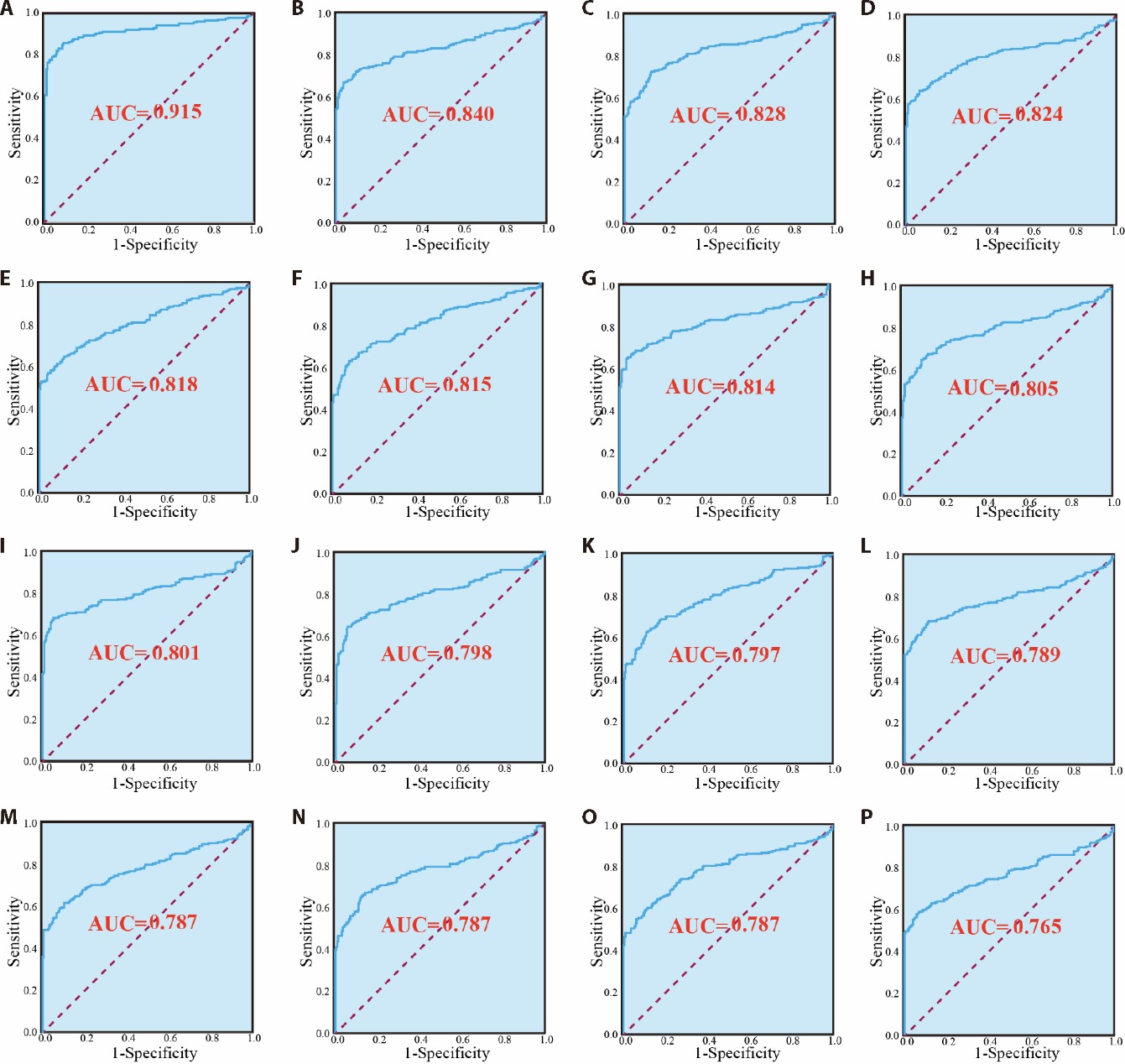
Figure 1 ROC curve for mechanical pain threshold at acupoints A: Renying (ST9); B: Quchi (LI11); C: Taichong (LR3); D: Yongquan (KI1); E: Xinshu (BL15); F: Fenglong (ST40); G: Xingjian (LR2); H: Zusanli (ST36); I: Taixi (KI3); J: Ganshu (BL18); K: Hegu (LI4); L: Shenshu (BL23); M: Sanyinjiao (SP6); N: Fengchi (GB20); O: Baihui (GV20); P: Neiguan (PC6). ROC curve of mechanical pain threshold of each acupoint. The horizontal coordinate is 1-specific, and the vertical coordinate is specific. AUC is the full name of area under the curve. Each acupoint is marked directly below each ROC curve. AUC values are all greater than 0.7. AUC greater than 0.9 indicates a high degree of differentiation, 0.7 < AUC ≤ 0.9 indicates a medium degree of differentiation, and AUC ≤ 0.7 indicates a low degree of differentiation. AUC values in this figure are all greater than 0.7. ROC: receiver operating characteristic; AUC: areas under the curves.
Figure 1 ROC curve for mechanical pain threshold at acupoints A: Renying (ST9); B: Quchi (LI11); C: Taichong (LR3); D: Yongquan (KI1); E: Xinshu (BL15); F: Fenglong (ST40); G: Xingjian (LR2); H: Zusanli (ST36); I: Taixi (KI3); J: Ganshu (BL18); K: Hegu (LI4); L: Shenshu (BL23); M: Sanyinjiao (SP6); N: Fengchi (GB20); O: Baihui (GV20); P: Neiguan (PC6). ROC curve of mechanical pain threshold of each acupoint. The horizontal coordinate is 1-specific, and the vertical coordinate is specific. AUC is the full name of area under the curve. Each acupoint is marked directly below each ROC curve. AUC values are all greater than 0.7. AUC greater than 0.9 indicates a high degree of differentiation, 0.7 < AUC ≤ 0.9 indicates a medium degree of differentiation, and AUC ≤ 0.7 indicates a low degree of differentiation. AUC values in this figure are all greater than 0.7. ROC: receiver operating characteristic; AUC: areas under the curves.
Table 3 Comparison of acupoint pressure threshold between hypertensive patients and healthy people
| Acupoint | Hypertension patients (g) | Healthy controls (g) | P value | Diagnostic threshold (g) | Sensitivity | Specificity | Youden Index | Patient sensitization rate (%) | Sensitization rate of healthy controls (%) | |||
|---|---|---|---|---|---|---|---|---|---|---|---|---|
| Quchi (LI11) | 1946±646 | 3745±1506 | <0.001a | 2853 | 0.75 | 0.07 | 0.68 | 93 | 25 | |||
| Neiguan (PC6) | 1597±546 | 3007±1196 | <0.001a | 2319 | 0.78 | 0.15 | 0.63 | 95 | 28 | |||
| Hegu (LI4) | 1769±590 | 3468±1511 | <0.001a | 2406 | 0.72 | 0.05 | 0.67 | 85 | 22 | |||
| Taichong (LR3) | 1362±442 | 2657±1118 | <0.001a | 1995 | 0.72 | 0.05 | 0.67 | 97 | 28 | |||
| Sanyinjiao (SP6) | 2452±854 | 4569±1636 | <0.001a | 3647 | 0.75 | 0.07 | 0.68 | 93 | 25 | |||
| Zusanli (ST36) | 2464±867 | 4582±1752 | <0.001a | 3443 | 0.80 | 0.10 | 0.70 | 90 | 20 | |||
| Fenglong (ST40) | 2484±897 | 4593±1807 | <0.001a | 3708 | 0.68 | 0.07 | 0.62 | 93 | 32 | |||
| Xingjian (LR2) | 1458±452 | 2689±1008 | <0.001a | 2185 | 0.72 | 0.03 | 0.68 | 95 | 28 | |||
| Taixi (KI3) | 1865±657 | 3768±1687 | <0.001a | 2708 | 0.73 | 0.03 | 0.70 | 95 | 27 | |||
| Yongquan (KI1) | 1501±543 | 2931±1328 | <0.001a | 2354 | 0.77 | 0.07 | 0.70 | 94 | 23 | |||
| Baihui (GV20) | 2062±787 | 4355±1775 | <0.001a | 3117 | 0.73 | 0.03 | 0.70 | 95 | 27 | |||
| Fengchi (GB20) | 1957±664 | 3759±1546 | <0.001a | 2635 | 0.70 | 0.10 | 0.60 | 90 | 30 | |||
| Renying (ST9) | 1562±543 | 2957±1225 | <0.001a | 2442 | 0.70 | 0.07 | 0.63 | 93 | 30 | |||
| Xinshu (BL15) | 2604±1427 | 4630±1922 | <0.001a | 3507 | 0.77 | 0.28 | 0.48 | 72 | 23 | |||
| Ganshu (BL18) | 2810±1651 | 4518±1835 | <0.001a | 4383 | 0.52 | 0.12 | 0.40 | 88 | 38 | |||
| Shenshu (BL23) | 3028±1822 | 4686±1941 | <0.001a | 5260 | 0.47 | 0.08 | 0.38 | 92 | 43 | |||
Table 3 Comparison of acupoint pressure threshold between hypertensive patients and healthy people
| Acupoint | Hypertension patients (g) | Healthy controls (g) | P value | Diagnostic threshold (g) | Sensitivity | Specificity | Youden Index | Patient sensitization rate (%) | Sensitization rate of healthy controls (%) | |||
|---|---|---|---|---|---|---|---|---|---|---|---|---|
| Quchi (LI11) | 1946±646 | 3745±1506 | <0.001a | 2853 | 0.75 | 0.07 | 0.68 | 93 | 25 | |||
| Neiguan (PC6) | 1597±546 | 3007±1196 | <0.001a | 2319 | 0.78 | 0.15 | 0.63 | 95 | 28 | |||
| Hegu (LI4) | 1769±590 | 3468±1511 | <0.001a | 2406 | 0.72 | 0.05 | 0.67 | 85 | 22 | |||
| Taichong (LR3) | 1362±442 | 2657±1118 | <0.001a | 1995 | 0.72 | 0.05 | 0.67 | 97 | 28 | |||
| Sanyinjiao (SP6) | 2452±854 | 4569±1636 | <0.001a | 3647 | 0.75 | 0.07 | 0.68 | 93 | 25 | |||
| Zusanli (ST36) | 2464±867 | 4582±1752 | <0.001a | 3443 | 0.80 | 0.10 | 0.70 | 90 | 20 | |||
| Fenglong (ST40) | 2484±897 | 4593±1807 | <0.001a | 3708 | 0.68 | 0.07 | 0.62 | 93 | 32 | |||
| Xingjian (LR2) | 1458±452 | 2689±1008 | <0.001a | 2185 | 0.72 | 0.03 | 0.68 | 95 | 28 | |||
| Taixi (KI3) | 1865±657 | 3768±1687 | <0.001a | 2708 | 0.73 | 0.03 | 0.70 | 95 | 27 | |||
| Yongquan (KI1) | 1501±543 | 2931±1328 | <0.001a | 2354 | 0.77 | 0.07 | 0.70 | 94 | 23 | |||
| Baihui (GV20) | 2062±787 | 4355±1775 | <0.001a | 3117 | 0.73 | 0.03 | 0.70 | 95 | 27 | |||
| Fengchi (GB20) | 1957±664 | 3759±1546 | <0.001a | 2635 | 0.70 | 0.10 | 0.60 | 90 | 30 | |||
| Renying (ST9) | 1562±543 | 2957±1225 | <0.001a | 2442 | 0.70 | 0.07 | 0.63 | 93 | 30 | |||
| Xinshu (BL15) | 2604±1427 | 4630±1922 | <0.001a | 3507 | 0.77 | 0.28 | 0.48 | 72 | 23 | |||
| Ganshu (BL18) | 2810±1651 | 4518±1835 | <0.001a | 4383 | 0.52 | 0.12 | 0.40 | 88 | 38 | |||
| Shenshu (BL23) | 3028±1822 | 4686±1941 | <0.001a | 5260 | 0.47 | 0.08 | 0.38 | 92 | 43 | |||
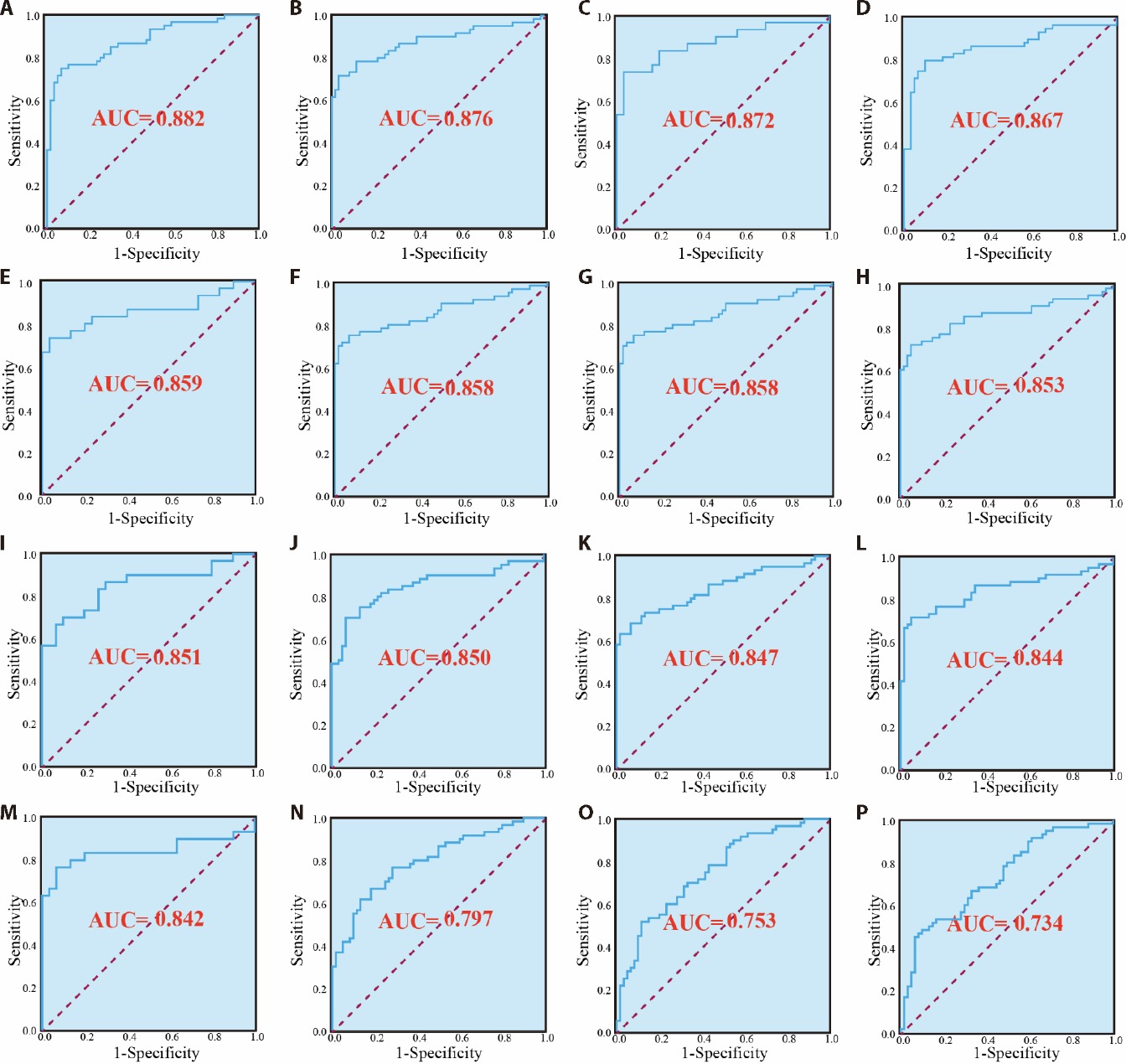
Figure 2 ROC curve for acupoint tenderness threshold A: Sanyinjiao (SP6); B: Xingjian (LR2); C: Baihui (GV20); D: Zusanli (ST36); E: Taixi (KI3); F: Quchi (LI11); G: Hegu (LI4); H: Taichong (LR3); I: Fengchi (GB20); J: Renying (ST9); K: Fenglong (ST40); L: Neiguan (PC6); M: Yongquan (KI1); N: Xinshu (BL15); O: Ganshu (BL18); P: Shenshu (BL23). ROC curve of pressure threshold of each acupoint.The horizontal coordinate is 1-specific, and the vertical coordinate is specific. AUC is the full name of area under the curve. Each acupoint is marked directly below each ROC curve. In this figure, the AUC values of ROC curves are all greater than 0.7. AUC greater than 0.9 indicates a high degree of differentiation, 0.7 < AUC ≤ 0.9 indicates a medium degree of differentiation, and AUC ≤ 0.7 indicates a low degree of differentiation. AUC values in this figure are all greater than 0.7. ROC: receiver operating characteristic; AUC: areas under the curves.
Figure 2 ROC curve for acupoint tenderness threshold A: Sanyinjiao (SP6); B: Xingjian (LR2); C: Baihui (GV20); D: Zusanli (ST36); E: Taixi (KI3); F: Quchi (LI11); G: Hegu (LI4); H: Taichong (LR3); I: Fengchi (GB20); J: Renying (ST9); K: Fenglong (ST40); L: Neiguan (PC6); M: Yongquan (KI1); N: Xinshu (BL15); O: Ganshu (BL18); P: Shenshu (BL23). ROC curve of pressure threshold of each acupoint.The horizontal coordinate is 1-specific, and the vertical coordinate is specific. AUC is the full name of area under the curve. Each acupoint is marked directly below each ROC curve. In this figure, the AUC values of ROC curves are all greater than 0.7. AUC greater than 0.9 indicates a high degree of differentiation, 0.7 < AUC ≤ 0.9 indicates a medium degree of differentiation, and AUC ≤ 0.7 indicates a low degree of differentiation. AUC values in this figure are all greater than 0.7. ROC: receiver operating characteristic; AUC: areas under the curves.
| 1. |
Mills KT, Stefanescu A, He J. The global epidemiology of hypertension. Nature Reviews Nephrology 2020; 16: 223-37.
DOI PMID |
| 2. |
NCD Risk Factor Collaboration (NCD-RisC). Worldwide trends in hypertension prevalence and progress in treatment and control from 1990 to 2019: a pooled analysis of 1201 population-representative studies with 104 million participants. Lancet 2021; 398: 957-80.
DOI PMID |
| 3. | Rossier BC, Bochud M, Devuyst O. The Hypertension pandemic: an evolutionary perspective. Physiology (Bethesda, Md) 2017; 32: 112-25. |
| 4. |
Guzik TJ, Nosalski R, Maffia P, Drummond GR. Immune and inflammatory mechanisms in hypertension. Nature Reviews Cardiology 2024; 21: 396-416.
DOI PMID |
| 5. |
Zhu Y, Sheng ZF, Yao H, Li DP. Emerging mechanisms involving brain Kv7 channel in the pathogenesis of hypertension. Biochem Pharmacol 2022; 206: 115318.
DOI URL |
| 6. |
Dong A, Gao Z, Wang H, et al. Acupuncture alleviates chronic ischemic white matter injury in SHR rats via JNK-NMDAR circuit. Mol Neurobiol 2024; 61: 3144-60.
DOI |
| 7. |
Zhang L, Lai H, Li L, et al. Effects of acupuncture with needle manipulation at different frequencies for patients with hypertension: result of a 24- week clinical observation. Complement Ther Med 2019; 45: 142-8.
DOI PMID |
| 8. |
Fan H, Yang JW, Wang LQ, et al. The hypotensive role of acupuncture in hypertension: clinical study and mechanistic study. Front Aging Neurosci 2020; 12: 138.
DOI PMID |
| 9. | Yang J, Chen J, Yang M, et al. Acupuncture for hypertension. Cochrane Db Syst Rev 2018; 11: CD008821. |
| 10. |
Li YY, Liu JP, Shi SF, et al. Acupuncture with twirling reinforcing and reducing manipulation shows a control of hypertension and regulation of blood pressure-related target brain regions in spontaneously hypertensive rat: a preliminary resting-state functional MRI study. Front Neurosci 2023; 17: 1161578.
DOI URL |
| 11. |
Liu JP, Li YY, Yang KZ, et al. Electroacupuncture and manual acupuncture at LR3 and ST36 have attenuating effects on hypertension and subsequent cognitive dysfunction in spontaneously hypertensive rats: a preliminary resting-state functional magnetic resonance imaging study. Front Neurosci 2023; 17: 1129688.
DOI URL |
| 12. |
Wu XL, Zhang L, Zhang J, et al. Acupuncture modulation of the ACE/Ang II/AT1R and ACE2/Ang (1-7)/MasR pathways in the rostral ventrolateral medulla reduces sympathetic output and prevents cardiac injury caused by SHR hypertension. Neuroreport 2024; 35: 839-45.
DOI URL |
| 13. |
Yang K, Zhang P, Lü T, Wu J, Liu Q. Acupuncture at Taichong and Zusanli points exerts hypotensive effect in spontaneously hypertensive rats by metabolomic analysis. J Chromatogr B Analyt Technol Biomed Life Sci 2022; 1207: 123352.
DOI URL |
| 14. |
XI HQ, LI X, Zhang ZY, et al. Neuro- and immuno-modulation mediated by the cardiac sympathetic nerve: a novel insight into the anti-ischemic efficacy of acupuncture. J Tradit Chin Med 2024; 44: 1058-66.
DOI |
| 15. |
Li W, Liu J, Chen A, et al. Shared nociceptive dorsal root ganglion neurons participating in acupoint sensitization. Front Mol Neurosci 2022; 15: 974007.
DOI URL |
| 16. |
Wang X, Zuo G, Liu J, et al. Skin temperature of acupoints in health and primary dysmenorrhea patients: a systematic review and Meta-analysis. J Pain Res 2023; 16: 2027-46.
DOI PMID |
| 17. | Yan CQ, Zhang S, Li QQ, et al. Detection of peripheral and central sensitisation at acupoints in patients with unilateral shoulder pain in Beijing: a cross-sectional matched case-control study. BMJ open 2017; 7: e014438. |
| 18. |
Pan LH, Wang YF, Lai KL, Chen WT, Chen SP, Ling YH, et al. Mechanical punctate pain threshold is associated with headache frequency and phase in patients with migraine. Cephalalgia 2020; 40: 990-7.
DOI PMID |
| 19. | Ding N, Liu X, Chen N, et al. Lack of association between acupoint sensitization and microcirculatory structural changes in a mouse model of knee osteoarthritis: a pilot study. J Biophotonics 2019; 12: e201800458. |
| 20. |
Arendt-Nielsen L, Morlion B, Perrot S, et al. Assessment and manifestation of central sensitisation across different chronic pain conditions. Eur J Pain 2018; 22: 216-41.
DOI URL |
| 21. |
Woolf CJ. Central sensitization: implications for the diagnosis and treatment of pain. Pain 2011; 152: S2-15.
DOI URL |
| 22. |
Pujol J, Martínez-Vilavella G, Llorente-Onaindia J, et al. Brain imaging of pain sensitization in patients with knee osteoarthritis. Pain 2017; 158: 1831-38.
DOI PMID |
| 23. | Eken A, Kara M, Baskak B, Baltacı A, Gökçay D. Differential efficiency of transcutaneous electrical nerve stimulation in dominant versus nondominant hands in fibromyalgia: placebo-controlled functional near-infrared spectroscopy study. Neurophotonics 2018; 5: 011005. |
| 24. |
Cha M, Lee KH, Kwon M, Lee BH. Possible therapeutic options for complex regional pain syndrome. Biomedicines 2021; 9: 596.
DOI URL |
| 25. |
Kersten M, Swets JA, Cox CR, Kusumi T, Nishihata K, Watanabe T. Attenuating pain with the past: nostalgia reduces physical pain. Front Psychol 2020; 11: 572881.
DOI URL |
| 26. |
Dalewski B, Kamińska A, Kiczmer P, et al. Pressure algometry evaluation of two occlusal splint designs in bruxism management-randomized, controlled clinical trial. J Clin Med 2021; 10: 2342.
DOI URL |
| 27. | He YQ, Liang BX, Feng WY, Xian SX. Rules of acupoint selection and drug use in clinical treatment of hypertension with acupoint application therapy. Zhong Guo Zhen Jiu 2020; 40: 565-9. |
| 28. | Liu H, Gao HB, Wang Y. Literature study on acupoint selection rules of acupuncture treatment for hypertension. Zhong Yi Za Zhi 2014; 55: 1055-8. |
| 29. |
Bacchetti P, Leung JM. Sample size calculations in clinical research. Anesthesiology 2002; 97: 1028-32.
DOI PMID |
| 30. |
Xie D, Liu Z, Hou X, et al. Heat sensitisation in suspended moxibustion: features and clinical relevance. Acupunct Med 2013; 31: 422-4.
DOI PMID |
| 31. |
Shi S, Qin G. Direct estimation of volume under the ROC surface with verification bias. J Biopharm Stat 2024; 34: 553-81.
DOI URL |
| 32. |
Thase ME, Harrington A, Calabrese J, Montgomery S, Niu X, Patel MD. Evaluation of MADRS severity thresholds in patients with bipolar depression. J Affect Disord 2021; 286: 58-63.
DOI URL |
| 33. |
Zheng T, Jing DU, Wenhao L, Jixiang LU, Yagi M, Yonei Y. Clinical observation on edema based on the thermal sensitivity measurement method. J Tradit Chin Med 2025; 45: 639-50.
DOI |
| 34. | Xu L, Jing L, He K, Wang JL, Wang Y. Treatment of knee osteoarthritis with acupuncture and moxibustion: a randomized controlled trial. Zhong Guo Zhen Jiu 2013; 33: 871-6. |
| 35. |
Wang XY, Nie ZY, Yu QQ, et al. Acupuncture enhances signals at sensitized acupoints to elevate pressure pain threshold in knee osteoarthritis patients. Chin J Integr Med 2022; 28: 1105-10.
DOI |
| 36. |
Zweig MH, Campbell G. Receiver-operating characteristic (ROC) plots: a fundamental evaluation tool in clinical medicine. Clin Chem 1993; 39: 561-77.
PMID |
| 37. | Zhang S, Yang L, Jia S, Jin Z, Zheng B. Detection of pain thresholds of acupoints for irritable bowel syndrome. Zhong Guo Zhen Jiu 2016; 36: 835-9. |
| 38. |
Vallbo AB, Olausson H, Wessberg J. Unmyelinated afferents constitute a second system coding tactile stimuli of the human hairy skin. J Neurophysiol 1999; 81: 2753-63.
PMID |
| 39. |
Han KH, Cho KH, Han C, et al. The effectiveness and safety of acupuncture treatment on sciatica: a systematic review and Meta-analysis. Complement Ther Med 2022; 71: 102872.
DOI URL |
| 40. |
Lang-Illievich K, Winter R, Rumpold-Seitlinger G, et al. The effect of low-level light therapy on capsaicin-induced peripheral and central sensitization in healthy volunteers: a double-blinded, randomized, sham-controlled trial. Pain Ther 2020; 9: 717-26.
DOI PMID |
| 41. |
Cui X, Liu K, Xu D, et al. Mast cell deficiency attenuates acupuncture analgesia for mechanical pain using c-kit gene mutant rats. J Pain Res 2018; 11: 483-95.
DOI PMID |
| 42. | Miyachi R, Nishimura T, Noguchi M, et al. Subgroup characteristics of middle-aged and older women with chronic low back pain by multiple factors: a hierarchical cluster analysis. J Funct Morphol Kinesiol 2025; 10: 30. |
| 43. |
Liu J, Li Y, Li L, et al. Effects of acupuncture at acupoints with lower versus higher pain threshold for knee osteoarthritis: a multicenter randomized controlled trial. Chin Med 2022; 17: 67.
DOI |
| 44. |
Wang YX, Liu YH, Zhang ZL, et al. Influence of acupuncture intensity on analgesic effects in AA rat models. Front Bioeng Biotechnol 2024; 12: 1502535.
DOI URL |
| 45. |
Sun S, Liu L, Zhou M, Liu Y, Sun M, Zhao L. The analgesic effect and potential mechanisms of acupuncture for migraine rats: a systematic review and Meta-analysis. J Pain Res 2023; 16: 2525-42.
DOI PMID |
| 46. |
Plummer JP. Anatomical findings at acupuncture loci. Am J Chin Med 1980; 8: 170-80.
DOI URL |
| 47. | Shi J, Wang J, Wang Y, et al. Correlation between referred pain region and sensitized acupoints in patients with stable angina pectoris and distribution of sensitized spots in rats with myocardial ischemia. Zhen Ci Yan Jiu 2018; 43: 277-84. |
| 48. |
Oh DS, Kang W, Choi SM, Son CG. Effect of acupuncture for gastrointestinal activity differs depending on the pathophysiological condition. Acupunct Med 2011; 29: 316-7.
DOI URL |
| 49. |
Zhu B, Xu WD, Rong PJ, Ben H, Gao XY. A C-fiber reflex inhibition induced by electroacupuncture with different intensities applied at homotopic and heterotopic acupoints in rats selectively destructive effects on myelinated and unmyelinated afferent fibers. Brain Res 2004; 1011: 228-37.
DOI PMID |
| 50. |
Tschugg A, Löscher WN, Hartmann S, Neururer S, Wildauer M, Thomé C. Gender influences radicular pain perception in patients with lumbar disc herniation. J Womens Health (Larchmt) 2015; 24: 771-6.
DOI PMID |
| 51. |
Li Y, Yu Y, Liu Y, Yao W. Mast cells and acupuncture analgesia. Cells 2022; 11: 860.
DOI URL |
| 52. | Ding N, Jiang J, Qin P, Wang Q, Hu J, Li Z. Mast cells are important regulator of acupoint sensitization via the secretion of tryptase, 5-hydroxytryptamine, and histamine. PLoS One 2018; 13: e0194022. |
| [1] | WANG Runxi, FANG Liyuan, WANG Yan, XIE Yi, FANG Yuhang, SUI Bailu, YUAN Xinhe, CHEN Yu, ZHANG Ying. Association between the fear of cancer recurrence and Traditional Chinese Medicine constitution in breast cancer patients: a cross-sectional study [J]. Journal of Traditional Chinese Medicine, 2026, 46(3): 715-725. |
| [2] | WANG Xuehui, SUN Yuxin, Birling Yoann, LI Xun, ZHAO Ruotong, ZHENG Youyou, SONG Zhenmei, ZHANG Yanli, DU Hongbo, WANG Jianyun, LI Yinqing, LIU Zhaolan, LIU Jianping. A Meta-analysis of Traditional Chinese Medicine constitution distribution in people with functional constipation [J]. Journal of Traditional Chinese Medicine, 2026, 46(2): 261-273. |
| [3] | LI Tianxing, ZHU Linghui, WANG Xueke, TANG Jun, YANG Lingling, PANG Guoming, LI Huang, WANG Liying, DONG Yang, ZHAO Shipeng, LI Yingshuai, LI Lingru. Gut microbial characteristics of the damp-heat constitution: a population-based multicenter cross-sectional study [J]. Journal of Traditional Chinese Medicine, 2025, 45(1): 140-151. |
| [4] | FAN Xisheng, DU Xiaoyi, PAN Lijia, SONG Xiaodan, LIU Jun, ZHANG Juncha, CHEN Hao, GAO Yayu, ZHANG Mingjian, SHI Xuliang, SHE Yanfen. An infrared thermographic analysis of the sensitization acupoints of women with primary dysmenorrhea [J]. Journal of Traditional Chinese Medicine, 2022, 42(5): 825-832. |
| [5] | ZHU Guohua, SUN Xipeng, DING Cuntao, ZHAO Huan, LI Jing, HUA Qi. Effect of Songlingxuemaikang(松龄血脉康) on mild essential hypertension in patients: a randomized parallel-controlled study [J]. Journal of Traditional Chinese Medicine, 2021, 41(5): 799-805. |
| [6] | Wang Weijie, Tang Xiaopo, Wang Xinchang, Jiang Quan, Fan Yongsheng. Classifying rheumatoid arthritis by Traditional Chinese Medicine Zheng: a multi-center cross-sectional study [J]. Journal of Traditional Chinese Medicine, 2019, 39(03): 425-432. |
| [7] | Zhao Zhengxiao, Liu Lumei, Tang Zihui, Mohammadtursun Nabijan, Lu Linwei, Li Mihui, Lü Yibao, Mo Shuming, Ma Wenjuan, Wang Meng, Wei Ying, Gong Weiyi, Dong Jingcheng. Kidney-Qi deficiency diagnosed by Deng's diagnosis standard was not correlated with aging based on clinical observation of 90 participants [J]. Journal of Traditional Chinese Medicine, 2019, 39(02): 267-274. |
| [8] | Ping-Ho Chen, Sheng-Miauh Huang, Jerry Cheng-Yen Lai, Chen-Jei Tai, Li-Yin Chien, Yun-Hsiang Lee. Factors associated with seeking western or Chinese medical treatment for fertility among women with breast cancer in Taiwan [J]. Journal of Traditional Chinese Medicine, 2018, 38(06): 904-910. |
| [9] | Guo Yan, Lu Juan, Liang Jingrong, Zhao Ruili, Xu Jing, Zhang Wei, Park Kibeum, Zhu Shipeng, Chen Huan, Ma Liangxiao. Effect of acupuncture at Renying(ST 9) on gene expression profile of hypothalamus in spontaneously hypertensive rats [J]. Journal of Traditional Chinese Medicine, 2018, 38(02): 227-241. |
| [10] | Marzieh Alamolhoda, Peyman Jafari, Seyyed Mohammad Taghi Ayatollahi, Parvin Afsar Kazerooni. Reliability and validity of Persian version of Medical Outcome Study-HIV health survey in Iranian people living with HIV [J]. Journal of Traditional Chinese Medicine, 2017, 37(05): 695-701. |
| [11] | Yanbo Zhu, Qi Wang, Zhaoyu Dai, Hideki Origasa, Jie Di, Yangyang Wang, Lin Lin, Chunpok Fan. Case-control study on the associations between lifestyle-behavioral risk factors and phlegm-wetness cbonstitution [J]. Journal of Traditional Chinese Medicine, 2014, 34(03): 286-292. |
| [12] | Peng, Jin; Wu, Xiaqiu; Hu, Jingqing; Fang, Yigong; Zi, Mingjie; Liu, Baoyan. Influencing factors on efficacy of summer acupoint application treatment for allergic rhinitis:a retrospective study [J]. Journal of Traditional Chinese Medicine, 2012, 32(03): 377-381. |
| Viewed | ||||||
|
Full text |
|
|||||
|
Abstract |
|
|||||