
Journal of Traditional Chinese Medicine ›› 2026, Vol. 46 ›› Issue (3): 715-725.DOI: 10.19852/j.cnki.jtcm.2026.03.011
• Original Articles • Previous Articles Next Articles
Association between the fear of cancer recurrence and Traditional Chinese Medicine constitution in breast cancer patients: a cross-sectional study
WANG Runxi1, FANG Liyuan1, WANG Yan1, XIE Yi1,2, FANG Yuhang1,2, SUI Bailu1,2, YUAN Xinhe1,2, CHEN Yu1,2, ZHANG Ying1( )
)
- 1
1Oncology Department ,Guang’anmen Hospital, China Academy of Chinese Medical Sciences Beijing 100000, China
2Graduate School ,Beijing University of Chinese Medicine Beijing 100000, China
-
Received:2025-04-27Accepted:2025-09-29Online:2026-06-15Published:2026-06-08 -
Contact:Prof. ZHANG Ying, Oncology Department of Guang'anmen Hospital, China Academy of Chinese Medical Sciences, Beijing 100000, China. zylzy501@163.com, Telephone: +86-19840871565 -
Supported by:Scientific and Technological Innovation Project of the China Academy of Chinese Medical Sciences: Series Research on Traditional Chinese Medicine Oncology Nutrition(CI2022C002-03)

Cite this article
WANG Runxi, FANG Liyuan, WANG Yan, XIE Yi, FANG Yuhang, SUI Bailu, YUAN Xinhe, CHEN Yu, ZHANG Ying. Association between the fear of cancer recurrence and Traditional Chinese Medicine constitution in breast cancer patients: a cross-sectional study[J]. Journal of Traditional Chinese Medicine, 2026, 46(3): 715-725.
share this article
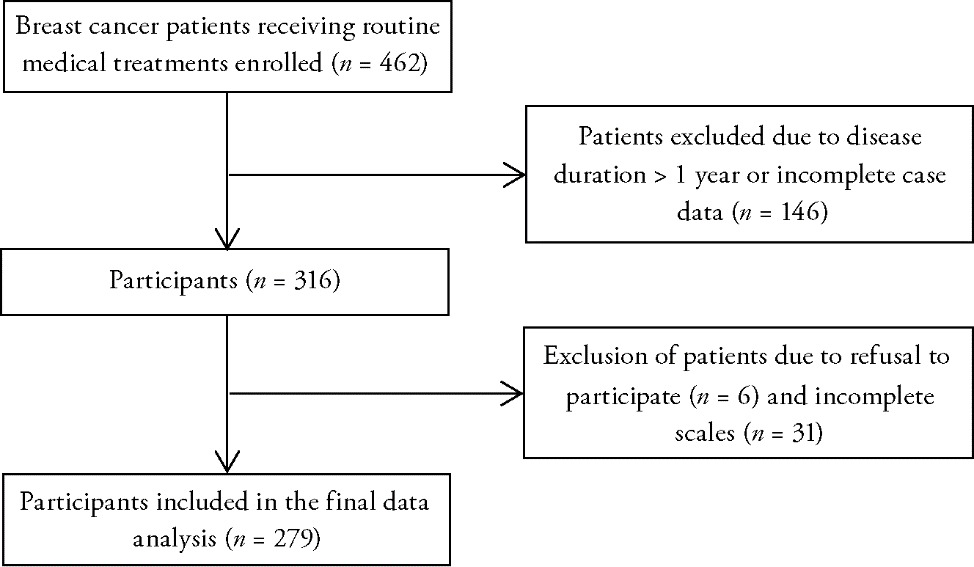
Figure 1 Patients screening process
Figure 1 Patients screening process
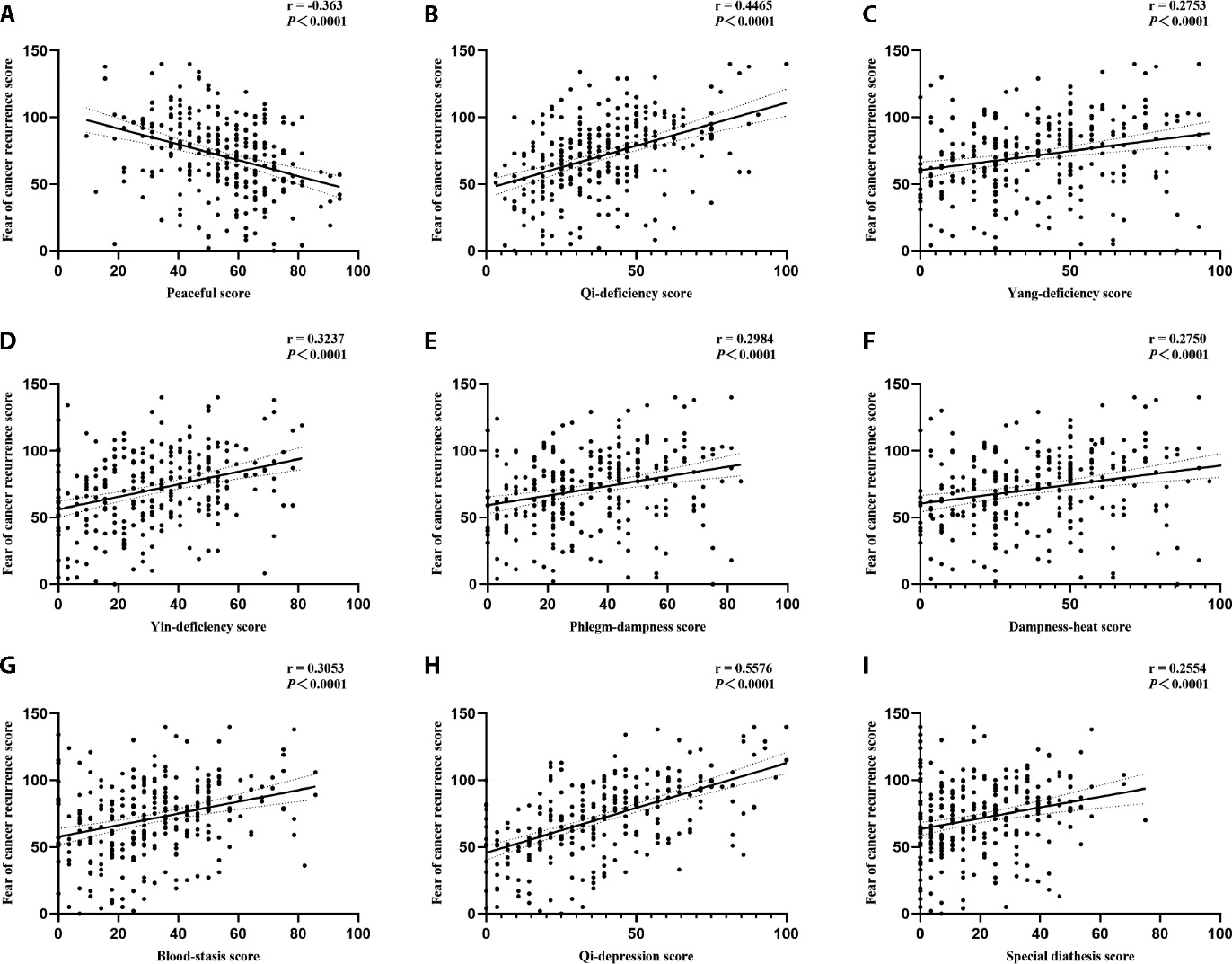
Figure 2 FCR Linear Correlation Diagram of breast cancer Patients with Different TCM constitutions Scatter plots showing the linear correlation between FCR scores and specific constitutions: A: peaceful; B: Qi-deficiency; C: Yang-deficiency; D: Yin-deficiency; E: phlegm-dampness; F: dampness-heat; G: blood-stasis; H: Qi-depression; I: special diathesis. FCR: fear of cancer recurrence; TCM: Traditional Chinese Medicine. The solid lines represent the line of best fit from linear regression, and the dotted lines indicate the 95% confidence bands. The r values represent the Pearson correlation coefficients. P < 0.0001 indicates a statistically significant correlation.
Figure 2 FCR Linear Correlation Diagram of breast cancer Patients with Different TCM constitutions Scatter plots showing the linear correlation between FCR scores and specific constitutions: A: peaceful; B: Qi-deficiency; C: Yang-deficiency; D: Yin-deficiency; E: phlegm-dampness; F: dampness-heat; G: blood-stasis; H: Qi-depression; I: special diathesis. FCR: fear of cancer recurrence; TCM: Traditional Chinese Medicine. The solid lines represent the line of best fit from linear regression, and the dotted lines indicate the 95% confidence bands. The r values represent the Pearson correlation coefficients. P < 0.0001 indicates a statistically significant correlation.
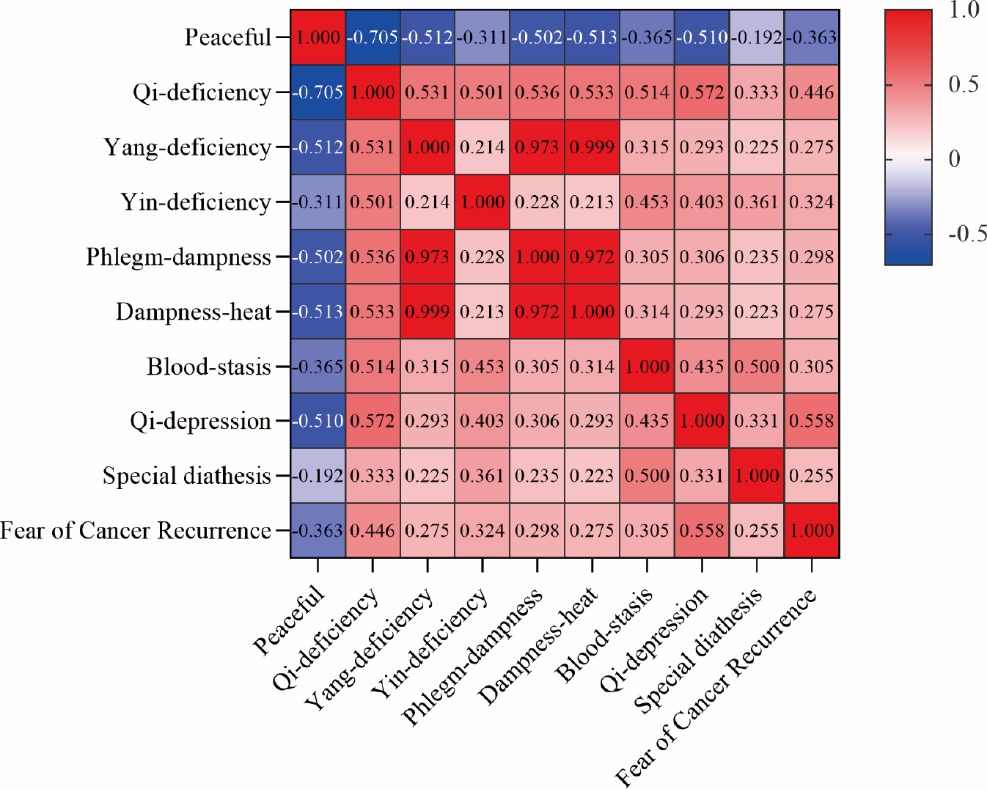
Figure 3 FCR Heat Map of breast cancer Patients with Different TCM constitutions This figure illustrates the correlation matrix between nine TCM body constitutions and FCR in breast cancer patients. The values in the cells represent the correlation coefficients. The color gradient from blue to red represents the strength and direction of the correlation ranging from -1.0 to 1.0, where red indicates a positive correlation and blue indicates a negative correlation. FCR: fear of cancer recurrence; TCM: Traditional Chinese Medicine.
Figure 3 FCR Heat Map of breast cancer Patients with Different TCM constitutions This figure illustrates the correlation matrix between nine TCM body constitutions and FCR in breast cancer patients. The values in the cells represent the correlation coefficients. The color gradient from blue to red represents the strength and direction of the correlation ranging from -1.0 to 1.0, where red indicates a positive correlation and blue indicates a negative correlation. FCR: fear of cancer recurrence; TCM: Traditional Chinese Medicine.
Table 1 Multiple logistic regression of FCR for TCM constitutions in different models
| Crude model | Model Ⅰ | Model Ⅱ | ||||||
|---|---|---|---|---|---|---|---|---|
| Item | OR (95% CI) | P value | OR (95% CI) | P value | OR (95% CI) | P value | ||
| Peaceful | 0.991 (0.973, 1.011) | 0.380 | 0.994 (0.974, 1.015) | 0.578 | 0.995 (0.973.1.018) | 0.668 | ||
| Qi-deficiency | 0.998 (0.944, 1.054) | 0.934 | 0.861 (0.637, 1.162) | 0.327 | 0.991 (0.957, 1.026) | 0.612 | ||
| Yang-deficiency | 1.022 (1.004, 1.041) | 0.017 | 1.026 (1.006, 1.047) | 0.010 | 1.026 (1.004, 1.049) | 0.021 | ||
| Yin-deficiency | 0.976 (0.947, 1.007) | 0.126 | 0.972 (0.935, 1.010) | 0.149 | 0.963 (0.915, 1.013) | 0.145 | ||
| Phlegm-dampness | 1.023 (1.005, 1.041) | 0.012 | 1.025 (1.006, 1.045) | 0.012 | 1.028 (1.006, 1.051) | 0.013 | ||
| Dampness-heat | 0.998 (0.978, 1.018) | 0.832 | 1.000 (0.979, 1.022) | 0.985 | 1.002 (0.978, 1.027) | 0.871 | ||
| Blood-stasis | 0.978 (0.96, 0.995) | 0.012 | 0.975 (0.957, 0.994) | 0.012 | 0.972 (0.951, 0.994) | 0.013 | ||
| Qi-depression | 0.993 (0.974, 1.013) | 0.479 | 0.995 (0.974, 1.016) | 0.639 | 0.995 (0.972, 1.018) | 0.671 | ||
| Special diathesis | 0.995 (0.972, 1.018) | 0.642 | 0.995 (0.971, 1.019) | 0.659 | 1.001 (0.975, 1.029) | 0.925 | ||
Table 1 Multiple logistic regression of FCR for TCM constitutions in different models
| Crude model | Model Ⅰ | Model Ⅱ | ||||||
|---|---|---|---|---|---|---|---|---|
| Item | OR (95% CI) | P value | OR (95% CI) | P value | OR (95% CI) | P value | ||
| Peaceful | 0.991 (0.973, 1.011) | 0.380 | 0.994 (0.974, 1.015) | 0.578 | 0.995 (0.973.1.018) | 0.668 | ||
| Qi-deficiency | 0.998 (0.944, 1.054) | 0.934 | 0.861 (0.637, 1.162) | 0.327 | 0.991 (0.957, 1.026) | 0.612 | ||
| Yang-deficiency | 1.022 (1.004, 1.041) | 0.017 | 1.026 (1.006, 1.047) | 0.010 | 1.026 (1.004, 1.049) | 0.021 | ||
| Yin-deficiency | 0.976 (0.947, 1.007) | 0.126 | 0.972 (0.935, 1.010) | 0.149 | 0.963 (0.915, 1.013) | 0.145 | ||
| Phlegm-dampness | 1.023 (1.005, 1.041) | 0.012 | 1.025 (1.006, 1.045) | 0.012 | 1.028 (1.006, 1.051) | 0.013 | ||
| Dampness-heat | 0.998 (0.978, 1.018) | 0.832 | 1.000 (0.979, 1.022) | 0.985 | 1.002 (0.978, 1.027) | 0.871 | ||
| Blood-stasis | 0.978 (0.96, 0.995) | 0.012 | 0.975 (0.957, 0.994) | 0.012 | 0.972 (0.951, 0.994) | 0.013 | ||
| Qi-depression | 0.993 (0.974, 1.013) | 0.479 | 0.995 (0.974, 1.016) | 0.639 | 0.995 (0.972, 1.018) | 0.671 | ||
| Special diathesis | 0.995 (0.972, 1.018) | 0.642 | 0.995 (0.971, 1.019) | 0.659 | 1.001 (0.975, 1.029) | 0.925 | ||
Table 2 Multiple linear regression of FCR
| Model | Unstandardized coefficients | Standardized coefficients | t | Sig. | 95% CI for B | ||
|---|---|---|---|---|---|---|---|
| B | Std. error | Beta | Lower bound | Upper bound | |||
| Constant | 63.984 | 29.416 | - | 2.175 | 0.032 | 5.586 | 122.383 |
| TCM constitutions | 2.892 | 1.022 | 0.264 | 2.830 | 0.006 | 0.864 | 4.921 |
| Age | 0.042 | 0.298 | 0.016 | -0.139 | 0.890 | 0.633 | 0.550 |
| Pathological type | 3.474 | 3.081 | 0.110 | 1.128 | 0.262 | -2.643 | 9.591 |
| Tumour Stages | 6.720 | 5.008 | 0.157 | 1.342 | 0.183 | -3.223 | 16.663 |
| ER+ | -33.908 | 23.056 | 0.150 | -1.471 | 0.145 | -79.679 | 11.863 |
| PR+ | 2.315 | 10.842 | 0.022 | 0.214 | 0.831 | -19.209 | 23.839 |
| Ki-67 | -5.220 | 5.169 | 0.099 | -1.010 | 0.315 | -15.482 | 5.043 |
| lymphatic node transfern | -23.203 | 7.279 | 0.380 | -3.188 | 0.002 | -37.653 | -8.754 |
| Time of illness | 2.115 | 1.094 | 0.197 | 1.934 | 0.056 | 0.056 | 4.287 |
| Treatment programme | 1.458 | 1.459 | 0.105 | 1.000 | 0.320 | -1.438 | 4.354 |
| Endocrine therapy | 4.164 | 2.089 | 0.206 | 1.993 | 0.049 | 0.017 | 8.311 |
| Surgical procedure | -1.112 | 6.411 | 0.018 | 0.173 | 0.863 | -13.840 | 11.616 |
Table 2 Multiple linear regression of FCR
| Model | Unstandardized coefficients | Standardized coefficients | t | Sig. | 95% CI for B | ||
|---|---|---|---|---|---|---|---|
| B | Std. error | Beta | Lower bound | Upper bound | |||
| Constant | 63.984 | 29.416 | - | 2.175 | 0.032 | 5.586 | 122.383 |
| TCM constitutions | 2.892 | 1.022 | 0.264 | 2.830 | 0.006 | 0.864 | 4.921 |
| Age | 0.042 | 0.298 | 0.016 | -0.139 | 0.890 | 0.633 | 0.550 |
| Pathological type | 3.474 | 3.081 | 0.110 | 1.128 | 0.262 | -2.643 | 9.591 |
| Tumour Stages | 6.720 | 5.008 | 0.157 | 1.342 | 0.183 | -3.223 | 16.663 |
| ER+ | -33.908 | 23.056 | 0.150 | -1.471 | 0.145 | -79.679 | 11.863 |
| PR+ | 2.315 | 10.842 | 0.022 | 0.214 | 0.831 | -19.209 | 23.839 |
| Ki-67 | -5.220 | 5.169 | 0.099 | -1.010 | 0.315 | -15.482 | 5.043 |
| lymphatic node transfern | -23.203 | 7.279 | 0.380 | -3.188 | 0.002 | -37.653 | -8.754 |
| Time of illness | 2.115 | 1.094 | 0.197 | 1.934 | 0.056 | 0.056 | 4.287 |
| Treatment programme | 1.458 | 1.459 | 0.105 | 1.000 | 0.320 | -1.438 | 4.354 |
| Endocrine therapy | 4.164 | 2.089 | 0.206 | 1.993 | 0.049 | 0.017 | 8.311 |
| Surgical procedure | -1.112 | 6.411 | 0.018 | 0.173 | 0.863 | -13.840 | 11.616 |
| 1. | International agency for research on cancer. Epidemiological data of breast cancer. Epidemiological data of breast cancer serial online, 2025-09-12, cited 2026-05-15. Available from URL: https://gco.iarc.who.int/media/globocan/factsheets/cancers/20-breast-fact-sheet.pdf. |
| 2. | Siegel RL, Kratzer TB, Giaquinto AN, et al. Cancer statistics, 2025. CA Cancer J Clin 2025; 75: 10-45. |
| 3. |
Allemani C, Matsuda T, Di Carlo V, et al. Global surveillance of trends in cancer survival 2000-14 (CONCORD-3): analysis of individual records for 37513025 patients diagnosed with one of 18 cancers from 322 population-based registries in 71 countries. Lancet 2018; 391: 1023-75.
DOI PMID |
| 4. | Chua AV, Sheng H, Liang E, et al. Epidemiology of early vs late recurrence among women with early-stage estrogen receptor-positive breast cancer in the pathways study. J Natl Cancer Inst 2024; djae128. |
| 5. |
Calderon C, Gustems M, Galán-Moral R, et al. Fear of recurrence in advanced cancer patients: sociodemographic, clinical, and psychological correlates. Cancers (Basel) 2024; 16: 909.
DOI URL |
| 6. |
Simard S, Thewes B, Humphris G, et al. Fear of cancer recurrence in adult cancer survivors: a systematic review of quantitative studies. J Cancer Surviv 2013; 7: 300-22.
DOI PMID |
| 7. | Savard J, Filion C, Brearty CM, et al. Fear of cancer recurrence in breast cancer survivors carrying a BRCA1/2 mutation: a qualitative study. Cancer Med 2024; 13: e6889. |
| 8. | Bi SR, Wang B, Gu WX, et al. Correlation between body mass and time of birth among young and middle-aged people in Shenzhen based on the theory of luck. Zhong Hua Zhong Yi Yao Za Zhi 2023; 38: 2235-9. |
| 9. | Yu XX, Gao JP. Analysis of the correlation between depressive symptoms and Traditional Chinese Medicine physical fitness among college students in higher education. Lin Chuang Yi Xue Yan Jiu Yu Shi Jian 2024; 9: 60-3. |
| 10. |
Zhu K, Guo Y, Zhao C, et al. Etiology exploration of non-alcoholic fatty liver disease from Traditional Chinese Medicine constitution perspective: a cross-sectional study. Front Public Health 2021; 9: 635818.
DOI URL |
| 11. | Anonymous (Western Han dynasty). Huang Di Nei Jing. Beijing: People's Medical Publishing House, 2012: 15. |
| 12. | Wang Q. TCM body consititution. Beijing: People's Medical Publishing House, 2009: 125-43. |
| 13. | Chen C, Xie Y, Wu E. Analysis of the influencing factors and correlation between self-expression and fear of cancer recurrence during chemotherapy in breast cancer patients. Hai Jun Yi Xue Za Zhi 2023; 44: 1137-41. |
| 14. |
Koch L, Bertram H, Eberle A, et al. Fear of recurrence in long-term breast cancer survivors-still an issue. Results on prevalence, determinants, and the association with quality of life and depression from the cancer survivorship--a multi-regional population-based study. Psychooncology 2014; 23: 547-54.
DOI PMID |
| 15. |
Li H, Sun Y, Yang T, et al. Dyadic effects of financial toxicity and social support on the fear of cancer recurrence in breast cancer patients and caregivers: an actor-partner interdependence mediation model. BMC Nurs 2024; 23: 378.
DOI PMID |
| 16. | Wang Q. Physique of Chinese medicine. Beijing: People's Health Publishing House, 2005: 21-36. |
| 17. | Chinese Society of Traditional Chinese Medicine. Classification and determination of physical qualities in Chinese medicine. Beijing: China Press of Traditional Chinese Medicine, 2009: 58-64. |
| 18. |
Bai MH, Li ZQ, Wang HY, et al. Development and evaluation of short-form version of the constitution in Chinese medicine questionnaire: study a new and best brief instrument of Chinese medicine for health management. Chin Med 2023; 18: 140.
DOI |
| 19. |
Smith AB, Bamgboje-Ayodele A, Butow P, et al. Development and usability evaluation of an online self-management intervention for fear of cancer recurrence. Psychooncology 2020; 29: 98-106.
DOI URL |
| 20. |
Bai Y, Zhang J, Sun Y, et al. Latent profile analysis and related factors for fear of cancer recurrence among Chinese breast cancer patients in rehabilitation. Eur J Oncol Nurs 2024; 71: 102651.
DOI URL |
| 21. | Bai X, Ta N, Gong GH, et al. Effects of integrated Chinese traditional medicine and conventional western medicine on the quality of life of breast cancer patients: a systematic review and meta-analysis. Evid Based Complement Alternat Med 2022; 2022: 3123878. |
| 22. |
Zeng NX, Li H, Su MY, et al. Therapeutic potential of Erxian decoction and its special chemical markers in depression: a review of clinical and preclinical studies. Front Pharmacol 2024; 15: 1377079.
DOI URL |
| 23. |
Wu P, Mao S, Zuo Q, Guo Q, Chen Q. A systematic review and exploration of clinical application of liver depression syndrome in breast cancer. Front Oncol 2025; 15: 1614903.
DOI URL |
| 24. |
Liu Y, Fan L, Zhao M, et al. Study on a Traditional Chinese Medicine constitution recognition model using tongue image characteristics and deep learning: a prospective dual-center investigation. Chin Med 2025; 20: 84.
DOI |
| 25. | Zhang WH, Peng SL. Logistic regression analysis of the correlation between breast cancer and Chinese medicine physique. Zhong Guo Xian Dai Yi Sheng 2013; 51: 124-5, 28. |
| 26. | Zou CT, Zhang MX, Wang SY, et al. Meta-analysis of the correlation between body type and breast cancer in Chinese medicine. Liaoning Zhong Yi Yao Da Xue Xue Bao 2022; 24: 157-62. |
| 27. |
Yu X, Yan L, Lan Q, et al. Correlation between TCM constitutional types and lung carcinoma in various geographical areas: a systematic review and Meta-analysis. Contrast Media Mol Imaging 2022; 2022: 5660231.
DOI URL |
| 28. | Yap SY, Foo CN, Lim YM, et al. Traditional Chinese Medicine body constitutions and psychological determinants of depression among university students in Malaysia: a pilot study. Int J Environ Res Public Health 2021; 18: 5366. |
| 29. | Wang Q. Classification of 9 basic TCM body types and their diagnostic basis. Beijing Zhong Yi Yao Da Xue Xue Bao 2005; 28: 1-8. |
| 30. | Wu Y, Cheng CS, Li Q, et al. The application of Citrus folium in breast cancer and the mechanism of its main component nobiletin: a systematic review. Evid Based Complement Alternat Med 2021; 2021: 2847466. |
| 31. |
Sun Y, Chen Q, Liu P, et al. Impact of Traditional Chinese Medicine constitution on breast cancer incidence: a case-control and cross-sectional study. Pharmacophore 2021; 12: 46-56.
DOI URL |
| 32. |
Deng SM, Chiu AF, Wu SC, et al. Association between cancer-related fatigue and Traditional Chinese Medicine body constitution in female patients with breast cancer. J Tradit Complement Med 2020; 11: 62-7.
DOI URL |
| 33. |
Wu H, Aziz AR, Dehghan M, et al. Use of complementary and alternative medicine for reducing fear of cancer recurrence among cancer survivors: does it work? Asia Pac J Oncol Nurs 2023; 10: 100278.
DOI URL |
| 34. | Xu XM. Study on the correlation between Chinese medicine body quality, sleep quality and cancer-caused fatigue in breast cancer patients. Jinan: Shandong University of Traditional Chinese Medicine, 2023: 1-68. |
| 35. |
Zhang T, Wang J, Wang Y, et al. Wenyang-Tianjing-Jieyu decoction improves depression rats of kidney Yang deficiency pattern by regulating T cell homeostasis and inflammation level. Neuropsychiatr Dis Treat 2024; 20: 631-47.
DOI URL |
| 36. |
Chen KW, Chung KP, Hsu CH. The intention of utilization and experience toward Traditional Chinese Medicine among breast cancer patients in the early and late stages: a qualitative study. BMC Complement Med Ther 2023; 23: 226.
DOI |
| 37. |
Liang X, Luo H, Li L. Clinical research linking Traditional Chinese Medicine constitution types with diseases: a literature review of 1639 observational studies. J Tradit Chin Med 2020; 40: 690-702.
DOI |
| 38. |
Li L, Yao H, Wang J, Li Y, Wang Q. The role of Chinese medicine in health maintenance and disease prevention: application of constitution theory. Am J Chin Med 2019; 47: 495-506.
DOI URL |
| 39. | Shen T, Wang S, Wang Z, et al. Association between the Traditional Chinese Medicine constitution and metabolic dysfunction-associated fatty liver disease in older people: a cross-sectional study. Heliyon 2024; 10: e24905. |
| 40. | Zhu YB, Wang Q, Origasa H. Evaluation on reliability and validity of the constitution in Chinese medicine questionnaire (CCMQ). Chin J Behav Med Sci 2007; 16: 651-4. |
| 41. |
Wang Y, Kanneganti TD. Yin and Yang of innate immune cell death. Cell Res 2024; 34: 828-9.
DOI |
| 42. |
Li TX, Z L, W X, et al. Gut microbial characteristics of the damp-heat constitution: a population-based multicenter cross-sectional study. J Tradit Chin Med 2025; 45: 140-51.
DOI |
| 43. |
Zhou Y, Hu L, Zhang H, et al. Guominkang formula alleviate inflammation in eosinophilic asthma by regulating immune balance of Th1/2 and Treg/Th17 cells. Front Pharmacol 2022; 13: 978421.
DOI URL |
| 44. |
Zhu LH, Sun ZW, Guan YY, et al. Differences in vascular endothelial function and serum proteome between obese people with phlegm-dampness constitution and balanced constitution. J Tradit Chin Med 2024; 44: 188-96.
DOI |
| 45. |
Zhang Y, Wang Y, Xin E, et al. Network pharmacology and experimental verification reveal the mechanism of Hedysari Radix and Curcumae Rhizoma with the optimal compatibility ratio against colitis-associated colorectal cancer. J Ethnopharmacol 2024; 322: 117555.
DOI URL |
| 46. |
Dong C, Li Y, Niu Q, et al. SUMOylation involves in β-arrestin-2-dependent metabolic regulation in breast cancer cell. Biochem Biophys Res Commun 2020; 529: 950-6.
DOI URL |
| 47. |
Shen ZQ, Chiu WT, Kao CH, et al. Wolfram syndrome 2 gene (CISD2) deficiency disrupts Ca2+-mediated insulin secretion in β-cells. Mol Metab 2025; 96: 102140.
DOI URL |
| 48. |
Bower JE, Ganz PA, Aziz N, et al. Fatigue and proinflammatory cytokine activity in breast cancer survivors. Psychosom Med 2002; 64: 604-11.
DOI PMID |
| 49. |
Lundstrom S, Furst CJ. Symptoms in advanced cancer: relationship to endogenous cortisol levels. Palliat Med 2003; 17: 503-8.
PMID |
| 50. |
Zhou X, Yang Q, Bi L, et al. Integrating traditional apprenticeship and modern educational approaches in Traditional Chinese Medicine education. Med Teach 2024; 46: 792-807.
DOI URL |
| 51. | Yao L, Li Y, Wang T, et al. Chinese medical staff's knowledge, attitudes and practices towards breast cancer patients' sexual health management: a cross-sectional study. Heliyon 2023; 9: e19701. |
| [1] | GONG Yu, HAO Xiaomin, LIU Qingguo, TIAN Junjian, LIU Yu. Clinical characteristics of acupoint sensitization in patients with essential hypertension: a cross-sectional matched case-control study [J]. Journal of Traditional Chinese Medicine, 2026, 46(3): 684-694. |
| [2] | WANG Xuehui, SUN Yuxin, Birling Yoann, LI Xun, ZHAO Ruotong, ZHENG Youyou, SONG Zhenmei, ZHANG Yanli, DU Hongbo, WANG Jianyun, LI Yinqing, LIU Zhaolan, LIU Jianping. A Meta-analysis of Traditional Chinese Medicine constitution distribution in people with functional constipation [J]. Journal of Traditional Chinese Medicine, 2026, 46(2): 261-273. |
| [3] | JIA Ao, LIU Shuang, GAO Tingting, ZHANG Haoran, GAO Wenyuan, WU Xiongzhi. Mechanisms of Gualou Beimu Yin (瓜蒌贝母饮) in suppressing the development and metastasis of triple-negative breast cancer: an integrated study based on network pharmacology, transcriptomics, and metabolomics [J]. Journal of Traditional Chinese Medicine, 2026, 46(1): 149-159. |
| [4] | YUE Yao, CAI Xiaohong. Research on intelligent identification of Traditional Chinese Medicine constitutions based on multi-model fusion [J]. Journal of Traditional Chinese Medicine, 2026, 46(1): 226-235. |
| [5] | LIU Xin, YANG Shuning, XU Yun. Effect of Yang-deficiency constitution on cognitive impairment in cerebral small vessel disease and its neuroimaging mechanism [J]. Journal of Traditional Chinese Medicine, 2025, 45(5): 1144-1151. |
| [6] | LONG Xi, WU Zixuan, YU Yunfeng, LIN Jie, PENG Qinghua. Identification of characteristic genes of Yin and Yang deficiency constitutions: an integrated analysis based on bioinformatics and machine learning [J]. Journal of Traditional Chinese Medicine, 2025, 45(4): 909-921. |
| [7] | ZHANG Yang, LYU Wang, XU Xin, LI Jie, HU Shengli, WANG Ying. Clinical effect of Shugan Jieyu San (疏肝解郁散) for improving liver function and alleviating depression in patients with triple negative breast cancer [J]. Journal of Traditional Chinese Medicine, 2025, 45(3): 633-638. |
| [8] | LI Tianxing, ZHU Linghui, WANG Xueke, TANG Jun, YANG Lingling, PANG Guoming, LI Huang, WANG Liying, DONG Yang, ZHAO Shipeng, LI Yingshuai, LI Lingru. Gut microbial characteristics of the damp-heat constitution: a population-based multicenter cross-sectional study [J]. Journal of Traditional Chinese Medicine, 2025, 45(1): 140-151. |
| [9] | YANG Yuqing, CHEN Yuhuan, LI Chunxiao, LING Xiao, WANG Panpan, GUO Jing, ZHANG Yingying. Effectiveness and safety of Pingxiao capsule (平消胶囊) as adjuvant therapy in treatment of breast cancer: a systematic review and Meta-analysis [J]. Journal of Traditional Chinese Medicine, 2023, 43(5): 851-859. |
| [10] | TANG Wenjuan, HU Yu, ZHU Man, DONG Mingzhi, LIU Tieming, SARWAR Ammar, ZHAN Yingzhuan, ZHANG Yanmin. Pingxiao capsule (平消胶囊) inhibits lung metastasis of triple-negative breast cancer and sensitizes breast cancer to radiotherapy [J]. Journal of Traditional Chinese Medicine, 2023, 43(5): 897-905. |
| [11] | Saghachian Mahasti, Barry Caroline, Asselain Bernard, LI Yunfen, NIE Jianyun, LIU Dequan, CHEN Dedian, CHEN Chunxin, Laura Estevez, LI Wenhui, Jean-Pierre Armand, ZHU Miansheng, JU Liya. An international multicentric phase Ⅲ randomized controlled trial of time-acupoints-space acupuncture for the prevention of chemotherapy-induced fatigue in patients with early stage breast cancer: a study protocol [J]. Journal of Traditional Chinese Medicine, 2022, 42(2): 289-295. |
| [12] | ZHU Manjing, XIE Su, XIE Qing, ZHU Jiulong, HUANG Yazhen. Effecacy of Biejia(Carapax Trionycis) and Ezhu(Rhizoma Curcumae Phaeocaulis) couplet medicine on epithelial-mesenchymal transition, invasion and migration of MDA-MB-231 triple negative breast cancer cells via PI3K/Akt/mTOR signaling pathway [J]. Journal of Traditional Chinese Medicine, 2021, 41(6): 853-861. |
| [13] | ZHAO Shuai, TAN Jun, YU Hengmei, TIAN Ying, WU Youfang, LUO Rui, GUO Jianjun. In vivo and in vitro antiproliferative and antimetastatic effects of hemolymph of Aspongopus chinensis Dallas on breast cancer cells [J]. Journal of Traditional Chinese Medicine, 2021, 41(4): 523-529. |
| [14] | Zheng Lixiang, Zheng Qing, Yu Zhipeng, Wang Jian, Ren Xiaoying, Gong Yan, Yang Xue, Hunag Ping, Weng Meizhi, Liu Hongning, Liu Haizhou. Liuwei Dihuang pill suppresses metastasis by regulating the wnt pathway and disrupting β-catenin/T cell factor interactions in a murine model of triple-negative breast cancer [J]. Journal of Traditional Chinese Medicine, 2019, 39(06): 826-832. |
| [15] | Guan Huiting, Xie Su, Liu Shangyi, Xie Qing, Hou Shengkai, Liu Huarong, Zhang Yunjie, Hu Yaqing, Zhang Chenyu. Effects of Jiazhu decoction in combination with cyclophosphamide on breast cancer in mice [J]. Journal of Traditional Chinese Medicine, 2019, 39(05): 642-648. |
| Viewed | ||||||
|
Full text |
|
|||||
|
Abstract |
|
|||||
