
Journal of Traditional Chinese Medicine ›› 2026, Vol. 46 ›› Issue (1): 226-235.DOI: 10.19852/j.cnki.jtcm.2026.01.022
• Original Articles • Previous Articles Next Articles
Research on intelligent identification of Traditional Chinese Medicine constitutions based on multi-model fusion
YUE Yao1, CAI Xiaohong2,3( )
)
- 1 Department of Information Engineering, Hubei University of Chinese Medicine, Wuhan 430065, China
2 Department of Information Engineering, Hubei University of Chinese Medicine, Wuhan 430065, China
3 Hubei Shizhen Laboratory, Wuhan 430060, China
-
Received:2024-12-22Accepted:2025-04-30Online:2026-02-15Published:2026-01-28 -
Contact:CAI Xiaohong, Department of Information Engineering, Hubei University of Chinese Medicine, Wuhan 430065, China; Hubei Shizhen Laboratory, Wuhan 430060, China.caixh@hbucm.edu.cn ; Telephone: +86-13209553110; +86-27-68890153 -
Supported by:Traditional Chinese Medicine Standardization Project of National Administration of Traditional Chinese Medicine: Research on the Physical Characteristics and Pre-disease Health Management of the Elderly in Hubei Province(GZY-FJS-2022-046)

Cite this article
YUE Yao, CAI Xiaohong. Research on intelligent identification of Traditional Chinese Medicine constitutions based on multi-model fusion[J]. Journal of Traditional Chinese Medicine, 2026, 46(1): 226-235.
share this article

Figure 1 Flowchart depicting the model construction
Figure 1 Flowchart depicting the model construction
Table 1 Correspondence between body type and elements of body identification
| Body type | Elements of physique recognition |
|---|---|
| Peaceful constitution | Abundant energy, ruddy complexion, cold tolerance, good sleep |
| Qi deficiency constitution | Fatigue, shortness of breath, easy to catch a cold, spontaneous sweating |
| Yang deficiency constitution | Cold hands and feet, weak and cold, fear of cold |
| Yin deficiency constitution | Hot hands, feet and heart, prefer cold drinks, dry mouth, dry stools |
| Blood stasis constitution | Pain syndrome, dull skin complexion, dull lips and mouth, blood stasis |
| Qi stagnation constitution | Feeling of depression, emotional fragility, anxious, depressed appearance |
| Damp heat constitution | Greasy facial complexion, acne prone, short yellow urine |
| Phlegm-dampness constitution | Abdominal plumpness, obesity, oily facial skin, flabby abdomen |
| Endowment | Sneezing, allergic constitution, congenital disorders |
Table 1 Correspondence between body type and elements of body identification
| Body type | Elements of physique recognition |
|---|---|
| Peaceful constitution | Abundant energy, ruddy complexion, cold tolerance, good sleep |
| Qi deficiency constitution | Fatigue, shortness of breath, easy to catch a cold, spontaneous sweating |
| Yang deficiency constitution | Cold hands and feet, weak and cold, fear of cold |
| Yin deficiency constitution | Hot hands, feet and heart, prefer cold drinks, dry mouth, dry stools |
| Blood stasis constitution | Pain syndrome, dull skin complexion, dull lips and mouth, blood stasis |
| Qi stagnation constitution | Feeling of depression, emotional fragility, anxious, depressed appearance |
| Damp heat constitution | Greasy facial complexion, acne prone, short yellow urine |
| Phlegm-dampness constitution | Abdominal plumpness, obesity, oily facial skin, flabby abdomen |
| Endowment | Sneezing, allergic constitution, congenital disorders |

Figure 2 The feature-importance ranking As shown in Figure 3, the results of the five-fold cross-validation demonstrate that the model performs well across most body constitution types. The average accuracy ranges from 0.71 to 0.78, indicating a consistently reliable classification performance. Precision values fall between 0.66 and 0.78 for the majority of constitution types, reflecting the model’s effectiveness in correctly identifying positive cases. Recall scores are similarly high (0.67-0.78), suggesting that the model successfully captures a substantial proportion of true positive instances. The F1-score, which represents the harmonic mean of precision and recall, underscores the model’s balanced performance, confirming its ability to maintain both accuracy and comprehensiveness in predicting constitution types.
Figure 2 The feature-importance ranking As shown in Figure 3, the results of the five-fold cross-validation demonstrate that the model performs well across most body constitution types. The average accuracy ranges from 0.71 to 0.78, indicating a consistently reliable classification performance. Precision values fall between 0.66 and 0.78 for the majority of constitution types, reflecting the model’s effectiveness in correctly identifying positive cases. Recall scores are similarly high (0.67-0.78), suggesting that the model successfully captures a substantial proportion of true positive instances. The F1-score, which represents the harmonic mean of precision and recall, underscores the model’s balanced performance, confirming its ability to maintain both accuracy and comprehensiveness in predicting constitution types.
Table 2 Model results
| Body type | Accuracy | F1-score | Precision | Recall |
|---|---|---|---|---|
| Qi deficiency constitution | 0.74 | 0.72 | 0.73 | 0.73 |
| Yang deficiency Constitution | 0.78 | 0.78 | 0.78 | 0.78 |
| Yin deficiency constitution | 0.73 | 0.71 | 0.69 | 0.68 |
| Blood stasis constitution | 0.71 | 0.70 | 0.70 | 0.70 |
| Qi stagnation constitution | 0.76 | 0.78 | 0.77 | 0.76 |
| Damp heat constitution | 0.76 | 0.76 | 0.76 | 0.76 |
| Phlegm-dampness constitution | 0.72 | 0.70 | 0.73 | 0.72 |
| Endowment | 0.74 | 0.75 | 0.66 | 0.67 |
Table 2 Model results
| Body type | Accuracy | F1-score | Precision | Recall |
|---|---|---|---|---|
| Qi deficiency constitution | 0.74 | 0.72 | 0.73 | 0.73 |
| Yang deficiency Constitution | 0.78 | 0.78 | 0.78 | 0.78 |
| Yin deficiency constitution | 0.73 | 0.71 | 0.69 | 0.68 |
| Blood stasis constitution | 0.71 | 0.70 | 0.70 | 0.70 |
| Qi stagnation constitution | 0.76 | 0.78 | 0.77 | 0.76 |
| Damp heat constitution | 0.76 | 0.76 | 0.76 | 0.76 |
| Phlegm-dampness constitution | 0.72 | 0.70 | 0.73 | 0.72 |
| Endowment | 0.74 | 0.75 | 0.66 | 0.67 |
Table 3 Comparison of results
| Model | Multi-model fusion | ACON | SVM | MLP |
|---|---|---|---|---|
| Qi deficiency constitution | 0.74 | 0.83 | 0.85 | 0.76 |
| Yang deficiency constitution | 0.78 | - | - | 0.68 |
| Yin deficiency constitution | 0.73 | 0.78 | 0.75 | 0.68 |
| Blood stasis constitution | 0.71 | 0.71 | 0.71 | 0.76 |
| Qi stagnation constitution | 0.76 | - | - | 0.68 |
| Damp heat constitution | 0.76 | - | - | 0.76 |
| Phlegm-dampness constitution | 0.72 | - | - | 0.68 |
| Endowment | 0.74 | - | - | 0.68 |
Table 3 Comparison of results
| Model | Multi-model fusion | ACON | SVM | MLP |
|---|---|---|---|---|
| Qi deficiency constitution | 0.74 | 0.83 | 0.85 | 0.76 |
| Yang deficiency constitution | 0.78 | - | - | 0.68 |
| Yin deficiency constitution | 0.73 | 0.78 | 0.75 | 0.68 |
| Blood stasis constitution | 0.71 | 0.71 | 0.71 | 0.76 |
| Qi stagnation constitution | 0.76 | - | - | 0.68 |
| Damp heat constitution | 0.76 | - | - | 0.76 |
| Phlegm-dampness constitution | 0.72 | - | - | 0.68 |
| Endowment | 0.74 | - | - | 0.68 |
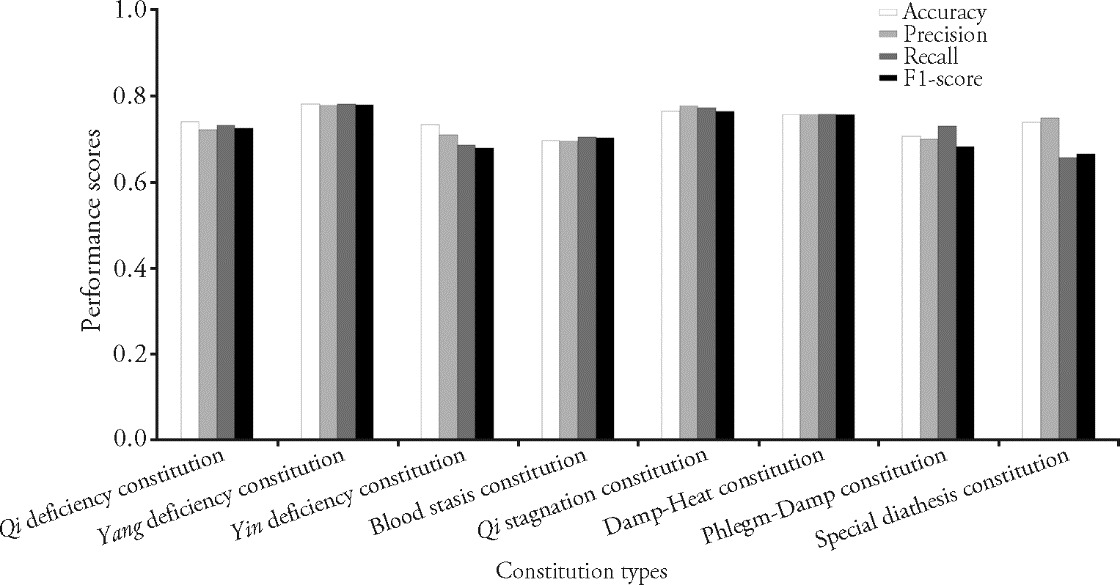
Figure 3 Five-fold cross-validation results Accuracy = ? T P + T N T P + F N + F P + T N, Reflects the overall prediction accuracy of the model. Precision = ? T P T P + F P, Measures the exactness of positive predictions. Recall = ? T P T P + F N, Measures the completeness of positive identifications. F1-score = ? 2 × P r e c i s i o n × R e c a l l P r e c i s i o n + R e c a l l, Provides a balanced measure combining precision and recall. Performance metrics of voting classifier for different traditional Chinese medicine constitutions.
Figure 3 Five-fold cross-validation results Accuracy = ? T P + T N T P + F N + F P + T N, Reflects the overall prediction accuracy of the model. Precision = ? T P T P + F P, Measures the exactness of positive predictions. Recall = ? T P T P + F N, Measures the completeness of positive identifications. F1-score = ? 2 × P r e c i s i o n × R e c a l l P r e c i s i o n + R e c a l l, Provides a balanced measure combining precision and recall. Performance metrics of voting classifier for different traditional Chinese medicine constitutions.
| 1. | Chen G, Zhai YH, Zong LF. Progress of research on physique recognition in Chinese medicine. Yunnan Zhong Yi Zhong Yao Za Zhi 2020; 41: 87-8. |
| 2. | Ma JZ. Taking advantage of the theory of body mass in Chinese medicine to improve the scientific level of treating future diseases. Nat Tradit Chin Med Admin J serial online, 2017-08-23, cited 2024-10-20; online screens. Available from URL: http://www.natcm.gov.cn/hudongjiaoliu/guanfangweixin/2018-03-24/4584.html. 2017. |
| 3. | Zhou YY, Kang QQ, Di SN, et al. Progress and reflections on physique classification in Chinese medicine. Xin Zhong Yi 2022; 54: 187-91. |
| 4. | Zhou YY, Kang QQ, Yu M, et al. Explanation of the classification of body qualities in the yellow emperor's canon of internal medicine. Zhong Guo Zhong Yi Ji Chu Yi Xue Za Zhi 2020; 26: 866-68. |
| 5. | Liao YC, Chen LL, Wang HC, et al. The association between Traditional Chinese Medicine body constitution deviation and essential hypertension: a case-control study. J Nurs Res 2021; 29: e160. |
| 6. | Xia C, Zhu QB, Huang F, et al. Traditional Chinese Medicine constitution types in 127 elderly patients with insomnia: an investigation in communities of Yangpu District, Shanghai. J Chin Integr Med 2012; 10: 866-73. |
| 7. |
Xiao Y, Wang T, Xiang H. Optimizing oil-source correlation analysis using support vector machines and sensory attention networks. Comput Geosci 2024; 189: 105641.
DOI URL |
| 8. |
Rahman M, Islam A, Pasha S, et al. IDF23- 0558 a federated learning approach for type-2 diabetes detection using a naive bayes classifier. Diabetes Res Clin Pract 2024; 209: 111538.
DOI URL |
| 9. |
Yang SS, Yang GX, Hu HX, et al. Novel decision tree models predict the overall survival of patients with submandibular gland cancer. Clin Oral Investig 2024; 28: 395.
DOI |
| 10. |
Wei Z, Wang X, Lu L, et al. Construction of an early risk prediction model for type 2 diabetic peripheral neuropathy based on random forest. Comput Inform Nurs 2024; 42: 665-74.
DOI PMID |
| 11. |
Wang J, Qi Y. Personalized recommendation research based on logistic regression algorithm for amazon product reviews. J Innov Econ Manag 2024; 5: 141-60.
DOI |
| 12. | Jin HL, Kim YG, Jin ZR, et al. Optimization and analysis of bioenergy production using machine learning modeling: multi-layer perceptron, gaussian processes regression, k-nearest neighbors, and artificial neural network models. Energy Rep 2022; 8: 13979-96. |
| 13. |
Wang YY, Wang ST, SiMa XT, et al. Expanded feature space-based gradient boosting ensemble learning for risk prediction of type 2 diabetes complications. Appl Soft Comput 2023; 144: 110451.
DOI URL |
| 14. | Gong H, Zhang H, Zhou L, et al. An interpretable artificial intelligence model of Chinese medicine treatment based on XGBoost algorithm; 2020 IEEE International Conference on Bioinformatics and Biomedicine (BIBM) IEEE, 2020: 1550-4. |
| 15. | Zhu YB, Wang Q, Shi HM, et al. Development and evaluation of a short version of the 30-entry Chinese medicine body mass scale. Zhong Yi Za Zhi 2018; 59: 1554-9. |
| 16. | Zhong Hua Zhong Yi Yao Xue Hui. Classification and Determination of Constitution in Traditional Chinese Medicine:ZYYXH/ 157-2009T. Beijing: China Press of Traditional Chinese Medicine, 2009: 1-38 [2024-08-05] https://www.cacm.org.cn/standard/detail/zyyxh-t-157-2009. |
| 17. | Pan SH, Lin Y, Zhou SJ, et al. Research on physique recognition model of traditional chinese medicine based on neural network and support vector machine. Shi Jie Ke Xue Ji Shu—Zhong Yi Yao Xian Dai Hua 2020; 22: 1341-7. |
| 18. |
Li B, Wei Q, Zhou X. Research on model and algorithm of TCM constitution identification based on artificial intelligence. J Comb Optim 2019; 42: 1-16.
DOI |
| 19. | Zhou H, Hu G, Zhang X. Constitution identification of tongue image based on CNN. In: CISP-BMEI 2018 Program Committee, editors. 2018 11th International Congress on Image and Signal Processing, BioMedical Engineering and Informatics (CISP-BMEI); 2018 Oct 13-15; Beijing, China. Piscataway: IEEE 2018: 1-5. |
| 20. |
Zhang H, Zhou Y. A neural network-nased weighted voting algorithm for multi-target classification in WSN. Sensors 2023; 24: 123.
DOI URL |
| 21. |
Kyriakopoulos C, Gallopoulos E, Venetis IE. Hierarchical dynamic workload scheduling on heterogeneous clusters for grid search of inverse problems. J Supercomput 2023; 79: 16720-72.
DOI |
| 22. |
Vamsikrishna A, Gijo EV. New techniques to perform cross-validation for time series models. Operations Research Forum 2024; 5: 51.
DOI |
| 23. | Wu Y. Optimal two-phase smpling for comparing correlated areas under the ROC curves of two screening tests in the presence of verification bias. J Biopharm Stat 2024; 35: 11-7. |
| 24. | Yin M, Jennifer Wortman V, Wallach H. Understanding the effect of accuracy on trust in machine learning models. In: CHI 2019 Program Committee, editors. Proceedings of the 2019 chi conference on human factors in computing systems; 2019 May 4-9; Glasgow, UK. New York: ACM, 2019: 1-12. |
| 25. |
Parekh DH, Dahiya V. Predicting breast cancer using machine learning classifiers and enhancing the output by combining the predictions to generate optimal F1-score. Biomed Biotechnol Res J 2021; 5: 331-4.
DOI URL |
| 26. | Khan RH, Miah J, Nipun SAA, et al. A comparative study of machine learning classifiers to analyze the precision of myocardial infarction prediction. In: IEEE CCWC 2023 Technical Program Committee, editors. 2023 IEEE 13th Annual Computing and Communication Workshop and Conference; 2023 Mar 5-8; Las Vegas, NV, USA. Piscataway: IEEE 2023: 949-54. |
| 27. | Gupta A, Anand A, Hasija Y. Recall-based machine learning approach for early detection of cervical cancer. In: I2CT 2021 Technical Program Committee, editors. 2021 6th International Conference for Convergence in Technology; 2021 Apr 8-10; Mumbai, India. Piscataway: IEEE, 2021: 1-5. |
| 28. | Gong H, Jin M, Zhou L, et al. An automatic clinical model for Chinese medicine based on interpretable machine learning algorithms. In: IEEE BIBM 2021 Technical Program Committee, editors. 2021 IEEE International Conference on Bioinformatics and Biomedicine; 2021 Dec 9-12; Dubai, UAE. Piscataway: IEEE, 2021: 3805-11. |
| 29. | Wang Z, Li H, Zhou Z, et al. Research on TCM constitution identification models based on human skeletal features. Zhong Hua Zhong Yi Yao Xue Kan 2024; 42: 37-40+266-7. |
| 30. | Жұмабекова А, Усатова О, Қалимолдаев М, et al. The study of machine and deep learning models for malware classification. Vestnik KazUTB 2024; 4: 559. |
| [1] | LIU Xin, YANG Shuning, XU Yun. Effect of Yang-deficiency constitution on cognitive impairment in cerebral small vessel disease and its neuroimaging mechanism [J]. Journal of Traditional Chinese Medicine, 2025, 45(5): 1144-1151. |
| [2] | LONG Xi, WU Zixuan, YU Yunfeng, LIN Jie, PENG Qinghua. Identification of characteristic genes of Yin and Yang deficiency constitutions: an integrated analysis based on bioinformatics and machine learning [J]. Journal of Traditional Chinese Medicine, 2025, 45(4): 909-921. |
| [3] | LI Tianxing, ZHU Linghui, WANG Xueke, TANG Jun, YANG Lingling, PANG Guoming, LI Huang, WANG Liying, DONG Yang, ZHAO Shipeng, LI Yingshuai, LI Lingru. Gut microbial characteristics of the damp-heat constitution: a population-based multicenter cross-sectional study [J]. Journal of Traditional Chinese Medicine, 2025, 45(1): 140-151. |
| [4] | Xuming Yang, Lingyu Xu, Fei Zhong, Ying Zhu. Data mining-based detection of acupuncture treatment on juvenile myopia [J]. Journal of Traditional Chinese Medicine, 2012, 32(03): 372-376. |
| Viewed | ||||||
|
Full text |
|
|||||
|
Abstract |
|
|||||
