
Journal of Traditional Chinese Medicine ›› 2026, Vol. 46 ›› Issue (1): 195-204.DOI: 10.19852/j.cnki.jtcm.2026.01.018
• Original Articles • Previous Articles Next Articles
Effect of point application therapy for bronchial asthma: a multicenter randomized controlled trial
XU Huanfang1, LI Jiashan1, YANG Li1, WU Wenzhong2, YANG Jun3, ZHANG Wei4, LI Hui5, QU Nini, WANG Rui7, WANG Landi8, YANG Hongzhi9, ZHANG Lihua10, HE Yong11, XIONG Guanyu12, LIU Baoyan13( ), FANG Yigong1()
- 1 Acupuncture and Moxibustion Hospital, Institute of Acupuncture and Moxibustion, China Academy of Chinese Medical Sciences, Beijing 100700, China
2 Department of Acupuncture and Moxibustion, Jiangsu Provincial Hospital of Chinese Medicine, Nanjing 210029, China
3 Department of Acupuncture and Moxibustion, the First Affiliated Hospital of Anhui University of Chinese Medicine, Hefei 230031, China
4 Department of Acupuncture and Moxibustion, the First Hospital of Hunan University of Chinese Medicine, Changsha 410007, China
5 Department of Acupuncture and Moxibustion, Guang’anmen Hospital, China Academy of Chinese Medical Sciences, Beijing 100053, China
6 Department of Respiratory Medicine, the Affiliated Hospital of Liaoning University of Traditional Chinese Medicine, Shenyang 110032, China
7 Department of Acupuncture and Moxibustion, Affiliated Hospital of Shandong University of Traditional Chinese Medicine, Jinan 250011, China
8 Department of Respiratory Medicine, Gansu Provincial Hospital of Traditional Chinese Medicine, Lanzhou 730050, China
9 Department of Acupuncture and Moxibustion, Hubei Provincial Hospital of Traditional Chinese Medicine, Wuhan 430061, China
10 Department of Acupuncture and Moxibustion, Shaanxi Provincial Hospital of Traditional Chinese Medicine, Xi’an 710003, China
11 Department of Respiratory Medicine, Zhengzhou Hospital of Traditional Chinese Medicine, Zhengzhou 450007, China
12 Department of Acupuncture and Moxibustion, Kaifeng Hospital of Traditional Chinese Medicine, Kaifeng 475000, China
13 Department of Acupuncture and Moxibustion, China Academy of Chinese Medical Sciences, Beijing 100700, China
-
Received:2024-11-27Accepted:2025-06-09Online:2026-02-15Published:2026-01-28 -
Contact:Prof. FANG Yigong, Acupuncture and Moxibustion Hospital, Institute of Acupuncture and Moxibustion, China Academy of Chinese Medical Sciences, Beijing 100700, China.fangyigong@163.com ; PProf. LIU Baoyan, Department of Acupuncture and Moxibustion, China Academy of Chinese Medical Sciences, Beijing 100700, China.baoyanjournal@163.com ;Telephone: +86-18210547483 -
About author:XU Huanfang andLI Jiashan are co-first authors and contributed equally to this work -
Supported by:“12th Five-year” National Science and Technology Pillar Program by the Ministry of Science and Technology of the People’s Republic of China: Clinical Evaluation and Technical Operation Specification Research on Preventing Bronchial Asthma Attacks by Acupoint Application in Winter Disease Summer Treatment(2015BAI04B11)

Cite this article
XU Huanfang, LI Jiashan, YANG Li, WU Wenzhong, YANG Jun, ZHANG Wei, LI Hui, QU Nini, WANG Rui, WANG Landi, YANG Hongzhi, ZHANG Lihua, HE Yong, XIONG Guanyu, LIU Baoyan, FANG Yigong. Effect of point application therapy for bronchial asthma: a multicenter randomized controlled trial[J]. Journal of Traditional Chinese Medicine, 2026, 46(1): 195-204.
share this article
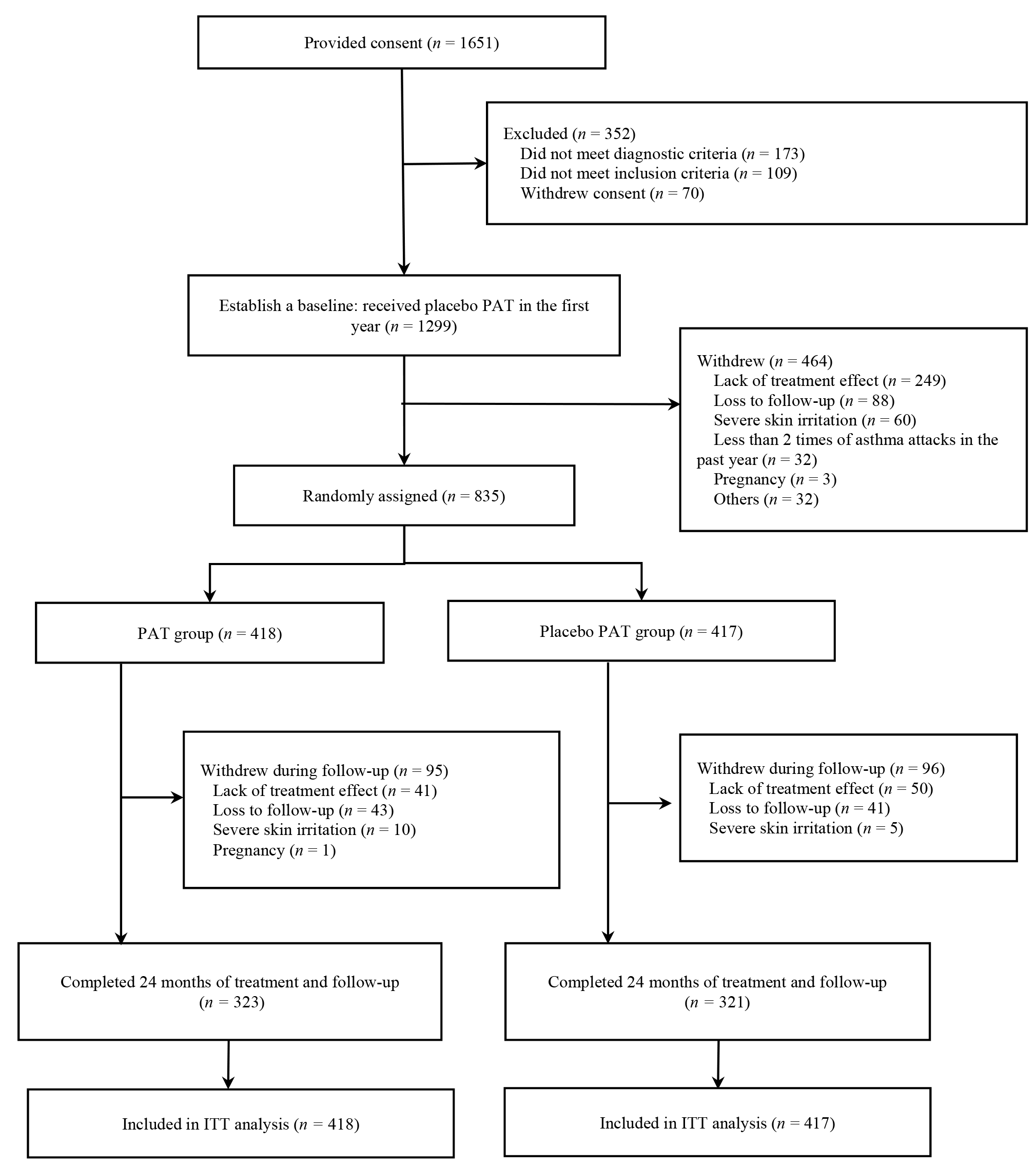
Figure 1 Flow of participants PAT: point application therapy; ITT: intention-to-treat.
Figure 1 Flow of participants PAT: point application therapy; ITT: intention-to-treat.
Table 1 Baseline characteristics of the participants
| Characteristic | PAT (n = 418) | Placebo PAT (n = 417) |
|---|---|---|
| Female Sex [n (%)] | 257 (61.48) | 253 (64.99) |
| Age ($\bar{x} \pm s$, years) | 52.5±12.5 | 52.7±12.6 |
| Smoker [n (%)] | 63 (15.07) | 77 (18.47) |
| Duration of disease ($\bar{x} \pm s$, years) | 10.4±6.1 | 10.1±6.0 |
| Patients with comorbidities [n (%)] | 46 (11.08) | 45 (10.87) |
| Number of asthma exacerbation [median (Q1, Q3)] | 4.00 (2.00, 7.00) | 4.00 (2.00, 8.00) |
| Severity of asthma exacerbation [n (%)]a | ||
| Mild | 1718 (77.04) | 1654 (75.42) |
| Moderate | 436 (19.55) | 451 (20.57) |
| Severe | 76 (3.41) | 88 (4.01) |
| Lung function | ||
| FEV1%pred ($\bar{x} \pm s$, %) | 74.4±23.4 | 73.1±23.4 |
| FEV1/FVC ($\bar{x} \pm s$) | 70.4±15.5 | 68.3±15.4 |
| PEF ($\bar{x} \pm s$, L/s) | 4.1±2.8 | 3.8±2.5 |
| ACT score ($\bar{x} \pm s$) | 20.5±3.0 | 20.6±2.9 |
| Patients using reliever medications [n (%)] | 355 (84.93) | 334 (80.10) |
| Use of reliever [n (%)] | ||
| Corticosteroids | 235 (56.22) | 242 (58.03) |
| β2 receptor agonist | 224 (53.59) | 228 (54.68) |
| Others | 69 (16.51) | 75 (17.99) |
| AEs [n (%)] | 20 (4.78) | 20 (4.80) |
Table 1 Baseline characteristics of the participants
| Characteristic | PAT (n = 418) | Placebo PAT (n = 417) |
|---|---|---|
| Female Sex [n (%)] | 257 (61.48) | 253 (64.99) |
| Age ($\bar{x} \pm s$, years) | 52.5±12.5 | 52.7±12.6 |
| Smoker [n (%)] | 63 (15.07) | 77 (18.47) |
| Duration of disease ($\bar{x} \pm s$, years) | 10.4±6.1 | 10.1±6.0 |
| Patients with comorbidities [n (%)] | 46 (11.08) | 45 (10.87) |
| Number of asthma exacerbation [median (Q1, Q3)] | 4.00 (2.00, 7.00) | 4.00 (2.00, 8.00) |
| Severity of asthma exacerbation [n (%)]a | ||
| Mild | 1718 (77.04) | 1654 (75.42) |
| Moderate | 436 (19.55) | 451 (20.57) |
| Severe | 76 (3.41) | 88 (4.01) |
| Lung function | ||
| FEV1%pred ($\bar{x} \pm s$, %) | 74.4±23.4 | 73.1±23.4 |
| FEV1/FVC ($\bar{x} \pm s$) | 70.4±15.5 | 68.3±15.4 |
| PEF ($\bar{x} \pm s$, L/s) | 4.1±2.8 | 3.8±2.5 |
| ACT score ($\bar{x} \pm s$) | 20.5±3.0 | 20.6±2.9 |
| Patients using reliever medications [n (%)] | 355 (84.93) | 334 (80.10) |
| Use of reliever [n (%)] | ||
| Corticosteroids | 235 (56.22) | 242 (58.03) |
| β2 receptor agonist | 224 (53.59) | 228 (54.68) |
| Others | 69 (16.51) | 75 (17.99) |
| AEs [n (%)] | 20 (4.78) | 20 (4.80) |
Table 2 Severity of asthma exacerbations [n (%)]
| Variable | PAT | Placebo PAT | P value |
|---|---|---|---|
| 12 months | 0.062 | ||
| Mild | 630 (79.85) | (75.51) | |
| Moderate | 148 (18.76) | 217 (22.14) | |
| Severe | 11 (1.39) | 23 (2.35) | |
| 24 months | < 0.001 | ||
| Mild | 473 (85.53) | (74.56) | |
| Moderate | 68 (12.30) | 171 (23.01) | |
| Severe | 12 (2.17) | 18 (2.42) |
Table 2 Severity of asthma exacerbations [n (%)]
| Variable | PAT | Placebo PAT | P value |
|---|---|---|---|
| 12 months | 0.062 | ||
| Mild | 630 (79.85) | (75.51) | |
| Moderate | 148 (18.76) | 217 (22.14) | |
| Severe | 11 (1.39) | 23 (2.35) | |
| 24 months | < 0.001 | ||
| Mild | 473 (85.53) | (74.56) | |
| Moderate | 68 (12.30) | 171 (23.01) | |
| Severe | 12 (2.17) | 18 (2.42) |
Table 3 Other secondary outcomes
| Variable | PAT (n = 418) | Placebo PAT (n = 417) | Difference (95% CI) | P value |
|---|---|---|---|---|
| FEV1%pred ($\bar{x} \pm s$, %) | ||||
| 12 months | 76.5±20.4 | 73.3±23.9 | 2.92 (-0.79, 6.23) | 0.120 |
| 24 months | 76.4±18.7 | 73.4±23.0 | 3.05 (-0.35, 6.45) | 0.039 |
| FEV1/FVC ($\bar{x} \pm s$, %) | ||||
| 12 months | 71.6±15.8 | 67.8±15.6 | 4.11 (1.76, 6.47) | 0.001 |
| 24 months | 77.2±16.7 | 72.2±18.1 | 4.61 (1.72, 7.51) | 0.001 |
| PEF ($\bar{x} \pm s$, L/s) | ||||
| 12 months | 4.2±2.8 | 4.2±2.7 | -0.03 (-0.37, 0.30) | 0.755 |
| 24 months | 4.2±2.7 | 4.07±2.6 | 0.25 (-0.09, 0.58) | 0.645 |
| ACT score ($\bar{x} \pm s$) | ||||
| 12 months | 21.7±2.4 | 21.5±2.3 | 0.26 (-0.05, 0.58) | 0.269 |
| 24 months | 22.1±2.2 | 21.5±2.5 | 0.60 (0.33, 0.87) | 0.005 |
| Patients using reliever medications [n (%)] | ||||
| 12 months | 186 (44.50) | 218 (52.28) | 0.024 | |
| 24 months | 159 (38.04) | 175 (41.97) | 0.037 | |
| Use of relievera [n (%)] | ||||
| 12 months | ||||
| Corticosteroid | 109 (26.08) | 129 (30.94) | 0.050 | |
| β2 receptor agonist | 109 (26.08) | 137 (32.85) | ||
| Others | 56 (13.40) | 75 (17.99) | ||
| 24 months | ||||
| Corticosteroid | 91 (21.78) | 105 (25.18) | 0.039 | |
| β2 receptor agonist | 91 (21.78) | 109 (26.14) | ||
| Others | 38 (9.10) | 41 (9.83) | ||
| Blindness assessmentb [n (%)] | ||||
| Yes | 28 (75.67) | 25 (67.56) | 0.688 | |
| No | 3 (8.11) | 5 (13.51) | ||
| Unknown | 6 (16.22) | 7 (18.92) | ||
Table 3 Other secondary outcomes
| Variable | PAT (n = 418) | Placebo PAT (n = 417) | Difference (95% CI) | P value |
|---|---|---|---|---|
| FEV1%pred ($\bar{x} \pm s$, %) | ||||
| 12 months | 76.5±20.4 | 73.3±23.9 | 2.92 (-0.79, 6.23) | 0.120 |
| 24 months | 76.4±18.7 | 73.4±23.0 | 3.05 (-0.35, 6.45) | 0.039 |
| FEV1/FVC ($\bar{x} \pm s$, %) | ||||
| 12 months | 71.6±15.8 | 67.8±15.6 | 4.11 (1.76, 6.47) | 0.001 |
| 24 months | 77.2±16.7 | 72.2±18.1 | 4.61 (1.72, 7.51) | 0.001 |
| PEF ($\bar{x} \pm s$, L/s) | ||||
| 12 months | 4.2±2.8 | 4.2±2.7 | -0.03 (-0.37, 0.30) | 0.755 |
| 24 months | 4.2±2.7 | 4.07±2.6 | 0.25 (-0.09, 0.58) | 0.645 |
| ACT score ($\bar{x} \pm s$) | ||||
| 12 months | 21.7±2.4 | 21.5±2.3 | 0.26 (-0.05, 0.58) | 0.269 |
| 24 months | 22.1±2.2 | 21.5±2.5 | 0.60 (0.33, 0.87) | 0.005 |
| Patients using reliever medications [n (%)] | ||||
| 12 months | 186 (44.50) | 218 (52.28) | 0.024 | |
| 24 months | 159 (38.04) | 175 (41.97) | 0.037 | |
| Use of relievera [n (%)] | ||||
| 12 months | ||||
| Corticosteroid | 109 (26.08) | 129 (30.94) | 0.050 | |
| β2 receptor agonist | 109 (26.08) | 137 (32.85) | ||
| Others | 56 (13.40) | 75 (17.99) | ||
| 24 months | ||||
| Corticosteroid | 91 (21.78) | 105 (25.18) | 0.039 | |
| β2 receptor agonist | 91 (21.78) | 109 (26.14) | ||
| Others | 38 (9.10) | 41 (9.83) | ||
| Blindness assessmentb [n (%)] | ||||
| Yes | 28 (75.67) | 25 (67.56) | 0.688 | |
| No | 3 (8.11) | 5 (13.51) | ||
| Unknown | 6 (16.22) | 7 (18.92) | ||
Table 4 Treatment-related AEs [n (%)]
| AEsa | PAT (n = 418) | Placebo PAT (n = 417) |
|---|---|---|
| Totalb | 81 (19.4) | 21 (5) |
| SAEs | 0 | 0 |
| Blister | 3 (0.7) | 4 (1.0) |
| Asthma aggravation | 3 (0.7) | 1 (0.2) |
| Cough | 1 (0.2) | 2 (0.5) |
| Skin allergyb | 74 (17.7) | 14 (3.4) |
Table 4 Treatment-related AEs [n (%)]
| AEsa | PAT (n = 418) | Placebo PAT (n = 417) |
|---|---|---|
| Totalb | 81 (19.4) | 21 (5) |
| SAEs | 0 | 0 |
| Blister | 3 (0.7) | 4 (1.0) |
| Asthma aggravation | 3 (0.7) | 1 (0.2) |
| Cough | 1 (0.2) | 2 (0.5) |
| Skin allergyb | 74 (17.7) | 14 (3.4) |
| 1. |
Levy ML, Bacharier LB, Bateman E, et al. Key recommendations for primary care from the 2022 global initiative for Asthma (GINA) update. NPJ Prim Care Respir Med 2023; 33: 7.
DOI |
| 2. | Masoli M, Fabian D, Holt S, Beasley R; Global Initiative for Asthma (GINA) Program. The global burden of asthma: executive summary of the GINA dissemination ommittee report. Allergy 2004; 59: 469-78. |
| 3. | Song WJ, Kang MG, Chang YS, Cho SH. Epidemiology of adultasthma in Asia: toward a better understanding. AsiaPac Allergy 2014; 4: 75-85. |
| 4. |
Barnes NC. Can guideline-defined asthma control be achieved? The gaining optimal asthma control study. Am J Respir Crit Care Med 2004; 170: 830-1.
DOI URL |
| 5. |
Castillo JR, Peters SP, Busse WW. Asthma exacerbations: pathogenesis, prevention, and treatment. J Allergy Clin Immunol Pract 2017; 5: 918-27.
DOI PMID |
| 6. |
Schatz M, Meckley LM, Kim M, Stockwell BT, Castro M. Asthma exacerbation rates in adults are unchanged over a 5-year period despite high-intensity therapy. J Allergy Clin Immunol Pract 2014; 2: 570-4.
DOI PMID |
| 7. | Beijing Municipal People's Government. Data on the application of acupoint application therapy for asthma in Beijing. 2023-06-27, cited 2024-01-23; 1: 1 screens. Available from: URL https://www.beijing.gov.cn/fuwu/bmfw/sy/jrts/202306/t20230627_3147049.html. |
| 8. | Qin S, Xu B, Wu WZ, et al. Clinical therapeutic effect on bronchial asthma by the observation of skin reaction after acupoint application based on chronic disease management platform of asthma. Zhong Guo Zhen Jiu 2021; 41: 1221-4. |
| 9. |
Jin YT, Wu LT, Guo YL, Chong X, Yu BY, Xuan LH. Long-term efficacy of point application therapy on different acupoints and durations in the treatment of asthma: a randomized controlled trial. J Tradit Chin Med 2023; 43: 146-53.
DOI |
| 10. | Zhao SM, Gong XY, Hu J, et al. Anti-asthma components and mechanism of Kechuanting acupoint application therapy: based on serum metabolomics and network pharmacology. Zhong Guo Zhong Yao Za Zhi; 2022 47: 6780-93. |
| 11. | Asthma Group of Chinese Thoracic Society, Chinese Medical Association, Primary Care Society of Chinese Medical Association. Chinese guidelines for bronchial asthma prevention and treatment (primary care edition). Zhong Hua Jie He Za Zhi 2013; 36: 331-6. |
| 12. |
Reddel HK, Taylor DR, Bateman ED, et al. An official American Thoracic Society/European Respiratory Society statement: asthma control and exacerbations: standardizing endpoints for clinical asthma trials and clinical practice. Am J Respir Crit Care Med 2009; 180: 59-99.
DOI URL |
| 13. |
Nathan RA, Sorkness CA, Kosinski M, et al. Development of the asthma control test: a survey for assessing asthma control. J Allergy Clin Immunol 2004; 113: 59-65.
DOI URL |
| 14. | Wu ZH, Zheng YC, Chen YX, et al. The role of acupoint application of herbal medicine for asthma: Meta-analysis of randomized double-blind placebo-controlled trials. Evid Based Complement Alternat Med 2022; 2022: 5589433. |
| 15. |
Wei CL, Zhang X, Li PF, Li W. Acupoint herbal patching during Sanfu Days on reducing frequency of acute asthma attack in children: a systematic review and Meta-analysis. Medicine (Baltimore) 2020; 99: e18962.
DOI URL |
| 16. |
Zhou F, Liang N, Maier M, Liu JP. Sanfu acupoint herbal patching for stable asthma: a systematic review and Meta-analysis of randomised controlled trials. Complement Ther Med 2017; 30: 40-53.
DOI PMID |
| 17. |
Lee SH, Chang GT, Zhang X, Lee H. Acupoint herbal patching for asthma: a systematic review and Meta-analysis of randomized controlled trials. Medicine (Baltimore) 2016; 95: e2439.
DOI URL |
| 18. |
Park HJ, Huh JY, Lee JS, et al. Comparative efficacy of inhalers in mild-to-moderate asthma: systematic review and network Meta-analysis. Sci Rep 2022; 12: 5949.
DOI PMID |
| 19. |
Hardy J, Baggott C, Fingleton J, et al. Budesonide-formoterol reliever therapy versus maintenance budesonide plus terbutaline reliever therapy in adults with mild to moderate asthma (PRACTICAL): a 52-week, open-label, multicentre, superiority, randomised controlled trial. Lancet 2019; 394: 919-28.
DOI PMID |
| 20. |
Pellegrino R, Viegi G, Brusasco V, et al. Interpretative strategies for lung function tests. Eur Respir J 2005; 26: 948-68.
DOI PMID |
| 21. | Shi LJ, Zhao Y. Clinical observation of acupoint patching in summer for winter diseases therapy for preventing children asthma recurrence in 92 cases. Zhong Guo Zhong Yi Ji Zheng 2014; 23: 2342-4. |
| 22. | Wu F, Yao MH, Zhu Y. Clinical study on prevention of recurrence of asthma in children by Xiaochuangao acupoint paste: treating winter diseases in summer. Zhong Guo Zhong Yao Za Zhi 2012; 37: 2646-8. |
| 23. |
Bateman ED, Hurd SS, Barnes PJ, et al. Global strategy for asthma management and prevention: GINA executive summary. Eur Respir J 2008; 31: 143-78.
DOI PMID |
| 24. | Bonini M, Di Paolo M, Bagnasco D, et al. Minimal clinically important difference for asthma endpoints: an expert consensus report. Eur Respir Rev 2020; 29: 190137. |
| 25. |
Wu XQ, Peng J, Li GQ, Su HP, Liu GX, Liu BY. Association between skin reactions and efficacy of summer acupoint application treatment on chronic pulmonary disease: a prospective study. Chin J Integr Med 2016; 22: 284-92.
DOI URL |
| 26. | Li N, Xing YJ, Zhao M, Geng WJ, Zhao M. Influence of different skin reactions of acupoint-application on clinical outcomes in the prevention and treatment of bronchial asthma. Zhen Ci Yan Jiu 2014; 39: 222-7. |
| 27. | Wang H, Wang HS, Liu LY, et al. Effects of contact dermatitis induced by acupoint application on asthma control level and serum IFN-γ/IL-4 in patients with bronchial asthma. Zhong Yi Za Zhi 2018; 59: 582-5. |
| 28. | Hu J, Weng L, Zhang C, et al. Components of drugs in acupoint sticking therapy and its mechanism of intervention on bronchial asthma based on UPLC-Q-TOF-MS combined with network pharmacology and experimental verification. Zhong Guo Zhong Yao Za Zhi 2022; 47: 1359-69. |
| 29. | Wen BL, Zhou H, Liu BY, et al. Analysis on acupoint prescription for acupoint sticking therapy of treating winter diseases in summer for preventing and curing chronic cough and asthma. Zhong Guo Zhen Jiu 2010; 30: 647-52. |
| 30. | Li GQ, Wang L, Lin YX. Randomized controlled trial of Xiaochuangao acupoint paste to treat chronic obstructive pulmonary disease in the stable phase: treating winter diseases in summer. Zhong Guo Zhong Xi Yi Jie He Za Zhi 2011; 31: 1187-90. |
| 31. | Lu ZM, Ai BW, Liu CY, et al. Research overview of the mechanism of acupoint application in the treatment of bronchial asthma in the past 10 years. Liaoning Zhong Yi Yao Za Zhi 2021; 48: 242-4. |
| 32. | Liu YH. Research overview of the mechanism of acupoint application in the prevention and treatment of bronchial asthma. Zhong Yi Za Zhi 2015; 56: 1884-6. |
| 33. | Gu HD. Influence of Xiaochuan paste acupoint application on recrudesce and Th1/Th2 in children with asthma. Zhong Hua Zhong Yi Yao Xue Kan 2017; 35: 1014-6. |
| 34. | Li H, Wu ZY, Zhang Y, et al. Regulative effect of acupoint application with Xiaochuan Gao on Th1 /Th2 in rats with asthma induced by egg albumin. Beijing Zhong Yi Yao Da Xue Xue Bao 2012; 35: 623-5+29+49. |
| 35. | Liu LY, Qiao M, Gao F, et al. Effect of Acupiont sticking therapy with kechuanting paste on expression of T-bet and GATA-3 mRNA in lung for chronic asthma airway inflammation rats. Nanjing Zhong Yi Yao Da Xue Xue Bao 2014; 30: 550-3. |
| 36. | Liu CY, Qin S, Liu LY, et al. Inhibitory Effect of acupoint application on airway remodeling and expression of TGF-β1/Smad 3 in the lung tissue of chronic asthma mice. Zhen Ci Yan Jiu 2017; 42: 153-8. |
| 37. | Li N, Dong WX, Cai LP. Effect of acupoint application of semen sinapis on airway hyperresponsiveness and the expression of TRPV1 in lung tissue of guinea pigs with bronchial asthma. Liaoning Zhong Yi Yao Za Zhi 2017; 44: 1307. |
| 38. | Li BL, Wang YL, Yang Q, et al. Effect of Acupoint application therapy of summer treatment for winter diseases on nerve-endocrine-immune network system in patient with non-acute attack asthma. Zhong Guo Zhong Xi Yi Jie He Za Zhi 2017; 37: 68. |
| [1] | ZHAO Mingzhe, YAN Peizheng, ZHAO Xiaomin, CHEN Yufan, LI Mengsitong, ZHOU Yuping, ZHANG Lu, DOU Liwen, LIU Yan, ZHENG Hong, LI Jia. A network pharmacology-based strategy to discover the molecular mechanism of correlation between the treatment of bronchial asthma with Wenyang Huayin decoction (温阳化饮方) and autophagy [J]. Journal of Traditional Chinese Medicine, 2026, 46(1): 138-148. |
| [2] | YUAN Menghua, SHAO Jianbin, YANG Yawei, ZHAO Yan, HU Xingang. Combined acupuncture and herb treatment improves intestinal flora inabdominally obese subjects based on 16s rRNA sequencing: a randomized controlled trial [J]. Journal of Traditional Chinese Medicine, 2026, 46(1): 205-210. |
| [3] | WEI Mumu, YAN Xiaoyu, ZHANG Yujing, ZHANG Xinxin, YAN Yongbin. Soufeng Yuchuan formula (搜风愈喘方) alleviates asthma airway inflammation and suppresses the progression of asthma by inhibiting ferroptosis in airway epithelial cells [J]. Journal of Traditional Chinese Medicine, 2026, 46(1): 73-84. |
| [4] | LI Jiansheng, WANG Haifeng, ZHANG Kang, XIE Kai, LI Suyun, ZHANG Chenxi, ZHANG Yaqing. Traditional Chinese Medicine treatment with syndrome differentiation for patients with severe community-acquired pneumonia: a multicenter, randomized, placebo-controlled trial [J]. Journal of Traditional Chinese Medicine, 2025, 45(6): 1376-1384. |
| [5] | ZHANG Yibao, CHEN Feng, SUN Meng, WANG Zhenwei, TANG Binqing, QIAN Yechang, JIA Wei, BAO Yufang, LI Wenjie, LI Shanqun, ZHANG Wei. Dongtian Changchun ointment (洞天长春膏) for moderate-to-severe chronic obstructive pulmonary disease: a multicenter, prospective, open-label, randomized controlled trial [J]. Journal of Traditional Chinese Medicine, 2025, 45(6): 1395-1404. |
| [6] | ZHANG Xiaosi, ZHANG Shuangyuan, CHEN Hanqing, LIN Zhengdao, XIE Chune, LI Junxiang, LI Xiaohong. Hewei Jiangni recipe (和胃降逆方) improved the quality of life in patients with cold-heat mixed nonerosive reflux disease: a randomized, double-blinded study [J]. Journal of Traditional Chinese Medicine, 2025, 45(5): 1106-1118. |
| [7] | HAO Shulan, NAN Peng, LIU Likun, LI Xiaoli, ZHONG Qiming, GAO Yu, WANG Xixing, NIE Yingfang. Effectiveness of Yiqi Chupi powder (益气除疲散) for alleviating cancer-related fatigue in patients following colorectal cancer surgery: a randomized controlled trial [J]. Journal of Traditional Chinese Medicine, 2025, 45(5): 1119-1126. |
| [8] | GUO Jixing, JI Changchun, XIE Chaoju, RAO Xiang, SUN Zhangyin, XING Yu, ZHANG Rongni, QU Qiangqiang, DONG Youpeng, YANG Jinsheng. Various acupuncture therapies for managing nonspecific low back pain: a network Meta-analysis [J]. Journal of Traditional Chinese Medicine, 2025, 45(5): 954-962. |
| [9] | CHEN Ziying, ZHAO Xiaoping, FAN Xiaoxuan, TANG Didi, SUN Wen, LYU Jing, HUANG Lan, QI Fan. Seven Traditional Chinese Medicine external treatments combined with rehabilitation training on the functional recovery of limbs in patients with cerebral hemorrhage: a network Meta-analysis [J]. Journal of Traditional Chinese Medicine, 2025, 45(4): 711-719. |
| [10] | FAN Changzheng, ZHANG Qiong, FAN Maorong, MENG Hongxu, CONG Xiaodong, FAN Yiling, YUAN Shasha, MIAO Qing. Qufeng Jiejing formula (祛风解痉方) ameliorated the injury of airway smooth muscle cells induced by platelet-derived growth factor-BB through the transforming growth factor-β1/Smads signaling pathway [J]. Journal of Traditional Chinese Medicine, 2025, 45(4): 730-738. |
| [11] | ZHANG Hongchun, LIU Jian, CHEN Sheng, ZHANG Wei, LU Xuechao, LI Ying, YU Xueqing, HUANG Yan, SU Lianhua, WEI Baolin, LI Zhuyin, PEI Shuai, LEI Xiang, YANG Daowen, GUO Jianning. Efficacy and safety of Suhuang Zhike capsule (苏黄止咳胶囊) for cough variant asthma: a multicenter, single-arm, open-label phase IV real-world clinical trial [J]. Journal of Traditional Chinese Medicine, 2025, 45(4): 817-828. |
| [12] | ZHAO Weibo, WANG Yaqi, KONG Lingyao, WANG Tianyi, ZHAO Haihong, ZHANG Ying, LUO Bin, WANG Ji, WANG Qi. Efficacy and safety of Tuomin Zhiti decoction (脱敏止嚏汤) on patients with seasonal allergic rhinitis: a randomized, double-blind, placebo-controlled trial [J]. Journal of Traditional Chinese Medicine, 2025, 45(4): 829-835. |
| [13] | LI Yuxuan, LI Yan, WANG Wujiao, CUI Xiaoyun, WAN Jie, ZHOU Kun, LU Jinjin, LIU Jing, LIN Qian, LI Dong. Clinical study of Yiqi Liangxue Shengji prescription (益气凉血生肌方) for improving cardiac function after myocardial ischemia reperfusion injury in patients with acute myocardial infarction: a randomized, double-blind, placebo-controlled trial [J]. Journal of Traditional Chinese Medicine, 2025, 45(4): 836-844. |
| [14] | ZHENG Ruwen, DONG Xu, WANG Tianyi, FENG Liyuan, ZHANG Hongyan, HUO Hong, ZHANG Ying, ZHANG Qianshi, ZHU Xingyan, WANG Dongyan. Electroacupuncture versus conventional acupuncture of scalp motor area for post-stroke wrist dyskinesia and its effect on muscle function: a randomized, controlled clinical trial [J]. Journal of Traditional Chinese Medicine, 2025, 45(4): 852-859. |
| [15] | XIAO Jing, SONG Danlei, LIANG Caiming, HE Yinuo, ZHENG Weifang, WU Xiaqiu. Efficacy of Jianpi formulas (健脾剂) in reducing the recurrence of colorectal adenoma after polypectomy: a systematic review and Meta-analysis [J]. Journal of Traditional Chinese Medicine, 2025, 45(2): 225-233. |
| Viewed | ||||||
|
Full text |
|
|||||
|
Abstract |
|
|||||
