
Journal of Traditional Chinese Medicine ›› 2025, Vol. 45 ›› Issue (5): 1098-1105.DOI: 10.19852/j.cnki.jtcm.2025.05.016
• Original Articles • Previous Articles Next Articles
Sequential therapy for infertility in women with polycystic ovary syndrome and luteal phase defects by Yangxin Dianji decoction (养心奠基方) and Nuangong Tiaojing decoction (暖宫调经方): a real-world study
JIANG Xiaoyue1,2, DIING Yinyin1,2, LIU Xinyuan1,2, RUAN Fang1,2, ZOU Yeting2, HONG Yanli3( ), ZHOU Huifang2()
- 1 the First School of Clinical Medicine, Nanjing University of Chinese Medicine, Nanjing 210023, China
2 Department of Gynecology, Affiliated Hospital of Nanjing University of Chinese Medicine, Nanjing 210029, China
3 Department of Reproductive Medicine, Affiliated Hospital of Nanjing University of Chinese Medicine, Nanjing 210029, China
-
Received:2024-08-12Accepted:2025-02-25Online:2025-10-15Published:2025-09-15 -
Contact:Dr HONG Yanli, Affiliated Hospital of Nanjing University of Chinese Medicine, Nanjing 210029, China. 15951711586@126.com;
Prof. ZHOU Huifang, Affiliated Hospital of Nanjing University of Chinese Medicine, Nanjing 210029, China. zhouhuifang2011301@163.com.,Telephone: +86-15951711586; +86-13851858108 -
Supported by:National Natural Science Foundation of China: Elucidation of a New Mechanism of the Prescription for Reinforcing Kidney and Promoting Pregnancy (Bushen Zhuyun Decoction) in Treating Luteal Phase Defects Infertility based on Coenzyme Q10/Ubiquinol Mediated New Ferroptosis Pathway in Endometrium During Implantation(82474567);Jiangsu Province Key Research and Development Plan (Society Development) Project: a Multicenter Real-world Study of Sequential Treatment of Luteal Phase Defects Infertility with “Improving Endometrial Receptivity” as the Effect Point(BE2021726);Project of Clinical Innovation Center of Traditional Chinese Medicine in Jiangsu Province: Clinical And Basic Research on the Treatment of Luteal Phase Defects Infertility with “Improving Endometrial Receptivity” as the Effect Point(k2021j18-1)

Cite this article
JIANG Xiaoyue, DIING Yinyin, LIU Xinyuan, RUAN Fang, ZOU Yeting, HONG Yanli, ZHOU Huifang. Sequential therapy for infertility in women with polycystic ovary syndrome and luteal phase defects by Yangxin Dianji decoction (养心奠基方) and Nuangong Tiaojing decoction (暖宫调经方): a real-world study[J]. Journal of Traditional Chinese Medicine, 2025, 45(5): 1098-1105.
share this article
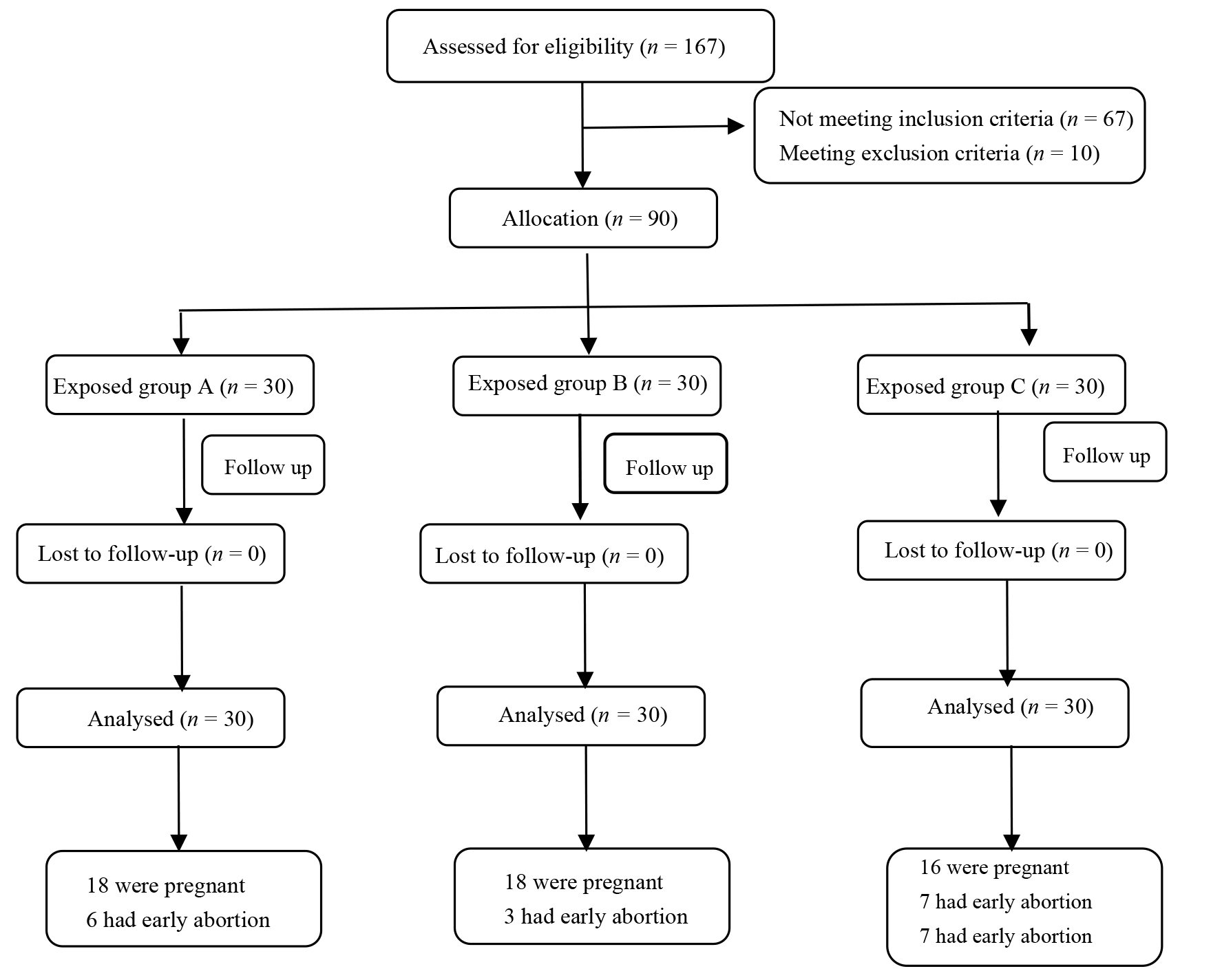
Figure 1 Flow diagram of the study
Figure 1 Flow diagram of the study
Table 1 Baseline characteristics in the three groups
| General character | Exposed group A (n = 30) | Exposed group B (n = 30) | Control group (n = 30) | F value | P value |
|---|---|---|---|---|---|
| Age (years) | 30.7±3.3 | 29.2±2.8 | 30.2±4.1 | 1.566 | 0.215 |
| Height (cm) | 161.5±3.6 | 161.4±5.5 | 162.4±4.4 | 0.419 | 0.659 |
| Weight (kg) | 57.6±7.5 | 62.3±10.2 | 58.0±10.2 | 2.308 | 0.106 |
| BMI (kg/m2) | 22.1±2.8 | 24.0±4.4 | 22.0±3.6 | 2.870 | 0.062 |
| Secondary infertility [n (%)] | 14.0 (46.7) | 12.0 (40.0) | 11.0 (36.7) | 0.643 | 0.725 |
| Primary infertility [n (%)] | 16.0 (53.30) | 18.0 (60.0) | 19.0 (63.3) |
Table 1 Baseline characteristics in the three groups
| General character | Exposed group A (n = 30) | Exposed group B (n = 30) | Control group (n = 30) | F value | P value |
|---|---|---|---|---|---|
| Age (years) | 30.7±3.3 | 29.2±2.8 | 30.2±4.1 | 1.566 | 0.215 |
| Height (cm) | 161.5±3.6 | 161.4±5.5 | 162.4±4.4 | 0.419 | 0.659 |
| Weight (kg) | 57.6±7.5 | 62.3±10.2 | 58.0±10.2 | 2.308 | 0.106 |
| BMI (kg/m2) | 22.1±2.8 | 24.0±4.4 | 22.0±3.6 | 2.870 | 0.062 |
| Secondary infertility [n (%)] | 14.0 (46.7) | 12.0 (40.0) | 11.0 (36.7) | 0.643 | 0.725 |
| Primary infertility [n (%)] | 16.0 (53.30) | 18.0 (60.0) | 19.0 (63.3) |
Table 2 TCM symptom score before and after treatment
| Symptom | Time | Exposed group A (n = 30) | Exposed group B (n = 30) | Control group (n = 30) | Z/χ2/F value | P value |
|---|---|---|---|---|---|---|
| Premenstrual backache | Pre-treatment | 3.00 (2.25, 6.00) | 3.00 (3.00, 9.00) | 3.00 (3.00, 3.75) | 1.074 | 0.584 |
| Post-treatment | 0.00 (0.00, 3.00)ab | 0.00 (0.00, 0.00)ab | 3.00 (3.00, 3.00) | 14.026 | 0.001 | |
| Breast swelling and pain | Pre-treatment | 3.00 (3.00, 6.00) | 3.00 (0.00, 6.00) | 3.00 (0.00, 6.00) | 4.093 | 0.129 |
| Post-treatment | 0.00 (0.00, 3.00)a | 0.00(0.00, 0.00) | 3.00 (0.00, 3.00) | 6.031 | 0.049 | |
| Cold intolerance | Pre-treatment | 3.00 (0.00, 6.00) | 3.00 (3.00, 6.00) | 3.00 (0.00, 3.00) | 4.905 | 0.086 |
| Post-treatment | 0.00 (0.00, 3.00)ac | 0.00 (0.00, 0.00)bd | 3.00 (0.00, 3.00) | 14.418 | 0.001 | |
| Depression or irritability | Pre-treatment | 3.00 (0.00, 6.00) | 3.00 (0.00, 6.00) | 3.00 (3.00, 6.00) | 1.262 | 0.532 |
| Post-treatment | 0.00 (0.00, 3.00)ac | 0.00 (0.00, 3.00)bd | 3.00 (0.00, 3.00) | 6.465 | 0.039 | |
| Insomnia | Pre-treatment | 3.00 (0.00, 3.00) | 3.00 (3.00, 6.00) | 3.00 (0.00, 3.00) | 2.651 | 0.266 |
| Post-treatment | 0.00 (0.00, 3.00)a | 0.00 (0.00, 1.50)a | 0.00(0.00, 0.00)a | 2.651 | 0.266 | |
| Dysmenorrhea | Pre-treatment | 3.00 (0.00, 3.00) | 3.00 (3.00, 6.00) | 3.00 (3.00, 3.00) | 2.651 | 0.266 |
| Post-treatment | 0.00 (0.00, 0.00)a | 0.00 (0.00, 1.50)a | 0.00 (0.00,0.00)a | 2.651 | 0.266 | |
| Total TCM symptom score | Pre-treatment | 24.90±11.00 | 21.80±9.08 | 20.40±8.05 | 1.778 | 0.175 |
| Post-treatment | 8.40±9.91ab | 7.20±9.21 ab | 13.10±7.58a | 3.890 | 0.024 |
Table 2 TCM symptom score before and after treatment
| Symptom | Time | Exposed group A (n = 30) | Exposed group B (n = 30) | Control group (n = 30) | Z/χ2/F value | P value |
|---|---|---|---|---|---|---|
| Premenstrual backache | Pre-treatment | 3.00 (2.25, 6.00) | 3.00 (3.00, 9.00) | 3.00 (3.00, 3.75) | 1.074 | 0.584 |
| Post-treatment | 0.00 (0.00, 3.00)ab | 0.00 (0.00, 0.00)ab | 3.00 (3.00, 3.00) | 14.026 | 0.001 | |
| Breast swelling and pain | Pre-treatment | 3.00 (3.00, 6.00) | 3.00 (0.00, 6.00) | 3.00 (0.00, 6.00) | 4.093 | 0.129 |
| Post-treatment | 0.00 (0.00, 3.00)a | 0.00(0.00, 0.00) | 3.00 (0.00, 3.00) | 6.031 | 0.049 | |
| Cold intolerance | Pre-treatment | 3.00 (0.00, 6.00) | 3.00 (3.00, 6.00) | 3.00 (0.00, 3.00) | 4.905 | 0.086 |
| Post-treatment | 0.00 (0.00, 3.00)ac | 0.00 (0.00, 0.00)bd | 3.00 (0.00, 3.00) | 14.418 | 0.001 | |
| Depression or irritability | Pre-treatment | 3.00 (0.00, 6.00) | 3.00 (0.00, 6.00) | 3.00 (3.00, 6.00) | 1.262 | 0.532 |
| Post-treatment | 0.00 (0.00, 3.00)ac | 0.00 (0.00, 3.00)bd | 3.00 (0.00, 3.00) | 6.465 | 0.039 | |
| Insomnia | Pre-treatment | 3.00 (0.00, 3.00) | 3.00 (3.00, 6.00) | 3.00 (0.00, 3.00) | 2.651 | 0.266 |
| Post-treatment | 0.00 (0.00, 3.00)a | 0.00 (0.00, 1.50)a | 0.00(0.00, 0.00)a | 2.651 | 0.266 | |
| Dysmenorrhea | Pre-treatment | 3.00 (0.00, 3.00) | 3.00 (3.00, 6.00) | 3.00 (3.00, 3.00) | 2.651 | 0.266 |
| Post-treatment | 0.00 (0.00, 0.00)a | 0.00 (0.00, 1.50)a | 0.00 (0.00,0.00)a | 2.651 | 0.266 | |
| Total TCM symptom score | Pre-treatment | 24.90±11.00 | 21.80±9.08 | 20.40±8.05 | 1.778 | 0.175 |
| Post-treatment | 8.40±9.91ab | 7.20±9.21 ab | 13.10±7.58a | 3.890 | 0.024 |
Table 3 Changes in serum indexes and endometrial receptivity indicators
| Item | Time | Exposed group A (n = 30) | Exposed group B (n = 30) | Control group (n = 30) | Z/χ2/F value | P value |
|---|---|---|---|---|---|---|
| E2 (ng/L) | Pre-treatment | 165.00 (119.25, 231.25) | 167.00 (94.75, 203.50) | 187.15 (139.03, 221.50) | 1.543 | 0.462 |
| Post-treatment | 209.50 (140.75, 250.75)a | 226.00 (145.00, 300.75)b | 225.00 (161.33, 71.75)a | 1.305 | 0.521 | |
| P (ng/mL) | Pre-treatment | 8.98 (6.30, 10.71) | 9.59 (6.85, 15.51) | 7.43 (5.35, 12.68) | 2.589 | 0.274 |
| Post-treatment | 12.91 (8.59, 17.42)b | 22.45 (15.52, 29.39)bc | 13.00 (8.62, 24.96)a | 14.578 | 0.001 | |
| EV (mL) | Pre-treatment | 2.64 (2.16, 3.38) | 2.70 (2.15, 3.81) | 3.06 (2.29, 3.91) | 0.928 | 0.629 |
| Post-treatment | 3.57 (2.69, 5.49)bc | 3.86 (3.10, 5.25)bc | 2.66 (2.02, 3.75) | 12.316 | 0.002 | |
| VI | Pre-treatment | 0.88 (0.21, 2.21) | 0.82 (0.10, 2.91) | 2.14 (0.48, 2.94) | 3.776 | 0.151 |
| Post-treatment | 2.30 (1.04, 3.25)b | 2.18 (0.50, 4.36) | 1.31 (0.60, 2.71) | 1.879 | 0.391 | |
| FI | Pre-treatment | 19.11 (10.42, 23.70) | 19.35 (16.60, 24.22) | 21.64 (10.00, 25.28) | 0.278 | 0.870 |
| Post-treatment | 24.2 (20.28, 26.07)bc | 24.70 (22.60, 28.67)bc | 20.57 (13.20, 24.20) | 14.95 | 0.001 | |
| VFI | Pre-treatment | 0.10 (0.02, 0.38) | 0.07 (0.02, 0.59) | 0.23 (0.04, 0.55) | 1.428 | 0.490 |
| Post-treatment | 0.79 (0.33, 1.10)bc | 0.90 (0.18, 1.37)bc | 0.26 (0.06, 0.63) | 10.974 | 0.004 |
Table 3 Changes in serum indexes and endometrial receptivity indicators
| Item | Time | Exposed group A (n = 30) | Exposed group B (n = 30) | Control group (n = 30) | Z/χ2/F value | P value |
|---|---|---|---|---|---|---|
| E2 (ng/L) | Pre-treatment | 165.00 (119.25, 231.25) | 167.00 (94.75, 203.50) | 187.15 (139.03, 221.50) | 1.543 | 0.462 |
| Post-treatment | 209.50 (140.75, 250.75)a | 226.00 (145.00, 300.75)b | 225.00 (161.33, 71.75)a | 1.305 | 0.521 | |
| P (ng/mL) | Pre-treatment | 8.98 (6.30, 10.71) | 9.59 (6.85, 15.51) | 7.43 (5.35, 12.68) | 2.589 | 0.274 |
| Post-treatment | 12.91 (8.59, 17.42)b | 22.45 (15.52, 29.39)bc | 13.00 (8.62, 24.96)a | 14.578 | 0.001 | |
| EV (mL) | Pre-treatment | 2.64 (2.16, 3.38) | 2.70 (2.15, 3.81) | 3.06 (2.29, 3.91) | 0.928 | 0.629 |
| Post-treatment | 3.57 (2.69, 5.49)bc | 3.86 (3.10, 5.25)bc | 2.66 (2.02, 3.75) | 12.316 | 0.002 | |
| VI | Pre-treatment | 0.88 (0.21, 2.21) | 0.82 (0.10, 2.91) | 2.14 (0.48, 2.94) | 3.776 | 0.151 |
| Post-treatment | 2.30 (1.04, 3.25)b | 2.18 (0.50, 4.36) | 1.31 (0.60, 2.71) | 1.879 | 0.391 | |
| FI | Pre-treatment | 19.11 (10.42, 23.70) | 19.35 (16.60, 24.22) | 21.64 (10.00, 25.28) | 0.278 | 0.870 |
| Post-treatment | 24.2 (20.28, 26.07)bc | 24.70 (22.60, 28.67)bc | 20.57 (13.20, 24.20) | 14.95 | 0.001 | |
| VFI | Pre-treatment | 0.10 (0.02, 0.38) | 0.07 (0.02, 0.59) | 0.23 (0.04, 0.55) | 1.428 | 0.490 |
| Post-treatment | 0.79 (0.33, 1.10)bc | 0.90 (0.18, 1.37)bc | 0.26 (0.06, 0.63) | 10.974 | 0.004 |
Table 4 Adverse events in process of treatment [n (%)]
| Any adverse events | Exposed group A (n = 30) | Exposed group B (n = 30) | Control group (n = 30) |
|---|---|---|---|
| Increased aspart aminotransferase | 1 (3.33) | 2 (6.67) | 1 (3.33) |
| Increased alanine aminotransferase | 0 | 3 (10.00) | 2 (6.67) |
| Increased uric acid | 0 | 4 (13.33) | 2 (6.67) |
| Nausea and vomiting | 0 | 1 (3.33) | 3 (10.00) |
| Dizziness | 0 | 1 (3.33) | 2 (6.67) |
| Headache | 0 | 0 | 0 |
| Increased white blood cell | 2 (6.67) | 6 (20.00) | 5 (16.67) |
| Increased red blood cell | 2 (6.67) | 3 (10.00) | 1 (3.33) |
| Increased blood platelet | 2 (6.67) | 6 (20.00) | 6 (20.00) |
| Increased neutrophil granulocyte | 3 (10.00) | 5 (16.67) | 3 (10.00) |
Table 4 Adverse events in process of treatment [n (%)]
| Any adverse events | Exposed group A (n = 30) | Exposed group B (n = 30) | Control group (n = 30) |
|---|---|---|---|
| Increased aspart aminotransferase | 1 (3.33) | 2 (6.67) | 1 (3.33) |
| Increased alanine aminotransferase | 0 | 3 (10.00) | 2 (6.67) |
| Increased uric acid | 0 | 4 (13.33) | 2 (6.67) |
| Nausea and vomiting | 0 | 1 (3.33) | 3 (10.00) |
| Dizziness | 0 | 1 (3.33) | 2 (6.67) |
| Headache | 0 | 0 | 0 |
| Increased white blood cell | 2 (6.67) | 6 (20.00) | 5 (16.67) |
| Increased red blood cell | 2 (6.67) | 3 (10.00) | 1 (3.33) |
| Increased blood platelet | 2 (6.67) | 6 (20.00) | 6 (20.00) |
| Increased neutrophil granulocyte | 3 (10.00) | 5 (16.67) | 3 (10.00) |
| 1. | Stańczak NA, Grywalska E, Dudzińska E. The latest reports and treatment methods on polycystic ovary syndrome. Ann Med 2024; 56: 2357737. |
| 2. | Duane M, Schliep K, Porucznik CA, Najmabadi S, Stanford JB. Does a short luteal phase correlate with an increased risk of miscarriage? A cohort study. BMC Pregnancy Childbirth 2022; 22: 922. |
| 3. | Shi L, Cui L, Yang L, et al. Hotspots and frontiers in luteal phase defect research: an in-depth global trend bibliometric and visualization analysis over a 52-year period. Heliyon 2024; 10: e35088. |
| 4. | Dabravolski SA, Nikiforov NG, Eid AH, et al. Mitochondrial dysfunction and chronic inflammation in polycystic ovary syndrome. Int J Mol Sci 2021; 22: 3923. |
| 5. | Luan YY, Zhang L, Peng YQ, Li YY, Liu RX, Yin CH. Immune regulation in polycystic ovary syndrome. Clin Chim Acta 2022; 531: 265-72. |
| 6. |
Palomba S, Piltonen TT, Giudice LC. Endometrial function in women with polycystic ovary syndrome: a comprehensive review. Hum Reprod Update 2021; 27: 584-618.
DOI PMID |
| 7. | Awonuga AO, Camp OG, Abu-Soud HM. A review of nitric oxide and oxidative stress in typical ovulatory women and in the pathogenesis of ovulatory dysfunction in PCOS. Reprod Biol Endocrinol 2023; 21: 111. |
| 8. | Tavaniotou A, Smitz J, Bourgain C, Devroey P. Ovulation induction disrupts luteal phase function. Ann N Y Acad Sci 2001; 943: 55-63. |
| 9. | Tesarik J, Conde-López C, Galán-Lázaro M, Mendoza-Tesarik R. Luteal phase in assisted reproductive technology. Front Reprod Health 2020; 2: 595183. |
| 10. |
Tavaniotou A, Albano C, Smitz J, Devroey P. Impact of ovarian stimulation on corpus luteum function and embryonic implantation. J Reprod Immunol 2002; 55: 123-30.
PMID |
| 11. | Messinis IE, Messini CI, Dafopoulos K. Luteal-phase endocrinology. Reprod Biomed Online 2009; 19 Suppl 4: 4314. |
| 12. |
Meenakumari KJ, Agarwal S, Krishna A, Pandey LK. Effects of metformin treatment on luteal phase progesterone concentration in polycystic ovary syndrome. Braz J Med Biol Res 2004; 37: 1637-44.
PMID |
| 13. | Xue Z, Li J, Feng J, et al. Research progress on the mechanism between polycystic ovary syndrome and abnormal endometrium. Front Physiol 2021; 12: 788772. |
| 14. |
Mir R, Altayar MA, Hamadi A, et al. Molecular determination of progesterone receptor's PROGINS allele (Alu insertion) and its association with the predisposition and susceptibility to polycystic ovary syndrome (PCOS). Mamm Genome 2022; 33: 508-16.
DOI PMID |
| 15. | MacLean JA 2nd, Hayashi K. Progesterone actions and resistance in gynecological disorders. Cells 2022; 11: 647. |
| 16. | Department of Traditional Chinese Medicine of Shanghai Health Bureau, Jiangsu Provincial Administration of Traditional Chinese Medicine, Zhejiang Provincial Administration of Traditional Chinese Medicine, Jiangsu Provincial Association of Chinese Medicine. Criteria of diagnosis and therapeutic effect of gynecological diseases and syndromes in Traditional Chinese Medicine: ZY/T 001.3-94. Beijing: National Administration of Traditional Chinese Medicine, 1994: 59-73 [accessed October 25, 2023] https://kns.cnki.net/kcms2/article/abstract?v=wScU5_ zS5 CMXbgGG7kZy_lXHV3iJI1O08amNL3VyYmtq8qfJ93bG1guwGDWrzYQcocIDMw0tiaAK-VqbfIJhka3KvembScUjDDVm S2c KtNBpuqP6zFT5DevR6hKqFB6eXm6LaTyPN2g7U5h4amA_zn9PUZdZGp3aA-Wly0hcVWc92nvJ4vxk8A==&uniplatform=N ZKPT&language=CHS . |
| 17. | Endocrinology Subgroup and Expert Panel, Chinese Society of Obstetrics and Gyneocology, Chinese Medical Association. Chinese Society of Obstetrics and Gyneocology, Chinese Medical Association. Chinese guideline for diagnosis and management of polycystic ovary syndrome. Zhong Hua Fu Chan Ke Za Zhi 2018; 53: 2-6. |
| 18. |
Teede HJ, Misso ML, Costello MF, et al. Recommendations from the international evidence-based guideline for the assessment and management of polycystic ovary syndrome. Fertil Steril 2018; 110: 364-79.
DOI PMID |
| 19. |
Practice Committees of the American Society for Reproductive Medicine and the Society for Reproductive Endocrinology and Infertility. Diagnosis and treatment of luteal phase deficiency: a committee opinion. Fertil Steril 2021; 115: 1416-23.
DOI PMID |
| 20. | Yu J. Practical Obstetrics gynecology of integrated Chinese and Western Medicine. Beijing: Peking University Health Science Center and Peking Union Medical College Press, 1997: 100-5 |
| 21. | Chen ZJ, Liu JY, Huang HF, et al. Guideline on diagnosis of infertility. Zhong Hua Fu Chan Ke Za Zhi 2019; 54: 505-11. |
| 22. | Qiu YL. Clinical study of Bushen Zhuyun decoction the treatment of infertility with luteal dysfunction induced by continuous stress. Nanjing: Nanjing University of Chinese Medicine, 2020: 22-37. |
| 23. | Zhang Y, Wang JH, Hu YY, Sao BY, Fu ZJ, Liu JP. Determination of pre-test sample size in clinical research of Traditional Chinese Medicine. J Tradit Chin Med 2021; 62: 307-11. |
| 24. | Zheng XY. Guiding principles of clinical research on new drugs of Traditional Chinese Medicine:trial implementation. Beijing: China Medical Science and Technology Press, 2002: 239-43. |
| 25. |
Zung WW. A rating instrument for anxiety disorders. Psychosomatics 1971; 12: 371-9.
DOI PMID |
| 26. |
Zung WW. A self-rating depression scale. Arch Gen Psychiatry 1965; 12: 63-70.
PMID |
| 27. | Wang P, Du S, Guo C, et al. The presence of blastocyst within the uteri facilitates lumenal epithelium transformation for implantation via upregulating lysosome proteostasis activity. Autophagy 2024; 20: 58-75. |
| 28. | Labarta E, Sebastian-Leon P, Devesa-Peiro A, et al. Analysis of serum and endometrial progesterone in determining endometrial receptivity. Hum Reprod 2021; 36: 2861-70. |
| 29. |
McCartney CR, Eagleson CA, Marshall JC. Regulation of gonadotropin secretion: implications for polycystic ovary syndrome. Semin Reprod Med 2002; 20: 317-26.
DOI PMID |
| 30. |
Naji M, Nekoonam S, Aleyasin A, et al. Expression of miR-15a, miR-145, and miR-182 in granulosa-lutein cells, follicular fluid, and serum of women with polycystic ovary syndrome (PCOS). Arch Gynecol Obstet 2018; 297: 221-1.
DOI PMID |
| 31. | Ping L. Formation of corpus luteum and mechanism of luteal insufficiency. Zhong Guo Shi Yong Fu Ke Yu Chan Ke Za Zhi 2021; 37: 412-4. |
| 32. | Zhang Y, Xu SY, Liu MN, et al. Comparative studies on chemical contents and effect in kidney-Yang deficiency rats of salt-processed product and wine-processed product of Cuscutae Semen. Evid Based Complement Alternat Med 2019; 2019: 2049497. |
| 33. | Hao Q, Wang J, Niu J, et al. Study on phytoestrogenic-like effects of four kinds of Chinese medicine including Radix Rehmanniae Preparata, Radix Paeoniae Alba, Radix Angelicae Sinensis, Rhizoma Chuanxiong. Zhong Guo Zhong Yao Za Zhi 2009; 34: 620-4. |
| 34. | Liu PL, Song AR, Dong CD, et al. Network pharmacology study on the mechanism of the herb pair of prepared Rehmannia root-Chinese arborvitae kernel for anxiety disorders. Ann Palliat Med 2021; 10: 3313-27. |
| 35. | Li X, Rao Z, Xie Z, Qi H, Zeng N. Isolation, structure and bioactivity of polysaccharides from Atractylodes macrocephala: a review. J Ethnopharmacol 2022; 296: 115506. |
| 36. | Luo L, Cai J, Zhou Z, et al. Polysaccharides from Rhizoma Atractylodis Macrocephalae: a review on their extraction, purification, structure, and bioactivities. Evid Based Complement Alternat Med 2022: 2338533. |
| 37. |
Nai J, Zhang C, Shao H, et al. Extraction, structure, pharmacological activities and drug carrier applications of Angelica sinensis polysaccharide. Int J Biol Macromol 2021; 183: 2337-53.
DOI PMID |
| 38. | Shan XX, Hong BZ, Liu J, et al. Review of chemical composition, pharmacological effects, and clinical application of Salviae Miltiorrhizae Radix et Rhizoma and prediction of its Q-markers. Zhong Guo Zhong Yao Za Zhi 2021; 46: 5496-11. |
| 39. | Bian Z, Zhang W, Tang J, et al. Mechanisms underlying the action of Ziziphi Spinosae Semen in the treatment of insomnia: a study involving network pharmacology and experimental validation. Front Pharmacol 2021; 12: 752211. |
| 40. | Han T, Jia Z, Zhang H, et al. Analysis of color regulation of fluoritum in Chinese pharmacopoeia based on the coloration mechanism of fluorite. Zhong Guo Zhong Yao Za Zhi 2016; 41: 4469-73. |
| 41. | Gao X, Liu Y, An Z, Ni J. Active components and pharmacological effects of Cornus Officinalis: literature review. Front Pharmacol 2021; 12: 633447. |
| 42. | Lyu JL, Bai Y, Lv YE, et al. Integrated colon microbiome and metabolomics to elucidate the antidepressant mechanisms of the Radix Bupleuri-Radix Paeoniae Alba herb pair. Metab Brain Dis 2024; 28; 40-45. |
| 43. | Zhang S, Zhou HF, Liu YN, et al. Study on Modified Dihuang decoction regulating Bcl-2-related mitochondrial apoptosis signal pathway to improve mouse ovarian reserve function. Zhong Guo Zhong Yao Za Zhi 2021; 46: 6493-501. |
| 44. | Jiang XF, Zhou HF, Shi M, et al. Bu-Shen-Zhu-Yun decoction promotes synthesis and secretion of FSHβ and LHβ in anterior pituitary cells in vitro. Biomed Pharmacother 2018; 102: 494-501. |
| 45. | Zhou HF, Li AP, Tan Y. Effect of Bushen Zhuyun recipe on the expression of ER, PR and integrin α5, β3 protein in rat endometrium during embryo implantation. Zhong Guo Jie He Yi Xue Za Zhi 2009; 29: 628-31. |
| 46. | Zhou HF, Jiang FG, Dun WL, Tan Y. Effect of Bushen Zhuyun recipe on morphology of endometrium and ovary during embryo implantation in rats. Shanxi Zhong Yi Yao Za Zhi 2009; 30: 117-8. |
| 47. | Karunyam BV, Abdul Karim AK, Naina Mohamed I, et al. Infertility and cortisol: a systematic review. Front Endocrinol (Lausanne) 2023; 14: 1147306. |
| [1] | TANG Weiwei, LIU Kaili, FAN Xumei, ZHU Li, ZENG Zheng, SUN Jiali, SHI Jie, ZHANG Zhenzhen, GUI Tao, WAN Guiping. Bushen Huoxue decoction (补肾活血汤) improves the reproduction of endometriosis-associated infertility by regulating Homeobox A10 and αlpha(v)beta(3) integrin expression [J]. Journal of Traditional Chinese Medicine, 2024, 44(6): 1137-1145. |
| [2] | JIANG Wenjing, JIANG Huaying, YUAN Lihua, SA Yuanhong, XIAO Jimei, SUN Hongqi, SONG Jingyan, SUN Zhengao. Xiaoyi Yusi decoction (消异育嗣汤) improves in vitro fertilization and embryo transfer outcomes in patients with endometriosis [J]. Journal of Traditional Chinese Medicine, 2023, 43(5): 1026-1033. |
| [3] | Naser Mirazi, Sheida Hesami, Alireza Nourian, Abdolkarim Hosseini. Protective efficacy of dark chocolate in letrozole-induced ovary toxicity model rats: hormonal, biochemical, and histopathological investigation [J]. Journal of Traditional Chinese Medicine, 2022, 42(5): 741-748. |
| [4] | ZHAO Qingyi, SUN Yi, ZHOU Jing, GAO Yanling, MA Guizhi, HU Zhihai, WANG Yi, SHI Yin. Effectiveness of herb-partitioned moxibustion combined with electroacupuncture on polycystic ovary syndrome in patients with symptom pattern of kidney deficiency and phlegm-dampness [J]. Journal of Traditional Chinese Medicine, 2021, 41(6): 985-993. |
| [5] | LIU Chang, LIU Lihong, LI Nan, XIU Aihui, ZHANG Zhixing, AI Hao. Efficacy of an Yinyanghuo (Herba Epimedii Brevicornus)-Xianmao (Rhizoma Curculiginis) drug pair in a rat model of polycystic ovary syndrome [J]. Journal of Traditional Chinese Medicine, 2021, 41(4): 588-599. |
| [6] | YAO Zouying;WANG Jing;LU Hua;LI Limin;ZHUO Tianxiu;WAN Qian;YIE Shangmian;. Zichong granules(资冲颗粒)promote differentiation of ovarian granulosa-like cells from human embryonic stem cells in vitro [J]. Journal of Traditional Chinese Medicine, 2021, 41(2): 203-211. |
| [7] | Zhang Zhijie, Liu Shaoming, Zhang Yueyang, Yang Jingzhe, Kong Tao, Wang Chengli, Ning Peng, Chen Xiaochao, Li Xuesong, Jia Yusen, Chen Xiaojun. Traditional Chinese Medicine syndrome elements of male infertility revealed by latent tree model analysis [J]. Journal of Traditional Chinese Medicine, 2018, 38(06): 926-935. |
| [8] | Zhao Yiming, Zheng Dongxue, Cheng Ran, Xu Xin, Lian Fengmei, Tong Xiaolin, Liu Xinmin. Dose-effect analysis of treatment by modified Zhibaidihuang decoction on polycystic ovary syndrome hyperandrogenism [J]. Journal of Traditional Chinese Medicine, 2018, 38(02): 280-286. |
| [9] | Xia Wanting, Zhong Yanmei, Zhang Ying, Xue Huarong, Huang Jinzhu, Wang Zhen, Zhou Hang, Ma Qianhong, Zeng Qian. Curative effect of assisted reproduction technology by Traditional Chinese Medicine multi-channel interventional therapy on 95 cases of in vitro fertilization and embryo transfer failure [J]. Journal of Traditional Chinese Medicine, 2017, 37(05): 681-687. |
| [10] | Gao Hui, Xia Tian, Ma Ruihong, Zhao Zhimei, Song Xueru, Wang Baojuan, Liu Lijing, Han Kaimei, Wang Guoqing, Fu Yu, Hao Guimin. Heyan Kuntai capsule versus dehydroepiandrosterone in treating Chinese patients with infertility caused by diminished ovarian reserve: a multicenter, randomized controlled trial [J]. Journal of Traditional Chinese Medicine, 2017, 37(04): 530-537. |
| [11] | Shaofang Peng, Yanping Zheng, Kangzhuang Zheng, Ke Lin, Juhong Wu, Wenqin Zheng, Yongzhong Li, Yang Li, Chuangjian Lin. Effect of a comprehensive therapy plus Gushenyutai plaster administered at Guanyuan(CV 4) on male infertility associated with semen non-liquefaction [J]. Journal of Traditional Chinese Medicine, 2014, 34(06): 666-672. |
| [12] | Du Gao, Yun Cui, Jun Wu, Fan Zhang, Yang Zhou. Effect of Traditional Chinese Medicine on oligoasthenospermatism:a narrative review [J]. Journal of Traditional Chinese Medicine, 2014, 34(05): 616-620. |
| [13] | Jia Guo, Dong Li, Cheng Liu, Xiao lanJi, Rong Li, Xiao guo DU. Effects of Chinese herbs combined with in vitro fertilization and embryo transplantation on infertility:a clinical randomized controlled trial [J]. Journal of Traditional Chinese Medicine, 2014, 34(03): 267-273. |
| [14] | Huijia Fu, Yan Qiu, Feng Wei, Li Yang, Min Xia, Huiyu He. Spleen-Yang-deficiency patients with polycystic ovary syndrome have higher levels of visfatin [J]. Journal of Traditional Chinese Medicine, 2014, 34(01): 42-47. |
| [15] | Liqing Yu, Yanjun Liao, Huangan Wu, Jimeng Zhao, Luyi Wu, Yin Shi, Jianqiao Fang. Effects of electroacupuncture and Chinese kidney-nourishing medicine on polycystic ovary syndrome in obese patients [J]. Journal of Traditional Chinese Medicine, 2013, 33(03): 287-293. |
| Viewed | ||||||
|
Full text |
|
|||||
|
Abstract |
|
|||||
