
Journal of Traditional Chinese Medicine ›› 2026, Vol. 46 ›› Issue (5): 1266-1275.DOI: 10.19852/j.cnki.jtcm.2026.05.019
• Original Articles • Previous Articles Next Articles
Effect of Fuyuan Tongluo acupuncture on neurological function and serum chitinase-3-like protein 1, platelet-activating factor and osteopontin in patients with acute cerebral infarction and its prognostic factors
XU Xiaoming, MA Xiaoping
Hai'an Hospital of Traditional Chinese Medicine Haian 226600, China
-
Received:2025-04-12Accepted:2026-01-14Online:2026-10-15Published:2026-10-09 -
Supported by:Clinical Study on the Treatment of Erectile Dysfunction in Young Stroke Patients Using Deep Acupuncture at Ciliao Point Combined with Sexual Rehabilitation Therapy Nantong City Traditional Chinese Medicine Medical Alliance Research Project(TZYK202407)

Cite this article
XU Xiaoming, MA Xiaoping. Effect of Fuyuan Tongluo acupuncture on neurological function and serum chitinase-3-like protein 1, platelet-activating factor and osteopontin in patients with acute cerebral infarction and its prognostic factors[J]. Journal of Traditional Chinese Medicine, 2026, 46(5): 1266-1275.
share this article
Table 1 Comparison of baseline data of ACI patients after grouping
| Baseline data | Group A (n = 50) | Group B (n = 52) | u/t/χ2 value | P value | |||
|---|---|---|---|---|---|---|---|
| Male [n (%)] | 32 (64.00) | 39 (75.00) | 0.124 | 0.725 | |||
| Age (years) | 66.28±6.37 | 66.10±7.52 | 0.353 | 0.725 | |||
| Course of disease (years) | 3.82±2.26 | 4.19±2.05 | 0.873 | 0.385 | |||
| BMI (kg/m2) [n (%)] | Thin | 13 (26.00) | 7 (13.46) | 5.303 | 0.151 | ||
| Normal | 28 (56.00) | 27 (51.92) | |||||
| Overweight | 7 (14.00) | 16 (30.77) | |||||
| Fat | 2 (4.00) | 2 (3.85) | |||||
| Smoking history [n (%)] | 29 (58.00) | 38 (73.08) | 1.945 | 0.163 | |||
| Drinking history [n (%)] | 26 (52.00) | 25 (48.08) | 0.039 | 0.843 | |||
| FPG (mmol/L) | 6.26±1.48 | 6.43±1.69 | 0.553 | 0.582 | |||
| TG (mmol/L) | 1.97±0.24 | 2.03±0.27 | 1.185 | 0.239 | |||
| TC (mmol/L) | 4.73±0.66 | 4.67±0.73 | 0.427 | 0.670 | |||
| H-DLC (mmol/L) | 1.35±0.37 | 1.43±0.35 | 1.142 | 0.256 | |||
| L-DLC (mmol/L) | 2.04±0.80 | 2.16±0.69 | 0.812 | 0.419 | |||
| IMT (mm) | 1.36±0.18 | 1.43±0.21 | 1.861 | 0.066 | |||
| Carotid atherosclerotic plaque [n (%)] | No plaque | 21 (42.00) | 20 (38.46) | 1.670 | 0.434 | ||
| Stable plaque | 18 (36.00) | 16 (30.77) | |||||
| Unstable plaque | 11 (22.00) | 16 (30.77) | |||||

Figure 1 Scatter plots illustrating the correlations between serum YKL-40, PAF, OPN levels and carotid IMT in ACI patients A: correlation between serum YKL-40 levels and IMT (r = 0.426, P < 0.001); B: correlation between serum PAF levels and IMT (r = 0.588, P < 0.001); C: correlation between serum OPN levels and IMT (r = 0.474, P < 0.001). All three inflammatory markers demonstrated significant positive correlations with IMT, indicating that elevated inflammatory levels are closely associated with the progression of carotid atherosclerosis. ACI: acute cerebral infarction; YKL-40: chitinase-3-like protein 1; PAF: platelet-activating factor; OPN: osteopontin; IMT: intima-media thickness. Pearson correlation analysis was performed in 102 patients with ACI.
Figure 1 Scatter plots illustrating the correlations between serum YKL-40, PAF, OPN levels and carotid IMT in ACI patients A: correlation between serum YKL-40 levels and IMT (r = 0.426, P < 0.001); B: correlation between serum PAF levels and IMT (r = 0.588, P < 0.001); C: correlation between serum OPN levels and IMT (r = 0.474, P < 0.001). All three inflammatory markers demonstrated significant positive correlations with IMT, indicating that elevated inflammatory levels are closely associated with the progression of carotid atherosclerosis. ACI: acute cerebral infarction; YKL-40: chitinase-3-like protein 1; PAF: platelet-activating factor; OPN: osteopontin; IMT: intima-media thickness. Pearson correlation analysis was performed in 102 patients with ACI.
Table 2 Comparison of YKL-40, PAF and OPN levels between the two groups before and after treatment ($\bar{x}$ ± s)
| Group | n | Time | YKL-40 (ng/mL) | PAF (pg/mL) | OPN (ng/mL) |
|---|---|---|---|---|---|
| A | 50 | Before treatment | 178±48 | 134±43 | 60±18 |
| After treatment | 90±21ab | 99±20ab | 35±6ab | ||
| B | 52 | Before treatment | 180±49 | 138±48 | 60±20 |
| After treatment | 124±20a | 117±18a | 51±8a |
Table 3 Comparison of NIHSS score, MMSE score and Barthel Index before and after treatment between the two groups ($\bar{x}$± s)
| Group | n | Time | NIHSS score | MMSE score | Barthel index |
|---|---|---|---|---|---|
| A | 50 | Before treatment | 18.6±2.7 | 19.2±3.6 | 27.6±5.8 |
| After treatment | 6.5±1.9ab | 28.0±4.4ab | 66.2±6.1ab | ||
| B | 52 | Before treatment | 18.9±2.6 | 19.2±3.4 | 27.4±6.3 |
| After treatment | 9.4±2.8a | 21.6±2.0a | 53.6±7.4a |
Table 4 Comparison of baseline data of ACI patients with different prognosis
| Baseline data | Poor prognosis (n = 21) | Good prognosis (n = 81) | u/t /χ2 value | P value | |
|---|---|---|---|---|---|
| Men [n (%)] | 15 (71.43) | 56 (69.14) | 1.190 | 0.241 | |
| Age (years) | 66.81±5.66 | 66.02±7.27 | 0.579 | 0.566 | |
| Duration of illness (years) | 4.83±1.45 | 3.80±2.26 | 1.976 | 0.051 | |
| BMI (kg/m2) | On the thin side | 3 (14.29) | 14 (17.28) | 1.191 | 0.755 |
| Normal | 13 (61.90) | 52 (64.20) | |||
| Overweight | 4 (19.05) | 14 (17.28) | |||
| Obesity | 1 (4.76) | 1 (1.23) | |||
| Smoking history [n (%)] | 12 (57.14) | 55 (67.90) | 0.446 | 0.504 | |
| History of alcohol consumption [n (%)] | 7 (28.57) | 45 (55.56) | 2.466 | 0.116 | |
| FPG (mmol/L) | 6.66±1.71 | 6.27±1.55 | 0.949 | 0.350 | |
| TG (mmol/L) | 2.21±0.28 | 1.95±0.60 | 1.927 | 0.057 | |
| TC (mmol/L) | 4.82±0.76 | 4.66±0.67 | 0.948 | 0.345 | |
| H-DLC (mmol/L) | 1.45±0.23 | 1.37±0.39 | 0.898 | 0.371 | |
| L-DLC (mmol/L) | 2.31±0.65 | 2.17±0.78 | 0.756 | 0.451 | |
| IMT (mm) | 1.69±0.15 | 1.33±0.25 | 6.297 | <0.001 | |
| Carotid atherosclerotic plaque [n (%)] | Absence of plaque | 1 (4.76) | 40 (49.38) | 29.172 | <0.001 |
| Stability plaque | 5 (23.81) | 29 (35.80) | |||
| Unstable plaque | 15 (71.43) | 12 (14.81) | |||
| YKL-40 (ng/mL) | 231.72±37.42 | 163.72±40.21 | 7.316 | <0.001 | |
| PAF (pg/mL) | 188.24±25.09 | 120.21±34.59 | 10.190 | <0.001 | |
| OPN (ng/mL) | 79.52±21.42 | 54.16±13.26 | 5.177 | <0.001 | |
Table 5 Factors associated with prognosis in patients with ACI
| Influencing factor | β | SE | Wald x2 | P | OR | 95% CI |
|---|---|---|---|---|---|---|
| Constant term | 24.114 | 5.683 | 18.003 | < 0.001 | ||
| Carotid atherosclerosis plaque classification | -1.484 | 0.723 | 4.216 | 0.162 | 0.227 | 0.055-0.935 |
| IMT | -3.507 | 3.378 | 1.078 | 0.46 | 0.03 | 0-22.512 |
| YKL-40 | -0.036 | 0.015 | 5.516 | 0.017 | 0.965 | 0.936-0.994 |
| PAF | -0.032 | 0.015 | 4.684 | 0.045 | 0.968 | 0.941-0.997 |
| OPN | -0.051 | 0.03 | 2.913 | 0.157 | 0.951 | 0.897-1.008 |
| BMI | -0.709 | 0.859 | 0.682 | 0.625 | 0.492 | 0.091-2.648 |
| Smoking history | 0.057 | 1.129 | 0.003 | 0.97 | 1.059 | 0.116-9.681 |
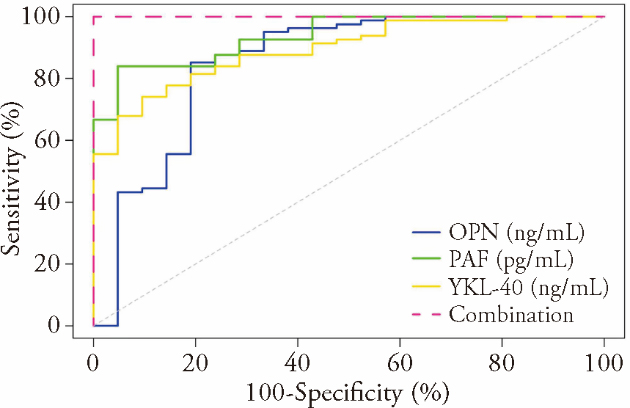
Figure 2 Receiver operating characteristic curves of serum YKL-40, PAF, OPN, and their combination for predicting poor 90-day prognosis in patients with ACI YKL-40: chitinase-3-like protein 1; PAF: platelet-activating factor; OPN: osteopontin; ACI: acute cerebral infarction; ROC: receiver operating characteristic.
Figure 2 Receiver operating characteristic curves of serum YKL-40, PAF, OPN, and their combination for predicting poor 90-day prognosis in patients with ACI YKL-40: chitinase-3-like protein 1; PAF: platelet-activating factor; OPN: osteopontin; ACI: acute cerebral infarction; ROC: receiver operating characteristic.
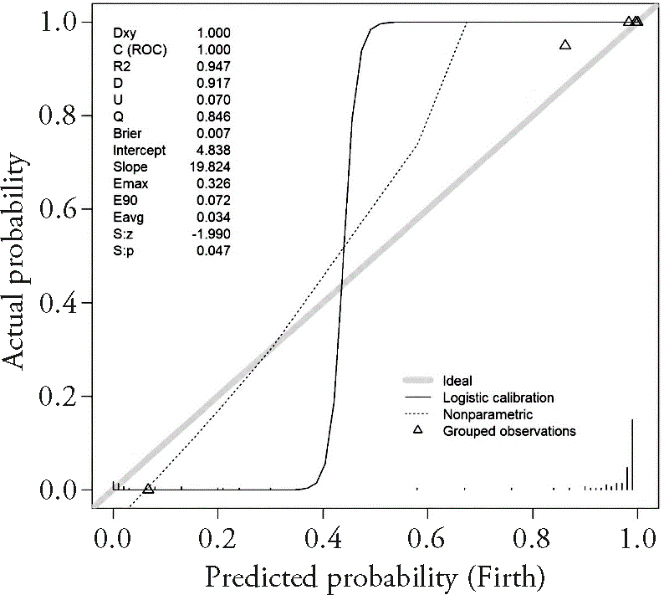
Figure 3 Calibration plot of the combined prognostic model incorporating YKL-40, PAF, and OPN The plot compares predicted probabilities with observed probabilities of the study outcome. YKL-40: chitinase-3-like protein 1; PAF: platelet-activating factor; OPN: osteopontin.
Figure 3 Calibration plot of the combined prognostic model incorporating YKL-40, PAF, and OPN The plot compares predicted probabilities with observed probabilities of the study outcome. YKL-40: chitinase-3-like protein 1; PAF: platelet-activating factor; OPN: osteopontin.
| [1] | Zhang Z, Qian M, Ge Z, et al. Effects of glycosylated hemoglobin levels on intravenous thrombolysis in patients with acute cerebral infarction and type 2 diabetes mellitus. Pak J Med Sci 2019; 35: 862-7. |
| [2] | Li F, Pan L, Liu F. Relationship between serum vaspin, apelin, chemerin and carotid plaque properties and prognosis in patients with cerebral infarction. Re Dai Yi Xue Za Zhi 2019; 19: 346-9, 68. |
| [3] | Li XQ. Research progress on the relationship between type 2 diabetes mellitus complicated with hyperhomocysteinemia and atherosclerotic cerebral infarction. Shi Yong Xin Nao Fei Xue Guan Bing Za Zhi 2020; 28: 1-5. |
| [4] | Schroder J, Jakobsen JC, Winkel P, et al. Prognosis and reclassification by YKL-40 in stable coronary artery disease. J Am Heart Assoc 2020; 9: e014634. |
| [5] | Chinese Society of Neurology, Chinese Society of Neurology Cerebrovascular Disease Group. Chinese guidelines for diagnosis and treatment of acute ischemic stroke 2014. Zhong Hua Shen Jing Ke Za Zhi 2015; 48: 246-57. |
| [6] | Wang XW. The application value of serum osteopontin, glial fibrillary acidic protein and growth differentiation factor 15 levels in the evaluation of nerve injury and prognosis in patients with acute cerebral infarction. Xinxiang Yi Xue Yuan Xue Bao 2019; 36: 479-82. |
| [7] | Conlin PR, Colburn J, Aron D, et al. Synopsis of the 2017 U.S. department of veterans affairs/U.S. Department of defense clinical practice guideline: management of type 2 diabetes mellitus. Ann Intern Med 2017; 167: 655-63. |
| [8] | Li B, Wang JL. Pathogenesis of post-stroke cognitive impairment and ideas of acupuncture treatment from the theory of "toxic damage to cerebral collateral-Conghua". Shandong Zhong Yi Za Zhi 2024; 43: 508-13. |
| [9] | Wang QK, Jiang ZH, Xu Z, et al. Correlation between serum fatty acid binding protein 4 expression and clinical prognosis in patients with acute cerebral infarction complicated with type 2 diabetes mellitus. Shi Jie Fu He Yi Xue 2019; 5: 13-7. |
| [10] | Yang WH, Ning XZ, Zhao DF, et al. Expression and clinical significance of serum pentraxin 3, chitinase protein 40 and leukocyte differentiation antigen 36 in patients with cerebral infarction. Shaanxi Yi Xue Za Zhi 2019; 48: 301-3. |
| [11] | Ściborski K, Kuliczkowski W, Karolko B, et al. Plasma YKL-40 levels correlate with the severity of coronary artery disease atherosclerosis assessed with the SYNTAX score. Pol Arch Intern Med 2018; 128: 644-8. |
| [12] | Chen J, Wan X, Chen L, et al. Evaluation of carotid plaque neovascularization by contrast-enhanced ultrasound in patients with acute cerebral infarction and its correlation with serum YKL-40 protein and Lp-PLA2 levels. Xian Dai Sheng Wu Yi Xue Jin Zhan 2020; 20: 2877-81. |
| [13] | Guo LF, Mu N, Liu ZW, et al. Dynamic changes and correlation of serum CRP, VEGF and YKL-40 levels in elderly patients with acute cerebral infarction. Zhong Guo Lao Nian Xue Za Zhi 2020; 40: 14-9. |
| [14] | Li W, Zhang MJ, Wang Y, et al. Association of platelet activating factor and vascular endothelial activity markers with lacunar cerebral infarction. Hua Xi Yi Xue 2019; 34: 1143-7. |
| [15] | Hyland IK, O'Toole RF, Smith JA, et al. Progress in the development of platelet-activating factor receptor (PAFr) antagonists and applications in the treatment of inflammatory diseases. Chem Med Chem 2018; 13: 1873-84. |
| [16] | Li LX, Li B, He QH, et al. Evaluation value of serum lipoprotein-associated phospholipase A2, ischemia modified protein and platelet activating factor in the severity and prognosis of ischemic stroke. Zhong Xi Yi Jie He Xin Nao Xue Guan Bing Za Zhi 2020; 18: 4061-4. |
| [17] | Parolin M, Dassie F, Martini C, et al. Preclinical markers of atherosclerosis in acromegaly: a systematic review and Meta-analysis. Pituitary 2018; 21: 653-62. |
| [18] | Wang BX, Wang JJ, Wang P, et al. Relationship between serum dipeptidyl peptidase 4 level and carotid atherosclerosis in patients with type 2 diabetes mellitus. Zhong Guo Shen Jing Mian Yi Xue He Shen Jing Bing Xue Za Zhi 2020; 27: 309-11, 325. |
| [19] | Wang Y, Hou LC, Wang C, et al. Relationship between serum PAF, P-selectin and stability of carotid atherosclerotic plaque in patients with acute cerebral infarction. Zu Zhong Yu Shen Jing Ji Bing 2018; 35: 1076-8. |
| [20] | Lok ZSY, Lyle AN. Osteopontin in vascular disease. Arterioscler Thromb Vasc Biol 2019; 39: 613-22. |
| [21] | Zhao SJ, Han X, Gao YJ. Correlation between plasma osteopontin level and carotid intima-media thickness in patients with acute cerebral infarction. Zu Zhong Yu Shen Jing Ji Bing 2019; 26: 36-8. |
| [22] | Zhang Y, Wang JR, Zhang EN, et al. Analysis of the effect of changes in serum osteopontin levels on patients with acute cerebral infarction. Pak J Med Sci 2024; 40: 718-22. |
| [23] | Sun XY, He TZ, Yang LC, et al. Correlation between serum lysophosphatidic acid, cystatin-C levels and carotid plaque stability in patients with acute cerebral infarction. Shi Yong Yi Yuan Lin Chuang Za Zhi 2020; 17: 151-4. |
| [1] | LI Menghan, WANG Yu, RAN Dawei, YANG Xinming, DENG Shizhe, SHI Lei, MENG Zhihong. Effects of anterior sciatic nerve acupuncture on lower limb paralysis after cerebral infarction: study protocol for a randomized controlled trial [J]. Journal of Traditional Chinese Medicine, 2024, 44(1): 205-211. |
| [2] | Tan Di, Wu Jiarui, Liu Shi, Zhang Dan, Cui Yingying, Zhang Xiaomeng, Zhang Bing. Injections of ginkgo in the treatment of cerebral infarction: a systematic review and network Meta-analysis [J]. Journal of Traditional Chinese Medicine, 2018, 38(01): 1-11. |
| [3] | Ping Liu, Li Gao, Juexian Song, Haiping Zhao, XiaoguangWu, Liyuan Huang, Pingping Wang, Yumin Luo. Correlation between tongue manifestations and glucose, total cholesterol, and high-density lipoprotein cholesterol in patients with acute cerebral infarction [J]. Journal of Traditional Chinese Medicine, 2014, 34(02): 162-165. |
| [4] | Yao Wen Ping , Wang Shu , Han Lin , Ma Jin Quan , Shen Yan. Effects of different frequencies of electro-acupuncture at Shuigou(GV 26) on recovery of motor function in rats with focal cerebra ischemic injury [J]. Journal of Traditional Chinese Medicine, 2012, 32(01): 99-104. |
| Viewed | ||||||
|
Full text |
|
|||||
|
Abstract |
|
|||||